periodical issue
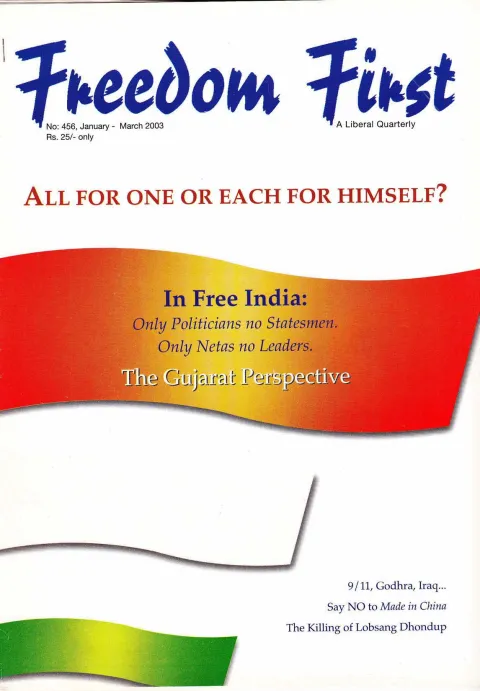
Freedom First
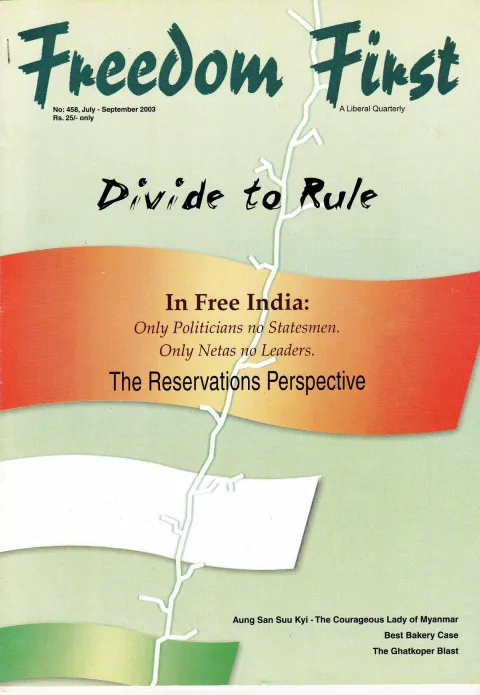
Divide to Rule
By Sharad Joshi
Published by J. R. Patel for the Indian Committee for Cultural Freedom and printed by him at Kaiser-E-Hind Private Ltd., 300, Perin Nariman Street, Mumbai 400 001. · Mumbai · 2003
52 pages
Freedom First
Summary
Freedom First No. 458 (July-September 2003), published by the Indian Committee for Cultural Freedom and edited by S. V. Raju, is the third installment of a running series asking why fifty-six years after independence India has produced ‘only politicians, no statesmen’ and ‘only netas, no leaders’. This issue views that puzzle through the lens of caste and communal reservations, opening with Nagindas Sanghavi’s lead essay ‘Reservations and National Integration’, which argues that the reservation policy is replaying, in the social sphere, the same divisive logic that the colonial-era communal electorate played in the political sphere, and warns of parallel dangers to the caste and communal unrest of the 1930s-40s. The issue’s dominant thread is post-Godhra communal terrorism in Gujarat and Maharashtra, covered through R. Srinivasan’s account of the collapsed Best Bakery trial (all 73 witnesses turning hostile, acquittal of all 21 accused, and the subsequent NHRC push for a retrial outside Gujarat) and Ashok Karnik’s piece revisiting the Ghatkopar bus blast. In the rendered pages, the editorial notes the series will conclude in the next issue with a piece on ‘What India Needs’, tied to a one-day seminar the magazine is co-organising with the Indian Liberal Group on 27 September 2003. The issue also carries an appreciative obituary tribute to the Forum of Free Enterprise’s M. R. Pai (1931-2003), written by editor S. V. Raju, and shorter items including ‘Of Cabbages and Kings’ miscellany, a note on Howard Fast’s break with the Communist Party, an obituary for Kannada writer Professor A. N. Murthy Rao, an extract by H. M. Seervai on reservations and universal adult suffrage (reprinted from 1985), and M. S. Kilpady’s polemic on the neglect of pensioners’ Dearness Relief contrasted with lavish MP/minister perquisites.
Key points
-
Cover story series ‘In Free India: Only Politicians No Statesmen, Only Netas No Leaders’ reaches its third part, this time examined through the reservations/caste-quota angle.
-
Nagindas Sanghavi’s lead essay compares India’s reservation policy to the earlier communal electorate, warning both entrench group-based politics rather than resolve inequality.
-
Two articles cover post-Godhra communal violence and terrorism: the collapsed Best Bakery trial in Baroda (R. Srinivasan) and the Ghatkopar bus blast (Ashok Karnik).
-
The issue announces a one-day seminar with the Indian Liberal Group on ‘What India Needs’, to be held 27 September 2003 in Mumbai, tied to the concluding part of the series.
-
A tribute obituary for M. R. Pai (1931-2003), long-time Secretary of the Forum of Free Enterprise, written personally by editor S. V. Raju, closes with a Tagore poem dedicated to his memory.
-
H. M. Seervai’s 1985 Freedom First essay on reservations and universal adult suffrage is reprinted as a sidebar within the Sanghavi piece.
-
M. S. Kilpady’s column contrasts the government’s freeze on pensioners’ Dearness Relief with lavish increases to MPs’ salaries, allowances, and perks.
-
Miscellany items include a note on the death of Communist writer Howard Fast, a Meerut University curriculum controversy over replacing Shakespeare with Kalam/Vajpayee, and an obituary for Kannada writer A. N. Murthy Rao.
Generated by the v1.5 extraction pipeline. Awaiting editorial review.
Metadata and summary are AI-extracted from the source PDF and reviewed for editorial accuracy. The original work is available via the Read PDF tab above (where present); paragraph-level citation inside the PDF is deferred to a future engagement.