periodical issue
Freedom First
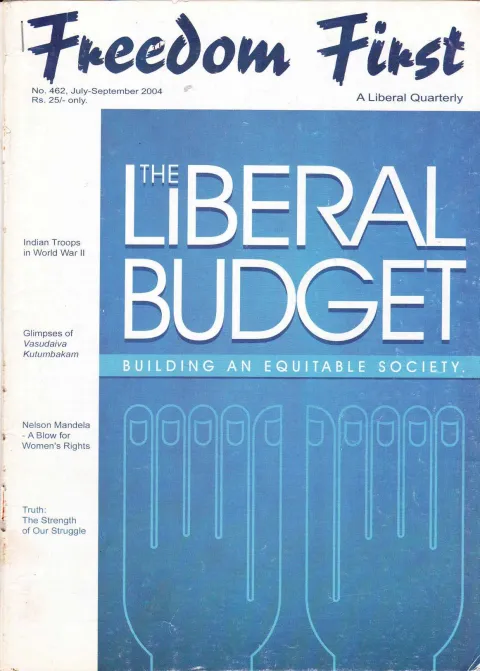
The Liberal Budget - Building an Equitable Society
By S. V. Raju
Published by J. R. Patel for the Indian Committee for Cultural Freedom and printed by him at Kaiser-E-Hind Private Ltd., 300, Perin Nariman Street, Mumbai 400 001. · Mumbai (Bombay) · 2004
52 pages
Freedom First
Summary
This is issue No. 462 of Freedom First (July-September 2004), a liberal quarterly published in Bombay by the Indian Committee for Cultural Freedom, edited by S. V. Raju with R. Srinivasan as Associate Editor, in its 52nd year of publication. The cover feature is “The Liberal Budget - Building an Equitable Society,” a joint effort of the Indian Liberal Group and the Project for Economic Education presented as an alternative model to the Union government’s annual budget, argued by S. V. Raju in the lead essay and summarised in a companion piece. The issue opens with two obituaries (Dr. Indumati Parikh, a Radical Humanist associated with M. N. Roy’s circle, and Abe Solomon, a rationalist and longtime patron of Freedom First, to whose memory the issue is dedicated), followed by the editor’s “Between Ourselves” note, two recurring quotation/commentary columns (“With Many Voices” and “Of Cabbages and Kings”), the multi-part Liberal Budget feature, an essay on the uncommemorated role of Indian troops in the Second World War, a review of the Eighth Mumbai International Film Festival, Louella Lobo Prabhu’s satirical column “Reflections Serious and Facetious,” and (beyond the rendered pages) further pieces on Nelson Mandela, press freedom, Panchsheel, Tibet, and a profile of Kamaladevi Chattopadhyaya, per the table of contents.
Key points
-
Freedom First No. 462 (July-Sept 2004) is dedicated to Abe Solomon, the magazine’s longtime patron and fundraiser, alongside an obituary for Radical Humanist Dr. Indumati Parikh.
-
The cover feature, “The Liberal Budget - Building an Equitable Society,” presented by S. V. Raju as a joint Indian Liberal Group/Project for Economic Education effort, offers the first liberal alternative to the government’s annual Union Budget.
-
Raju’s essay grounds the Liberal Budget in Ludwig von Mises’s distinction between liberalism and socialism as a matter of means not ends, setting nine numeric human-development targets for 2007 and 2012 and calling for abolishing discretionary tax search-and-seizure powers.
-
The Liberal Budget summary argues disinvestment should be tested by whether the state belongs in an activity at all, calls for lifting agricultural land ceilings and internal trade barriers, and for genuinely independent regulators.
-
Major General E. D’Souza’s “Indian Troops in World War II” argues the contribution of Indian soldiers, who won 37 Victoria Crosses, has been erased from British and American memory, crediting Baroness Sheila Flather’s campaign for the Hyde Park Corner Memorial Gate.
-
Prem Vaidya reviews the Eighth Mumbai International Film Festival, including a tribute to Leni Riefenstahl and documentaries on youth suicide in Kerala, a 1971 war rape survivor in Bangladesh, and forced tribal-marriage settlements in Pakistan.
-
Louella Lobo Prabhu’s satirical column comments on M. F. Hussain’s controversial career, a Supreme Court ruling that the right to strike is not fundamental, and the forcible shutdown of screenings of the film “Girl Friend” over its lesbian subject matter.
-
“Of Cabbages and Kings” welcomes Manmohan Singh’s appointment as Prime Minister while criticising the politicisation of Governors’ appointments under successive governments.
Essays
Between Ourselves
By The editor
The editor’s “Between Ourselves” note (unsigned, by S. V. Raju as editor) introduces the issue’s cover feature, “The Liberal Budget - Building an Equitable Society,” describing it as the first time an alternative to the annual Union Budget has been offered by liberal groups, a joint production of the Indian Liberal Group and the Project for Economic Education. It also pays special tribute to Abe Solomon, described as the editor’s “friend, philosopher and guide and fund raiser” and the person responsible for the continued publication of Freedom First, to whose memory the issue is dedicated. It previews the rest of the issue (the Nelson Mandela piece, regular features) and announces that the next issue will mark the Second National Convention of the Indian Liberal Group in Mangalore in December.
- Announces The Liberal Budget as a first-of-its-kind liberal alternative to the government’s annual budget
- Dedicates the issue to the memory of Abe Solomon, who died July 4, 2004
- Describes Solomon as instrumental in keeping Freedom First financially afloat
- Previews a ‘not-so-flattering’ assessment of Nelson Mandela elsewhere in the issue
- Announces the next issue will cover the Indian Liberal Group’s Second National Convention in Mangalore, Dec 3-5
Many Voices
“With Many Voices” is a recurring column of pointed quotations culled from the Indian press (The Indian Express, The Times of India, National Review, The Hindu Magazine) covering the mid-2004 political moment: the change of government in Delhi, assessments of the BJP’s post-defeat disarray, remarks by Arun Shourie on bureaucratic self-perpetuation, comments from Communist leaders Bardhan and Yechury, Union Finance Minister P. Chidambaram on economic confidence, Bunker Roy on rural development priorities, and West Bengal Chief Minister Buddhadeb Bhattacharjee’s embrace of private capital.
- Juxtaposes quotes from politicians across the spectrum on the 2004 change of government
- Includes Arun Shourie’s critique of entrenched civil-service practice
- Includes Communist leaders’ contradictory statements on markets, quoted to satirical effect
- Includes Buddhadeb Bhattacharjee inviting private and foreign capital while leading a ‘Leftist government’
- Includes S. Jaipal Reddy on ‘Saffronisation and Stalinisation’ as extreme ideologies
Cabbages and Kings
“Of Cabbages and Kings” is the magazine’s unsigned editorial commentary column, covering: the 2004 change of government and its ‘sense of deja vu,’ with cautious praise for Manmohan Singh and P. Chidambaram; a hypothetical on how Communists in power would have curbed both trade unions and civil liberties even while accelerating reform; the erosion of the constitutional norm of appointing distinguished, non-partisan Governors (citing Sarojini Naidu, K. M. Munshi, and C. Rajagopalachari as past examples of impartial governors) and its politicisation continuing under the UPA; a satirical item on the RSS considering a ‘contemporary’ uniform redesign; a report on superstition-driven violence (an old man beheaded in West Bengal to appease a flooding river); and a piece on Pune as a rising hub for foreign students, quoting Dr. Santishree Pandit of the University of Pune’s International Centre.
- Welcomes Manmohan Singh’s appointment as PM while worrying about coalition constraints and a new ‘kitchen cabinet’ under Sonia Gandhi’s National Advisory Council
- Argues economic freedom without civil liberties (as in West Bengal) is not the liberal ideal, contra a hypothetical Communist-run India
- Criticises both the Janata Party precedent and the current UPA government for politicising Governors’ appointments
- Notes the RSS reportedly considering a modernised uniform for its cadres
- Reports Pune hosting over 8,000 foreign students, citing University of Pune data
- Reproduces N. G. Ranga’s 1961 Swatantra Party statement on property rights in a boxed feature
The Liberal Budget - Building An Equitable Society
By S. V. Raju
S. V. Raju’s essay introduces “The Liberal Budget - Building an Equitable Society,” a model budget document prepared over the preceding year by a Drafting Group convened by the Indian Liberal Group and the Project for Economic Education. Raju argues that Union budgets have grown needlessly complex and unmoored from a coherent economic philosophy since India’s 1991 reforms, and that a genuinely liberal budget should be simple, transparent, and reflect classical liberal economic principles rather than the residual statism of the license-permit-quota Raj. The essay defines an ‘equitable society’ explicitly against the socialist egalitarian ideal: not equal outcomes, but a state that provides opportunities for growth to all regardless of caste, creed, or economic/social status, concentrating on primary education, health care, drinking water, infrastructure, and rule of law as the core enabling functions of a liberal state.
- Frames the Liberal Budget as the first alternative to the government’s annual budget offered by Indian liberals
- Attributes work to a Drafting Group with the motto ‘Everyone knows what’s wrong. The job is to offer the people what is right’
- Distinguishes the liberal ‘equitable society’ from the socialist ‘egalitarian’ ideal
- States the Liberal Budget will undergo annual review and is not fixed
- Identifies the state’s core role as an ‘enabler’ providing education, health care, water, roads, and law and order
The Liberal Budget - A Summary
“The Liberal Budget - A Summary” lays out the document’s philosophical grounding (invoking Ludwig von Mises’s distinction between liberalism and socialism as one of means, not ends) and its nine measurable human-development targets for 2007/2012 (poverty reduction, universal schooling, literacy, infant and maternal mortality, child nutrition, drinking water, and sanitation). It then details five guiding budgetary principles (fiscal governance, consolidation, efficiency, growth, equity) and specific policy prescriptions across expenditure management (shifting spending toward development, performance-linked ministry targets), tax reform (simplification, abolition of search-and-seizure and ‘public interest’ discretionary powers, referencing the Kelkar Task Force report), and structural reforms (accelerated PSU disinvestment with the test being whether the state should be in that activity at all, agricultural deregulation including lifting land ceilings and inter-state trade controls, independent regulators, and government rightsizing). Within my rendered pages the summary runs through the sections on tax administration, disinvestment criteria, agriculture, and government restructuring, concluding that a genuinely liberal economy requires a Liberal Budget of the kind envisioned in the document.
- Grounds the Budget’s rationale in Ludwig von Mises’s liberalism/socialism distinction (‘not by the goal … but by the means’)
- Sets nine numeric human-development targets for 2007 and 2012 (poverty, schooling, literacy, IMR, MMR, nutrition, water, sanitation)
- Advocates expenditure growth capped at real GDP growth with development spending rising from ~7% to 9% of GDP
- Calls for abolishing search-and-seizure tax powers and discretionary ‘public interest’ exemptions as unproductive and abuse-prone
- Argues the disinvestment test should be whether the state belongs in an activity at all, not whether a PSU is profitable
- Calls for lifting land ceilings and internal trade barriers to attract private investment in agriculture
- Calls for genuinely independent regulators rather than government-controlled ones
- Recommends rightsizing (not blanket downsizing) of government staff via ministry performance audits
A boxed notice describing the full 40-page Liberal Budget brochure published separately by the Project for Economic Education, listing its chapters (Liberal Perspectives and Human Development; The Current Budget Scenario; Policy Framework and Structure) and appendices (six ‘Liberal Budgets’ expressed in Rs. crores and percentage of GDP; a note on e-Governance potential). It names the document’s authors: S. S. Bhandare (former Economic Adviser, Tata Services Ltd.), Dr. C. S. Deshpande (Executive Director, Maharashtra Economic Development Council), Dr. Ajit Karnik (Head, Department of Economics, University of Mumbai), Sanjay Panse (Chartered Accountant), and Seetha (freelance journalist and copy editor), and gives contact details for readers wanting a copy.
- Full budget document is a separately published 40-page brochure by the Project for Economic Education
- Lists five named authors of the Liberal Budget document, spanning economics, accountancy, and journalism
- Appendices include six historical ‘Liberal Budgets’ recast in Rs. crores and % of GDP
- Readers can request a free copy via the Indian Liberal Group’s Mumbai address
Indian Troops in World War II
By E. D’Souza
Major General (Retd.) E. D’Souza’s essay “Indian Troops in World War II” argues that the contribution of Indian soldiers to the Allied victory has been systematically erased from British and American public memory, despite Indian troops earning 37 Victoria Crosses and serving across Hong Kong, Singapore, Malaysia, Burma, the North West Frontier, Aden, Eritrea, Somalia, North Africa, and Italy. The piece credits Baroness Sheila Flather, a Peeress of Punjabi origin, with campaigning for the Memorial Gate at Hyde Park Corner honouring Indian and Caribbean subcontinent soldiers, funded through a five-million-pound effort after London authorities relented. D’Souza closes by turning the critique inward, asking whether India itself has adequately memorialised its own 19,000 post-Independence war dead, contrasting the modest Amar Jawan Jyoti with the grandeur of the imperial India Gate that dwarfs it.
- 37 Victoria Crosses won by Indian troops in WWII went largely uncredited in British/American memory
- Indian troops served across many theatres including Burma, North Africa, and the Western Desert
- Baroness Sheila Flather led the campaign for the Hyde Park Corner Memorial Gate honouring Subcontinent and Caribbean soldiers
- The memorial, comprising four pillars and urns, also honours Victoria Cross and George Cross awardees
- The essay questions whether India has adequately memorialised its own 19,000 post-Independence war dead
Glimpses of Vasudaiva Kutumbakam - The Eighth Mumbai International Film Festival - 2004
By Prem Vaidya
Prem Vaidya’s review of the Eighth Mumbai International Film Festival (MIFF-2004) covers a tribute to the late German filmmaker Leni Riefenstahl (1902-2003), including an account of how her Nazi propaganda film Triumph of the Will was commissioned by Adolf Hitler in 1934 against her initial reluctance, and surveys a range of documentaries screened at the festival: Ek Sagar Kinare (Goa), Survivors (Kerala, on youth suicide), A Certain Liberation (Bangladesh, on the 1971 war and its aftermath for a rape survivor), Swara (Pakistan, on forced marriage as tribal peace-settlement), Twin Towers (USA, on 9/11 firefighters), and Intihar/Suicide (Lebanon, on the fall of Baghdad), alongside remarks from filmmakers Helena Trestikova, Suprio Sen, and Patrick Cazals praising the festival’s international character.
- MIFF-2004 opened with a tribute screening of Leni Riefenstahl’s Triumph of the Will, commissioned by Hitler in 1934
- Riefenstahl reportedly resisted political interference in the film’s content despite Hitler’s pressure
- Documentaries reviewed span Goa, Kerala, Bangladesh, Pakistan, the USA, and Lebanon
- Swara (Pakistan) documents girls given in marriage as tribal peace settlements, a practice condemned even by Pervez Musharraf as beyond his power to stop
- Twin Towers documents NYC firefighters, including quotes from former Mayor Rudolph Giuliani
Nelson Mandela - A Blow to Women’s Rights
By Kusum Choppra
No summary was extracted for this article. Listed for completeness.
‘Let Freedom Reign’ for the Young
By Sukrit Sabhlok
No summary was extracted for this article. Listed for completeness.
South Asia at Islamabad
By Usha Thakkar
No summary was extracted for this article. Listed for completeness.
Reflections Serious and Facetious
By Louella Lobo Prabhu
Louella Lobo Prabhu’s satirical column “Reflections Serious and Facetious” comments on several current-affairs items: M. F. Hussain’s controversial art career and record sale price; the overwork and public resentment faced by police personnel; the Supreme Court ruling (in a case involving Tamil Nadu Chief Minister Jayalalithaa) that the right to strike is not a fundamental right; and the BJP-affiliated forcible shutdown of screenings of the film “Girl Friend” over its lesbian subject matter, despite the film’s Censor Board ‘A’ certification.
- Comments on M. F. Hussain’s controversial career and a $1 million sale of 22 of his paintings
- Criticises the overwork of police personnel while acknowledging public resentment of the force
- Praises the Supreme Court ruling backed by Jayalalithaa that the right to strike is not fundamental
- Condemns BJP-affiliated groups for forcibly stopping screenings of ‘Girl Friend’ despite its Censor Board clearance
Generated by the v1.5 extraction pipeline. Awaiting editorial review.
Metadata and summary are AI-extracted from the source PDF and reviewed for editorial accuracy. The original work is available via the Read PDF tab above (where present); paragraph-level citation inside the PDF is deferred to a future engagement.