periodical issue
Freedom First
While the Economy Soars, Governance Plummets
By Sharad Joshi, S. V. Raju, Sharad Bailur
Published by J. R. Patel for the Indian Committee for Cultural Freedom (ICCF) and printed by him at Kaiser-E-Hind Private Ltd., Plot No.A-191, Road No.16A, MIDC, Wagle Industrial Estate, Thane (W) - 400 604. Publishers: Indian Committee for Cultural Freedom (ICCF), 3rd Floor, Army & Navy Building, 148, Mahatma Gandhi Road, Mumbai 400 001. · Mumbai (Bombay) · 2006
52 pages
Freedom First
Summary
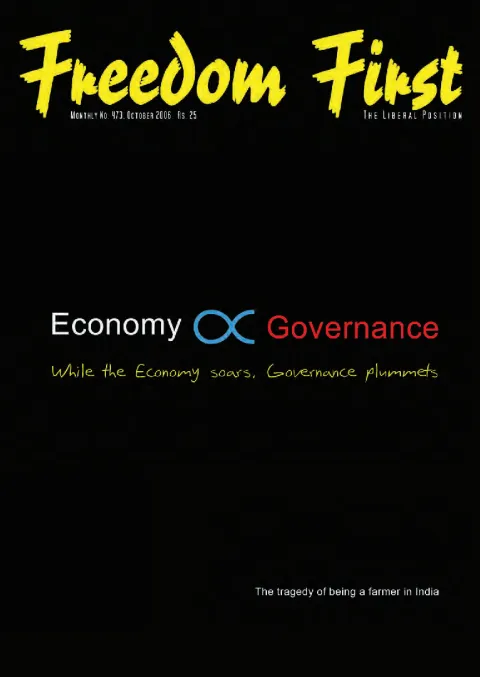
This is the October 2006 issue (No. 473, 54th year) of Freedom First, published monthly by the Indian Committee for Cultural Freedom under founder Minoo Masani’s legacy, edited by S. V. Raju with R. Srinivasan as Associate Editor. The editorial explains a new bi-tier publication schedule (12-page monthly issues eight times a year, 48-page quarterly issues four times a year) and frames this issue’s cover feature as a response to the growing gap between India’s booming economy and its declining quality of governance. In the rendered pages, the issue opens with a tribute to Kanshi Ram on his death, a ‘With Many Voices’ page of press quotations, an ‘Of Cabbages and Kings’ column on media, judiciary and civic decay, a three-part cover feature (‘Dharma in Politics’ by S. L. N. Simha, ‘Things Fall Apart; the Centre Cannot Hold’ by R. Srinivasan) diagnosing India’s governance crisis in ethical and historical terms, a ‘Point Counter Point’ column by Ashok Karnik presenting both sides of contemporary controversies (Malegaon blasts, disqualification of tainted politicians, the Indo-US nuclear deal, and the India-Pakistan Havana declaration), and the opening pages of Sharad Joshi’s Rajya Sabha speech on farmer suicides, ‘The Tragedy of Being a Farmer in India.’ The volume’s argumentative center in the rendered material is a diagnosis of institutional and moral decline in Indian public life, paired with concrete case studies (agrarian distress, criminal-political nexus, media professionalism) and a classical-liberal insistence on individual responsibility, rule of law, and skepticism of state intervention.
Key points
-
Freedom First No. 473 (October 2006) explains a new bi-tier publication schedule — 12-page monthly issues and 48-page quarterlies — and devotes its cover feature to the widening gap between India’s booming economy and its declining quality of governance.
-
An obituary recalls Dalit leader Kanshi Ram, founder of the Bahujan Samaj Party, as an amoral but historically significant political strategist who made OBCs and Dalits a numerical force through his protegee Mayawati.
-
S. L. N. Simha’s “Dharma in Politics” argues declining ethical standards trace to the erosion of Dharma, citing a World Bank governance-indicators report ranking India poorly among 213 countries.
-
R. Srinivasan’s “Things Fall Apart; the Centre Cannot Hold” cites Karnataka Chief Minister Kumaraswamy’s family acquiring a Rs. 36-crore IT park within 51 days of taking office, contrasting today’s venality with the trusteeship ethic of Y. B. Chavan, Kamaraj, and Jayaprakash Narayan.
-
Ashok Karnik’s “Point Counter Point” weighs the Malegaon blasts, disqualification of tainted politicians, the Indo-US nuclear treaty, and the India-Pakistan Havana declaration from opposing angles.
-
Sharad Joshi’s Rajya Sabha speech, “The Tragedy of Being a Farmer in India,” traces farmer suicides to the Green Revolution’s failure to secure remunerative prices, estimating negative price support cost farmers roughly Rs. 300,000 crores between 1980 and 2000.
-
“Of Cabbages and Kings” reports the Supreme Court’s 2006 order finally allowing uncut telecast of Anand Patwardhan’s documentary “Father, Son and Holy War,” and criticises Karnataka’s Belgaum politicking over Tipu Sultan’s place in textbooks.
Essays
Essay 1
An unbylined obituary tribute to Dalit political leader Kanshi Ram (1934-2006), written by someone who knew him personally through the Swatantra Party’s central office in Bombay in the late 1960s and 1970s. The author recalls Kanshi Ram as president of BAMCEF (Backward and Minority Classes Employees’ Federation), a numbers-driven political strategist convinced that OBCs and Dalits, being a numerical majority, had the right to rule India. The piece reproduces the author’s own 1985 Freedom First review of Kanshi Ram’s book ‘The Chamcha Age – An Era of Stooges,’ recounts a cold, unacknowledged encounter with Kanshi Ram at Bombay airport years later, and assesses him as amoral, driven purely by the pursuit of power, but historically significant for making the OBCs and Dalits a political force to reckon with, including through his protegee Mayawati.
- Kanshi Ram died on October 9, 2006; the piece is a personal recollection by a former Swatantra Party office contact.
- Kanshi Ram led BAMCEF before founding the Bahujan Samaj Party (BSP) in 1984.
- His political thesis: OBCs and Dalits are a numerical majority and therefore have the right to rule India.
- Reproduces the author’s 1985 Freedom First review of Kanshi Ram’s book ‘The Chamcha Age – An Era of Stooges’, which used ‘chamcha’ as a term for backward-community members who serve upper-caste interests.
- Describes Kanshi Ram as amoral and devoid of emotion, willing to work with any party (Congress, BJP, Mulayam Singh) if it served his aim of power.
- Credits Kanshi Ram with having trained Mayawati thoroughly, and with making OBCs and Dalits a force to be reckoned with regardless of personal agreement with his methods.
Essay 0
The ‘Between Ourselves’ editorial note (unsigned, by the Editor) clarifies reader confusion over the magazine’s new publishing schedule — four 48-page quarterly issues (January, April, July, October) and eight 12-page monthly issues in the other months — reassuring a subscriber who threatened to cancel that the quarterly format continues. It apologises for this October issue’s delay due to unforeseen circumstances, and introduces the cover feature on the widening gap between India’s economic growth and its deteriorating governance, inviting reader responses on both governance decline and the ongoing reservations debate. This is followed by the masthead/contents page confirming Issue No. 473, October 2006, 54th year of publication, founder Minoo Masani, editor S. V. Raju, associate editor R. Srinivasan, published by the Indian Committee for Cultural Freedom (ICCF), Mumbai.
- Clarifies that the 48-page quarterly format continues in January, April, July, October; monthly 12-page issues appear in the other eight months.
- Apologises for this issue’s delay due to unforeseen circumstances.
- Frames the cover feature as beginning a discussion on why governance is deteriorating even as the economy grows.
- Invites reader views on governance decline and continued debate on Reservations.
- Masthead confirms: No. 473, October 2006, 54th Year of Publication; Founder Minoo Masani; Editor S. V. Raju; Associate Editor R. Srinivasan; Publisher Indian Committee for Cultural Freedom (ICCF), Mumbai.
Many Voices
The ‘With Many Voices’ page (epigraph from Tennyson) compiles brief press quotations from September-October 2006 on Indian and international affairs — comments on Parliament, the Prime Minister, the RBI, media partisanship, secularism, ethnic profiling, Bengal’s communists, NGOs, and Iran — from commentators including Sumanta Banerjee, S. Prasannarajan, Gurmeet Kanwal, Vir Sanghvi, Karan Singh, Tushar Gandhi, Anne Applebaum, Prakash Karat, Tavleen Singh, Ila Patnaik, Shashi Baliga, and Shirin Ebadi.
- Compiles topical press quotations from September-October 2006 across Indian and international outlets.
- Quotes span politics, media criticism, secularism, and free speech.
- Includes a comment from CPM General Secretary Prakash Karat and Congress leader Karan Singh.
- Includes Nobel laureate Shirin Ebadi on Iran’s crackdown on a human rights group.
Of Cabbages and Kings
By SVR
The ‘Of Cabbages and Kings’ column (signed SVR, i.e. S. V. Raju) covers several unrelated current-affairs items: the years-long legal battle over Doordarshan’s refusal to telecast Anand Patwardhan’s documentary ‘Father, Son and Holy War’ (finally resolved by the Supreme Court in August 2006 ordering telecast without cuts); a five-year-old case in which a mob destroyed Thane’s Singhania Hospital after a Shiv Sena leader’s death, with all 63 accused acquitted for want of evidence; a note on Hindu-Muslim religious syncretism (an Indonesian Rupiah note bearing Lord Ganesha, a Muslim gentleman named Bhaskar Hussain Reddy) as evidence of historical secular integration; commentary on traffic indiscipline in Kolkata and Mumbai; and a closing section on ‘Preoccupation with Non-issues’ criticizing politicians over the Belgaum border dispute and the BJP’s move to purge Tipu Sultan from Karnataka textbooks, blaming such politicking for undermining Bangalore’s IT-sector reputation.
- Details the legal saga (Bombay High Court to Supreme Court, 2001-2006) over Doordarshan’s refusal to air Anand Patwardhan’s documentary ‘Father, Son and Holy War’, finally ordered telecast uncut by the Supreme Court on 25 August 2006.
- Recounts the 2001 mob destruction of Singhania Hospital in Thane after a Shiv Sena leader’s death, with all 63 accused acquitted for lack of evidence, seen as political vendetta by the ruling Congress-NCP government.
- Notes examples of Hindu-Muslim cultural syncretism as evidence that ‘our ancients were obviously more integrated than we moderns’.
- Criticises rampant traffic indiscipline in Kolkata and Mumbai as a ‘national phenomenon’.
- Criticises the Karnataka assembly’s Belgaum session and the BJP’s push to erase Tipu Sultan from textbooks as costly, damaging political theatre that undermines Bangalore’s standing as an IT hub.
Dharma in Politics
By S.L.N. Simha
In the cover feature’s first essay, ‘Dharma in Politics,’ S. L. N. Simha (former RBI advisor and IMF board member) argues that declining ethical standards and rising corruption in political institutions worldwide, including India, stem from the erosion of Dharma — the Sanskrit concept of duty-bound conduct holding society together. He explains Dharma’s etymology and scope, invokes the maxim ‘Yatha Raja, thatha Praja’ (as the ruler, so the people), and argues corruption requires complicity on both government and citizen sides. He surveys a World Bank governance-indicators assessment ranking India poorly among 213 countries on voice/accountability, political stability, government effectiveness, regulatory quality, rule of law and corruption control, while cautioning that such survey-based cross-country comparisons should be read carefully. He closes (in the seen portion) by crediting the media’s potential role in promoting vibrant democracy through alert, objective reporting, praising the Indian press’s overall record while urging it to rise still further, and stressing education as the vital channel for instilling civic duty in citizens from an early age — ultimately calling for the revival of Dharma-based instruction (invoking Nitisastra) to lift Indian governance toward something approaching Ramarajya.
- Argues that decline in political ethical standards is linked to erosion of Dharma, the Sanskrit concept of duty binding society together.
- Cites a World Bank/IMF Governance Indicators report placing India at or below the 50th percentile on most of six governance facets across 213 countries.
- Argues corruption requires complicity from both government and the public (‘like both hands being required to clap’).
- Credits India’s press with a generally good record but urges it to rise to the standards of the US, UK, Germany, Switzerland and Netherlands.
- Calls for reviving early civic/Dharma education (via Nitisastra) to build a citizenry equipped for democratic duties and rights.
- Frames the ultimate goal as moving governance toward something approximating Ramarajya, though not literally attainable.
”Things Fall Apart; the Centre Cannot Hold”
By R.Srinivasan
In the cover feature’s second essay, ‘Things Fall Apart; the Centre Cannot Hold’ (its title borrowed from W. B. Yeats), R. Srinivasan argues that India’s governance and civic values have reached a nadir, citing examples such as the Karnataka Chief Minister’s family acquiring a Rs. 36-crore IT park within 51 days of taking office amid bribery allegations, MPs voting themselves salary hikes despite failing their duties, defections in Jharkhand, illegal construction and building-code violations across Delhi and Mumbai’s suburbs (Kalyan, Dombivli), and a near-paralyzed Delhi administration facing satyagraha-style protest. He contrasts this with the early post-independence decades, when leaders like Y. B. Chavan, Kamaraj, Jayaprakash Narayan, Rajaji and C. D. Deshmukh treated politics as a sacred trusteeship for the poor, citing the example of Dalit minister Kakkan queuing for a bus on a modest pension after leaving office, and invokes Edmund Burke’s dictum on natural law. He quotes Yeats’s ‘The Second Coming’ as an apt description of contemporary India, laments the lack of a strong leader since Indira Gandhi (acknowledging her authoritarian faults alongside her decisiveness), and closes (in the seen portion) reflecting on whether reviving religious/ethical seriousness — as exemplified by Anna Hazare, Baba Amte, Sivaram Karanth and (Sunderlal) Bahuguna — could restore civic values, invoking Chief Seattle’s oration on the sacredness of land and ancestors as an analogy for a needed reverence toward community and nature.
- Diagnoses India’s governance and civic decline as reaching ‘its nadir’, citing MPs’ self-voted perks, defections (Jharkhand), and illegal construction across Delhi, Kalyan and Dombivli.
- Cites the Karnataka CM Kumaraswamy’s family acquiring a Rs. 36-crore IT park within 51 days of taking office, amid bribery allegations from Bellary mine owners.
- Contrasts today’s venality with the early post-independence generation (Y. B. Chavan, Kamaraj, JP, Rajaji, Masani, C. D. Deshmukh) who saw politics as trusteeship for the poor.
- Cites Dalit Congress minister ‘Kakkan’ living modestly on a Rs. 500 pension after office as emblematic of the older generation’s integrity.
- Quotes W. B. Yeats’s ‘The Second Coming’ at length as capturing contemporary India’s condition.
- Argues no leader since Indira Gandhi has shown comparable decisive authority, despite her authoritarian record and the Emergency.
- Closes (in rendered pages) invoking Chief Seattle’s speech on the sacredness of land as a model for the reverence needed from India’s leaders and citizens.
Point Counter Point
By Ashok Karnik
Ashok Karnik’s recurring ‘Point Counter Point’ column presents both sides of four live controversies of the day: the 2006 Malegaon bomb blasts (weighing communal-divide fears and Lashkar-e-Taiba/ISI suspicion against calls for Hindu-Muslim unity against terrorism); the disqualification of tainted politicians facing criminal charges (weighing due-process protections against the public’s failure to demand moral rectitude from candidates); the Indo-US nuclear treaty (laying out both the scientific community’s objections — trust, thorium dependency, testing moratorium — and younger scientists’ more pragmatic pro-treaty arguments); and the India-Pakistan Havana declaration on joint anti-terrorism mechanisms (questioning whether it lets Pakistan off the hook for harbouring figures like Dawood Ibrahim while noting a diplomatic thaw). Karnik invites readers to submit views on serious issues of the day to his email address.
- Format presents two contrasting viewpoints on each of four topics without adjudicating between them.
- Malegaon blasts: fear of a new communal divide and L-e-T/ISI involvement versus calls for both communities to blame only ‘the adversary’.
- Tainted politicians: due-process concerns about disqualifying merely-accused candidates versus the argument that only conviction-proof screening will ever work given electorate failure.
- Indo-US nuclear treaty: lists five scientific-community objections (trust, lost self-reliance, testing moratorium, fissionable-material ban, stranded thorium programme) against five pragmatic counter-arguments (fuel need, obsolete reactors, moratorium already in place, thorium timeline, de facto nuclear-power recognition).
- Havana declaration: questions whether India is legitimising Pakistan’s claims about Dawood Ibrahim and Jamaat-ud-Dawa while noting the reduction in bilateral acrimony as a silver lining.
The Tragedy of Being a Farmer In India (The Rural Perspective)
By Sharad Joshi
No summary was extracted for this article. Listed for completeness.
Taking Reforms to the Poor: Liberal Budget 2007-2008
By Sharad Joshi
In ‘The Tragedy of Being a Farmer in India: Why are Farmers Committing Suicide?’ — extracts from his August 23, 2006 Rajya Sabha speech — Sharad Joshi, sole MP of the Swatantra Bharat Paksha (successor to Rajagopalachari’s Swatantra Party) and national president of the farmers’ movement, describes farmer suicides as a personal as well as national tragedy, tracing the crisis to the Green Revolution: productivity rose 10-15 times but farmers were never given remunerative prices, leaving the ‘wound’ of below-cost-of-production returns to fester for over 50 years. He recounts founding India’s first farmers’ movement 30 years earlier, cites C. Subramaniam’s Agricultural Prices Commission as briefly effective before being captured by ‘Leftist’ chairmen hostile to farmers (‘kulaks’), and presents a calculation that negative Aggregate Measurement of Support cost farmers roughly Rs. 300,000 crores between 1980 and 2000 alone. In the rendered portion he begins listing concrete policy prescriptions — starting with expanded agricultural credit — while noting that increased credit alone, given uneven access, risks deepening farmer indebtedness rather than relieving it.
- Frames the farmer suicide epidemic as both a national and deeply personal tragedy, noting his 25-year-old oath to secure remunerative prices for farmers has failed.
- Traces the crisis to the Green Revolution: productivity rose 10-15x but farmers could not recover even the cost of production, festering as a ‘gangrened wound’ over 50-55 years.
- Credits C. Subramaniam’s Agricultural Prices Commission (APC) with initial success before capture by ‘Leftist’ chairmen who treated farmers as kulaks.
- Cites a calculation that negative Aggregate Measurement of Support cost farmers about Rs. 300,000 crores from 1980 to 2000 alone.
- Notes the Prime Minister’s Vidarbha visit and expert consultations failed to produce solutions, with roughly a thousand Vidarbha farmer suicides in 2006 alone.
- Begins a numbered prescription list starting with additional agricultural credit, cautioning that credit expansion without wider access risks worsening indebtedness and suicides.
Generated by the v1.5 extraction pipeline. Awaiting editorial review.
Metadata and summary are AI-extracted from the source PDF and reviewed for editorial accuracy. The original work is available via the Read PDF tab above (where present); paragraph-level citation inside the PDF is deferred to a future engagement.