periodical issue
Freedom First
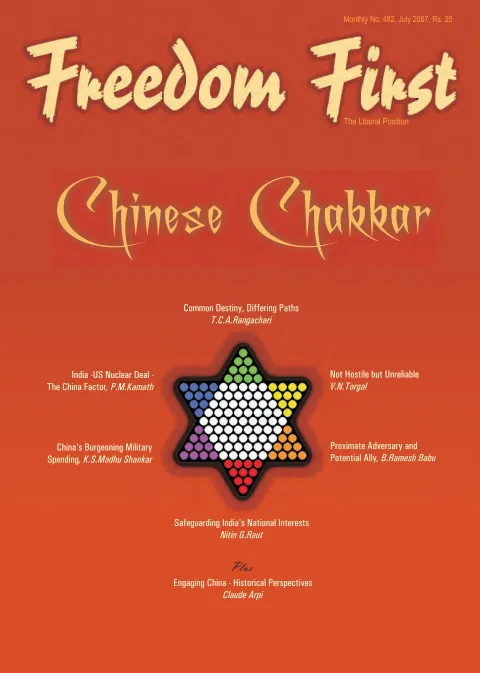
Chinese Chakkar
Edited by S. V. Raju
Publishers: Indian Committee for Cultural Freedom (ICCF), 3rd Floor, Army & Navy Building, 148, Mahatma Gandhi Road, Mumbai 400 001. Published by J. R. Patel for the Indian Committee for Cultural Freedom (ICCF) and printed by him at Kaiser-E-Hind Private Ltd., Plot No.A-191, Road No.16A, MIDC, Wagle Industrial Estate, Thane (W) - 400 604. · Mumbai · 2007
48 pages
Freedom First
Summary
Freedom First No. 482 (July 2007), the classical-liberal monthly published by the Indian Committee for Cultural Freedom, devotes its cover feature ‘Chinese Chakkar’ to seven essays on India-China relations, framed by the editor as a rejection of naive ‘Hindi-Chini Bhai Bhai’ sentiment in favour of a clear-eyed accounting of the relationship’s dangers and opportunities. In the rendered pages, T. C. A. Rangachari opens with a comparative review of India’s and China’s post-Independence trajectories and the shifting logic of Cold War and post-9/11 alignments; B. Ramesh Babu (title given on the cover as ‘Proximate Adversary and Potential Ally’) argues China remains a strategic rival despite shared developing-world interests, citing Chinese ‘cartographic aggression’ and use of Pakistan, Nepal, Burma and Bangladesh to contain India; P. M. Kamath examines how the US-India civil nuclear deal is read by American commentators partly as a hedge against China; and Claude Arpi’s ‘Engaging China: Historical Perspectives’ surveys the unresolved Tibet question, the Tawang dispute, and repeated Chinese pressure tactics against a backdrop of continuing Nehruvian caution in New Delhi. The issue also carries the regular front-matter: a ‘Statement of Purpose’, the ‘Many Voices’ page of press quotations, the ‘Of Cabbages and Kings’ editorial column (on Pratibha Patil’s election and the Haneef case), and a letter from S. V. Raju correcting an account of the Swatantra Party’s role in the 1967 presidential election.
Key points
-
Freedom First No. 482 (July 2007) devotes its cover feature, “Chinese Chakkar,” to seven essays on India-China relations, rejecting naive “Hindi-Chini Bhai Bhai” sentiment in favour of a clear-eyed accounting of the relationship.
-
T. C. A. Rangachari compares India’s and China’s parallel post-war rise, contrasting China’s pragmatic, ideology-free foreign-policy pivots with India’s more principle-constrained diplomacy, including its consistent support for China’s UN membership after 1962.
-
P. M. Kamath examines how American commentators, including Selig Harrison and Samuel Huntington, read the US-India civil nuclear deal partly as a hedge against China’s rise, noting China is the deal’s most vocal opponent.
-
B. Ramesh Babu argues China remains a strategic rival despite shared developing-world interests, citing “cartographic aggression” and Beijing’s use of Pakistan, Nepal, Burma and Bangladesh to contain India.
-
Claude Arpi’s “Engaging China: Historical Perspectives” traces renewed Chinese pressure over the Tawang sector in 2007, including a scholar’s public call for India to “return” Tawang and a disputed May 2007 incursion report denied by state and military officials.
-
“Of Cabbages and Kings” criticises the Congress-led UPA’s manipulation of Pratibha Patil’s presidential candidacy and the government’s weak defence of Dr. Mohamed Haneef, detained in Australia.
Essays
Many Voices
Editorial column ‘Of Cabbages and Kings’ covering three topics: the election of Pratibha Patil as President and the Congress-led UPA’s manipulation of the process; a Mumbai Mirror report on badly-planned traffic signals in the city as a symptom of weak law enforcement; and the Mohamed Haneef case in Australia, arguing India’s government responded too weakly in defending an Indian citizen accused without adequate evidence.
- Criticizes the Congress-led UPA for having predetermined Pratibha Patil’s candidacy while other more qualified candidates were available
- Contrasts outgoing President Kalam favourably with the manner of Patil’s selection
- Uses a report on Mumbai traffic signals to argue laws are meaningless without enforcement
- Calls minimum but strongly enforced government a core liberal position
- Criticizes the Government of India for a weak response to the detention of Dr. Mohamed Haneef in Australia
India-China Relations : A Review
By T. C. A. Rangachari
Rangachari’s opening cover-feature essay compares India’s and China’s parallel rise from post-war poverty to global prominence as India approaches its 60th year of independence. He traces the shift in US strategic calculus from Kissinger-era tilt toward China (including the 1971 Bangladesh war episode) to the present US courtship of India as a counterweight and potential superpower partner. The essay contrasts China’s single-minded, pragmatic pursuit of national interest — illustrated by its ideology-free foreign-policy pivots from the USSR to the US — with India’s foreign policy, which the author argues has been more constrained by principle, citing India’s consistent support for China’s UN and Security Council membership even after the 1962 war, and Nehru’s 1940 remarks on India-China friendship.
- India and China are the only two countries to rise from post-war ‘ruination to riches’ on this scale
- US strategic view of China shifted from Kissinger’s Cold War tilt (including tacit backing during the 1971 Bangladesh crisis) to now building up India as a counterweight
- China’s economy transformed from chronic food/goods shortages during the Cultural Revolution era to becoming ‘the factory of the world’
- China follows pragmatic, principle-free foreign policy realignments (USSR to US) driven purely by national interest
- India’s foreign policy is presented as more consistent and principle-driven, e.g. backing China’s UN admission despite the 1962 war
India-US Civil Nuclear Deal – The China Factor
By P. M. Kamath
Kamath’s essay (in the visible portion) examines the ‘China factor’ behind the US-India civil nuclear deal, arguing that American strategic thinking increasingly frames India as a democratic counterweight to Communist China even as officials publicly deny this. He surveys American commentary — Selig Harrison, Stanley Weiss, Fareed Zakaria, and Samuel Huntington’s ‘Clash of Civilizations’ — pointing to a widely shared American view that containing China’s rise will draw the US and India closer together, and that US willingness to share nuclear technology with China while restricting India is seen by many American voices as an inequity.
- Bush called India a ‘natural partner’ of the US because the two are ‘brothers in the cause of human liberty’
- China’s post-9/11 cooperation on the war on terror initially delayed further US-India rapprochement
- American commentators (Selig Harrison, Stanley Weiss, Fareed Zakaria) frame the US-China nuclear technology-sharing arrangement as an inequity relative to India’s non-proliferation record
- Huntington’s Clash of Civilizations is cited as predicting that shared interest in containing China would draw India and the US together
- China is described as the country most vocally opposed to the US-India nuclear deal
Proximate Adversary and Potential Ally
By B. Ramesh Babu
Claude Arpi’s essay (as rendered) surveys the historical roots of India-China friction with a focus on Tibet and the Tawang sector of Arunachal Pradesh. He notes Zhou Enlai’s 1956 promise of Tibetan autonomy went unfulfilled, and that renewed Chinese pressure in 2007 — including a Chinese scholar’s press statement demanding the ‘return’ of Tawang — appears designed to pressure New Delhi in ongoing border talks. The essay also recounts a contested claim of a 20 km Chinese incursion into the Tawang sector reported by an Arunachal MLA and MP in May 2007, which was denied by the state Chief Minister, the Home Minister, and the Indian Army, and situates this against the embarrassing 2003 precedent of intrusions reported during PM Vajpayee’s return from China.
- Zhou Enlai promised Tibetan autonomy during his November 1956 visit; Beijing today rejects any such autonomy
- In March 2007 Chinese scholar Prof Ma Jiali publicly called for India to return Tawang to ease border talks, seen as pressure tactics
- The Dalai Lama has repeatedly accepted the McMahon Line as the India-Tibet border, deepening the puzzle of continued Chinese claims
- In May 2007 an Arunachal Pradesh MLA and BJP MP alleged a 20 km Chinese incursion in the Tawang sector, which state and military officials denied
- A similar embarrassing intrusion episode occurred in June 2003 during PM Vajpayee’s return from a China visit
Generated by the v1.5 extraction pipeline. Awaiting editorial review.
Metadata and summary are AI-extracted from the source PDF and reviewed for editorial accuracy. The original work is available via the Read PDF tab above (where present); paragraph-level citation inside the PDF is deferred to a future engagement.