periodical issue
Freedom First
The Liberal Position
Edited by S. V. Raju
Publishers: Indian Committee for Cultural Freedom (ICCF), 3rd Floor, Army & Navy Building, 148, Mahatma Gandhi Road, Mumbai 400 001. Published by J. R. Patel for the Indian Committee for Cultural Freedom (ICCF) and printed by him at Kaiser-E-Hind Private Ltd., Plot No.A-191, Road No.16A, MIDC, Wagle Industrial Estate, Thane (W) - 400 604. · Mumbai · 2008
60 pages
Freedom First
Summary
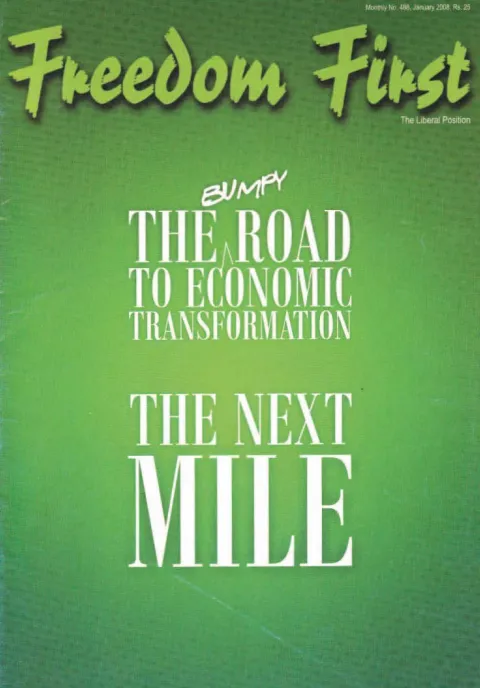
This is No. 488 (January 2008) of Freedom First, the Bombay-based liberal monthly founded by Minoo Masani, marking its 54th year of publication. The rendered pages cover the front matter and the first half of the issue’s regular sections: a New Year message on India’s post-Independence “revolutions” and persistent poverty, a digest of press quotations (“Many Voices”), the editor’s “Of Cabbages and Kings” column on bandh legality and vanishing small-denomination coins, S. V. Raju’s piece on the long-pending Swatantra Party registration case, Amit Dholakia’s analysis of Narendra Modi’s December 2007 Gujarat election win, a tribute to the late historian Professor Y. D. Phadke, Ashish Puntambekar’s essay on the possible disintegration of Pakistan after Benazir Bhutto’s assassination, Ashok Karnik’s “Point Counter Point” debate column (covering the death of democracy in Pakistan, the Modi phenomenon, Deshmukh vs Rane in Maharashtra, and the Pawar-Thackeray meeting), and Cyrus Guzder’s reflections on Minoo Masani drawn from a talk marking Masani’s biography launch. The issue’s cover feature, “The Bumpy Road to Economic Transformation — The Next Mile” (a review of the Indian Liberal Group / Project for Economic Education’s Liberal Budgets), begins later in the issue at printed page 21, past the rendered pages.
Key points
-
Freedom First No. 488 (January 2008) opens its New Year issue reflecting on India’s post-Independence “revolutions” and persistent poverty.
-
S. V. Raju revisits the Swatantra Party’s 14-year-old Bombay High Court petition seeking Election Commission registration without swearing allegiance to socialism, quoting Minoo Masani’s essay on Liberalism to explain the party’s actual relationship to socialism’s aims.
-
Amit Dholakia analyses the BJP’s December 2007 Gujarat landslide under Narendra Modi, attributing the win to Modi’s personal charisma and administrative record rather than a referendum on Hindutva, while cautioning that Gujarat’s human-development indices still lag its growth.
-
Ashish Puntambekar argues Benazir Bhutto’s assassination has made a political solution in Pakistan nearly impossible, warning of possible Sindhi separatism, a jihadi takeover, and a refugee influx of four to five million people into India.
-
Ashok Karnik’s “Point Counter Point” debates the death of democracy in Pakistan, the Modi phenomenon, the Rane-Deshmukh rift in Maharashtra Congress, and the Pawar-Thackeray meeting.
-
Cyrus Guzder revisits Minoo Masani’s 1969 Rajaji Memorial Lecture “Too Much Politics, Too Little Citizenship,” assessing India’s mixed progress on the ills Masani diagnosed, from economic stagnation giving way to growth to persistent decay in public life.
-
A tribute remembers historian Professor Y. D. Phadke, praising his pioneering study of the Samyukta Maharashtra Movement and his eight-volume history of Maharashtra.
Essays
Essay 1
A page of quoted commentary from Indian newspapers and magazines (October 2007-January 2008) on federalism, socialism under capitalism, Sonia Gandhi’s leadership, the Gujarat election and Narendra Modi, secularism, national honours, and free speech, closing with a Satish Acharya cartoon on freedom and grumbling.
- Compiles editorial and columnist quotations rather than original prose
- Touches on chief ministers eclipsing the Prime Minister in India’s federal politics
- Jyoti Basu quoted affirming private capital’s role within a still-unachieved socialism
- Ramaswamy Iyer questions whether the ‘Gujarati psyche’ remains redeemable after the Modi-era elections
- Soli Sorabjee distinguishes a secular state from an anti-God one
- Closes on a cartoon contrasting Indians’ freedoms with their grumbling
Many Voices
The editor’s regular column: a reader’s letter-style piece defending the Supreme Court’s ban on bandhs against retired Justice Rajindar Sachar’s criticism, arguing citizens’ rights to go about their business outweigh protestors’ right to disrupt cities; followed by a short piece on the disappearance of small-denomination coins in Mumbai as the cost of living rises.
- Argues bandhs harm ordinary citizens and businesses more than they vindicate protestors’ free-speech rights
- Notes Justice Sachar’s Radical Humanist article contesting the Kerala High Court/Supreme Court bandh ban
- Describes Mumbai residents’ fear of Shiv Sena-called bandhs specifically
- Second item traces the vanishing one-paisa, five-paisa and now 25-paisa coins as the rupee’s purchasing power erodes
- Illustrates the point with an anecdote about a blind beggar refusing 25-paisa coins on a Mumbai local train
Of Cabbages and Kings
S. V. Raju revisits the Swatantra Party (Maharashtra)‘s 14-year-old writ petition in the Bombay High Court, seeking registration by the Election Commission without swearing allegiance to socialism as the Representation of the People Act amendment requires. He rebuts a recent press characterization of the case as a fading, quixotic effort, invokes Minoo Masani’s essay on Liberalism to explain the party’s actual relationship to socialism’s stated aims, and reaffirms the petition’s narrow purpose.
- Responds to a Mint article calling the Swatantra Party’s court challenge unsuccessful and dismissible
- The core petition, pending in the Bombay High Court since December 15, 1994, seeks registration without a socialist allegiance clause
- Distinguishes Swatantra’s objection to compelled socialist rhetoric from any hostility to social welfare or figures like Jayaprakash Narayan or Ram Manohar Lohia
- Quotes Minoo Masani’s essay on Liberalism explaining why he rejects socialism as a means despite endorsing its egalitarian aims
- Frames the party’s founding as a fusion of Western liberalism and Gandhian teaching
Of Swatantra and Socialism and “Flogging a Dead Horse”
By S. V. Raju
Amit Dholakia analyzes the BJP’s December 2007 Gujarat Vidhan Sabha landslide under Narendra Modi, arguing the result should not be read through the simple ‘secularism vs Hindutva’ lens favored by commentators. He attributes the win to Modi’s personal charisma, oratory, and image as an efficient administrator and economic liberalizer who delivered double-digit growth, infrastructure gains, and reduced corruption, while cautioning that Modi’s national ambitions will require moderating his style and that Gujarat’s social and human development indices still lag its economic growth.
- BJP increased its vote-share lead over Congress from 9% (2002) to 11% (2007) despite dissidence, anti-incumbency, and hostile media coverage
- Argues the election was decided by Modi’s personal charisma and administrative record rather than an ideological referendum on Hindutva
- Describes Modi’s oratory and campaign professionalism as driving a ‘presidentialization’ of Gujarat’s parliamentary politics
- Credits Modi’s economic record (growth rate, per capita income, infrastructure, e-governance) and programmes like Beti Bachao and Kanya Kelavani for broad appeal
- Cautions that Modi’s national ambitions will require moderating his style, and that rural infrastructure, health and education indices still lag
- Author identified as Dr. Amit Dholakia, Reader in Political Science at Maharaja Sayajirao University of Baroda and a member of the Indian Liberal Group
Gujarat Elections
By Amit Dholakia
A brief obituary tribute by R. Srinivasan to historian Professor Y. D. Phadke (1931-2008), praising his decades of teaching in Mumbai, Pune and TISS, his pioneering study of the Samyukta Maharashtra Movement, his eight-volume history of nineteenth- and twentieth-century Maharashtra, his two-volume study of Subhas Chandra Bose, and his uncompromising liberal and secular humanist values.
- Phadke (1931-2008) taught in the Universities of Mumbai, Pune and T.I.S.S.
- His study of the Samyukta Maharashtra Movement is described as pioneering and still authoritative
- Wrote an eight-volume history of Maharashtra and a two-volume study of Subhas Chandra Bose
- Presided over the Marathi Sahitya Sammelan and received numerous honours
- Remembered as critical of capitalism’s excesses yet equally wary of state overreach (‘the leviathan that would swallow its children’)
What Happens if Pakistan Disintegrates
By Ashish Puntambekar
Ashish Puntambekar argues that Benazir Bhutto’s assassination has made a political solution in Pakistan nearly impossible and raises the likelihood of the country’s disintegration. He surveys the prospects for Sindhi separatism, a possible civil war between Sindhis and Punjabi/Mohajir settlers, the risk of a jihadi takeover given weak political institutions and a demoralized army, China’s strategic interest in Pakistan’s survival (via Gwadar and the Karakoram corridor), and India’s need to prepare for a possible refugee influx of four to five million people across the western border.
- Benazir’s murder is framed as having made a negotiated political solution ‘almost impossible,’ leaving the army as the only force able to hold Pakistan together
- Anticipates Sindhi demands for a separate state given no remaining stake in the union, and warns of a Serbia/Bosnia-like civil war if Musharraf deploys Punjabi-dominated troops to Karachi
- Cites a claim (from Stratfor) that most Pakistani nuclear weapons are already under US safeguards, complicating any breakaway state’s weaponization ambitions
- Describes 40 active Jihadi publications with roughly 1 million readers and about 30,000 madrassas as evidence of militancy’s growth since 1947
- Frames China’s investment in the Gwadar naval base and a Himalayan road corridor as reasons Beijing has a strategic stake in preventing Pakistan’s collapse
- Warns India to plan for a possible refugee crisis of four to five million people crossing into Gujarat and Rajasthan within six months to a year
- An editorial framing note (unsigned) points readers to Ashok Karnik’s ‘Point Counter Point’ column for a related view, and adds that Pakistan is ‘dangerously close to qualifying as a failed state’
- Author identified as a project visualizer for a large Indian corporate house; the views are stated as personal, not organisational
Point Counter Point
By Ashok Karnik
Ashok Karnik’s regular ‘Point Counter Point’ feature presents opposing viewpoints on four current controversies: whether Benazir Bhutto’s assassination marks the death of democracy in Pakistan; how to interpret Modi’s re-election in Gujarat; the Narayan Rane-Vilasrao Deshmukh rift in Maharashtra Congress politics; and the surprise December 2007 meeting between Sharad Pawar and Bal Thackeray.
- On Pakistan: one side sees Benazir’s killing as ending even the pretence of democracy under US-backed Musharraf; the other argues democracy was never healthy there and the real question is whether any new government secures the army’s backing against terrorism
- On Modi: one side reads the win as vindicating an efficient administrator unfairly maligned by biased media; the other insists an electoral victory does not erase accountability for the 2002 riots
- On Maharashtra Congress: the Rane-Deshmukh feud is read either as unusual open rebellion or as routine Congress High Command stagecraft to prevent any state leader (or CM) from becoming too powerful
- On the Pawar-Thackeray meeting: interpreted either as a genuine hint of a new NCP-Sena alliance option or as tactical signalling to Congress and the BJP with no real alliance intended
- Includes a boxed excerpt from Syed Saleem Shahzad (Asia Times Online) on al-Qaeda’s framing of Bhutto as a US-aligned target
- Includes a boxed excerpt from Ram Punyani distinguishing Gujarat’s ‘chronic fascism’ from Germany’s ‘acute fascism’ in the 1930s-40s
- Column invites reader submissions on serious issues of the day
Too Much Politics, Too Little Citizenship
By Cyrus Guzder
Cyrus Guzder, excerpting his November 2007 talk at the National Book Trust launch of Minoo Masani’s biography (written by S. V. Raju), revisits Masani’s 1969 Rajaji Memorial Lecture ‘Too Much Politics, Too Little Citizenship’ and assesses how far India has come, and fallen short, on the ten ills Masani diagnosed 38 years earlier: self-seeking, parochialism, indiscipline, cynicism, bureaucracy, corruption, economic stagnation, and the absence of a public philosophy. Guzder finds mixed progress (income tax rates, prohibition-era restrictions, and the ‘P’ form are gone; economic stagnation has given way to growth) but argues decay in public life, dynastic and personality-driven parties, and government hostility to civil-society NGOs persist or have worsened. He recounts Masani’s formative walk with Gandhi, his principled opposition to caste-based reservations even for Parsis, and closes on the cautiously hopeful note that grassroots civil-society movements (citing Aruna Roy’s RTI campaign) may fulfil Masani’s hope that India would be ‘saved by the small men.’
- Frames the piece around Masani’s January 18, 1969 Fourth Rajaji Birthday Lecture, delivered under the Gokhale Institute of Public Affairs
- Runs through an Air India hoarding-inspired checklist of 1969-era grievances (taxes, shortages, population, language) and scores India’s progress on each as of 2007
- Judges that ‘the decay in our public life’ and the ‘everyone wants to be in power’ syndrome Masani lamented are ‘very prevalent even today,’ citing Nandigram and the nuclear deal controversy as evidence
- Recounts Masani’s Constituent Assembly-era argument against reservations, including his own vote to reject reserved seats for Parsis, out of fear reservations would become self-perpetuating
- Cites recent state incursions into IIT/IIM autonomy as an example of Masani’s feared ‘levelling down, instead of levelling up’
- Describes government restrictions on NGO foreign funding as hostile to the civil-society resurgence (RTI, Aruna Roy’s Rajasthan movement) that Guzder argues would have given Masani hope
- Notes Masani’s formative 10-day walking tour with Gandhi through Orissa villages and lessons Gandhi taught him about means and ends and decentralization of power
- Closes by quoting Masani’s autobiography Against the Tide on India being saved by ‘the small men… the middle class of the cities and the landed farmers of the countryside’
- Author identified as Chairman & Managing Director, AFL Group; piece excerpted from a November 20, 2007 talk in Mumbai
Generated by the v1.5 extraction pipeline. Awaiting editorial review.
Rites, Rituals and Festivals (2)
By Suman Oak
No summary was extracted for this article. Listed for completeness.
Metadata and summary are AI-extracted from the source PDF and reviewed for editorial accuracy. The original work is available via the Read PDF tab above (where present); paragraph-level citation inside the PDF is deferred to a future engagement.