periodical issue
Freedom First
The Liberal Position
Publishers: Indian Committee for Cultural Freedom (ICCF), 3rd Floor, Army & Navy Building, 148, Mahatma Gandhi Road, Mumbai 400 001. Published by J. R. Patel for the Indian Committee for Cultural Freedom (ICCF) and printed by him at Kaiser-E-Hind Private Ltd., Plot No.A-191, Road No.16A, MIDC, Wagle Industrial Estate, Thane (W) - 400604. · Mumbai · 2008
40 pages
Freedom First
Summary
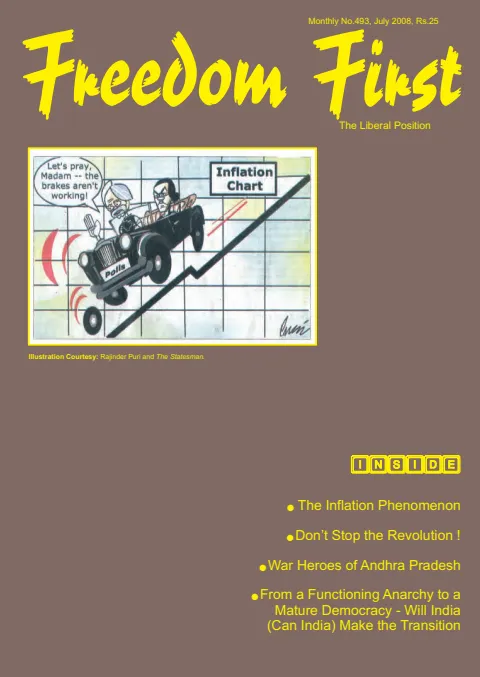
This is the July 2008 issue (No. 493, 55th year of publication) of Freedom First, the Bombay-based liberal monthly founded by Minoo Masani. The cover feature tackles the return of double-digit inflation in mid-2008, with Sunil Bhandare and C. S. Deshpande arguing from a classical-liberal standpoint that the current price surge is a global, largely oil-driven phenomenon rather than a consequence of India’s post-1991 economic liberalization, and warning against any political retreat into controls. The issue also runs its regular “Many Voices” digest of press quotations, Ashok Karnik’s “Point Counter Point” debate column (on inflation’s political fallout, a hypothetical Congress-BJP coalition, and the Jaipur terror attacks), V. Balachandran’s profile contrasting John McCain and Barack Obama ahead of the 2008 US election, Eknaath Nagarkar’s allegorical essay on the fragility of Indian democracy (personified as a ‘damsel’), and Firoze Hirjikaka’s “Cornucopia” column on political hypocrisy, bureaucratic failure against terrorism, and the renaming of Bombay to Mumbai. Consistent with the magazine’s stated purpose, the pieces argue for minimum government, individual responsibility, and skepticism of state intervention, while criticizing both the Left and populist/majoritarian politics.
Key points
-
Sunil Bhandare and C. S. Deshpande’s cover feature argues the mid-2008 inflation spike to a 13-year high of about 11% is a global, oil-driven phenomenon rather than a consequence of India’s post-1991 liberalisation, tracing repeated double-digit inflation under pre-reform centralised planning and warning against a return to price controls.
-
Ashok Karnik’s “Point Counter Point” debates whether inflation caused the BJP’s Karnataka victory, the feasibility of a Congress-BJP coalition, and India’s response to the May 2008 Jaipur bomb blasts.
-
V. Balachandran profiles John McCain and Barack Obama ahead of the 2008 US election, contrasting McCain’s hawkish ‘Jacksonian’ foreign policy with Obama’s stated philosophy of ‘empathy and inclusiveness.’
-
Eknaath Nagarkar’s allegorical essay personifies Indian democracy as a vulnerable ‘damsel,’ tracing its history from Nehru’s choice of secularism through the Emergency to the Karnataka forest brigand Veerappan as a decades-long antagonist of the state.
-
Firoze Hirjikaka’s “Cornucopia” criticises politicians’ selective outrage over a minister’s inverted flag-hoisting, cites nine major terror bombings since 2005 to argue security agencies rarely act on intelligence in time, and satirises the Shiv Sena’s Bombay-to-Mumbai renaming campaign.
-
The “Many Voices” digest compiles press quotations from April-June 2008 on topics including Advani’s book on Benazir Bhutto, caste politics, globalisation, Tibet, and Taslima Nasreen’s exile.
Essays
Many Voices
A compilation of short quotations from the Indian and international press (April-June 2008) on topics ranging from L. K. Advani’s book on Benazir Bhutto, caste and Lohia’s critique of Indian politics, globalisation’s beneficiaries, Tibet and the Dalai Lama, Taslima Nasreen’s exile, and China’s political economy.
- Compiles press quotations from named journalists and public figures on current events of April-June 2008
- Topics include Advani’s Bhutto book, caste politics, globalisation, Tibet, Taslima Nasreen, and China
The Inflation Phenomenon: A Liberal Perspective (Cover Feature)
By Sunil Bhandare / C. S. Deshpande
Sunil Bhandare and C. S. Deshpande argue that the inflation spike to a 13-year high (~11%) in mid-2008 is a reflection of bad economic policy globally, not a byproduct of India’s post-1991 economic liberalization. They trace India’s inflation history from the pre-reform decades (1957-1991), when double-digit inflation recurred repeatedly under centralized planning and state capitalism, through the relative moderation of the post-reform period (1991-2007), arguing the current bout is driven by global oil price shocks, rising agricultural stagnation, and rising middle-class consumption demand rather than domestic liberalization. They warn that reverting to controls and state intervention would be a ‘remedy worse than the disease’ and call for reforms to agriculture, energy security, infrastructure, and fiscal governance instead, while criticizing the Left for exploiting the crisis and the UPA government for lacking resolve.
- Inflation reached a 13-year high of ~11% by mid-2008, driven mainly by global oil price shocks (crude oil rose from $27.69/barrel in 2003 to $136/barrel by May 2008)
- Pre-1991 India (1957-1991) had at least 12 years of double-digit inflation under centralized planning and state capitalism, undercutting the claim that liberalization caused inflation
- Post-reform inflation moderated significantly: 10.6% (1991-96), 5.1% (1996-2001), 4.9% (2001-07 average, based on WPI)
- The article frames inflation as a regressive tax that hurts the poor, fixed-income earners, and senior citizens most, while benefiting hoarders and speculators
- Recommends agricultural productivity reform, energy security, infrastructure expansion, manpower capacity-building, and fiscal governance as solutions rather than reverting to price controls
- A sidebar reproduces a 1966 Swatantra Party pamphlet on ‘Anti-Inflation Day’ arguing controls only increase scarcity and corruption
- A second sidebar quotes Prof. S. L. N. Simha (Southern Economist) arguing inflation is a ‘phenomenon’ to be managed with monetary and fiscal instruments, not treated as a ‘menace’
Point Counter Point
By Ashok Karnik
Ashok Karnik’s recurring ‘Point Counter Point’ column presents opposing views on three live issues of mid-2008: whether inflation (not just Congress’s own failings) caused the Karnataka electoral defeat; whether a Congress-BJP coalition is conceivable given the two parties’ hostility; and how India should respond to the Jaipur bomb blasts of May 2008 given a string of terror attacks since 2005. Each side is given equal space, followed by a quoted aphorism.
- Debates whether inflation or local political factors (the JD(S)-BJP power-sharing collapse) caused BJP’s Karnataka victory
- Explores the feasibility of a Congress-BJP coalition, referencing suggestions by Rahul Bajaj, Meghnad Desai, P. A. Sangma, and RSS veteran M. G. Vaidya
- Addresses the May 13, 2008 Jaipur terrorist bombings in the context of a string of attacks since 2005 (Delhi, Mumbai trains, Hyderabad), criticizing bureaucratic and political inertia on anti-terror legislation and a federal anti-terror force
India Must Know its McCain and Obama
By V. Balachandran
V. Balachandran, a former Special Secretary in the Cabinet Secretariat, profiles the contrasting biographies and foreign-policy dispositions of the 2008 US presidential candidates John McCain and Barack Obama, ahead of the November election. He recounts McCain’s naval and POW background and his ‘Jacksonian’ hawkish foreign-policy views (from his November-December 2007 Foreign Affairs essay), versus Obama’s mixed-race, lower-middle-class upbringing and his stated philosophy of ‘empathy and inclusiveness’ drawn from his books Dreams from My Father and The Audacity of Hope. The essay closes by noting the broader Indian stake in the outcome, and America’s historical unpreparedness in anticipating shifts in foreign leadership (citing the 1981 Mitterrand and 1992 Clinton transitions).
- McCain (age 72 if elected) would be the oldest US president; Obama (47) would be the fifth youngest
- McCain’s Iraq/foreign policy views described as ‘Jacksonian’: unilateral intervention when American interests are threatened, expanding the military, and creating a ‘worldwide League of Democracies’
- Obama’s foreign policy, per his book The Audacity of Hope, emphasizes ‘empathy and inclusiveness’ and criticizes US trade barriers, patent regimes, and Cold War-era thinking
- Obama credited with a notable October 2002 anti-Iraq War speech and a widely praised 2004 Democratic National Convention keynote
- Indian diplomatic services criticized for historically failing to build relationships with rising political figures abroad (citing the 1981 Mitterrand and 1992 Clinton examples)
- Frames the US election as a choice between continued ‘militarism’ and a foreign policy of ‘empathy and inclusiveness’
Democracy Damsel in Distress
By Eknaath Nagarkar
Eknaath Nagarkar’s allegorical essay personifies Indian democracy as ‘SHE’ (a ‘damsel’), tracing her mythic and historical vulnerability from ancient Greek city-states through India’s independence movement, the framing of secularism by Nehru, the trauma of the Emergency, and finally the extended metaphor of the Karnataka forest brigand Veerappan as a chess opponent besting the state for three decades, ending in his death and the fall of Deve Gowda’s JD(S) in the 2008 Karnataka elections. The piece closes with a call for citizens to elect leaders wisely to protect the health of Indian democracy.
- Frames Indian democracy as a vulnerable ‘damsel’ repeatedly compromised by corrupt or opportunistic leaders
- Credits Minoo Masani and other Libertarians with setting up institutions (Democratic Research Service, Indian Committee for Cultural Freedom, Adult Education Institute) to nurture democratic capacity
- Recounts Nehru’s choice of ‘secularism’ over Masani’s suggested ‘non-denominational’ as India’s founding civic principle
- Uses Indira Gandhi’s Emergency as the moment democracy fell into a coma
- Extended chess allegory casts the sandalwood brigand Veerappan as a decades-long antagonist to the Karnataka state, ending with his 2004 death and framing the 2008 Karnataka election (fall of the JD(S)) as democracy’s uncertain recovery
- A sidebar separately covers ‘what happened to the money’ Veerappan allegedly accumulated, and a second sidebar (by Neelanant Patri) discusses the JD(S)‘s 2008 Karnataka election collapse
Cornucopia
By Firoze Hirjikaka
Firoze Hirjikaka’s ‘Cornucopia’ column, in the rendered pages, covers three short pieces: a critique of Indian politicians’ selective outrage over a Maharashtra minister’s inverted flag-hoisting versus their tolerance of real corruption and nepotism; an argument that Indian bureaucratic lethargy (illustrated by a stalled Maharashtra intelligence wing meant to respond to the 2006 Mumbai train blasts) is effectively an ally of terrorists; and a satirical reminiscence contrasting 1950s cosmopolitan Bombay with present-day Mumbai, mocking the Shiv Sena’s renaming campaign and its claimed restoration of the city’s ‘pristine glory’.
- Criticizes politicians’ selective outrage over a minister hoisting the flag upside-down while ignoring corruption and nepotism
- Uses the Times of India’s tally of nine major terrorist bombings since 2005 to argue Indian security agencies rarely act on intelligence in time
- Cites the stalled Maharashtra state intelligence wing (approved after the 2006 Mumbai train blasts, still unstaffed nearly two years later) as an example of bureaucratic failure enabling terrorism
- Satirizes the Shiv Sena’s Bombay-to-Mumbai renaming campaign and linguistic enforcement as having done nothing to fix the city’s real problems (flooding, crime, corruption)
Generated by the v1.5 extraction pipeline. Awaiting editorial review.
Metadata and summary are AI-extracted from the source PDF and reviewed for editorial accuracy. The original work is available via the Read PDF tab above (where present); paragraph-level citation inside the PDF is deferred to a future engagement.