periodical issue
Freedom First
The Liberal Position
Freedom First · Mumbai · 2009
24 pages
Freedom First
Summary
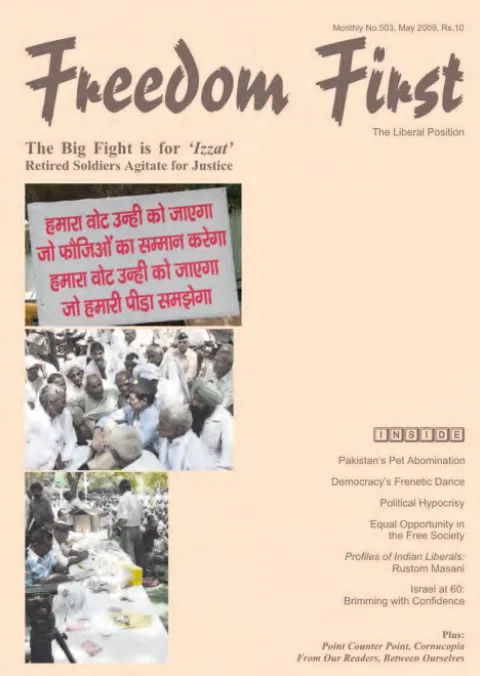
The rendered pages show the May 2009 issue of Freedom First as a liberal current-affairs periodical concerned with constitutional government, national security, political accountability, and individual freedom. The issue opens with Surjit Singh’s argument that ex-servicemen’s protests over pensions were also a protest against the loss of military dignity and status, then moves through Sharad Bailur’s critique of Pakistan’s identity politics, Firoze Hirjikaka’s attacks on democratic opportunism after 26/11, Ashok Karnik’s paired arguments on elections and terrorism, and essays on political language, equal opportunity, Indian liberal biography, assisted dying, and Israel’s democratic self-confidence.
Key points
-
Surjit Singh presents the Jantar Mantar veterans’ agitation as a fight for ‘izzat’ as much as pension arrears, citing the denial of One Rank One Pension and Sixth Pay Commission anomalies as evidence of a systematic downgrading of military status by civilian bureaucracy.
-
Sharad Bailur argues Pakistan has repeatedly defined its national identity in opposition to India rather than as an independent project, tracing this from Partition through the 1971 war, nuclear rivalry, and discomfort with the ‘AfPak’ label, including a courteous email exchange with retired Air Vice Marshal Shahzad Chaudhry.
-
Firoze Hirjikaka’s essay attacks India’s political class for opportunism and institutional manipulation, moving from Narendra Modi and media regulation through police reform, Bilkis Bano, Mayawati, and Sadhvi Pragya, while noting early signs of accountability through the Right to Information Act.
-
Ashok Karnik’s “Point Counter Point” describes the 2009 election as an auction of loyalty among wealthy candidates, criticises the mishandling of Varun Gandhi’s Pilibhit speech, and reads the Lahore Police Training Centre attack as evidence of Pakistan’s unresolved Taliban problem.
-
H. R. Bapu Satyanarayana criticises politically useful labels such as calling Mangalore ‘Talibanised’ or branding the BJP as non-secular, arguing Congress’s inherited legitimacy from the freedom struggle let it define secularism against its rivals.
-
Sanjeev Sabhlok develops equal opportunity as a liberal doctrine distinct from equal outcomes, aligning with Hayek on a social minimum funded only after defence, police, and justice, and proposing school vouchers, health insurance vouchers, and a negative income tax.
-
B. K. Karanjia’s profile of Rustom Masani, part of the “Profiles of Indian Liberals” series, presents him as a mediator between Congress and British authorities who criticised the 1939 Congress ministries’ resignation and mourned Partition’s costs.
-
Derek Humphry’s manifesto argues for a competent adult’s right to choose death amid terminal suffering, and Nitin G. Raut’s essay on Israel at sixty praises its parliamentary democracy, kibbutz-based social integration, and agricultural self-sufficiency.
Essays
The Big Fight is for ‘Izzat’
By Surjit Singh
Surjit Singh presents the Jantar Mantar veterans’ agitation as a struggle for izzat as much as for pension arrears. He argues that the denial of One Rank One Pension, anomalies in the Sixth Pay Commission settlement, and the exclusion of serving or retired soldiers from key decision-making bodies show a systematic downgrading of military status by civilian bureaucracy. The essay warns that distrust of soldiers and excessive bureaucratic control may damage morale, recruitment, civil-military relations, and command authority.
- The visible article contrasts the public honour given to soldiers after 1971 with veterans protesting for fair pensions in 2008.
- It cites surrendered medals, fasts, and pension anomalies as evidence of deep anger among retired personnel.
- The author argues that the deeper injury is loss of status, not only money.
- The Ministry of Defence is portrayed as delaying, committee-driven, and dominated by civil servants.
- The essay continues on page 22, which was not rendered.
Pakistan’s Pet Abomination
By Sharad Bailur
Sharad Bailur argues that Pakistan has repeatedly defined itself in relation to India rather than as an independent national project. The visible essay traces this tendency from early arguments over the name India, through the wars of 1965 and 1971, nuclear rivalry, the U.S.-India nuclear deal, the Mumbai attacks, and Pakistani discomfort with the term AfPak. Bailur’s central claim is that Pakistan’s self-conception has been damaged by dependence on anti-India comparison, religious nationalism, and strategic alignment with the Middle East.
- The article says Pakistan’s founding religious identity quickly became a competitive identity against India.
- It treats the 1971 Bangladesh war as a decisive reality check for Pakistan’s military mythology.
- It links Pakistan’s nuclear ambitions to rivalry with India and to the A. Q. Khan proliferation network.
- It argues that Pakistan objects to being de-hyphenated from India because comparison with India remains central to its self-image.
- The pages include a courteous email exchange between Bailur and retired Air Vice Marshal Shahzad Chaudhry.
Why Afghanistan is the Wrong War!
By John Mueller
No summary was extracted for this article. Listed for completeness.
Democracy’s Frenetic Dance
By Firoze Hirjikaka
Firoze Hirjikaka’s essay attacks India’s political class for opportunism, communal mobilisation, and institutional manipulation. In the rendered pages he moves from Narendra Modi and media regulation to police reform, Bilkis Bano, Mayawati, political bribery, Sadhvi Pragya, celebrity candidates, and early signs of accountability through the Right to Information Act and the Santosh Singh conviction. The visible essay is sharply anti-authoritarian and insists that terrorism, corruption, and executive arbitrariness cannot be excused by party interest.
- The article praises Ashok Karnik’s earlier piece on the devaluation of institutions and extends that critique through examples from 2006-2009.
- It criticizes political control over police and proposed controls over broadcasting.
- It condemns the habit of justifying one party’s misconduct by citing another party’s earlier misconduct.
- It argues that terrorism is a crime against humanity and must not be exploited for political gain.
- The essay continues on page 22, which was not rendered.
Point Counter Point
By Ashok Karnik
Ashok Karnik’s Point Counter Point column offers paired reflections on the 2009 election season, Varun Gandhi’s Pilibhit speech, and the Lahore Police Training Centre attack. Karnik describes elections as an auction of loyalty among wealthy candidates and potential post-poll defectors, argues that the Election Commission and the government mishandled Varun Gandhi even if the speech itself required legal scrutiny, and reads the Lahore attack as evidence of Pakistan’s unresolved Taliban problem and India’s need to maintain faith in its own constitutional system.
- The column attacks the transactional politics of coalition formation and millionaire candidates.
- It calls for stable government by larger national parties rather than blackmail by small groups.
- It criticizes both Varun Gandhi’s communal speech and the misuse of the National Security Act against him.
- It argues that terrorists in Pakistan seek to create fear and delegitimize the state.
- A following excerpt from Education World urges India’s intelligentsia to force health and education onto the election agenda.
Intelligentsia Must Rewrite National Agenda
No summary was extracted for this article. Listed for completeness.
Political Hypocrisy
By H. R. Bapu Satyanarayana
H. R. Bapu Satyanarayana criticizes what he sees as politically useful labels, especially the casual description of Mangalore as Talibanised and the routine branding of the BJP as non-secular. In the visible portion he argues that Congress inherited symbolic legitimacy from the freedom struggle and the Gandhi name, then used that position to define secularism against its rivals. The article frames later caste, religious, and reservation conflicts as the result of constitutional principles being subordinated to the thirst for power.
- The essay says inflammatory labels can condition public opinion and create disharmony.
- It argues that Congress benefited from being seen as the heir of the freedom movement and Mahatma Gandhi.
- It contrasts Nehru’s succession with a counterfactual in which Sardar Patel became prime minister.
- It says Hindutva has been painted in lurid terms even where courts did not treat the word as inherently negative.
- The essay continues on page 22, which was not rendered.
Equal Opportunity in the Free Society
By Sanjeev Sabhlok
Sanjeev Sabhlok develops equal opportunity as a liberal doctrine. He distinguishes political equality from equal outcomes, aligns himself with Hayek and classical liberals on a social minimum, rejects Rawls’s difference principle as a step toward socialism, and argues that a minimal safety net is justified by freedom, stability, and enlightened self-interest. The policy package he sketches includes anti-discrimination law, abolition of caste- and religion-based subsidies, school vouchers, health insurance vouchers, emergency care, and a negative income tax.
- Equal opportunity is defined first as political equality before law and public office.
- The author rejects equal outcomes and equal prospects as liberal goals.
- He supports a social minimum only after defence, police, and justice are funded.
- He argues that basic health, education, and income support help sustain a stable free society.
- The essay links these ideas to the Freedom Team of India’s policy-development work.
Cornucopia
By Firoze Hirjikaka
Firoze Hirjikaka’s Cornucopia column argues that the shock of the 26/11 Mumbai attacks has not produced the promised political and administrative change. The first visible item says parties still prize winnability, patronage, and red tape over security and public service; the second item begins an analysis of Varun Gandhi’s Pilibhit speech as an electoral calculation aimed at a particular constituency. The Varun Gandhi item is cut off at the bottom of page 15.
- The column says post-26/11 public outrage did not reform party behaviour or security procurement.
- It criticizes politicians and bureaucrats for indifference unless they fear electoral loss.
- It urges voters to choose candidates for public service rather than caste or populist promises.
- It begins a discussion of Varun Gandhi’s hate speech as politically calculated.
- The rendered page cuts off before the Varun Gandhi piece concludes.
Profiles of Indian Liberals: Rustom Masani
By B. K. Karanjia
B. K. Karanjia’s profile of Rustom Masani, excerpted under Profiles of Indian Liberals, presents Masani as a mediator, constitutionalist, and critic of strategic errors in the freedom struggle. The visible installment emphasizes Masani’s conversations with Gandhi, his concern for negotiated settlement, his criticism of the Congress ministries’ resignation in 1939, and his grief over Partition. It closes by praising Masani’s Britain in India as a fair-minded historical survey and by dwelling on the wounds of Partition that continued into the present.
- Masani is shown trying to keep channels open between Congress leaders and British authorities.
- The profile stresses his support for council entry and office-holding as practical nationalist strategy.
- It criticizes the political vacuum after Congress ministries resigned in 1939.
- It presents Partition as a disastrous failure whose consequences remained visible in India-Pakistan violence.
- The installment is marked “To be continued” on page 18.
Essay 11
By Derek Humphry
Derek Humphry’s manifesto argues for a competent adult’s right to choose death in the face of terminal suffering. It distinguishes voluntary assisted dying from coercion, supports advance directives and powers of attorney, and cites jurisdictions where medically hastened death is lawful. The piece frames autonomy at the end of life as a civil and personal liberty while respecting contrary views that do not override the dying person’s own decision.
- The manifesto asserts an adult’s right to choose the time and manner of death.
- It condemns persuasion or provocation to suicide.
- It supports lawful medically hastened death, terminal sedation, and palliative care for self-starvation and dehydration.
- It calls for advance directives and health-care powers of attorney to be respected.
Essay 12
By Nitin G. Raut
Nitin G. Raut’s article presents Israel at sixty as a democratic, industrial, militarily resilient, and socially integrated state in a hostile region. The visible article stresses Zionist aspiration, repeated Arab-Israeli wars, Israel’s parliamentary democracy, the social role of kibbutzim and moshavs, compulsory military training, the Law of Return, agricultural self-sufficiency, minority rights, economic strength, and growing India-Israel ties. It closes with a boxed excerpt defending Israel’s Gaza actions after Hamas rule.
- The essay describes Israel as an oasis of democracy and freedom in West Asia.
- It praises Israel’s integration of Jewish communities from many regions.
- It links Israel’s defence capacity to compulsory military training and reserve mobilisation.
- It highlights water conservation, drip irrigation, food self-sufficiency, and export agriculture.
- It describes India-Israel relations as increasingly strong after full diplomatic relations in 1992.
Generated by the v1.5 extraction pipeline. Awaiting editorial review.
Metadata and summary are AI-extracted from the source PDF and reviewed for editorial accuracy. The original work is available via the Read PDF tab above (where present); paragraph-level citation inside the PDF is deferred to a future engagement.