periodical issue
Freedom First
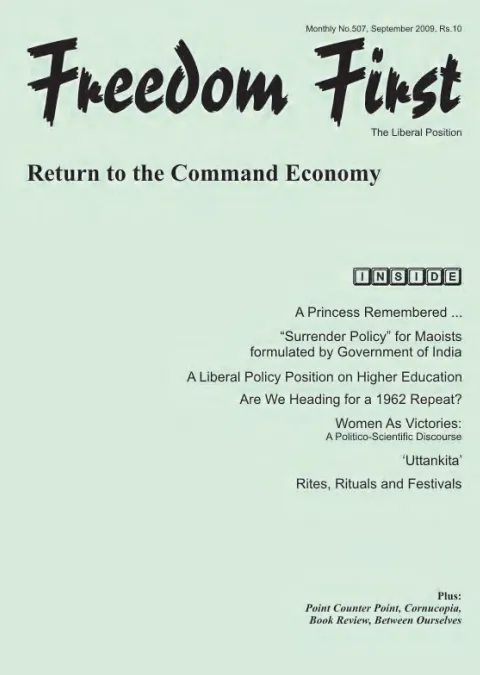
Return to the Command Economy
By D. R. Pendse
Freedom First · 2009
28 pages
Freedom First
Summary
The rendered pages show the September 2009 issue of Freedom First as a politically wide-ranging periodical issue. In these pages the issue opens by remembering Rajmata Gayatri Devi and reprinting her 1961 Swatantra Party speech, then moves through liberal economic criticism of the Union Budget, internal-security criticism of a proposed Maoist surrender policy, foreign-policy commentary on AfPak and India-Pakistan relations, higher-education privatization, defence preparedness against China, readers’ letters, gender and war, and an essay on Indian epigraphy.
Key points
-
A tribute to Rajmata Gayatri Devi reprints her 1961 speech announcing she had joined the Swatantra Party, in which she criticises rising taxes, cooperative farming, nationalisation, and broken promises to former princely rulers while defending citizens’ right to choose their political affiliation.
-
D. R. Pendse’s budget essay argues the 2009-10 Union Budget signals a return to command-economy habits, criticising the narrow electoral-trust mechanism for political funding, the 6.8% fiscal deficit, and a ritualistic Fiscal Responsibility and Budget Management Act that should be rescinded rather than ceremonially revived.
-
V. Balachandran argues the government’s proposed Maoist surrender policy will fail because it mistakes an ideological and social insurgency for a simple criminal-incentive problem, citing exploitation, caste hierarchy, and neglected villages as the true sustaining causes, illustrated by the Gangapur case where a road and direct engagement weakened Naxalite influence.
-
Ashok Karnik’s “Point Counter Point” is skeptical of US dependence on Pakistan under the AfPak policy, rebukes New York Times commentary urging India to concede more on trade and Kashmir, and criticises Indian media for magnifying national failures.
-
Sanjeev Sabhlok proposes a liberal policy for higher education in which the state exits ownership of institutions while retaining accreditation, selling public tertiary colleges and replacing subsidies with income-tax-linked loans for poor meritorious students.
-
E. D’Souza asks whether India risks repeating the 1962 war given renewed Chinese pressure around Tawang and NEFA, noting improved infrastructure and morale in Arunachal Pradesh but calling for stronger intelligence, logistics, and a Chief of Defence Staff.
-
Prasenjit Maiti’s essay on women and war argues that rape and sexualised violence are used to humiliate enemy communities, moving from epic examples to modern atrocities including comfort women, Vietnam, and Abu Ghraib, and calls for security-force sensitisation.
-
Gopal Krishna Gandhi’s review of the Uttankita Vidya Aranya epigraphy volume praises inscriptions as durable public communication and ancient equivalents of broadcasting, restoring primary sources to historical curiosity.
Essays
A Princess Remembered …
By Rajmata Gayatri Devi
The Gayatri Devi item combines an homage to the Rajmata with a reprint of her first speech after joining the Swatantra Party. The speech presents her move as a response to popular dissatisfaction, rising prices, taxation, cooperative farming, and threats to private property and princely commitments, while defending the right of citizens to choose their party.
- The opening tribute quotes C. Rajagopalachari praising Gayatri Devi’s courage.
- Gayatri Devi says she joined after thought, not impulse, because conditions in Jaipur and India made silence impossible.
- She criticizes taxes, rising costs, cooperative farming, nationalization, and broken promises to former rulers.
- The speech frames Swatantra as a party that respects the citizen’s right to choose political affiliation.
Return to the Command Economy
By D. R. Pendse
D. R. Pendse’s budget essay argues that the 2009-10 Union Budget signals a return toward command-economy habits. He welcomes partial transparency in political funding but says the electoral-finance proposal remains too narrow, then turns to fiscal deficit, warning that unchecked expenditure, ritualistic fiscal-responsibility promises, and praise for bank nationalization point away from reform.
- Pendse supports more transparent political funding but criticizes the electoral-trust mechanism and CBDT approval requirement.
- He treats the 6.8 percent fiscal deficit as a serious warning rather than a routine budgetary detail.
- He argues the FRBM Act has become ritualistic and should be rescinded rather than ceremonially revived.
- He contrasts the Economic Survey’s policy prescriptions with a budget he sees as politically uninterested in reform.
- He calls for public-policy institutions capable of building public support for reforms.
”Surrender Policy” for Maoists formulated by Government of India
By V. Balachandran
V. Balachandran argues that the Government of India’s proposed surrender incentives for Maoists will fail because they mistake an ideological, social, and administrative problem for a simple criminal-incentive problem. The rendered pages trace Naxalite roots in social inequality, local neglect, parallel governance, and staged revolutionary strategy, then argue that genuine development and responsive policing can weaken Naxalite control.
- The piece rejects the idea that fixed deposits and monthly payments can solve the Maoist/Naxalite insurgency.
- Balachandran emphasizes exploitation, caste hierarchy, poor administration, and neglected villages as sustaining causes.
- He distinguishes Indian Maoists from Nepali Maoists and stresses the Indian movement’s revolutionary ambition.
- The Gangapur case is used to show how a road and direct engagement weakened local Naxalite influence.
Point Counter Point
By Ashok Karnik
Ashok Karnik’s Point Counter Point offers paired arguments on AfPak policy, the New York Times’ criticism of India, and the outlook of non-resident Indians. The visible piece is skeptical of U.S. dependence on Pakistan, defensive of India’s security concerns after terrorism, and critical of Indian media habits that, in Karnik’s view, understate achievement and magnify national failures.
- Karnik warns that U.S. AfPak policy may pressure India while enabling Pakistan’s role in Afghanistan.
- He rebukes New York Times commentary that urges India to do more on trade, proliferation, Kashmir, and arms restraint.
- He says NRIs increasingly defend India’s achievements while Indian media often highlights failure.
- The piece closes by urging Indians to learn to take pride in themselves.
Essay 5
The short Kargil note, excerpted from Lt. Gen. Vijay Oberoi, asks why the tenth anniversary of Kargil Diwas passed with little fanfare. It argues that soldiers’ sacrifices should be publicly remembered and that the country needs to honor its military more deliberately.
- The note criticizes the lack of national attention to Kargil Diwas.
- It asks whether public nationalism has weakened or whether the government, military, or people should lead remembrance.
- It links honoring soldiers to national security, growth, and progress.
A Liberal Policy Position on Higher Education
By Sanjeev Sabhlok
Sanjeev Sabhlok’s higher-education article presents a liberal policy position in which the state exits ownership of higher-education institutions while retaining accreditation and anti-fraud regulation. He proposes selling public tertiary institutions, letting institutions set fees and courses, and replacing direct subsidy with income-tax-linked loans for poor meritorious students.
- Sabhlok says higher education is not a natural right and that subsidizing it can increase social inequality.
- He calls for government-owned tertiary institutions to be sold and converted into for-profit corporations.
- He proposes low-interest government loans, repaid through the tax system, for admitted students who need support.
- He argues competition will restrain fees and preserve liberal arts where they have commercial value.
Essay 7
The Education World excerpt criticizes Uttar Pradesh alphabet textbooks that use Bollywood star names, arguing that such materials signal misplaced education priorities and a broader cultural drift toward shallow celebrity imitation.
- The excerpt approves the government’s quick ban on the textbooks.
- It criticizes school materials that associate early literacy with film-star celebrity.
- It calls Bollywoodization a threat to cultural heritage.
Are We Heading for a 1962 Repeat?
By E. D’Souza
E. D’Souza asks whether India risks repeating 1962 in the face of Chinese pressure around Tawang and NEFA. The rendered pages combine warnings about China’s naval and border posture with a partial reassurance that infrastructure, military morale, and civil-military coordination in Arunachal Pradesh have improved, while still calling for stronger intelligence, logistics, counter-insurgency capacity, and defence planning.
- The article frames Tawang and NEFA as possible targets of renewed Chinese pressure.
- D’Souza revisits 1962 as a lesson in complacency, poor preparation, and ignored military advice.
- The author observes improved roads, accommodation, morale, and deployment in the sector.
- The piece calls for better infrastructure, early warning, Air Force readiness, and a Chief of Defence Staff.
Cornucopia
By Firoze Hirjikaka
Firoze Hirjikaka’s Cornucopia page begins with a comic personal essay about a medical check-up, diet advice, and the misery of giving up favorite foods. The same page then begins an Indo-Pak tensions essay arguing that after the 26/11 attacks India behaves like a defendant rather than the injured party, while Pakistan keeps asking for evidence and India keeps complying.
- The humor piece turns routine medical advice into a comic lament about aging, diet, and domestic discipline.
- The Indo-Pak section criticizes India’s diplomatic posture after 26/11.
- The Indo-Pak section says Pakistan is treated too deferentially despite acknowledged links to the attackers.
From Our Readers
The readers’ page contains letters responding to earlier Freedom First pieces on madrasas and burqas, plus a short verse on Sharm-el-Sheikh. The letters are polemical, questioning Muslim institutions, partition history, purdah, and the government’s handling of dialogue and terror.
- S. C. Panda’s letter criticizes madrasas, Muslim leadership, partition history, and the Sachar Committee discourse.
- Brigadier Suresh Chandra Sharma’s letter argues that burqua and purdah deny women’s freedom.
- Sadanand B. Kumta’s verse criticizes the Sharm-el-Sheikh statement and dialogue sequencing.
Women As Victories: A Politico-Scientific Discourse
By Prasenjit Maiti
Prasenjit Maiti’s essay treats women as both physical victims and symbolic targets in war. He argues that rape and sexualized violence are used to humiliate enemy communities and destroy morale, links these patterns to mythic and modern examples, and calls for civil-society, human-rights, peace, and academic institutions to make women-and-war a central humanitarian issue.
- Maiti argues that wartime violence against women attacks both bodies and collective dignity.
- He moves from epic examples to modern atrocities, including comfort women, Vietnam, Abu Ghraib, and disturbed areas in India.
- The essay says women face double jeopardy as persons and as symbols of male/community honor.
- It calls for security-force sensitization and broader institutional engagement with women-and-war.
‘Uttankita’
By Gopal Krishna Gandhi
Gopal Krishna Gandhi’s ‘Uttankita’ reflects on inscriptions as durable public communication, historical evidence, and a link between ancient administration and present concerns. In the rendered pages he praises the Uttankita Vidya Aranya volume, explains how inscriptions make authority legible, and reads them for ecological, bureaucratic, sociological, and land-related continuities across centuries.
- The essay explains ‘uttankita’ as inscribed, incised, graven, or cast in stone.
- Gandhi describes inscriptions as ancient equivalents of public broadcasting without commercial interruption.
- He praises epigraphic scholarship for restoring primary sources to wider historical curiosity.
- The rendered portion contrasts ecological abundance and land-based administration in old inscriptions with modern conditions.
Generated by the v1.5 extraction pipeline. Awaiting editorial review.
Rites, Rituals and Festivals
No summary was extracted for this article. Listed for completeness.
Book Review
No summary was extracted for this article. Listed for completeness.
Metadata and summary are AI-extracted from the source PDF and reviewed for editorial accuracy. The original work is available via the Read PDF tab above (where present); paragraph-level citation inside the PDF is deferred to a future engagement.