periodical issue
Freedom First
The Liberal Magazine
Publishers: Indian Committee for Cultural Freedom (ICCF), 3rd Floor, Army & Navy Building, 148, Mahatma Gandhi Road, Mumbai 400 001. · Mumbai · 2010
40 pages
Freedom First
Summary
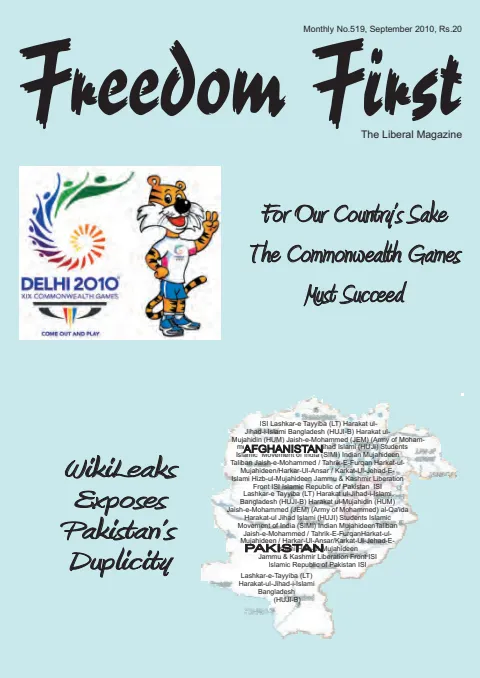
The rendered pages show the September 2010 issue of Freedom First, a liberal periodical issue framed by a cover on the Delhi 2010 Commonwealth Games and WikiLeaks’ disclosures about Pakistan. After an editorial note and reader letters, the issue moves through obituaries, public accountability, foreign policy, food inflation, political ethics, and parliamentary compensation. Its argumentative center in these pages is civic vigilance: the contributors repeatedly ask how public institutions, politicians, and citizens should behave when national prestige, public money, security, or justice are at stake.
Key points
-
Ashok Karnik’s article on the XIX Commonwealth Games argues that allegations of mismanagement and corruption are serious but urges readers not to let media spectacle and political score-settling undermine the Games before they occur, comparing India’s anxieties to South Africa’s pre-World Cup doubts.
-
Firoze Hirjikaka reads the WikiLeaks Afghanistan documents as evidence the United States knowingly tolerated Pakistan’s double game of receiving aid while its intelligence networks aided the Taliban and Al Qaeda, concluding that expediency governs both war and politics.
-
Neelakant Patri criticises Sharad Pawar’s food ministry for failing to protect consumers from rising food prices, blaming administrative failures, hoarding, and poor storage rather than natural scarcity.
-
M. B. Damania uses the Bhopal/Union Carbide controversy to question the public appetite for scapegoats, contrasting Satish Dhawan’s handling of an ISRO failure with demands for punishment after Bhopal and arguing accountability should distinguish negligence from criminal intent.
-
Vinay Hardikar’s tribute to S. H. Deshpande presents him as a Marathi liberal economist and public intellectual who connected Hindutva, democracy, and social development without becoming a partisan ideologue.
-
Sharad Bailur opposes a proposed salary hike for Members of Parliament, arguing for a transparent, market-valued compensation package stripped of hidden perks rather than raising salaries alone.
-
A tribute to novelist and liberal candidate Manohar Malgonkar accompanies a reprinted 1964 article defending the constitutional promises made to Indian princes against the abolition of privy purses.
-
Ashok Karnik’s “Point Counter Point” weighs scientific versus customary claims about khap panchayat authority over gotra marriage rules, and debates whether television coverage of communal violence amplifies political hooliganism.
Essays
Between Ourselves
“Between Ourselves” is an editorial housekeeping note that apologizes for proofreading errors in the August issue, especially misprints in B. P. Rastogi’s letter. It also reports rising interest in the soft-copy edition, notes discussions in Mumbai and Srinagar, and asks readers to renew subscriptions and help circulate the magazine.
- The editor apologizes for errors that changed the sense of a reader’s letter.
- The note says Freedom First’s soft copy has expanded readership beyond the printed circulation.
- The magazine asks readers to renew subscriptions and help find new subscribers.
Dr. S. H. Deshpande, R.I.P.
By Vinay Hardikar
Vinay Hardikar’s tribute to S. H. Deshpande presents him as a Marathi liberal intellectual, economist, teacher, researcher, and public writer whose work joined scholarship with civic concern. The article stresses Deshpande’s linguistic and cultural range, his roots in Maharashtra’s reformist and nationalist intellectual world, and his effort to connect Hindutva, democracy, liberalism, and social development without surrendering analytical independence.
- Deshpande is remembered as a teacher, economist, public speaker, writer, and rigorous critic.
- The tribute links him to Marathi intellectual life, Sanskrit learning, Hindustani music, and social reform circles in Poona.
- His work is described as spanning development studies, political Hindutva, memoir, and literary reflection.
- Hardikar emphasizes Deshpande’s warmth, independence, humour, and refusal to become a partisan ideologue.
From Our Readers
“From Our Readers” gathers letters on the magazine’s silver-jubilee editing, support for Freedom First, Tibet, Ooty’s Tibetan sweater sellers, and political ethics. The letters criticize India’s China policy, defend Tibetan self-determination, complain about corruption and poor local governance, and urge voters to reject politicians who rely on personal attacks and factional intrigue.
- Readers praise and financially support the magazine’s continued publication.
- A Tibetan memorandum asks India to review its policy and recognize Tibet’s historical independence.
- A Nilgiris letter criticizes neglect of Tibetan vendors, Ooty infrastructure, and corruption.
- A Chennai letter warns that personal political attacks damage democratic culture.
XIX Commonwealth Games
By Ashok Karnik
Ashok Karnik’s article on the XIX Commonwealth Games argues that the Delhi Games had become a national prestige issue amid allegations of mismanagement, corruption, shoddy construction, and official buck-passing. Karnik does not deny the seriousness of the accusations, but urges readers not to let factional attacks, media spectacle, or political score-settling undermine the Games before they occur.
- The article lists public fears about unfinished stadiums, leaks, road cave-ins, procurement, and organizing failures.
- Karnik argues that responsibility was being blurred across agencies while Kalmadi and the organizing committee became easy targets.
- He frames the Games as a national test and compares India’s anxieties with South Africa’s pre-World Cup doubts.
- The page also carries a separate anonymous note criticizing secretive government treatment of military accountability.
The Afghanistan Papers
By Firoze Hirjikaka
Firoze Hirjikaka reads the WikiLeaks Afghanistan documents as evidence that the United States knowingly tolerated Pakistan’s double game: receiving American aid and logistical dependence while its intelligence networks aided the Taliban and Al Qaeda. The article argues that Washington’s need for supply routes and a face-saving exit strategy led it to soften public criticism of Pakistan while leaving Afghanistan’s elected government vulnerable.
- The article treats the leaked documents as important even if illegally obtained.
- It claims Pakistan’s military intelligence maintained links with Taliban and Al Qaeda networks.
- It argues that U.S. dependence on Pakistan for supply routes and withdrawal planning muted American pressure.
- It concludes that in war and politics the only ethics that apply are expediency and self-interest.
Freedom First: This Month in September 1953
“Freedom First: This Month in September 1953” recounts the formation of the Indian Committee for Cultural Freedom’s monthly bulletin and sketches early debates around autonomy for radio and commercial broadcasting. The piece positions Freedom First as an instrument for liberal, anti-totalitarian public education and intellectual networking in the early years after independence.
- The first issue of the bulletin was published in September 1953 after ICCF discussions.
- The note says the bulletin was intended to inform readers about Communism, totalitarianism, and the ICCF’s activities.
- It excerpts arguments about radio autonomy and private commercial broadcasting.
Food Inflation and Sharad Pawar
By Neelakant Patri
Neelakant Patri’s article criticizes Sharad Pawar’s food and consumer affairs ministry for failing to protect consumers from rising food prices. Patri argues that inflation was worsened by administrative failures, hoarding, procurement policy, wastage, poor storage, and confused price controls rather than by natural scarcity alone.
- The article says Pawar should have paid greater attention to consumers instead of sport politics.
- It criticizes fuel-price policy, food subsidies, procurement prices, and weak distribution systems.
- It disputes the claim that the inflation problem was purely structural or unavoidable.
- It cites storage failures and wheat sales policy as examples of avoidable mismanagement.
We Want Their Blood!
By M. B. Damania
M. B. Damania uses the Bhopal/Union Carbide controversy to question the public appetite for scapegoats and vengeance. Moving from A. P. J. Abdul Kalam’s story about a failed satellite launch to air crashes, railway accidents, industrial liability, and Warren Anderson’s return to Bhopal, the article argues that accountability should distinguish negligence, systems failure, cooperation, and criminal intent.
- The essay opens with the management principle that leaders bear responsibility for organizational failure.
- It contrasts Satish Dhawan’s handling of an ISRO failure with demands for punishment after Bhopal.
- It argues that public outrage and media pressure often obscure legal standards and proportional responsibility.
- It suggests Union Carbide’s voluntary compensation should have been treated as cooperation rather than proof of criminal guilt.
Point Counter Point
By Ashok Karnik
Ashok Karnik’s “Point Counter Point” offers paired arguments on gotra and khap panchayats, Indo-Pak talks, and media/political reactions to violence. The format deliberately presents competing views rather than a single settled position, though the selections repeatedly return to evidence, institutional restraint, and the hazards of either romanticizing custom or rushing into performative outrage.
- The gotra section contrasts scientific and customary claims about kinship, marriage, and khap authority.
- The Indo-Pak section weighs dialogue against distrust after repeated Pakistani hostility.
- The final section considers whether television attention to attacks amplifies political hooliganism.
A Tribute to Manohar Malgonkar
The Malgonkar page combines an obituary note with a reprinted 1964 Freedom First article, “Extinction Through Accession.” The obituary remembers Manohar Malgonkar as a soldier, hunter, novelist, historian, and liberal candidate; the reprint criticizes the Indian state’s handling of princely privy purses and argues that legal rights and constitutional promises were being sacrificed to political impatience and envy.
- The memorial note places Malgonkar among soldiers, hunters, historians, and liberal political writers.
- The reprinted article defends constitutional promises made to Indian princes after accession.
- Malgonkar frames the privy-purse issue as an attack on legality, property, and honorable public commitments.
Salaries and Perks of Members of Parliament
By Sharad Bailur
Sharad Bailur’s article opposes a proposed salary hike for Members of Parliament by asking readers to calculate MPs’ full “Cost to the Nation” rather than salary alone. Drawing on older parliamentary debates and private-sector compensation logic, Bailur argues that MPs may deserve good pay, but only through a transparent package stripped of hidden perks and accompanied by enforceable rules against disorder and corruption.
- The article lists salaries, allowances, housing, travel, staff, security, phones, medical benefits, and other perks.
- It invokes earlier parliamentary debates that treated modest compensation as a public duty in a poor country.
- Bailur proposes replacing hidden benefits with a transparent market-valued compensation package.
- The essay ends by linking compensation to discipline, lawful conduct, and public accountability.
Generated by the v1.5 extraction pipeline. Awaiting editorial review.
Metadata and summary are AI-extracted from the source PDF and reviewed for editorial accuracy. The original work is available via the Read PDF tab above (where present); paragraph-level citation inside the PDF is deferred to a future engagement.