periodical issue
Freedom First
The Liberal Magazine
By Sharad Joshi
Publishers: Indian Committee for Cultural Freedom (ICCF), 3rd Floor, Army & Navy Building, 148, Mahatma Gandhi Road, Mumbai 400 001. Published by J. R. Patel for the Indian Committee for Cultural Freedom (ICCF) and printed by him at Union Press, 13 Homji Street, Fort, Mumbai 400 001. · Mumbai · 2010
44 pages
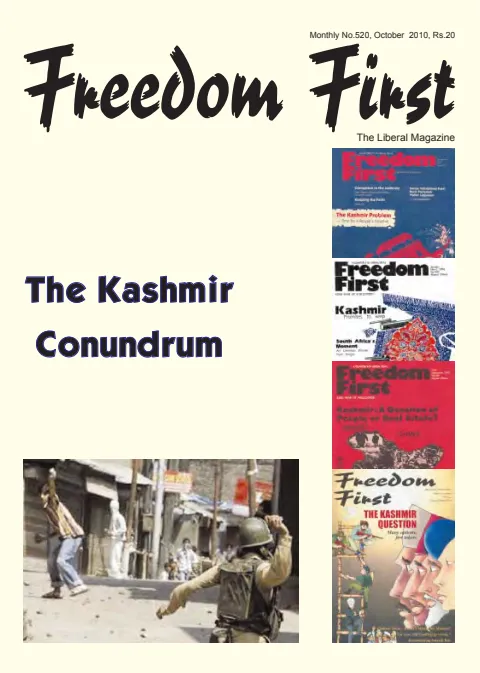
Freedom First
Summary
The rendered pages show the October 2010 issue of Freedom First, organized around a cover feature on Kashmir and framed by editorial notes, memorial tributes, reader correspondence, and a report from the North East. The editor’s opening note corrects an earlier subtitle error, explains the issue’s commemorative tone after recent deaths, and states Freedom First’s liberal position on Kashmir: the wishes of the people of Jammu and Kashmir should be ascertained, but law and order and the end of terrorism are preconditions for any next step.
Key points
-
The editor’s note states Freedom First’s position on Kashmir: the wishes of the people of Jammu and Kashmir should be ascertained, but law and order and the end of terrorism are preconditions for any next step.
-
The Kashmir cover feature, based on a Mumbai seminar, presents Ashok Karnik’s argument that separatist demands escalate with each concession, that ‘azaadi’ rather than unemployment is the agitators’ real demand, and that India should restore control and ‘wait it out’ rather than seek a quick settlement, warning that plebiscite logic could revive the two-nation theory.
-
Firoze Hirjikaka’s intervention in the Kashmir seminar challenges conventional wisdom by suggesting India might let the Valley go or use that possibility to negotiate from strength, while V. Balachandran distinguishes externally sponsored insurgency from domestic law-and-order problems and criticises media overexposure of Kashmir compared with Manipur.
-
Eustace D’Souza’s account of his 2010 visit to the North East rejects alarmist claims of poor Army morale and equipment scarcity, describing effective road development, schools, and interreligious integration in units stationed in Arunachal Pradesh and Manipur.
-
Memorial tributes remember businessman and philanthropist Jamshed N. Guzder and political science teacher Professor Aloo J. Dastur, an opponent of the Emergency and champion of minority rights and secular liberalism.
-
Reader letters reject the idea that Commonwealth Games prestige should suppress corruption allegations, arguing national prestige depends more on reducing poverty and illiteracy than on expensive spectacles.
-
Ram Narayanan’s column collects an email exchange between Mahendra Dave and Irfan Hussain contrasting Pakistan’s religious-state politics with India’s secular framework, alongside an Afghan national security adviser’s excerpt on the need for clarity about state sponsors of terrorism.
Essays
Between Ourselves
The opening editorial note, “Between Ourselves…,” combines house notices with the issue’s political framing. It apologizes for an error in the September issue, notes Freedom First’s recurring memorialization of public figures whom the editor believes the mainstream media overlooked, and introduces the Kashmir cover feature as a seminar report rather than a closed editorial verdict. The note affirms self-determination as an old Freedom First commitment while insisting that violence and disorder must first be stopped.
- Corrects a September issue subtitle error involving Sadanand Kumta’s article on Karnataka.
- Explains why the issue includes memorial tributes to Jamshed Guzder and Professor Aloo Dastur.
- Reasserts Freedom First’s earlier support for ascertaining the wishes of Jammu and Kashmir’s people.
- Pairs that liberal position with a rule-of-law insistence that terrorism and violence must end before a referendum or plebiscite can be considered.
In Memoriam
The memorial section honors two recently deceased figures. S. V. Raju’s tribute to Jamshed N. Guzder presents him as a successful businessman who remained simple, humane, and unusually generous, emphasizing his philanthropy, support for poor and needy people, and concern for the Zoroastrian community. R. Srinivasan’s tribute to Professor Aloo J. Dastur portrays her as a formative political science teacher, a secular liberal, an opponent of the Emergency, and a public intellectual who championed minority rights while refusing communal or regional loyalties.
- Guzder is praised for combining business success with philanthropy and personal accessibility.
- The tribute links Guzder’s social concern to his mother and to his trusts for medical, educational, and other assistance.
- Dastur is described as a pioneer in political science teaching at Bombay University and related institutions.
- Dastur’s opposition to the Emergency and her work on minority rights are presented as expressions of democracy, liberalism, and secularism.
From Our Readers
The reader correspondence page mixes praise for Freedom First with pointed public criticism. Letters on the Commonwealth Games reject the idea that prestige should suppress corruption allegations, arguing that national prestige depends more on reducing poverty and illiteracy than on expensive spectacles. Other letters mourn sociologist Dhiren Narain and recall General K. S. Thimayya’s reported grief over being ordered to stop military action in Kashmir in 1961.
- Two readers praise Freedom First and the ICCF for continuing the magazine.
- A Commonwealth Games letter argues that scams must be exposed, not hidden for prestige.
- Christie Davies remembers Dhiren Narain as a major influence on his understanding of India.
- A Kashmir-related letter blames Nehru’s reference of the dispute to the UN Security Council.
The Kashmir Conundrum
The Kashmir cover feature opens by revisiting Freedom First’s older support for Kashmiri self-determination, then asks whether that stance still holds after Pakistan’s role, the rise of Islamist militancy, and renewed stone-pelting violence. Ashok Karnik’s paper argues from an administrator’s standpoint that separatist demands escalate with each concession, that “azaadi” rather than unemployment is the real demand of the agitators, and that India should restore control, distinguish militants from ordinary Kashmiris, and “wait it out” rather than seek a quick settlement. He warns that plebiscite logic could revive the two-nation theory and have consequences for the North East.
- The feature frames the September 4 Mumbai seminar as a frank discussion on Kashmir and liberal principle.
- Karnik argues that autonomy and self-rule demands mask secessionist aims and that violence is used strategically to produce martyrs and pressure the state.
- The article contrasts Kashmir with Palestine, Tibet, Northern Ireland, Manipur, and other conflicts to argue against hasty concessions.
- Firoze Hirjikaka’s intervention challenges conventional wisdom by suggesting that India might let the Valley go or use that possibility to negotiate from strength.
- V. Balachandran’s remarks distinguish externally sponsored armed insurgency from domestic law-and-order problems and criticize media overexposure of Kashmir compared with Manipur.
The Troubled North East Revisited
By Eustace D’Souza
Eustace D’Souza’s “The Troubled North East Revisited” responds to alarmist magazine coverage about the Indian Army by narrating his 2010 visit to NEFA, Assam, Arunachal Pradesh, and Manipur. He finds logistical and security challenges, especially in counter-insurgency areas and border zones, but rejects claims of poor morale, second-hand clothing, equipment scarcity, or unfit soldiers. The article stresses road development, environmental care, local education, religious inclusion in army stations, and the role of army units in building goodwill with local communities.
- D’Souza revisits the North East to test claims that the army there suffers from poor morale, inadequate equipment, and strategic weakness.
- He describes Arunachal Pradesh’s roads, forests, schools, and Raj Bhavan initiatives as signs of civic and administrative effort.
- His army-unit visits emphasize good physical condition, adequate clothing and rations, high morale, and interreligious integration.
- The Manipur section notes porous borders with Bangladesh and Myanmar, ULFA-related networks, and counter-insurgency strain, but still praises unit effectiveness.
Ram Narayanan Draws the Attention of Freedom First Readers to ..
By Ram Narayanan
The rendered start of “Ram Narayanan Draws the Attention of Freedom First Readers to:” collects forwarded material rather than a single essay. It opens with an email exchange between Mahendra Dave and Irfan Hussain on Jinnah and secularism, in which Dave argues that Pakistan’s religious-state foundations and blasphemy laws contrast with India’s secular framework, while Hussain replies that India-Pakistan comparison is not valid because Pakistan has descended into religion-fuelled chaos. The page then advertises a U.S. conference on mitigating rural poverty in India and begins excerpts from an Afghan national security adviser’s article on terrorism, Pakistan, and the need for clarity about friends and foes.
- Mahendra Dave rejects praise for Jinnah’s late secularism and contrasts Pakistan’s religious politics with India’s secular legal order.
- Irfan Hussain replies briefly that Pakistan is in a religion-fuelled crisis and cannot be compared with India.
- The page announces an India Development Coalition of America conference on rural poverty, microfinance, and education.
- The Afghan security excerpt argues that terrorism in the region is internationally enabled and that state sponsors must be confronted.
Generated by the v1.5 extraction pipeline. Awaiting editorial review.
Metadata and summary are AI-extracted from the source PDF and reviewed for editorial accuracy. The original work is available via the Read PDF tab above (where present); paragraph-level citation inside the PDF is deferred to a future engagement.