
periodical issue
Freedom First
The Liberal Magazine
Published by J. R. Patel for the Indian Committee for Cultural Freedom (ICCF) and printed by him at Union Press, 13 Homji Street, Fort, Mumbai 400001. · Mumbai · 2013
40 pages
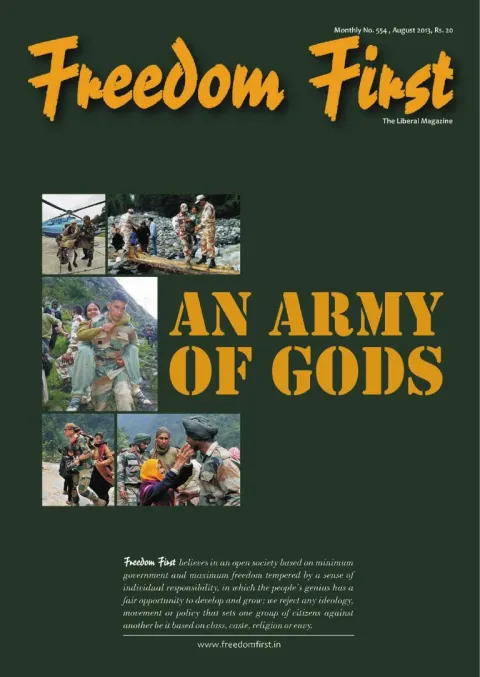
Freedom First
Summary
The August 2013 issue of Freedom First opens on the mid-day meal deaths at Saran, which the editor takes as the plainest case of a disaster waiting to happen: children dying of food poisoning in a state-funded scheme, while organisations that feed 1.3 million children safely go unmentioned.
The issue marks the thirty-eighth anniversary of the Emergency with Kuldip Nayar’s reminder that nobody found guilty of its excesses was punished, and that four of five Supreme Court judges justified it. Suresh C. Sharma reports the Uttarakhand flood disaster and the armed forces’ rescue; Sunil S. Bhandare traces the rupee’s 24 per cent depreciation under UPA II to domestic and external imbalances rather than global factors; B. Ramesh Babu reads the fourth India-US Strategic Dialogue as convergence in the abstract and conflict in the particular. R. G. Gidadhubli reports Freedom House on the twenty-nine nations in transit and Putin’s law on foreign agents, and Saratchandra C. Panda takes issue with the essay on secularism in Amartya Sen’s The Argumentative Indian. The issue carries an obituary of Dr. Rustom C. Cooper, a review of the Yerrangadu Arboretum, the fourteenth part of the Right to Education series, and a short story set in the Uttarakhand catastrophe.
Key points
-
The editorial sets the twenty-three children killed by a mid-day meal in Saran beside a string of similar reports from Goa, Neyveli, Dhenkanal and Solapur, and against them the Akshaya Patra Foundation’s 1.3 million meals a day, to argue that the failure is in the corrupt politician and NGO axis rather than in feeding children.
-
Kuldip Nayar’s Emergency piece records that no one guilty of the excesses was punished, that some of them now hold office, and that four of the five Supreme Court judges hearing the challenge, Justice H. R. Khanna excepted, upheld it.
-
Sunil S. Bhandare shows the rupee steady through UPA I, from 45.94 to the dollar in 2003-04 to 45.92 in 2008-09, and heading past 60 in 2013-14: a cumulative depreciation of about 24 per cent that he attributes to a combined fiscal deficit above 7 per cent of GDP rather than to forces beyond the government’s control.
-
Suresh C. Sharma’s report on the 16 June cloudburst above Kedarnath describes dams opened at Vishnuprayag and Srinagar to save them from bursting, villages left with only women and children, and rescue carried out by the armed forces where the civil administration was absent.
-
B. Ramesh Babu, writing after John Kerry’s visit, argues that India and the United States converge at the level of concept and diverge at the level of the concrete, and that holding relations on their present high plateau is itself an achievement.
-
R. G. Gidadhubli reports the Freedom House survey of twenty-nine post-socialist states: Russia’s 2012 law requiring foreign-funded NGOs to register as foreign agents, some 300 organisations inspected since March 2013 and nineteen so classified, and the suspension of the election monitor Golos.
-
Saratchandra C. Panda’s reply to Amartya Sen argues that Indian secularism has emphasised neutrality between religions rather than separation of state from religion, and questions Sen’s use of Akbar and Ashoka as its ancestry.
-
Firoze Hirjikaka’s Cornucopia calls Narendra Modi’s elevation the biggest gamble of his political life, noting the BJP’s near absence from the south, the north-east and Uttar Pradesh, and the loss of Nitish Kumar’s party from the NDA.
Essays
Lest We Forget the ‘Emergency’
By Kuldip Nayar
Nayar returns to the night of 26 June 1975, when the Constitution was suspended, the press gagged and the government turned into an authority for detaining its critics, all because a Prime Minister unseated for a poll offence chose to change the system rather than appeal against the judgment. His indictment falls hardest on the judiciary: four of five Supreme Court judges justified the Emergency and the one who did not, Justice H. R. Khanna, was superseded. He contrasts Indira Gandhi’s conduct with her father’s when Nehru considered and abandoned a supersession of his own.
- Records that no one found guilty of Emergency excesses was punished, and that some hold office still.
- Argues the judiciary has never fully recovered from the blows of those months.
- Uses the anniversary to insist that certain dates should not be allowed to fade.
The Uttarakhand Disaster: Armed Forces to the Rescue, Yet Again
By Suresh C. Sharma
Sharma reconstructs the June 2013 flood from the cloudburst at Vasukital above the Kedarnath valley through the opening of the Vishnuprayag and Srinagar dams to the inundation of four districts. Telephone networks failed, pilgrims at Badrinath had shelter but no way out, and in Ghat Gaon the men were washed away retrieving belongings, leaving a village of women and children. The rescue, in his account, belonged to the soldiers who carried the old on their backs.
- Follows the first warnings from an inspector who saw the Mandakini rising at Gaurikund.
- Records the absence of relief or guidance from the state government in the surrounding villages.
- Credits the defence and paramilitary forces with taking charge of an evacuation nobody else could run.
Implications of the Falling Rupee
By Sunil S. Bhandare
Bhandare returns to the Report Card he examined in the previous issue and to what it left out: the management of the external sector. He sets the rupee’s steadiness through UPA I against a depreciation of about 24 per cent under UPA II, and identifies three forces at work, deteriorating fundamentals, an unsteady market position, and speculative pressure, resting on a combined central and state fiscal deficit above 7 per cent of GDP and its mirror image in the current account.
- Quotes the RBI Governor attributing the fall to global factors, and disputes it.
- Traces the domestic imbalance to fiscal deficits sustained over three years.
- Argues that a market economy will not let policy failure stay concealed.
India-US Relations Today: Kerry Comes a-Calling
By B. Ramesh Babu
Written after the fourth India-US Strategic Dialogue of June 2013, the essay measures the rhetoric of “common DNA” and “natural allies” against the record of two estranged democracies that became engaged ones after the Soviet collapse. Ramesh Babu’s formula is that convergence rises at the conceptual level and conflict at the concrete: nuclear questions, H-1 visas, free trade against fair trade, and the place of the Taliban in Afghanistan’s future.
- Notes that consolidation on a high plateau is itself an achievement in a relationship of this kind.
- Argues that neither government is ready to take the next step at present.
- Dates the paradigm shift to the demise of the Soviet Union.
Freedom House Questions Freedom in ‘Nations in Transit’
By Dr. R. G. Gidadhubli
Gidadhubli reports the June 2013 Freedom House survey of twenty-nine former socialist states and finds the transition to open democratic societies going the other way. Most of the essay concerns Russia: the law Putin signed within a month of taking office requiring foreign-funded NGOs to register as foreign agents, the “random checking” law of June 2013, roughly 300 inspections since March, nineteen organisations branded, and a human rights group evicted from state premises.
- Notes the dispute over branding organisations that take 5 per cent of their budget from abroad alongside those taking 80 per cent.
- Records the six-month suspension of the election monitor Golos, which had stopped accepting foreign money.
- Concludes that the West’s expectations of the transition have not been met, and that Putin’s roadmap carries its own risks.
On Secularism
By Saratchandra C. Panda
Panda replies to “Secularism and its Discontents” in Amartya Sen’s The Argumentative Indian. He accepts Sen’s two definitions, neutrality between religions and the separation of state from religion, and argues that Indian practice has taken the first while calling it the second. He also disputes particulars, including the use of Tansen as an example of Akbar’s Hindu court, and asks whether symmetrical treatment means much in a population divided about 80 to 15.
- Works from dictionary and philosophical definitions before turning to the Indian case.
- Argues that Sen should have examined the philosophies behind Ashoka and Akbar rather than the two rulers themselves.
- Raises the question of what neutrality requires when communities are of very unequal size.
Modi’s Big Gamble
By Firoze Hirjikaka
The Cornucopia column reads Narendra Modi’s elevation as a wager rather than a coronation: a party with next to no presence in the south, the north-east or Uttar Pradesh, an ally lost in Nitish Kumar, and a candidate without the political capital to survive defeat. Hirjikaka also doubts that the big scandals move voters, arguing that it is the petty corruption of daily officialdom that touches people, and that governing Gujarat without an opposition is not the same as governing India.
- Argues there will be no second chance for Modi if 2014 is lost.
- Holds that 2G, the Commonwealth Games and Coalgate gave the public spectacle rather than injury.
- Blames the BJP’s disruption of Parliament for part of the economic paralysis it attacks the government over.
The Right to Education Act (14): Education of Children with Disabilities
By Suresh C. Sharma
The fourteenth part of the series takes up the question the Act does not settle: whether children with disabilities are better served in ordinary schools or in special ones. Sharma treats it as an open question the world over rather than one India has answered, and reads the Act’s provisions against what schools can actually deliver.
- Sets inclusion against specialist provision as the central choice.
- Notes that the debate is unresolved internationally, not only here.
- Continues the magazine’s running audit of the Act’s implementation.
Elsewhere in the issue
- An obituary of Dr. Rustom C. Cooper (1922-2013), accountant, former non-executive chairman of the Times of India group and president of the Indian Merchants’ Chamber, recalling his hesitation about serving as general secretary alongside Masani and the evening he took his misgivings to Rajaji.
- Point Counter Point, Ashok Karnik’s column, on Ishrat Jahan again, the Kashmir problem and Gopinath Munde’s bluster.
- S. Viswanathan’s review of Yerrangadu Arboretum by M. Murugesan, Lalitha Vijayan and V. S. Vijayan, on the arboretum raised from barren land south of Chennai by C. Ramakrishna and K. P. Geethakrishnan.
- “The Age of Darkness”, a short story by Dr. Ishita Marwah set against the Uttarakhand catastrophe.
- Nostalgia: Freedom First in August 1956, edited by V. B. Karnik.
Generated by the v1.5 extraction pipeline. Awaiting editorial review.
Metadata and summary are AI-extracted from the source PDF and reviewed for editorial accuracy. The original work is available via the Read PDF tab above (where present); paragraph-level citation inside the PDF is deferred to a future engagement.