
periodical issue
Freedom First
The Liberal Magazine
By Sunil S. Bhandare, Sharad Joshi, T. H. Chowdary
Published by J. R. Patel for the Indian Committee for Cultural Freedom (ICCF) and printed by him at Union Press, 13 Homji Street, Fort, Mumbai 400001. · Mumbai · 2013
44 pages
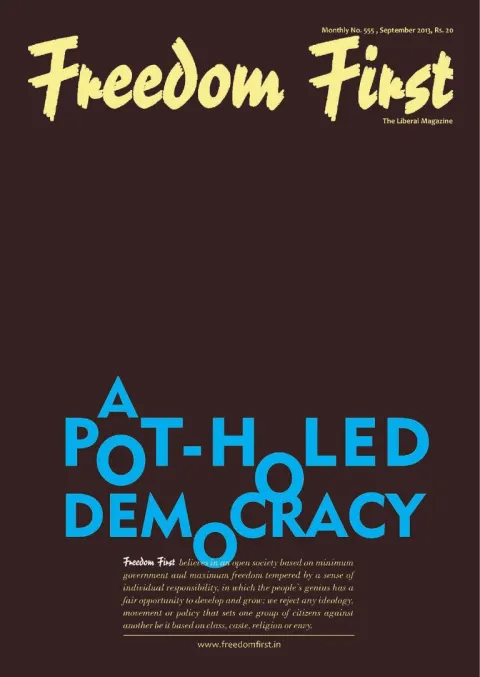
Freedom First
Summary
The September 2013 issue opens the magazine’s 62nd year, and its editorial opens on the murder of Dr. Narendra Dabholkar, shot on a morning walk in Pune, with a fuller account promised for October. The editor’s survey of the rest is bleak: mal-governance sustained by the arithmetic of survival until 2014, a rupee he expects to reach 80 to the dollar, and economic policy in reverse gear.
Two pieces follow the ambush at Poonch, Brig. S. C. Sharma calling it armed aggression rather than infiltration and Firoze Hirjikaka reading it as an incident engineered to foreclose dialogue. T. H. Chowdary and Yalamanchili Sivaji take opposite vantage points on the creation of Telangana, and V. G. Vaidya writes on the treatment of civil servants in Uttar Pradesh. Sunil S. Bhandare asks whether 1991 is returning and sets the macro-economic parameters of the two moments side by side; Sharad Joshi reads the politics of the poverty line back through Garibi Hatao; B. Ramesh Babu traces the passage from national security to human security. The issue closes with a four-part reckoning with the Uttarakhand catastrophe and an obituary of the naturalist Zafar Futehally.
Key points
-
The editorial records the assassination of Dr. Narendra Dabholkar, founder of the Andhashraddha Nirmoolan Samiti, killed in Pune in broad daylight, and warns that the demand for statehood on the Telangana model is spreading, with a second States Reorganisation Commission already spoken of.
-
Brig. S. C. Sharma’s report on the killing of five soldiers of the Bihar Regiment at the Sarla post gives the numbers behind it: ceasefire violations rising, thirty-seven security personnel killed in 2013 against seventeen the year before, and intelligence of 250 militants waiting at forty-seven launch pads.
-
Firoze Hirjikaka reads the same incident politically, arguing that the Pakistan army engineers such transgressions precisely to thwart dialogue, and that the Defence Minister’s statement was distorted into a clean chit it never gave.
-
T. H. Chowdary argues that the reorganisation of Andhra Pradesh will not end with Telangana, and that the Congress has again conceded only to militant agitation; Yalamanchili Sivaji traces the claim back to the Sribagh pact of 1937 and asks for a blueprint for the development of all three regions.
-
Sunil S. Bhandare takes Arvind Panagariya’s estimate of a 10 to 20 per cent chance of another 1991 and tests it against the record, tabulating the key macro parameters of 1989-92 beside 2011-14 and attributing the deceleration to policy confusion rather than to the world outside.
-
Sharad Joshi reads the poverty line through the politics that produced it, from Garibi Hatao in 1971 and the abolition of the privy purses to the argument that wealth is not a vice because it widens the range of choices available to rich and poor alike.
-
B. Ramesh Babu’s essay on the passage from national security to human security opens with Gurajada Appa Rao’s line that a country means its people, not its soil, and dates the end of the politics of fear to the close of the cold war.
-
Dr. Justice A. K. Rajan reads the National Water Policy of 2012 as an affront to federalism, setting it against Entry 17 of the State List and the narrow opening that Entry 56 of the Union List provides.
Essays
Shoot Out at Poonch
By Brig. S. C. Sharma
About twenty Pakistani soldiers of a Border Action Team ambushed an Indian patrol at the Sarla post on 6 August and killed five men of the Bihar Regiment. Sharma’s case is that this is a campaign rather than a series of accidents: infiltration and ceasefire violations are rising, casualties run two security personnel to one militant, and the argument that the violence would subside if India stopped foiling infiltration is contradicted by the figures.
- Gives incursion and casualty counts for 2011 through 2013.
- Reports intelligence of 250 militants ready at forty-seven launch pads.
- Reviews what previous rounds of talks with Pakistan have actually produced.
Politics of an Incursion
By Firoze Hirjikaka
Hirjikaka turns from the ambush to the reaction: politicians at their most opportunistic and television at its most inflammatory. He argues that the Pakistan army stages such incidents whenever dialogue threatens to yield a prosperity dividend that would expose its game, and defends the Defence Minister’s original statement, which described militants accompanied by men in Pakistani uniform and was misrepresented as absolution.
- Separates the incident’s gravity from the coverage it received.
- Reads army interference as the standing obstacle to India-Pakistan trade and talks.
- Criticises the political class for immaturity in the face of a military provocation.
”Durga Puja” - UP Style!!
By V. G. Vaidya
Written around Independence Day, Vaidya’s piece asks where the promise of 1947 has been failed, and answers with the steel frame of administration. He describes what happens to civil servants who enforce the law against the interests of their political masters, in Uttar Pradesh and elsewhere, and notes that the political class, which unites on nothing else, unites readily to amend a statute around an inconvenient court ruling.
- States the working philosophy of the services and shows what displaced it.
- Reads the treatment of upright officers as the beginning of a wider slide.
- Warns that relief at the prospect of politics free of criminals may prove short lived.
Reopening the Pandora’s Box: Jai Telengana, Jai Andhra, Jai Rayalaseema
By T. H. Chowdary
Chowdary’s argument is that the creation of the twenty-ninth state settles nothing. He reads the decision as another instance of the Congress conceding only to agitation and violence, notes that the party’s own groups on both sides pledged obedience to whatever the leadership decided, and predicts that the reorganisation of Andhra Pradesh will continue past Telangana.
- Sets the concession in a longer pattern running back to Partition.
- Records the submission of both factions to the party command.
- Argues that Rayalaseema and coastal Andhra will press claims of their own.
Emergence of Telangana: Need to Learn Lessons
By Yalamanchili Sivaji
Sivaji tells the story from the other end: an Andhra ambition more than a century old, born of the injustices of the old Madras state, and the 1937 Sribagh pact by which Rayalaseema leaders were brought into it. He carries the account through the formation of Andhra State with Kurnool as capital and the political manoeuvres that followed, and ends by asking the leaders to sit down together over a development blueprint for every region.
- Recovers the Sribagh pact and the terms on which the regions were joined.
- Traces the Communist insurrection’s effect on politics in Telangana and Andhra.
- Argues for comprehensive regional development rather than further division.
Back to 1991?
By Sunil S. Bhandare
Taking Arvind Panagariya’s remark that there is a 10 to 20 per cent chance of seeing 1991 again, Bhandare declines to enter the Bhagwati and Sen quarrel over growth against equity and instead tabulates the numbers: the key annual parameters for 1989-90 through 1991-92 set against 2011-12 through 2013-14. His conclusion is that the deceleration owes less to the world economy than to a non-performing government and prolonged policy paralysis.
- Compares the crisis year and the present on the same measures.
- Attributes the slowdown to the confusion in UPA II’s economic strategy.
- Leaves open how far the growth-versus-equity debate shaped that strategy.
Politics of the Poverty Line
By Sharad Joshi
Joshi begins with Jayaprakash Narayan and the 1977 election, then goes back to 1971, when Indira Gandhi answered “Indira Hatao” with “Garibi Hatao” and won. Poverty, he argues, was never the virtue its admirers made of it: it induces unhappiness and imbalance. Wealth, conversely, is not a vice, because more of it means a wider range of goods to choose among, whether or not any particular person chooses them.
- Reads the 1971 result as a verdict on poverty rather than on socialism.
- Sets the abolition of the privy purses and bank nationalisation in that context.
- Puts freedom of choice at the centre of the argument about the poverty line.
National Security to Human Security: A Conceptual Evolution
By B. Ramesh Babu
Ramesh Babu’s essay is about how usage narrows words: social security came to mean unemployment relief and pensions rather than the security of a society, and national security came to mean the state rather than the people in it. He sets the cold war’s balance of terror, which bound allies to the apron strings of the two great powers, against the human security thinking that succeeded it.
- Opens with Gurajada Appa Rao and the Atharva Veda on what a country is.
- Dates the politics of fear and panic to the cold war and its passing to 1991.
- Traces the conceptual shift from the state to the person as the unit of security.
The National Water Policy 2012: An Affront to Federalism
By Dr. Justice A. K. Rajan (Retd.)
Rajan’s objection is constitutional. Water is a state subject under Entry 17 of List II, as are agriculture and rights over land, and the Union’s competence under Entry 56 of List I extends only to inter-state rivers and river valleys, and only to the extent Parliament declares. Read against that scheme, he argues, the 2012 policy claims for the centre what the Constitution gave the states.
- Quotes the relevant entries in both legislative lists in full.
- Distinguishes regulation of inter-state rivers from control over water generally.
- Treats the policy as a federal question rather than a technical one.
The Right to Education Act (15): Midday-Meal Scheme
By Suresh C. Sharma
The fifteenth part of the series turns to the mid-day meal, written in the aftermath of the Saran deaths and opening with Meghnad Desai’s question about why the Indian state is so bad at the tasks it sets itself. It examines the scheme’s administration rather than its intention.
- Places the scheme within the Right to Education Act’s obligations.
- Reads the failures as failures of delivery and supervision.
- Continues the magazine’s issue-by-issue audit of the Act.
The Uttarakhand catastrophe
Four pieces close the issue. Jyoti Marwah’s “A Pre-Ordained Disaster Waiting to Happen” reads the flood as the consequence of building against the grain of a young and still-rising mountain range. Durba Das, Khusbu Mishra and Agnes George ask what caused it, weighing deforestation, unaccountable projects and human greed, and report the effects on health and on banking in Garhwal and Kumaon. Rita P. Bhambi turns to the coastline and proposes a programme of scientific survey and restoration to prevent an equivalent disaster at sea level. Louisa Rodrigues argues from the finiteness of the planet, using the Bandra Kurla Complex built on a riverbed, and the flooding of Kurla that followed, as the local instance of a general folly.
Elsewhere in the issue
- An obituary of Zafar Futehally (1920-2013), naturalist, long-serving vice president of the Bombay Natural History Society, Padma Shri in 1971 and holder of the Order of the Golden Ark and the Salim Ali International Award.
- Point Counter Point, Ashok Karnik’s column, on Dawood in Pakistan, the bar girls and the ban, and the Batla House encounter.
- Cornucopia, in which Firoze Hirjikaka asks whether India is ungovernable, and answers with the regional overlords who demand obedience within their own fiefdoms.
- Abhijit Nayak’s “A Cup of Coffee Together Can Reduce Attrition!”, on leaders who treat a team as a family and managers who do not.
- Kashinath Divecha’s review of Rajiv Gandhi: The Flight of the Scion by Fr. Benny Aguiar.
- Nostalgia: Freedom First in September 1956, on C. D. Deshmukh’s resignation and the charge that the Cabinet decided in a cavalier and unconstitutional manner, and on the Niyogi committee’s report on Christian missionaries.
Generated by the v1.5 extraction pipeline. Awaiting editorial review.
Metadata and summary are AI-extracted from the source PDF and reviewed for editorial accuracy. The original work is available via the Read PDF tab above (where present); paragraph-level citation inside the PDF is deferred to a future engagement.