
periodical issue
Freedom First
The Liberal Magazine
By Sharad Joshi
Published by J. R. Patel for the Indian Committee for Cultural Freedom (ICCF) and printed by him at Union Press, 13 Homji Street, Fort, Mumbai 400001. · Mumbai · 2013
40 pages
Freedom First
Summary
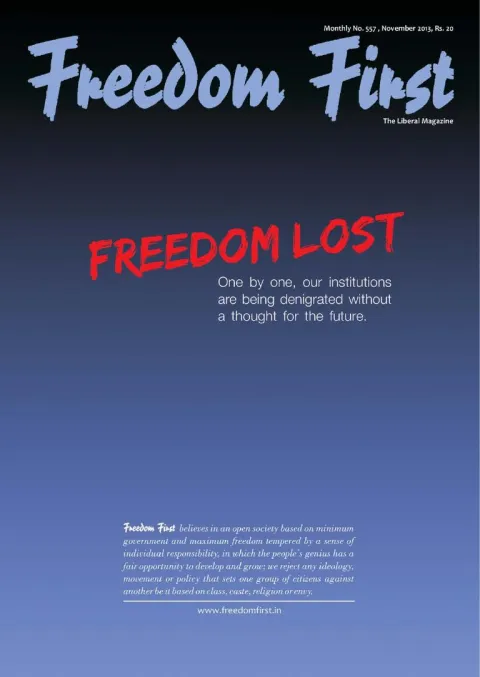
The November 2013 issue explains its own cover. Two columnists sent in pieces, Ashok Karnik asking the state and the public to spare the Army and Firoze Hirjikaka arguing that India is creeping towards better days, and the editor gave the cover to the first, on the ground that tinkering with the Army is the present and immediate danger, with only the Election Commission, the Supreme Court and the armed forces having survived sixty years intact.
Nitin G. Raut and Keshav Rau take apart the ordinance to protect convicted legislators from the Supreme Court’s judgment of 10 July, and the extra-constitutional way it was withdrawn. B. Ramesh Babu reports the failure of the Singh-Sharif meeting at the United Nations; V. Krishna Moorthy sets out the Reserve Bank’s proposed overhaul of the banking structure; Sharad Joshi asks why the Indian government abhors its farmers. Suresh C. Sharma reconstructs Nehru’s feeling of guilt after 1962 from Y. B. Chavan’s account, Brig. S. C. Sharma recovers the Navy’s part in the 1965 war, and R. Srinivasan reads Indian corruption through folklore. The issue ends with a group of short pieces on the Nirbhaya case, on women, and on the demands for new states that Telangana has set off.
Key points
-
The editor explains the choice of cover: with Pakistan’s army and its jihadis to the north-west and China to the north and east, this is a moment when the Army’s morale should be high, and the civil establishment’s favourite pastime of tinkering with it is the immediate danger.
-
Ashok Karnik examines the leaked Board of Officers report on the Army’s Technical Support Division and finds the allegations dubious on their face: the eavesdropping equipment was bought by the Defence Intelligence Agency, which reports to the Ministry and not the Army Chief, and the suggestion that Rs 1.30 crore could topple a state government does not survive stating.
-
Nitin G. Raut and Keshav Rau follow the ordinance meant to nullify the Supreme Court’s 10 July disqualification of legislators sentenced to more than two years, from the all-party assurance of 4 August to its withdrawal five days after Rahul Gandhi called it nonsense, with both authors noting the two supporters it was drafted to save.
-
B. Ramesh Babu records the failure of the Singh-Sharif meeting on the margins of the General Assembly, and the firing across the Line of Control in the Keran and Samba sectors that accompanied it: whoever holds office in Islamabad, the army decides relations with India.
-
V. Krishna Moorthy reports the Reserve Bank’s proposal to replace universal banking with differentiated licensing, arguing that continuous authorisation would keep competitive pressure on existing banks without the strain of block licensing, and that small banks are needed for small borrowers.
-
Sharad Joshi’s rural column argues that the state’s treatment of farmers is systematic rather than accidental, in prices and in the withholding of technology, and traces the Green Revolution’s yields to the balanced use of water, fertiliser, hybrid seed and pesticide that later policy made unaffordable.
-
Suresh C. Sharma, drawing on Y. B. Chavan’s meeting with Nehru after the 1962 defeat, sets out the warnings that were ignored: Generals Cariappa and Thimayya, B. K. Nehru’s report from Washington, and a paper Krishna Menon blocked from reaching the Prime Minister after President Radhakrishnan asked for it.
-
R. Srinivasan argues that folklore knew what Lasswell had to remind political scientists of, that politics is power in the last resort, and that where power matters the abuse of it is inevitable and must be understood rather than merely denounced.
Essays
Spare the Army
By Ashok Karnik
The cover feature takes the sensational reports about the Army’s Technical Support Division and reads them against the record. Karnik concedes that an inquiry by the Army’s own Board of Officers must be taken seriously, then dismantles its particulars: the equipment allegedly used for snooping was bought by the Defence Intelligence Agency, which does not work under the Army Chief; it was found unserviceable and given away; and the sum said to have toppled a government was Rs 1.30 crore. His larger anxiety is the habit of denigrating institutions one by one.
- Questions how a leaked internal inquiry became a public indictment.
- Separates what the DIA did from what the TSD is accused of.
- Warns that an apolitical Army placed in the dock is a loss the country will feel later.
India’s Creeping (R)(E)volution?
By Firoze Hirjikaka
Hirjikaka’s is the optimistic half of the issue: a revolution without mobs or insurrection, in which Indians have been clawing back the rights due to them in a working democracy. He tracks the retreat of the netas’ secrecy and the assertion of accountability as a birthright, while warning that asset declarations concealed behind benami entities are cosmetic unless independently audited, and that ending corruption alone would not be enough without a change in the mindset of those who regulate ordinary life.
- Describes a gradual, almost imperceptible change over five years.
- Calls the victory pyrrhic while candidates can conceal their true worth.
- Ends on the lethargy, procrastination and sense of entitlement still to be shed.
Whose Ordinance Was It Anyway?
By Nitin G. Raut
Raut lays out the chronology: the Supreme Court’s judgment of 10 July disqualifying legislators sentenced to more than two years, the government’s assurance on 4 August that it would amend the law, the rejection of its review petition on 4 September, the bill, and then the ordinance. He argues that a Cabinet decision of that kind could not have been taken without the National Advisory Council and the Congress core committee, and that coalition dharma required shielding the convicted.
- Reads the episode as a mockery of collective responsibility and accountability to Parliament.
- Names the two convicted supporters whose position the ordinance would have preserved.
- Sets out the constitutional limits on ordinances that the manoeuvre ignored.
Was the BJP Really Opposed to Protecting Convicted MPs?
By Keshav Rau
Rau follows the same ordinance to its withdrawal and finds nobody’s hands clean. Rahul Gandhi’s “complete nonsense” functioned as a directive that the Prime Minister and his Cabinet obeyed within five days, which he compares to an earlier member of the same family wielding unbridled power. He then tracks the BJP’s competing claims of credit, from its leaders’ call on the President to Narendra Modi’s defence of the Prime Minister’s dignity and Advani’s blog crediting Pranab Mukherjee.
- Treats the episode as a display of extra-constitutional authority with precedent.
- Shows both parties claiming the same withdrawal as their own achievement.
- Leaves the question of who actually opposed protecting convicted legislators open.
Singh-Sharif Meeting: A Failed Summit
By B. Ramesh Babu
Following his previous month’s article, Ramesh Babu records that nothing came of the meeting on the sidelines of the General Assembly, and that the hopes of pro-talks leaders in both countries were dashed by domestic factors, predictable on the Pakistani side and unforeseen on the Indian. Writing on 8 October, with guns firing in Keran and Samba, he concludes that the Pakistan army has again undermined its own Prime Minister’s credibility.
- Notes infiltration attempts made under covering fire during the talks.
- Reads the army, not the elected government, as India’s real interlocutor.
- Confirms his earlier warning about summits held without preparation.
Indian Banking: The Way Ahead
By V. Krishna Moorthy
Opening with Raghuram Rajan on monetary stability as the central bank’s primary role, Krishna Moorthy sets out the Reserve Bank’s proposed overhaul: an end to the universal banking structure as the only licensed form, continuous authorisation in place of block licensing, and room for smaller banks serving small borrowers alongside the large ones. The aim, as he reads it, is competition and financial inclusion without straining the system.
- Explains why continuous authorisation keeps pressure on incumbents.
- Notes the acknowledged need for both large and small banks.
- Places the proposals in the context of the year’s monetary turbulence.
Why the Indian Government Abhors Our Farmers
By Sharad Joshi
Joshi begins with the arithmetic of agriculture, where one seed returns a hundredfold because it draws on all five natural elements, and argues that policy has been arranged against the people who work it. If the government believed its own account of prices covering costs, its policies would discourage the inputs it in fact taxes; the Green Revolution came from the balanced use of water, fertiliser, hybrid seed and pesticide, and what followed made those inputs unrecoverable for the farmer.
- Defines agriculture broadly, against the food-grain focus of policy.
- Gives examples of manoeuvring against farmers in money and in technology.
- Treats access to inputs as inseparable from land and water.
”Nehru’s Feeling of Guilt for the 1962 Debacle”
By Suresh C. Sharma
Sharma builds the essay on Y. B. Chavan’s impression, on taking over from Krishna Menon as Defence Minister, that the Prime Minister was carrying a sense of guilt. He then assembles the warnings that were not heeded: Generals Cariappa and Thimayya, B. K. Nehru writing from Washington in September 1961, a paper the President asked to be shown to Nehru that Menon blocked, and the October incident in which Inspector Karam Singh was taken prisoner and ten of his constables shot.
- Sets the mood of defeat felt even far from the combat zone.
- Shows China becoming the exclusive preserve of one minister.
- Treats accountability at the top as the unstated subject.
The Indian Navy in the 1965 Indo-Pak War
By Brig. S. C. Sharma
Opening with Colin Powell on the seriousness of politicians who talk of limited war, Sharma returns to March 1965 and the two Pakistani posts established in the Rann of Kutch, an undemarcated area since 1947 with the prospect of oil beneath it. The best-remembered passage is Ayub Khan’s patronising remark to Lal Bahadur Shastri at the Commonwealth conference and Shastri’s reply, asking whether a general would choose a terrain where he had no logistics and his opponent had every advantage.
- Recovers a naval dimension usually left out of accounts of 1965.
- Explains why fighting in Kutch was tactically against Indian interests.
- Uses the Shastri exchange to show how the aggression was misrepresented.
Corruption: The Perspective from Folklore
By Dr. R. Srinivasan
Srinivasan asks whether folklore, which has held Indian attitudes more widely and deeply than books have, can explain the persistence of corruption. He notes the method’s limits, a fixed picture of a society that has changed slowly, and inattention to changes in government, and argues nevertheless that folklore has its finger on a central pulse: if politics is power in the last resort, the abuse of power is not an aberration to be denounced but a condition to be understood and reduced.
- Sets folklore beside political science as a source of evidence.
- States the reservations before making the claim.
- Aims at coming to terms with corruption rather than at simply condemning it.
The Right to Education Act (17): What is Education?
By Suresh C. Sharma
The seventeenth part of the series asks what the Act is actually promising. Education is not the transfer of information alone: sport, conduct among fellow students, debate and elocution, and self reliance are where much of the learning happens. Sharma’s test is the difference between reproducing a lesson and understanding it, which he sees in how such students fare in entrance examinations built on understanding.
- Distinguishes information transfer from education proper.
- Draws on syllabus revision at the National Defence Academy and other military colleges.
- Argues that the Act’s guarantees mean little without this distinction.
Elsewhere in the issue
- Point Counter Point, Ashok Karnik’s column of opposed positions on the month’s questions.
- “Japan’s Elderly Go on Petty Crime Spree”, reporting that crimes by Japan’s elderly have doubled in a decade and that shoplifters are now more likely to be over 65 than aged 14 to 19, offered as a matter of interest to India’s own ageing.
- “A New Begining: Nirbhaya Case” by Durba Das and Khushboo Mishra, and Priya Joshi’s “The Hand that Rocks the Cradle, Rules the World”.
- Four short pieces on the politics of the vote bank and the demand for new states, by Jyoti Marwah, Rita P. Bhambi, Monika Verma and Rahul Sunilkumar.
- Nostalgia: Freedom First in November 1956, on the Sino-Nepal treaty and India’s strategic interest in Nepal, and on the freedom of the press, which the magazine called fundamental to liberty because through it every other liberty can be recovered.
Generated by the v1.5 extraction pipeline. Awaiting editorial review.
Metadata and summary are AI-extracted from the source PDF and reviewed for editorial accuracy. The original work is available via the Read PDF tab above (where present); paragraph-level citation inside the PDF is deferred to a future engagement.