
periodical issue
Freedom First
The Liberal Magazine
By Sharad Joshi, T. H. Chowdary
Published by J. R. Patel for the Indian Committee for Cultural Freedom (ICCF) and printed by him at Union Press, 13 Homji Street, Fort, Mumbai 400001. · Mumbai · 2013
40 pages
Freedom First
Summary
The December 2013 issue opens by reprinting the Declaration on Cultural Freedom that the Indian Committee for Cultural Freedom adopted in Bombay in March 1951 and published in the magazine’s first issue, and asks readers to help re-examine it for a conference planned in Mumbai: political and economic freedom have not proved to march together as the Declaration assumed, free nations now find free speech an encumbrance, and the information revolution has opened a quarrel between privacy and national security.
The issue carries tributes to Rajaji on his 135th birth anniversary, in Minoo Masani’s words on Rajaji’s view of man as a moral animal, and to Masani himself on his 108th, by Kumar Anand. M. R. Venkatesh answers the New York Times on Narendra Modi, Nitin G. Raut defends opinion polls against a proposed ban, and V. Balachandran uses General V. K. Singh’s disclosure of secret payments in Kashmir to indict the intelligence system nobody has reformed since 1947. Sharad Joshi describes how sugar co-operatives are made sick and then bought cheap by the men who ran them; V. Krishna Moorthy takes up gold and the current account deficit; T. H. Chowdary contrasts the freedom fighters who chose to have no children with the son-stroked politicians of the present. Suresh C. Sharma recovers the Mukti Bahini’s part in 1971, and the issue closes with pieces on the Mars mission, the Cyrus cylinder and the recognition of schools under the Right to Education Act.
Key points
-
The Declaration on Cultural Freedom of 31 March 1951 is reprinted in full, with its claim that culture can flourish only in a free society, that the integrity of the individual is the primary ethical value, and that totalitarianism is the gravest challenge man has faced because it dictates not only how truth may be expressed but what truth is. The ICCF asks readers for written inputs before a conference to re-examine it after sixty-two years.
-
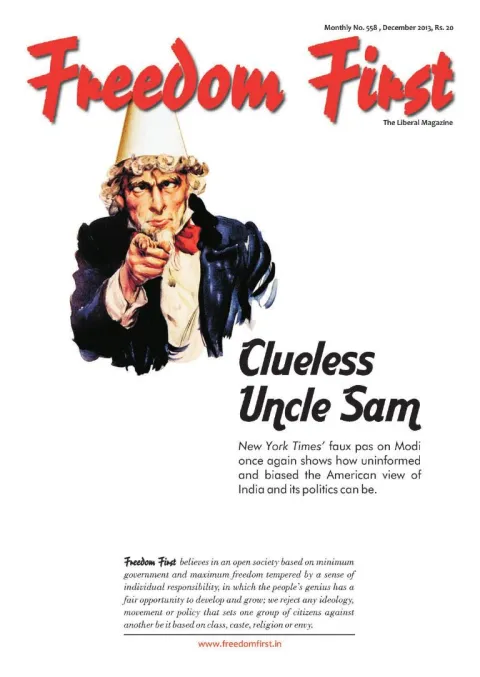
The editorial recalls Indira Gandhi’s “foreign hand” and Piloo Mody’s medallion reading “I am a CIA Agent”, and applies the memory to the New York Times, which wishes to save India’s democracy and its Muslims from Narendra Modi. The editor’s reply is that India’s minorities are safe and the Times may wait and see, and that the struggle in hand is to shrug off dynastic rule.
-
A tribute to Rajaji on his 135th birth anniversary excerpts Masani’s 1984 memorial lecture: the Swatantra Party’s politics and economics flowed from Rajaji’s understanding of man as a moral animal, derived from Hindu religious philosophy where Masani’s came from Western liberalism, and Nehru’s joke that God was evidently a partner in the party did not trouble him.
-
Kumar Anand’s tribute to Masani on his 108th birth anniversary follows him from admirer of the Soviet Union to freedom fighter, socialist, doubter, anti-communist and finally liberal with the founding of the Swatantra Party in 1959, and takes the lesson to be independence of mind: he listened to reason and evidence, and abandoned what did not work.
-
V. Balachandran argues that General V. K. Singh’s confirmation of secret payments to Kashmiri politicians through the Army since 1947 exposes India’s hypocrisy about democracy, and holds the Congress responsible for fifty-three years of leaving the intelligence system unaccountable, comparing the Technical Services Division to Donald Rumsfeld’s Strategic Support Branch, wound up by his successor.
-
Nitin G. Raut answers the case for banning pre-election opinion polls, made alongside a proposal to regulate journalists, by pointing to 2004, when the expected NDA victory did not arrive: voters are not naive, and the demand deprives citizens of the right to know.
-
Sharad Joshi describes the mechanism by which a co-operative sugar factory is declared sick by the board that ruined it, valued arbitrarily and sold cheaply to those same men, which he says is what privatisation has come to mean in the sector, and sets it against the Shetkari Sanghatana’s 1980 agitation for remunerative cane prices.
-
T. H. Chowdary sets the ordinance to protect convicted legislators against the example of Kripalani, Jayaprakash Narayan, N. G. Ranga and Sundarayya, who decided in the 1930s not to have children lest political life tempt them to acquire wealth for their sake.
Essays
Modi’s Spectacular Rise Rattles the New York Times!
By M. R. Venkatesh
Venkatesh takes the New York Times editorial of 26 October 2013, which conceded that Modi was a leading candidate and called his rise deeply troubling to many Indians and especially to the country’s Muslims, and asks why an American paper describes an Indian election in the vocabulary of Indian commentators. His complaint is less about the verdict than about the export of a domestic stereotype, and he sets it beside the 2012 American election, where a three point margin was not read as a moral crisis.
- Contrasts coverage of Obama and Romney with coverage of Indian candidates.
- Argues that an “idea” manufactured by Indian media has been exported wholesale.
- Puts home truths to a paper writing about a country it does not live in.
Who’s Afraid of Opinion Polls?
By Nitin G. Raut
Raut connects the proposed ban on pre-election opinion polls to the Information and Broadcasting Minister’s call for a regulatory authority for journalists and his earlier advisory threatening television licences. The objections to polls, that they are biased, unscientific or misleading, are in his account pretexts: voters are not so easily led, as 2004 showed when the expected NDA return did not happen, and what is really proposed is to deprive citizens of the right to know.
- Places the poll ban in a wider pattern of press regulation.
- Uses the 2004 result against the claim that polls determine outcomes.
- Treats knowledge of poll trends as a citizen’s right rather than a media privilege.
India’s Hypocrisy on Democracy Exposed
By V. Balachandran
Balachandran sets aside the question of whether General V. K. Singh should have shared a platform with the Gujarat Chief Minister and takes up what his disclosure revealed: secret payments to Kashmiri politicians routed through the Army since 1947, and an intelligence system that no government has made accountable. He compares the Technical Services Division with Rumsfeld’s unauthorised Strategic Support Branch, closed by Robert Gates in 2007, and contrasts both with the American reforms of the 1970s and the British and Canadian reforms of the 1980s.
- Holds the ruling party responsible for the opacity it inherited and preserved.
- Reads the affair as a failure of intelligence management rather than of one general.
- Notes that other democracies wrested control of their agencies decades ago.
‘Privatizing’ Sugar Co-operatives
By Sharad Joshi
Joshi begins with the Shetkari Sanghatana’s agitation of 10 November 1980, when cane growers stopped road and rail traffic to demand remunerative prices, and moves to what has become of the co-operatives since. The pattern he describes is circular: the chairman and board make the factory sick, the assets are valued arbitrarily, and the same men buy it cheap. That, he writes, is what privatisation means in the sugar sector.
- Sets out the sequence by which a co-operative is run down and then acquired.
- Draws on his own experience of the 1980 agitation and its aftermath.
- Distinguishes this from any privatisation a liberal would recognise.
The Glory of GOLD and its Different Avatars
By V. Krishna Moorthy
Taking I. G. Patel’s remark that in prosperity as in need the thoughts of most Indians turn to gold, Krishna Moorthy examines the appetite behind the current account deficit, the smuggling it once produced, and the long litigation over the Kolar mines, from the Karnataka High Court’s 2003 direction to hand them to the employees to the terms finally settled in 2010.
- Explains why continuous heavy imports are blamed for the deficit.
- Traces the domestic policy response and its unintended effects.
- Follows the mines case as an instance of how such assets are actually handled.
Son-Stroked Politicians
By T. H. Chowdary
Chowdary’s essay is built on a contrast. On one side, Acharya Kripalani and Sucheta, Jayaprakash Narayan and Prabhavati Devi, N. G. Ranga and Bharati Devi, Puchchalapalli Sundarayya and Leela, who decided in the 1930s to have no children, because public life would leave no time to raise them and property would become a temptation. On the other, the ordinance, aborted by Rahul Gandhi’s outburst, that would have kept convicted legislators in their seats. He also recounts the Nagpur session of 1962 and the night on which Indira Gandhi’s name displaced Nijalingappa’s for the Congress presidency.
- Reads the ordinance as a shock to anyone still hoping corruption could be contained.
- Uses the founders’ choices as the measure of the present.
- Records G. B. Pant’s protest at the substitution of candidates for the party presidency.
Role of Mukti Bahini in the Liberation War of 1971
By Suresh C. Sharma
Sharma returns to Yahya Khan’s refusal to let the majority leader form a government, the induction of four infantry divisions into East Pakistan, and the raising of the Mukti Bahini. He is candid about the terms of the arming: about a hundred thousand weapons handed over with emphasis on quantity rather than quality, and no records kept, which became a law and order problem in Bangladesh after victory. Mujibur Rahman’s acknowledgement stands at the head of the piece.
- Follows the political failure that made the war.
- Assesses the training and arming of the Mukti Bahini honestly, including its costs.
- Records the posts the force established and the part it played.
The Right to Education Act (18): Recognition of Schools
By Suresh C. Sharma
The eighteenth part of the series takes up Section 1.1(a) of the model rules, under which no school run for profit may be recognised and only societies and public trusts may be. Sharma’s objection is that this treats education as a charity by fiat while the schools actually serving poor families are small, often family-run establishments, hiring family members as teachers and administrators because that is the cheapest way to open a school at all.
- States the rule and who it excludes.
- Gives the example of a school to class ten in Rajasthan run by one family.
- Reads recognition policy as a question about upward mobility rather than about form.
Elsewhere in the issue
- The Declaration on Cultural Freedom of 1951, reprinted in full with the ICCF’s request for readers’ written contributions before a conference in Mumbai to reconsider it.
- Point Counter Point, Ashok Karnik’s column of opposed positions.
- Cornucopia, in which Firoze Hirjikaka’s “Modi Bellows to Conquer” grants that Modi speaks without notes, promises roads and electricity rather than freebies, and can point to Gujarat, while objecting to the manner in which he does it.
- B. Ramesh Babu’s continuation of “National Security to Human Security”.
- Suresh C. Sharma’s review of Towards a Geopolitics of Hope by William H. Thornton and Songok Han Thornton.
- Arvind Ananthanarayanan’s “Exploring Other Worlds: A Good Idea?”, written after the PSLV C-25 launch of 5 November 2013 carried India’s first Mars mission at a cost of Rs 450 crore, and using Venus as a warning about greenhouse effects at home.
- Aspi D. Moddie’s “The Cyrus Edict”, on the clay cylinder from Babylon in the British Museum and the copy U Thant accepted in 1971 as an example of man’s early attempts at human rights.
- Nostalgia: Freedom First in December 1956.
Generated by the v1.5 extraction pipeline. Awaiting editorial review.
Metadata and summary are AI-extracted from the source PDF and reviewed for editorial accuracy. The original work is available via the Read PDF tab above (where present); paragraph-level citation inside the PDF is deferred to a future engagement.