
periodical issue
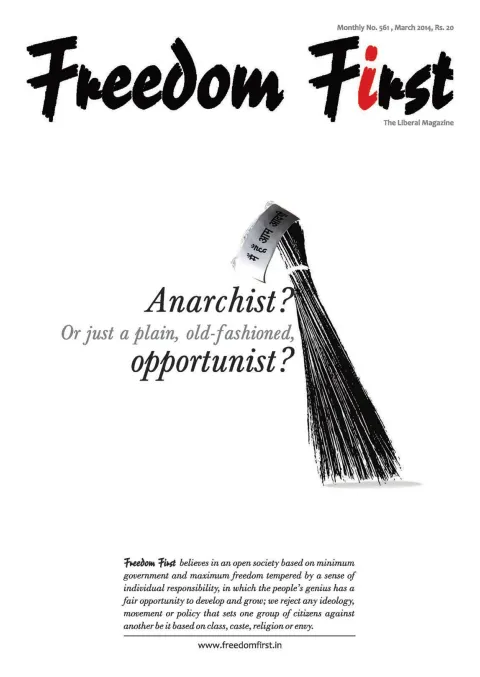
Freedom First
The Liberal Magazine
By Sunil S. Bhandare, Sharad Joshi
Published by J. R. Patel for the Indian Committee for Cultural Freedom and printed by him at Union Press, 13 Homji Street, Fort, Mumbai 400001. · Mumbai · 2014
40 pages
Freedom First
Summary
Freedom First No. 561 (March 2014, 62nd year of publication) is dominated by the fallout of Arvind Kejriwal’s 49-day Aam Aadmi Party government in Delhi, which resigned in mid-February 2014. The editorial (SVR) and three further pieces — Firoze Hirjikaka’s “Aam Aadmi Party – Confusion Compounded,” Bapu Satyanarayana’s “Changing Political Landscape in India,” and Ashok Karnik’s “Point Counter Point” — argue from different angles that AAP’s populism, inexperience and contempt for institutions squandered a genuine anti-corruption opening, while conceding it has forced other parties toward cleaner candidates. Ranga Kota extends the institutional critique to AAP’s populist power-tariff cuts and the wider collapse of India’s power-distribution economics. Sunil Bhandare surveys a decade of “economic drift” under UPA-II with GDP, investment and savings data, and B. Ramesh Babu closes a two-part retrospective on Manmohan Singh’s foreign policy record. Beyond the AAP/economy cluster, the issue carries Sharad Joshi’s personal account of founding the Shetkari Sanghatana farmers’ movement at his farm “Angarmala”; historical and biographical features on Rambhau Mhalgi, Maulana Azad, and Alexander’s failed invasion of India; investigative pieces on the Maharashtra CCTV tender and the Augusta Westland VVIP helicopter scandal; a continuing Right to Education Act column; and two pieces on the Muzaffarnagar riots and their administrative aftermath. A nostalgia reprint revisits Freedom First’s own March 1957 issue on “The Paradox of Jawaharlal Nehru,” and the issue closes with an obituary of Professor Vijay Kumar Sinha, reader letters, and short excerpted items from other publications.
Essays
Nostalgia: Freedom First: This Month in March 1957 (“The Paradox of Jawaharlal Nehru”)
By G. F. Hudson
A reprint excerpt from Freedom First’s own March 1957 issue (No. 58), reproducing G. F. Hudson’s essay on “The Paradox of Jawaharlal Nehru.” Hudson argues that Nehru applied a double standard in foreign affairs — harshly condemning Western colonial and semi-colonial powers while extending benevolent tolerance to Communist regimes, as seen in India’s mild response to the Soviet intervention in Hungary compared to its condemnation of the Anglo-French Suez action. The piece traces this to Nehru’s formative political conversion by Gandhi and to India’s lack of an inherited diplomatic tradition, and notes Jayaprakash Narayan’s contemporaneous public attack on Nehru over the Hungary response.
- Nehru abstained on the UN resolution condemning Soviet action in Hungary while strongly condemning the Anglo-French invasion of Egypt.
- Jayaprakash Narayan publicly criticised Nehru’s handling of the Hungary crisis, one of the most damaging attacks on Nehru since independence.
- Nehru’s own words (via journalist Tibor Mende) describe being ‘bowled over’ by Gandhi as the source of his political conviction.
- Hudson attributes the double standard to India’s lack of an inherited foreign-policy tradition and an unmodified doctrinaire anti-colonialism.
- India claimed a right to criticise Western/colonial powers from New Guinea to Morocco while treating non-interference in Communist affairs as sacrosanct.
From Our Readers
A compilation of reader letters responding to prior issues: tributes to the late Prof. Sheryar Ookerjee; a complaint about sensationalist New York Times coverage of India; several sharply divided reactions to the January/February editorials on AAP and Arvind Kejriwal (ranging from strong support to dismissal of him as an ‘immature adolescent’); a note on the Ministry of Defence reversing a directive on soldiers’ disability pensions; and a wry anecdote about a minister whose buffaloes, rather than wife, went missing.
- Readers are split on AAP: some feel FF’s criticism of the party was too harsh given its short time in office, others call it correctly damning.
- One letter faults the Congress and AAP debate for degenerating into personal insult rather than policy substance.
- A tribute letter corrects the record on the late Prof. Sheryar Ookerjee’s community background and recalls his mentorship.
- A defence-related letter notes the Ministry’s reversal, after MP intervention, of an order making disability-pension appeals harder to win.
- A short item comments wryly on a minister’s missing buffaloes rather than a runaway wife.
Editorial: What is this Aam Aadmi Party and What Does it Stand For
By SVR
The editorial (bylined SVR) traces the Aam Aadmi Party’s origin from Arvind Kejriwal’s NGO Parivartan and the India Against Corruption movement, through Anna Hazare’s fast and the movement’s capture of urban ‘geeks and yuppies,’ to its transformation into a political party backed by an anonymous crore-rupee donor and a pollster’s advice. It argues Kejriwal’s subsequent targeting of Mukesh Ambani and other big names, after cutting his teeth on municipal-level corruption, reflects his changed ambitions now that he is referred to as ‘Ex-CM.’
- AAP is presented as the political avatar of India Against Corruption (IAC), itself grown out of Kejriwal’s NGO Parivartan.
- The editorial contrasts Kejriwal’s movement with Mumbai municipal officer G. R. Khairnar’s earlier, less successful anti-corruption drive.
- Anna Hazare’s national profile is credited with giving IAC an all-India presence, aided by media and cyberspace attention.
- The party’s founding is attributed to a crore-rupee ‘seed’ donation and a pollster’s electoral calculations once Kejriwal split from Hazare.
- The editorial links Kejriwal’s populist focus on water and electricity to his Parivartan-era grievances, contrasted with his newer targeting of big corporate names.
Obituary: Professor Vijay Kumar Sinha
By SVR
An obituary for Professor Vijay Kumar Sinha (1933–2014), a longtime educator at Bombay-area colleges and a close associate of humanist scholar Prof. A. B. Shah in founding the Indian Association for Cultural Freedom and its journal New Quest, and later the Indian Secular Society and its journal The Secularist. The piece credits M. N. Roy as an intellectual inspiration for this secularism-as-public-policy project and notes Sinha’s later work with the Indian Liberal Group promoting liberal values across India.
- Sinha taught at Ruparel College, SIES College and Ramnarain Ruia College, retiring as vice-principal, and later chaired several IES institutions in Bandra.
- He was a close associate of humanist Prof. A. B. Shah and helped found the Indian Association for Cultural Freedom and its journal New Quest.
- He later worked with the Indian Secular Society and its journal The Secularist, founded to counteract emerging fundamentalism.
- His publications include Secularism in India and Modern Indian Political Thought; at his death he was Executive Editor of the Local Government Quarterly.
- He was actively associated with the Indian Liberal Group, presenting on secularism and liberal values across India.
Aam Aadmi Party – Confusion Compounded
By Firoze Hirjikaka
Firoze Hirjikaka gives a mostly critical account of AAP’s brief Delhi government, describing bewilderment at its ‘motley crew’ and arguing that its adoption of the broom symbol promised a utopian, fully participatory democracy that proved short on practicality. He details the abolition of water tax and halved electricity tariffs as populist, financially unexamined decrees; Kejriwal’s defence of law minister Somnath Bharti’s vigilante raid on African women in Delhi as a low point; and the reversal of the FDI-in-retail decision. He closes skeptical that Kejriwal, Prashant Bhushan and Yogendra Yadav’s ‘disparate group of idealistic opportunists’ can sustain momentum, with a postscript noting the government’s collapse shortly after the piece was written.
- AAP’s core appeal was its claim to have no ‘leaders,’ only ordinary citizens in office, symbolised by the broom.
- Early decrees — free water up to a limit and halved electricity tariffs — are called wildly impractical and financially unexamined.
- Law minister Somnath Bharti’s unauthorised raid on a Delhi locality, and Kejriwal’s subsequent dharna defending him, are cited as a major misstep.
- The government’s reversal of the Centre’s FDI-in-retail decision is likened to revolutionary overreach.
- The author is skeptical that Kejriwal is truly in charge, suspecting Prashant Bhushan and Yogendra Yadav as the real power behind the party; a postscript notes AAP’s government collapsed shortly after this was written.
Changing Political Landscape in India
By Bapu Satyanarayana
Bapu Satyanarayana surveys the churn in Indian politics since Anna Hazare’s 2011 fast, framing Kejriwal’s rise as chaotic but symptomatic of long-suppressed public frustration with dynastic rule and corruption. He argues the chief beneficiary of this churn is Narendra Modi and the BJP, criticises Manmohan Singh’s remark that a Modi premiership would be a ‘disaster’ as a political misstep likely to backfire, and lists eight specific ways AAP’s emergence has already reshaped the political landscape — from pressuring passage of the Lokpal Bill to forcing a paradigm shift in public intolerance of corruption ahead of the 2014 general election.
- The author compares the current political churning to a Ramayana-like drama, with Kejriwal cast as Hanuman creating productive chaos.
- Manmohan Singh’s description of a possible Modi premiership as a ‘disaster’ is called an error of judgment likely to boomerang electorally.
- AAP’s pressure is credited with forcing passage of the Lokpal Bill in Parliament.
- The essay notes Delhi’s CM has little real power, since police and key decisions remain with the Centre and Lieutenant Governor.
- The author concludes AAP is ‘here to stay,’ having recruited close to one crore members despite its many stumbles.
Point Counter Point
By Ashok Karnik
In this recurring debate-style column, Ashok Karnik presents opposing views on four issues: whether Kejriwal is an ‘anarch’ or a reckless opportunist who engineered AAP’s own downfall through street tactics and defiance of the Lieutenant Governor; the propriety of India seeking British SAS assistance for Operation Bluestar based on newly released UK documents (with Lt. Gen. Brar’s denial of foreign involvement set against evidence of MI5 consultation); the NCP’s cooling alliance with Congress ahead of 2014; and the political and ethical questions raised by senior bureaucrats’ post-retirement moves into opposition parties.
- One side argues Kejriwal’s AAP was designed for ‘martyrdom,’ seeking dismissal to prove its singular honesty against a corrupt system.
- The counter-view says Kejriwal achieved little in 49 days beyond cheap publicity, having failed to pursue available legal and administrative remedies.
- On Operation Bluestar, Lt. Gen. Brar denies any foreign role, while B. Raman’s book notes British MI5 officers visited the Golden Temple as advisors, not planners.
- NCP’s Sharad Pawar is likened to a spouse ‘preparing for divorce’ from Congress, positioning himself as a possible post-2014 mediator.
- The column questions whether senior bureaucrats like R. K. Singh joining opposition parties after retirement reflects the ‘AAP effect’ of heightened public scrutiny.
Reflections on India’s Continued Economic Drift
By Sunil S. Bhandare
Sunil S. Bhandare gives a data-driven assessment of India’s macroeconomic drift under UPA-II, opening with an ‘Old Mother Hubbard’ epigraph. He credits a good monsoon-driven agricultural recovery and external-sector stabilisation (narrower current account deficit, rebuilt forex reserves, a recovering rupee) to fortuitous conditions rather than policy, while pointing to sub-5% real GDP growth, negative manufacturing growth, a sharply falling investment rate (GDCF/GDP down from 38.1% in 2007-08 to 32.3% in 2013-14), and a collapsing household financial-savings rate as the deeper structural problems the next government will inherit.
- Real GDP growth is projected at 4.9% for 2013-14, with manufacturing growth negative (-0.2%) for the first time since 1991-92.
- The current account deficit is projected to fall to about 2.5% of GDP and forex reserves have risen over US$17 billion since September 2013, but this is attributed to the monsoon and external factors, not policy.
- The investment rate (GDCF/GDP) has fallen from a peak of 38.1% in 2007-08 to 32.3% in 2013-14, representing a large loss of future growth potential.
- Household financial savings have collapsed due to diversion into real estate and gold, high inflation, and weak formal-sector employment growth.
- The author argues the UPA-II government will leave the incoming administration with an ‘almost empty’ exchequer despite claims of fiscal consolidation.
Power (Electric and Otherwise) and Populism
By Ranga Kota
Ranga Kota examines AAP’s populist power-tariff and free-water announcements in Delhi against the backdrop of the 2003 Electricity Act’s unfinished liberalisation. He argues AAP’s disregard for the tariff-setting authority DERC reflects a broader ‘lack of faith in all established institutions,’ and traces how populist tariff cuts elsewhere (Maharashtra, Haryana) leave power distribution companies unable to pay generators, causing idle capacity even as India imports coal and gas the plants need. He warns the incoming central government has limited power over what is a state subject, and that continued ‘competitive populism’ will worsen power cuts and deter financial-sector investment in the sector.
- AAP’s cuts to Delhi’s water and power tariffs, and Maharashtra’s and Haryana’s matching tariff reductions, are framed as a spreading wave of political populism.
- The 2003 Electricity Act sought to unbundle generation, transmission and distribution and free tariff-setting to independent regulators, a reform states have not fully implemented.
- State distribution companies’ combined losses exceed Rs. 200,000 crore, leaving them unable to buy adequately priced power or invest in infrastructure.
- Idle thermal capacity coexists with power shortages because plants cannot sell power at economically viable rates — a paradox the author calls ‘Our Paradox.’
- Because power distribution is a state subject, the author argues the incoming central government has no ‘magic wand’ to fix the sector quickly.
Cornucopia (Is Indian Media Becoming Shallow? / Narendra Modi – A Man for All Seasons)
By Firoze Hirjikaka
In two linked columns, Firoze Hirjikaka first criticises Indian television news for chasing sensational but socially irrelevant controversies (citing Arnab Goswami’s Rahul Gandhi interview and the recycling of the 1984 and 2002 riots) at the expense of holding politicians accountable on governance. The second column, “Narendra Modi – A Man for All Seasons,” offers an ambivalent, often satirical portrait of Modi’s oratorical skill and audience-tailored messaging — from his Kolkata courting of Pranab Mukherjee’s Bengali pride to his Ahmedabad and Assam speeches — concluding (in the continuation on page 37) that Modi’s dominance leaves the BJP’s regional allies eager to share power despite unease with his autocratic style.
- Television news is accused of degenerating into ‘theatre of the absurd’ by rehashing 1984 and 2002 riots rather than covering governance failures.
- Arnab Goswami’s interview technique with Rahul Gandhi is criticised for provoking conflict rather than eliciting substantive answers.
- Modi is portrayed as a skilled orator who tailors his message to each audience, from Bengali pride in Kolkata to Muslim youth outreach in Ahmedabad.
- The author is skeptical that Modi’s Assam speech on Northeast neglect reflects genuine commitment given his own record.
- The concluding portion (page 37) predicts BJP’s regional allies will accept subordinate roles to Modi for a share of power after the 2014 election.
CCTV Confusion
By “Sardar” Sanjay Matkar
“Sardar” Sanjay Matkar critiques the Maharashtra Government’s Rs. 640-crore CCTV surveillance tender for Mumbai, Pune, Nashik and Nagpur, noting a chaotic bidding history (including a vendor’s mysterious 50% quotation cut with no government explanation demanded) and unnecessary secrecy given that comparable city systems’ designs are public elsewhere. He argues the tendered analogue technology is outdated, requiring costly fibre-optic trenching, when modern digital systems using existing mobile networks would cost a fraction as much, deploy faster, and offer better face/gait recognition — but that rigid procurement rules will likely exclude better local technology.
- Mumbai’s planned 6,000-camera CCTV system, tendered at Rs. 640 crore, has been re-tendered multiple times amid unexplained pricing swings.
- The Home Department requires bidders to sign confidentiality undertakings despite comparable London, Seattle and Boston system designs being publicly available.
- The tendered analogue technology requires costly fibre-optic trenching across the city, a largely needless expense.
- Digital CCTV systems using existing mobile networks could cost under Rs. 100 crore and deploy in six to eight months with better image quality and recognition capability.
- Rigid government procurement procedures risk excluding superior technology developed by Indian engineers and already deployed abroad.
Foreign Relations in the 21st Century: Manmohan Singh and India’s Foreign Policy, 2004-2014 (Part II)
By B. Ramesh Babu
In the second part of a performance review, B. Ramesh Babu assesses Manmohan Singh’s decade of foreign policy through the five principles the outgoing PM laid out in a November 2013 farewell address to ambassadors, tracing India’s shift from Cold War-era non-alignment to claiming a global ‘betterment’ role. He credits real achievements in South-South cooperation, the IBSA/BRICS groupings, and closer strategic ties with the US and Japan to counterbalance China, but argues these gains are undercut by the domestic economic slowdown (GDP growth falling from 10.25% in 2010 to 3.2% in 2012) for which he holds Singh’s government responsible.
- Manmohan Singh’s five stated principles of Indian foreign policy prioritise development, global integration, stable major-power relations, regional cooperation, and values-based diplomacy.
- The essay credits South-South cooperation and the BRICS/IBSA groupings as genuine foreign-policy achievements of the decade.
- India is described as recalibrating its China policy through strengthened defence capability, US and Japan partnerships, and support for a possible BRICS Bank alternative to the dollar system.
- The visits of Japanese PM Shinzo Abe and German President Joachim Gauck are read as part of a G-4 push for UN Security Council reform.
- The author argues Singh’s economic legacy — GDP growth collapsing from 10.25% (2010) to 3.2% (2012) — undermines the credibility of India’s foreign-policy achievements.
The Rural Perspective: The Lessons Learnt at ‘Angarmala’
By Sharad Joshi
Sharad Joshi, founder of the Shetkari Sanghatana farmers’ movement, recounts buying his farm ‘Angarmala’ in Ambethan village, Pune district, in December 1976 and the lessons that grew into his agrarian philosophy. He describes being humbled by farmers’ children’s practical knowledge of soil, insects and land-levelling, an anecdote about a government schools inspector stumped by tribal children’s botanical knowledge, and his realisation — backed by research at the Gokhale Institute and readings from Mahatma Phule to Bukharin — that farmer poverty stems from systemic exploitation rather than farmers’ own ignorance or wastefulness, a synthesis that became the founding philosophy of the Shetkari Sanghatana.
- Joshi bought the Angarmala farm in Ambethan, Chakan Tehsil, Pune district, in December 1976 and began agricultural experiments there.
- Village children’s effortless expertise in identifying insects and levelling land by instinct led him to question assumptions about farmer ignorance.
- An anecdote about a government schools inspector unable to identify leaves that tribal children readily named illustrates the same theme.
- He rejects the common intellectual argument that farmers’ poverty results from wasteful spending on weddings and festivals, citing Mahatma Phule’s account of farmers’ minimal wedding feasts.
- Library research (including a Preobrazhensky-Bukharin terms-of-trade debate) combined with field experience shaped the philosophy underlying the Shetkari Sanghatana farmers’ movement.
International Women’s Day 8th March 2014: Preventing Adolescent Pregnancy
By J. S. Apte
Marking International Women’s Day 2014, J. S. Apte draws on the State of World Population Report 2013 to describe the global scale of adolescent pregnancy, its concentration in South Asia and its links to poverty, gender inequality and lack of education access. He surveys programmatic responses in Jamaica, Kenya and Bihar (via Pathfinder International Prachar), and notes that legislation has had limited effect in India despite child-marriage bans, given weak enforcement and the perception of adolescent girls as financial burdens.
- About 19% of young women in developing countries become pregnant before age 18, with 17.4 million of 36.4 million such cases from South Asia.
- About 70,000 adolescent girls die annually in developing countries from pregnancy/childbirth-related causes.
- In India, 47% of girls are married before 18, yet only 11 people were convicted for performing child marriages in 2010 despite legislation forbidding it.
- Programmatic responses cited include Jamaica’s school-return support for pregnant girls, Kenya’s free-uniform enrolment incentives, and Bihar’s Pathfinder International Prachar programme.
- The Bihar programme reduced participants’ likelihood of early marriage by 44% and early childbearing by 39% compared to non-participants.
A Mantra for Better Governance
By Gogineni Sambasivarao
Gogineni Sambasivarao proposes a ‘People’s Opinion Act’ under which citizens would SMS a standardised code, keyed to Aadhaar authentication, to rate any government official or service provider from postman to Prime Minister as liked, disliked or neutral, with results published on an Election Commission website. He argues the scheme would create continuous moral pressure on officials between elections, reduce reliance on street agitation, and help honest politicians and officials distinguish themselves from corrupt ones, while acknowledging current Aadhaar and cellphone coverage gaps as implementation hurdles.
- The proposed Act would assign permanent three-digit codes to office-holders (e.g., ward member 101, Prime Minister 300) for SMS-based public rating.
- Voters would register likes, dislikes or neutral opinions via SMS keyed to their Aadhaar number for identity verification.
- The Election Commission would publish updated scores online, with rules against forced or purchased opinions and vote-buying-style enticement.
- The scheme is limited to expressing opinion; officials could not be removed solely on poor scores under this Act, though future legislation could add sanctions.
- Current gaps in Aadhaar (only ~40 crore enrolled) and rural cell coverage are flagged as implementation constraints rather than reasons to abandon the idea.
The Case of Helicopters for VVIPs
By Suresh C. Sharma
Suresh C. Sharma details the procurement history of the AW101 VVIP helicopter deal, from the 1999 RFP through revised altitude/cabin-height specifications that eliminated most competitors, to the unprecedented decision to trial equipment still under development, a benchmark price six times the IAF’s original estimate, and the 2012 bribery allegations in Italy that led to the contract’s 2013 cancellation and Finmeccanica’s blacklisting. He calls for investigation of procedural deviations approved at each stage and questions why the number of required helicopters was raised from 8 to 12 during negotiations.
- SQR revisions — altitude requirement lowered and cabin height raised to 1.8 metres — progressively narrowed the field to favour AW101/Finmeccanica.
- Field trials were conducted abroad (USA/UK) on helicopters still under development, the only such case in this procurement history.
- The benchmark price set by MOD in 2008 (Rs. 4,877.5 crore) was more than six times the IAF’s 2006 estimate (Rs. 793 crore).
- 2012 bribery allegations in Italy implicating Finmeccanica executives led to the contract’s cancellation in December 2013 and the company’s blacklisting.
- The CAG report found the acquisition process lacked transparency and accountability, with deviations from procedure approved on eight counts, always to the vendor’s benefit.
Rambhau Mhalgi: An Exception Aamdaar
By M. R. Damania
M. B. Damania offers a personal tribute to Ramchandra Kashinath ‘Rambhau’ Mhalgi, a two-term Lok Sabha MP from Thane (Janata Party 1977, BJP 1980) who used minimal allowances, methodically ran citizen meetings from memory without notes, and pursued government accountability through parliamentary questions rather than personal enrichment — including successfully forcing disclosure of pending power-generation approvals during a Thane electricity shortage. The piece closes with an account of Mhalgi’s final illness, his refusal of costly US treatment, and his death, framed as a model of selfless public service rare among contemporary politicians.
- Mhalgi defeated a prominent Congress lawyer in Thane in 1977 (Janata Party) and was re-elected in 1980 as a BJP candidate.
- He claimed only bare-necessity allowances and taught constituents to escalate unresolved grievances up to a parliamentary question if needed.
- A parliamentary question he raised about pending power-generation approvals directly resulted in stalled industrial expansion applications being approved.
- He personally visited government offices (e.g., the state insurance office) to observe service delivery and raise issues with staff and management.
- He refused his party’s offer to fund US treatment for his brain tumour, accepting only local hospital care, and died from the illness.
The Magnificent Deeds of the Indian Army
By Raj Mohindra
Captain Raj Mohindra (I.N., Retd.) recounts a 1967 port call by INS Brahmaputra in Taranto, Italy, prompted by a diversion during a Greek political crisis, and the extraordinary warmth shown by Taranto’s residents in gratitude for the Indian Army’s conduct during the Allied invasion of southern Italy in 1943 — when, residents recalled, Indian soldiers alone among the Allied forces refrained from rape, molestation and plunder, and in some cases actively protected local civilians from other Allied troops.
- The essay’s occasion is the Mayor of Taranto’s expression of regret for the 2012 killing of Indian fishermen by Italian marines, which the author says draws on the city’s historical goodwill toward India.
- The author’s ship, INS Brahmaputra, was diverted to Taranto in 1967 during a coup against King Constantine of Greece.
- Elderly Taranto residents recounted Indian soldiers protecting them from other Allied soldiers during the WWII invasion of Italy in 1943.
- The town gave the ship’s crew an enthusiastic reception with dinners, picnics and refused payment for purchases, and a large send-off when it departed.
- The author frames these episodes as testimony to the ethical standards and professionalism of the Indian Army.
The Legacy of Maulana Azad
By Dr. T. H. Chowdary
Dr. T. H. Chowdary argues against the conventional portrayal of Maulana Azad as a purely anti-Partition nationalist, contending his 1940 Congress presidential address and 1928 Muslim League remarks reveal a preference for preserving Muslim numerical strength within an undivided India rather than a rejection of communal politics per se. Citing 1937 and 1946 election results showing negligible support for ‘nationalist Muslims,’ Chowdary argues Azad represented Hindus within Congress more than Muslims, and quotes Azad’s own 1947 lament to Delhi’s Jama Masjid crowd about being repudiated by the community he had tried to guide; he closes by criticising the naming of Urdu universities after Azad’s legacy.
- Chowdary reads Azad’s opposition to Partition as motivated by preserving Muslim numerical strength in a unified India, not rejection of communal calculus.
- In the 1946 provincial elections, the Muslim League won 425 of 485 reserved Muslim seats; nationalist Muslims backing Congress’s single-nation position drew only 1.4% of the Muslim vote.
- Azad was not elected to the Constituent Assembly from any Muslim-reserved seat in 1946, and lost his NWFP seat after Partition, later entering via a general non-Muslim Bihar seat.
- In the Constituent Assembly, Azad led Muslim members in demanding continuance of separate electorates and weighted reservations, an idea denounced by former Muslim League figures like Begum Aizaz Rasul under Sardar Patel’s leadership.
- Azad’s posthumously published autobiography reportedly states he believed Sardar Patel, not Nehru, would have been a better Prime Minister.
Alexander’s Failed Invasion of India
The concluding part of an unsigned, internet-sourced feature (contributed by Col. T. S. Tanwar) argues, using Soviet Marshal Zhukov’s 1957 remarks to Indian Military Academy cadets and other sources, that Alexander’s 326 BCE campaign in India ended in effective defeat rather than conquest. It cites the unusually hard-fought Battle of Hydaspes against King Porus, Alexander’s unexplained generosity in restoring Porus’s kingdom, the implausibility of the standard ‘war-weary soldiers’ explanation for the retreat, and Greek writers’ own admissions of exaggeration, concluding the Macedonian army’s swift, harried withdrawal southward reflects a strategic failure obscured by later Western historiography.
- Marshal Zhukov reportedly told Indian cadets in 1957 that Alexander’s actions after the Battle of Hydaspes suggest an outright defeat, not the ‘conquest of India’ claimed by Western historians.
- Greek sources describe the Battle of Hydaspes as Alexander’s hardest fought battle, the only one after which his own army held a spontaneous victory celebration — seen here as evidence of a narrow, costly escape rather than triumph.
- Alexander’s restoration of Porus’s kingdom (and grant of Ambhi’s territory) after supposedly defeating him is called counterintuitive and inconsistent with his conduct elsewhere.
- On the retreat south, Alexander’s army was harried continuously by Indian partisans, suffering major losses at Sangala and Multan, where Alexander himself was severely wounded.
- Greek historian Strabo is quoted describing many ancient writers on Alexander’s Indian campaign as habitual exaggerators.
Educating Adults: The Right to Education Act (21) – The Way Ahead
By Suresh C. Sharma
In the 21st instalment of an ongoing series on the Right to Education Act, Suresh C. Sharma argues that recognition norms for schools are input-based and unrealistic given the state of rural infrastructure, and that shifting responsibility to private/NGO-run schools while raising fees will exclude poor families rather than fix government schools. He criticises the government’s abandonment of PISA testing after India ranked 73rd of 74 countries as evasive, argues for merit-based teacher recruitment insulated from bureaucratic interference, and says medium-of-instruction choice should rest with parents rather than be dictated by politicians who send their own children to English-medium or foreign schools.
- School recognition norms under RTE are criticised as utopian given that 65% of rural houses lack toilets and safe drinking water.
- NGO Pratham’s annual report found Class 3 students often could not read Class 1-level books, indicating poor foundational learning.
- India ranked 73rd of 74 countries in the PISA assessment; the government’s response was to withdraw from PISA for a decade rather than address the underlying problem.
- The RTE Act’s no-detention policy is said to risk making it an act for ‘compulsory schooling and not for education.’
- The author calls for medium-of-instruction choice to rest with parents, criticising political leaders who send their own children to English-medium or foreign institutions while promoting other languages for the public.
Jamboree and Junket in the Aftermath of Muzaffarnagar Riots
By Dr. Jyoti Marwah
Dr. Jyoti Marwah condemns the Uttar Pradesh government’s handling of the Muzaffarnagar riots’ aftermath, contrasting the deaths of displaced children from cold and disease in relief camps with a lavish two-week Saifai jamboree (with chartered flights for Bollywood stars) and a 20-day foreign ‘study tour’ by 22 ministers and MLAs during the crisis. She frames the episode as part of a pattern of political manipulation of communal division, comparing the plight of displaced Muzaffarnagar families to that of Kashmiri Pandits, and reports that most people she spoke with were disengaged from or confused about the events.
- More than 59 people died and nearly 9,000 families from 24 villages were displaced in Muzaffarnagar/Shamli over roughly five months from 24 August 2013.
- While displaced families suffered in cold relief camps, the UP government staged a two-week entertainment jamboree at Saifai and sent 22 ministers/MLAs on a 20-day foreign ‘study tour.’
- Islamic charitable groups reportedly stepped in to provide health and medical assistance the state government failed to deliver.
- The author draws a parallel between the displaced Muzaffarnagar families being called ‘refugees’ in their own country and the 1989 displacement of Kashmiri Pandits.
- Informal conversations with over a dozen people revealed widespread disengagement from and confusion about the causes of the riots.
Muzaffarnagar Riots: Democracy Under Threat
By Dr. R. K. Cheema
Dr. R. K. Cheema traces the Muzaffarnagar riots to an eve-teasing incident in Kawal village in August 2013 that escalated into week-long communal violence exposing failures of politics, police and media. She describes the burning of Lisad village’s Muslim homes, mosques and madrasas, roughly 147 affected villages and up to 40,000 displaced people, and criticises the state government’s negligence and the political blame game between the Samajwadi Party and Congress over the Communal Violence Bill, concluding that once communal disturbance is sown in a historically secular town, its social fabric cannot be fully restored.
- The riots are traced to an eve-teasing incident in Kawal village on 27 August 2013 that triggered over a week of communal violence.
- Lisad village in Shamli district, home to over 200 Muslim families, was vandalised and burnt, including mosques and madrasas.
- 147 villages across Shamli, Baghpat and Muzaffarnagar districts were affected, with close to 40,000 people displaced by conservative estimates.
- The author blames the state government’s negligence and the political blame game (Samajwadi Party vs. Congress over the Communal Violence Bill) for the scale of the crisis.
- The essay questions Chief Minister Akhilesh Yadav’s capacity to address such crises given the state’s poor rural infrastructure and lack of safety measures for women.
Generated by the v1.5 extraction pipeline. Awaiting editorial review.
Metadata and summary are AI-extracted from the source PDF and reviewed for editorial accuracy. The original work is available via the Read PDF tab above (where present); paragraph-level citation inside the PDF is deferred to a future engagement.