
periodical issue
Freedom First
The Liberal Magazine
Edited by S. V. Raju
Published by J. R. Patel for the Indian Committee for Cultural Freedom and printed by him at Union Press, 13 Homji Street, Fort, Mumbai 400001. Tel. 22660357, 22665526. Typeset by Narendra Kokat, A-605/606, Mahavir Platinium, Next to Indian Oil Nagar, Govandi, Mumbai 400043. · Mumbai · 2014
40 pages
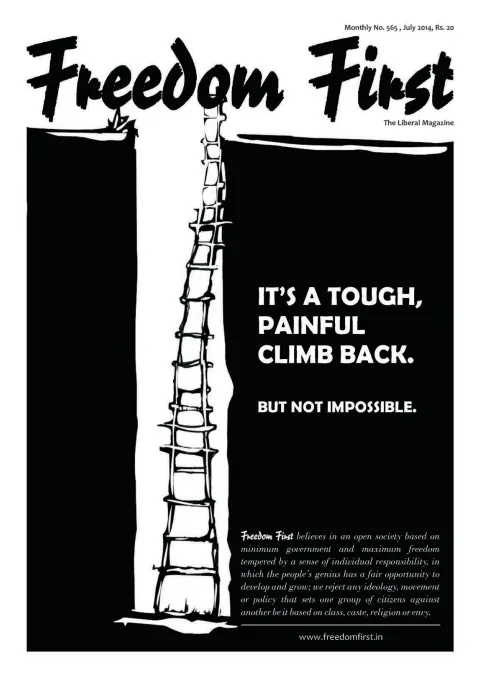
Freedom First
Summary
Freedom First No. 565 (July 2014) is the monthly issue of the Bombay-based liberal magazine published in its 63rd year, appearing roughly six weeks after Narendra Modi’s BJP won India’s 2014 general election. The issue is dominated by a large “General Elections 2014 and After” section in which several contributors — Ashok Karnik, H. R. Bapu Satyanarayana, Firoze Hirjikaka, Nitin G. Raut, P. Koshy and M. D. Kini — assess why the Congress-led UPA collapsed, what Modi’s cabinet formation and “Gujarat Model” portend for governance, and whether concentrating power in one leader is a cause for liberal concern even as the magazine’s editorial formally welcomes his government while pledging to avoid personal attacks on the Prime Minister. A companion cover feature reprints a 1979 interview in which Minoo Masani recalls founding the Swatantra Party with C. Rajagopalachari and Professor Ranga and reflects, pessimistically, on whether such a party could be revived. Beyond the election, the issue carries pieces on economic risk (an El Niño-driven monsoon warning), foreign policy and security (a roadmap for Modi’s foreign policy, an account of Taliban/ISI attacks on Indian assets in Afghanistan, and the Tibetan citizenship dilemma), social commentary (an essay on the causes of rape and a note on violence against women), a soldier’s personal remembrance, a book review, and a substantial student-contributed “Educating Adults” feature marking the World War I centenary with pieces on its causes, weapons, trenches, women’s wartime roles, and Japan’s role in the war.
The volume’s argumentative center is classical-liberal: minimum government, free enterprise, and scepticism of dynastic and statist politics, paired with real ambivalence about handing near-absolute power to any single leader, including one the magazine had itself supported. A “From Our Readers” letters section carrying strong pro- and anti-Modi reactions to the magazine’s own prior coverage, and several short items (on bureaucratic “cooling-off” rules, parliamentary mourning-adjournments, and a failed astrological election prediction) round out the issue.
Essays
Can The Swatantra Party Be Resurrected? - Minoo Masani in Conversation with Frits Bolkestein
By Minoo Masani in Conversation with Frits Bolkestein
This is a reprint of a May 1979 interview of Minoo Masani by Frits Bolkestein (then the Netherlands’ Minister for Foreign Trade and President of Liberal International), excerpted from a 1986 Festschrift. In the portion rendered, Masani recounts founding the Swatantra Party in 1959 with C. Rajagopalachari and Professor Ranga as a non-socialist Liberal-Conservative alternative, describes its rapid rise to become India’s largest opposition party by the late 1960s through modern campaign techniques he introduced from British politics, and then narrates its collapse after the 1971 “Indira wave” (44 seats down to 8) and its eventual 1974 merger into the B.K.D. under Piloo Mody and Charan Singh, a decision Masani opposed.
Asked directly whether the Swatantra Party could be resurrected, Masani is doubtful, arguing that Indira Gandhi had “destroyed standards” of Indian political conduct and that a party of Swatantra’s original moral calibre would now be much harder to build, though he maintains the party left a lasting mark by putting free enterprise “on the map of India.”
- Swatantra Party founded 1959 by Rajaji, Masani and Professor Ranga as a Liberal-Conservative reaction to Congress/socialist dominance; Rajaji coined the name from ‘Swa’ (self) and ‘tantra’ (mechanism).
- The party combined three strands: Rajaji’s conservative Hindu wing, Ranga’s agrarian wing, and Masani’s liberal bourgeoisie wing.
- Masani introduced British-style campaign methods (long-term constituency nursing, publicity, posters) that other Indian parties resisted; the party grew to 44 Lok Sabha seats by 1967, the largest opposition bloc.
- The party was devastated in the 1971 election (44 seats to 8) by the ‘Indira wave’ and was dissolved into the B.K.D. in 1974 under successors H. M. Patel and Piloo Mody, over Masani’s objection.
- In 1979 Masani doubted the party could be revived, citing a general decline in Indian political standards since Indira Gandhi, though he credits Swatantra with permanently establishing free enterprise as a live idea in Indian politics.
From Our Readers
The unsigned editorial (“The Importance of a Conservative-Liberal Alternative”) explains why Freedom First supported Narendra Modi and the BJP during the 2014 campaign, arguing Modi spoke “the Liberal’s language” — market economy, jobs over doles, and “minimum government, maximum governance.” It reviews the Congress-I’s four-decade record of never winning a majority of votes cast (peaking at 49.1% after Indira Gandhi’s assassination, versus 19.3% and 44 seats in 2014) and argues India now needs a middle-of-the-road party to eventually replace it, recalling Freedom First’s own hope for a revived Swatantra Party.
The editorial sets ground rules for the magazine’s future coverage: it will not publish personal attacks on Modi or the BJP but will offer concrete policy critique (citing the Union Budget as an example), noting the magazine also criticized Modi after the 2002 Gujarat riots to rebut any charge of uncritical cheerleading.
- Freedom First backed Modi/BJP in the 2014 campaign because Modi’s platform (market economy, jobs, women’s security, ‘Minimum Government, Maximum Governance’) echoed the magazine’s own liberal positions.
- Congress-I never won a majority of votes cast despite ruling most of the post-independence period; its 2014 result was 44 seats on 19.3% of the vote, versus a historic high of 49.1% after Indira Gandhi’s assassination.
- The editorial hopes Modi’s victory could be a ‘tipping point’ for a revived Liberal-Conservative Swatantra-style party to replace a declining Congress-I.
- States the magazine will avoid personal attacks or motive-attribution against Modi/BJP but will publish specific policy critique (e.g. on the Union Budget, law and order).
- Cites Freedom First’s own critical 2002 coverage of Modi after the Gujarat riots (FF453, April 2002) as evidence its 2014 support was not uncritical.
Editorial
V. Krishna Moorthy surveys the 2014 El Niño risk to India’s southwest monsoon, explaining the Pacific ocean-atmosphere mechanism behind El Niño and citing past drought years (2002, 2004, 2009) it triggered. He reviews IMD and South Asian Climate Outlook Forum forecasts showing a 33% chance of deficient rainfall, and traces the likely knock-on effects on kharif crop output, food and non-food inflation (CPI already near 8-10%), GDP growth (risking a third straight sub-5% year), banking-sector NPAs, and India’s rice-export competitiveness against Thailand.
He concludes that while poor monsoons have historically driven inflation spikes (food inflation hit 21% after the 2009 El Niño), El Niño is a necessary but not sufficient condition for drought, and calls for expanding north India’s irrigation model nationally, along with cold storage and food-processing investment, reviving Dr. K. L. Rao’s shelved river-linking proposal.
- El Niño (Pacific sea-surface warming) is linked to below-normal Indian monsoons and caused droughts in 2002, 2004 and 2009.
- IMD’s June 2014 forecast put a 33% chance of deficient rainfall, with analysts fearing agricultural GDP growth could slow to 0.8% in FY15 from 4.7% in FY14.
- Only 45% of India’s sown land is irrigated and the monsoon supplies over 70% of annual rainfall for 235 million farmers, so a weak monsoon threatens both inflation and overall GDP growth (already near 4.9-5.6%).
- A weak monsoon could also hit India’s rice-export dominance (a record 10.5 million tonnes in FY14) versus resurgent competition from Thailand.
- Author recommends replicating north India’s irrigation network nationally, building cold-storage/food-processing capacity, and reviving Dr. K. L. Rao’s perennial-river-linking proposal, dropped for lack of funding consensus.
EL NINO and India’s Monsoon Concerns
By V. Krishna Moorthy
Ashok Karnik’s recurring “Point Counter Point” column presents paired, opposing short takes on three post-election topics: Modi’s burden of unprecedented expectations (weighing his SAARC-leader outreach and anti-corruption SIT against fears of an emboldened Hindutva ‘mad fringe’); the Congress’s failure to introspect on its scam record (CWG, 2G, Coalgate, Adarsh, the Robert Vadra land deals) versus its lawyer-driven, legalistic defensiveness; and the appointment of Ajit Doval as National Security Advisor, praised from both sides as likely to galvanize India’s intelligence agencies into a more assertive posture.
A boxed sidebar, “Whither Astrology?”, mocks a Pune astrologer whose detailed pre-poll predictions for the 2014 election were all proven wrong.
- Format deliberately pairs a critical and a sympathetic view on each of three topics to model even-handed analysis.
- On Modi: risk of an over-empowered ‘mad fringe’ committing Hindutva-linked violence, weighed against his surprise SAARC-leader invitation and a new anti-black-money SIT.
- On Congress: criticized for refusing to investigate its own scam allegations and instead relying on ‘clever lawyers’ as spokespeople, which voters saw as evasive.
- On the new NSA: both takes welcome Ajit Doval’s operational record (the only civilian Kirti Chakra awardee) and expect him to push IB/R&AW into a more ‘action oriented’ mode.
- A sidebar highlights a Pune astrologer’s completely failed 2014 election predictions as a jab at astrology’s claims to scientific validity.
Point Counter Point
By Ashok Karnik
H. R. Bapu Satyanarayana chronicles Narendra Modi’s 26 May 2014 swearing-in as India’s 15th Prime Minister before a record 4,000-strong gathering that included, for the first time, the heads of all SAARC nations (including Pakistan’s Nawaz Sharif). He details Modi’s compact 45-minister cabinet (25% women), the scrapping of UPA-era Groups of Ministers, a 10-point rule-cutting mandate with 100-day departmental timetables, and outreach to top bureaucrats to speed decision-making.
The piece also covers early symbolic and diplomatic moves — the Ganga cleanup entrusted to Uma Bharati, scientist-led delegations abroad, and cautiously optimistic notes on Modi’s engagement with Nawaz Sharif and Jayalalithaa — closing with the President’s 9 June address to Parliament and praise (even from critic Shashi Tharoor) for Modi’s early conduct in office.
- Modi’s swearing-in on 26 May 2014 was attended by SAARC heads of state including Pakistan PM Nawaz Sharif for the first time in such a ceremony.
- His 45-member cabinet, with 7 women ministers (25%), combined related portfolios to speed inter-ministerial decision-making and was described as the most compact to date.
- Modi scrapped the UPA’s Groups/Empowered Groups of Ministers system, instructed departments to identify 10 obsolete rules each for removal, and set 100-day timetables.
- He engaged directly with 77 top bureaucrats to build a ‘symbiotic relationship’ between ministers and civil servants for faster implementation.
- Early diplomatic gestures — inviting SAARC leaders, courting Jayalalithaa, and entrusting the Ganga cleanup to Uma Bharati — are read as signs of both political skill and a cautiously constructive federal and foreign-policy approach.
A Tectonic Shift in Political and Administrative Culture
By H. R. Bapu Satyanaryana
Firoze Hirjikaka reflects on his own mostly-wrong pre-election predictions to analyze why Modi’s campaign of personal, near-plebiscitary appeal succeeded, tracing how both Rahul Gandhi and Arvind Kejriwal ‘pressed the self-destruct button’ — Rahul through poverty-glorifying rhetoric and abandoning reasoned discourse, Kejriwal through an all-consuming anti-Modi obsession that split the opposition vote and disillusioned his own base. He notes the stark disproportion between the BJP’s 31% vote share and its resulting near-60% parliamentary majority under first-past-the-post.
The essay closes on an ambivalent note: admiration for Modi’s oratorical and organizational skill and relief that hardliner Subramanian Swamy was excluded from the cabinet, mixed with unease at power concentrated in ‘a single individual’ who has ‘brooked no opposition’ in Gujarat, comparing him to Louis XIV’s ‘L’etat, c’est moi.’
- Author admits his April 2014 Freedom First predictions (decline of Rahul Gandhi’s threat, Shiv Sena’s decline) were largely wrong, attributing this to underestimating the scale of the ‘Modi wave.’
- Argues the BJP’s 31% vote share (versus Congress’s 19%) translated into roughly seven times the seats and a near-60% parliamentary majority, questioning the fairness of first-past-the-post representation.
- Both Rahul Gandhi and Arvind Kejriwal are blamed for self-destructive campaigns — Rahul for alienating the poor by dwelling on handouts, Kejriwal for an anti-Modi obsession that split anti-BJP votes.
- Notes UPA-2 had belatedly cleared 152 stalled infrastructure projects worth Rs. 5.30 lakh crore just before leaving office, credit for which Modi will likely claim.
- Expresses apprehension about concentrating ‘near absolute power’ in Modi, citing his sidelining of senior BJP leaders Advani and Joshi, while noting relief that Subramanian Swamy was kept out of the cabinet.
All Hail The King!
By Firoze Hirjikaka
Nitin G. Raut argues that Modi’s personal leadership, branded around ‘Vikas’ (development) and slogans like ‘Sab ka saath, sab ka vikas,’ single-handedly overcame the entrenched Nehru-Gandhi dynasty, likening it to Obama’s 2008 ‘Yes We Can’ campaign. He contends Congress-aligned ‘secularists’ discredited the term itself through appeasement politics (citing a UP minister’s remark linking soldiers’ religion to the Kargil War) and that this, combined with youth demand for jobs over doles, produced Modi’s decisive win.
The essay contrasts Modi’s self-made, oratorically confident leadership style with Rahul Gandhi’s scripted, dynasty-shielded persona, and frames the BJP’s outright majority — the first for a non-Congress party — as demolishing the post-1987 assumption that coalition government was India’s permanent future, while criticizing Congress’s post-defeat elevation of Mallikarjun Kharge as proof the party still prizes dynasty over merit.
- Frames 2014 as Modi single-handedly challenging the Nehru-Gandhi dynasty’s grip on Indian politics, comparing his campaign to Obama’s 2008 ‘Yes We Can.’
- Argues ‘secularist’ rhetoric was discredited by selective, vote-bank-driven appeasement politics, citing a UP minister’s remark on soldiers’ religion during the Kargil War debate.
- Contrasts Modi’s humble-origin, oratorically confident leadership with Rahul Gandhi’s dynastic, ghost-written persona.
- BJP’s outright majority (crossing 272 seats alone) is described as the first non-Congress party majority government and a repudiation of the post-1987 ‘permanent coalition era’ thesis.
- Criticizes Congress’s appointment of Mallikarjun Kharge as Lok Sabha leader as evidence the party still prioritizes the Gandhi family’s wishes over merit.
The Importance of Leadership
By Nitin G. Raut
P. Koshy diagnoses Congress’s 2014 defeat through ground-level anecdotes — voters frustrated by Aadhaar bureaucracy, MGNREGA’s labour-market distortions, the controversial Gadgil Committee (Western Ghats) report, and the divisive bifurcation of Andhra Pradesh — arguing UPA policy was enacted ‘without proper study, consultation and consensus.’ He contends the belated Food Security offer, on top of already-poor PDS grain quality, only deepened public disillusionment.
His central claim is that Congress fundamentally misread its own target voters: India’s poor prefer dignified, independent livelihoods (symbolized by the tea-vendor entrepreneur Modi presented himself as) over being cast as recipients of welfare schemes named after the Nehru-Gandhi family, and Congress’s continuing reliance on dynasty (illustrated by Rahul Gandhi’s refusal to lead the parliamentary party) shows it has not learned the lesson.
- Congress campaign managers, drawn from elite institutes (IIT/IIM), remained overconfident despite mounting anti-incumbency signs, including defections among usually loyal Congress voters in Kerala.
- Cites voter anecdotes on Aadhaar-linkage hassles, the disruptive labour-market effects of MGNREGA, and controversy over the Gadgil Committee’s Western Ghats ecology report.
- The pre-election Food Security scheme is seen as backfiring given already poor-quality subsidized PDS grain.
- Congress’s Christian-dress-code and reservation-in-private-sector remarks are cited as examples of the party’s own ‘venomous communalism’ even as it accused the BJP of communalism.
- Central argument: India’s poor prefer dignified independence over benefits under schemes named after the Nehru-Gandhi family, a psychological shift Congress failed to grasp.
What Happened to the Congress Party in 2014
By P. Koshy
M. D. Kini defends the ‘Gujarat Model of Development’ against critics who cite its average human-development-index ranking, cataloguing concrete administrative and infrastructure achievements under Modi: digitized e-governance and e-panchayats that curbed corruption, stable bureaucratic tenures via ‘Chintan Shivir’ brainstorming sessions, and reform of the Gujarat State Electricity Board (GSEB) under Manjula Subramaniam into a profit-making entity with 24-hour domestic power.
He details Gujarat’s agricultural transformation (100,000+ check dams, micro-irrigation area up fiftyfold, Bt cotton success, soil-health cards), infrastructure gains (port capacity more than doubled 2001-11, 74,000 km of roads), and cites migrant-worker testimonials from UP and Bihar as informal validation, concluding the 2014 election verdict is a mandate to replicate the model across all Indian states.
- E-governance (digitized procurement, village internet connections, e-panchayats) reduced corruption and ‘speed-money’ in government transactions.
- GSEB was transformed from a loss-making PSU into a profit-making entity by separating agricultural, industrial and domestic power feeders under Chairperson Manjula Subramaniam.
- Agricultural growth relied on massive check-dam and micro-irrigation expansion (from 10,000 to 500,000 hectares in ten years) with subsidized farmer incentives, plus Bt cotton and soil-health cards.
- Port capacity more than doubled (135 to 284 million tonnes, 2001-11) via public-private partnerships; road network reached 74,000 km connecting nearly all villages.
- Migrant-worker testimonials from UP and Bihar are cited as grassroots validation of higher wages, reliable power, and better roads in Gujarat versus their home states.
What is ‘The Gujarat Model’ of Development
By M. D. Kini
B. Ramesh Babu lays out a foreign-policy roadmap for the new Modi government, arguing that restoring domestic economic growth is foreign policy’s ‘most fundamental, enduring, and overarching’ purpose, while warning against the government becoming captured by ‘corporate capitalism’ favoring the Adanis and Ambanis. He calls for a stronger US-India-Japan strategic partnership to counter an ‘aggressively expansionist’ China, arguing India should build a broader Asia-Pacific coalition and treat the Modi visa-denial and Devyani episodes as manageable irritants rather than derailing the India-US relationship.
On Pakistan, he urges careful re-examination of India’s failed counter-terrorism approach, including cautious consideration of a ‘hot pursuit’ doctrine as a weapon of last resort, alongside continued expansion of trade and people-to-people ties. He also highlights India’s underappreciated role as a foreign-aid donor (~$2.5 billion over three decades to ~125 countries) and recommends a more coherent, MEA-led aid doctrine, plus expanded ties with Latin America.
- Argues restoring high, sustained economic growth is foreign policy’s central purpose, while cautioning against the government being captured by ‘corporate capitalism’ benefiting the Adani and Ambani groups.
- Recommends a stronger US-India-Japan strategic triangle to deter Chinese expansionism, since ‘the only thing China fears is our proximity to the U.S.’
- On Pakistan, urges re-examining a possible ‘hot pursuit’ doctrine against cross-border terrorists as a weapon of last resort, while cautioning this must not escalate into wider conflict given both countries’ nuclear arsenals.
- Highlights India as a significant, underpublicized foreign-aid donor (~$2.5 billion over three decades to ~125 countries) hampered by lack of MEA coordination across ministries.
- Recommends greater economic and political engagement with Latin America (Cuba, Brazil, Mexico, Venezuela, Argentina) as an underexploited opportunity.
Foreign Policy Agenda for the Modi Government
By B. Ramesh Babu
Tibetan writer and activist Tenzing Tsundue writes a first-person account of the February 2014 Election Commission ruling allowing Tibetans born in India between 1950 and 1987 to claim Indian citizenship and vote, describing the anguished community debate this triggered between pragmatists and identity-preserving idealists like himself. He recounts his own history of detention and prosecution as a ‘foreigner’ under the Foreigners Registration Act despite being born in India, and details how a landmark 2010 court case (Namgyal Dolkar’s passport suit) established that such Tibetans are legally natural-born Indian citizens.
He describes the low turnout (217 of 14,000 Dharamshala Tibetans voted on 7 May 2014) driven by fear of losing Registration Cards, and closes by arguing that Tibetan refugees — including 7,000 soldiers in India’s Special Frontier Force guarding the Himalayan border — are a strategic asset for India’s China policy that most Indians, and Indian textbooks, do not recognize.
- The Election Commission’s 7 February 2014 announcement allowed Tibetans in India, under Citizenship Act 1955 Section 3(1)(a), to register as citizens and vote for the first time.
- Namgyal Dolkar’s five-year legal battle (won 22 December 2010) established the precedent that Tibetans born in India between 26 January 1950 and 1 July 1987 are natural-born Indian citizens.
- Only 217 of 14,000 Dharamshala Tibetans voted on 7 May 2014, most fearing loss of their Registration Cards (RCs), which establish Tibetan refugee identity.
- Author was himself jailed 11 days and prosecuted under the Foreigners Registration Act 1946 despite being born in India, illustrating the community’s precarious legal status.
- Argues Tibetan refugees, the Dalai Lama, the Karmapa, the government-in-exile, and 7,000 Special Frontier Force soldiers are an unrecognized strategic asset for India’s border security and China policy.
To Be or Not To Be a Citizen: The Tibetan Dilemma
By Tenzing Tsundue
Brig. Suresh C. Sharma (retd.) surveys Taliban and ISI-linked attacks on Indian diplomatic and civilian assets in Afghanistan since 2005, arguing Pakistan views close Indo-Afghan relations as a strategic threat and has used the Taliban to damage them. He details a string of attacks — a 2007 grenade attack on the Jalalabad consulate, a 2008 ITBP soldier killing, and the deadliest attack, the 7 July 2008 suicide bombing at the Kabul embassy that killed 58 people including diplomat V. Venkateswara Rao and Defence Attaché Brig. Mehta, attributed by Afghan intelligence and RAW to the Haqqani Group with ISI backing — through the most recent 23 May 2014 assault on the Herat consulate.
He outlines India’s roughly $2 billion in Afghan infrastructure and humanitarian commitments (the Pul-i-Khumri power house, parliament building, Delaram-Zaranj road, Hajigak iron-ore mining) and argues that with US troop drawdown to about 10,000 by 2014, India must expand military/economic aid and soft-power support despite lacking the land access for direct military options.
- Pakistan sees close India-Afghanistan ties as a strategic disadvantage and has used its influence over the Taliban to disrupt Kabul-Delhi relations.
- The deadliest attack was the 7 July 2008 Kabul embassy suicide bombing, killing 58 including Indian diplomat V. Venkateswara Rao and Defence Attaché Brig. Mehta; the Afghanistan Intelligence Agency and RAW attributed it to the Haqqani Group with Pakistani ISI support.
- India has committed roughly $2 billion to Afghan infrastructure and humanitarian projects, including the Pul-i-Khumri power house, parliament building, Delaram-Zaranj road, and Hajigak iron-ore mining.
- A 23 May 2014 attack on the Herat consulate was repelled by ITBP and Afghan National Army forces with what the author calls ‘excellent coordination.’
- With US forces drawing down to about 10,000 troops, India faces a real security threat from Taliban spillover but has limited direct military options due to lack of land access, so must rely on aid, training, and soft power.
Attack on Indian Assets in Afghanistan
By Suresh C. Sharma
Sharu S. Rangnekar surveys the causes and history of rape — distinguishing under-recognized ‘war rapes’ (Nanking, WWII ‘comfort women,’ the 1971 Bangladesh Liberation War, the Bosnian War), commercial rape linked to prostitution, marital rape, and largely unreported incest and ‘date rape’ — and argues public reaction to the Delhi and Mumbai cases produced more stringent laws driven by ‘emotional outbursts rather than logical analysis.’
He contends the short-term remedy is sex education (credited with a 60% US reduction in rapes) and self-defence training, while the long-term structural fix is a partial return to matrilineal social systems (citing Kerala’s Nairs and Meghalaya’s Khasis), which he argues correlate with lower rape incidence than the male-dominated patrilineal systems that emerged as human society organized into families and tribes.
- Distinguishes categories often excluded from rape statistics: war rape (Nanking Massacre ~80,000 victims, WWII ‘comfort women,’ ~200,000 women raped during the 1971 Bangladesh Liberation War, ~20,000 Bosnian Muslim women during the Bosnian War, recognized as a crime against humanity only from 1998).
- Cites roughly 60% of rapes worldwide as unreported, and up to 95% of US campus rapes as unreported, with incest historically hidden within extended families.
- Argues marital rape, once widely condoned, is now criminalized by international convention though still tolerated in practice in many countries.
- Short-term recommended fixes are sex education (credited with a 60% US rape reduction) and self-defence training for women.
- Long-term structural argument: societies with matrilineal family systems (Kerala’s Nairs, Meghalaya’s Khasis) show lower rape incidence than patrilineal, male-dominated cultures, so partial restoration of matrilineal structures is proposed as the durable remedy.
Rape: Yesterday, Today and Tomorrow
By Sharu S. Rangnekar
Air Vice Marshal (Retd.) Cecil Parker offers a light, affectionate personal memoir of his 1951-cadet-course mate ‘Sugu,’ written for the 61st reunion anniversary of their Pilots Course (15 of the original 30 members surviving). Sugu is portrayed as an iconoclastic ‘uniformed liberal’ — a freethinking Brahmin who kept a secret diary of unflattering course-mate profiles, defied rules with ‘benign neglect,’ and generated a string of comic anecdotes, including ambushing the author with an unannounced honeymoon dinner and a run-in with a hotel over an NCC posting’s unpaid bill.
Sugu died in a helicopter flying accident in the late 1960s; his sealed memoir was never read. Decades later, in 1989, his widow recognized the author by chance at a Mumbai hospital, which the author offers as proof of how vividly Sugu is still remembered by those who knew him.
- Written to mark the 61st anniversary (30 August 2013) of the author’s 1951 Pilots Course, of whose original 30 members 15 survive.
- Sugu is characterized as a carefree, rule-bending freethinker who nonetheless was fiercely generous and loyal to friends.
- Anecdotes include an impromptu honeymoon-dinner ambush requiring the author to settle a taxi fare, and a dispute over unpaid hotel dues while commanding an NCC Air Squadron.
- Sugu kept a sealed personal diary titled ‘Sugu’s Story,’ containing ‘unflattering profiles’ of course-mates, that he intended to publish only after retirement — he died before ever doing so.
- Sugu died in a helicopter accident in the late 1960s; decades later his widow recognized the author by chance at a Mumbai hospital in 1989.
Sugu’s Story
By Cecil Parker
Dr. Parvathi Vasudevan reviews Gitika Commuri’s ‘Indian Identity Narratives and the Politics of Security’ (Sage, 2010), a doctoral-dissertation-based study of how India’s national identity (‘self’ versus ‘other’) has shaped its foreign policy from 1990–2003, using constructivist international-relations theory alongside case-study chapters on India-Pakistan and Sino-Indian relations. The bulk of the book (pp. 88–232) covers Indo-Pakistan relations, with Kashmir framed as central to ‘the Indian imagination’ where the province’s loss is equated with loss of India’s ‘secular Self,’ complicated by India’s secular self-image against Pakistan’s theocratic one.
The Sino-Indian chapter traces a ‘tri-lateral security complex’ from the 1950s ‘bhai-bhai’ period through the 1962 war and subsequent nuclear tests to more recent trade-focused pragmatism. The reviewer notes the book’s own concession that identity alone cannot fully explain foreign policy — national-interest maximization remains the dominant driver — and flags an editing lapse (an endnote incorrectly claims India has a land border with Sri Lanka) along with a recommendation to trim excessive endnotes in any future edition.
- The book (2010, Sage Publications, 315pp) is based on Commuri’s doctoral dissertation covering 1990–2003, focused on how India’s national and religious identity narratives shape its foreign-policy approach to neighbours.
- Indo-Pakistan relations occupy the bulk of the book (pp.88-232), with Kashmir framed as central to ‘the Indian imagination’ and its loss equated to the loss of India’s ‘secular Self.’
- The Sino-Indian chapter traces a shift from the 1950s ‘bhai-bhai’ era through the 1962 war and 1964/1998 nuclear tests to a more recent trade-centered, pragmatic relationship despite unresolved territorial disputes.
- The author’s concluding chapter concedes it was ‘not possible to establish clearly the significance of identity as an explanatory variable,’ with national-interest maximization remaining foreign policy’s core driver.
- Reviewer flags a factual/editing error (an endnote wrongly states India shares a land border with Sri Lanka) and recommends fewer, more reader-friendly endnotes in any second edition.
Book Review: Indian Identity Narratives and the Politics of Security by Gitika Coomuri
By Parvati Vasudevan
Dr. Rita P. Bhambi narrates the 28 June 1914 Sarajevo assassination of Archduke Franz Ferdinand by Gavrilo Princip against the background of Austro-Serbian tensions, the Triple Alliance/Triple Entente bloc system, and Austria-Hungary’s 1908 annexation of Bosnia-Herzegovina. She describes the botched Cabrinovic bomb attempt followed by Princip’s fatal shooting of the Archduke and Duchess Sophie on the Appel Quay, and notes that a Secret Austrian Commission of Inquiry found no evidence implicating the official Serbian government.
The essay traces the rapid diplomatic collapse that followed: Austria’s ten-point ultimatum (Serbia accepted seven), the 28 July bombardment of Belgrade, Russian mobilization, and the cascading declarations of war among Germany, France, Britain and eventually Italy and Turkey by early August 1914, framing WWI as arising from European leaders’ failure to foresee the consequences of their alliance commitments.
- Sets the assassination against decades of Austro-Serbian rivalry following Austria-Hungary’s 1908 annexation of Bosnia-Herzegovina and the bloc system of the Triple Alliance versus Triple Entente.
- Describes the 28 June 1914 attack: Cabrinovic’s failed bomb attempt was followed by Gavrilo Princip fatally shooting Archduke Franz Ferdinand and Duchess Sophie in their car.
- A Secret Austrian Commission of Inquiry found no evidence of official Serbian government involvement in the plot, though public opinion widely blamed Serbia.
- Austria’s ten-point ultimatum (Serbia accepted seven of ten points) was followed by the 28 July bombardment of Belgrade, triggering Russian mobilization and a rapid chain of declarations of war.
- Frames WWI as the result of a European leadership failure to foresee the consequences of the alliance system, calling it ‘the suicide of an epoch.‘
The Assassination of the Archduke Franz Ferdinand: The Immediate Cause of the First World War
By Rita P. Bhambi
Jyoti Marwah argues that despite Britain’s Magna Carta heritage, pre-WWI British women had few rights at home or work; wartime labour shortages opened postal, firefighting, munitions and military-support jobs to women for the first time, making women’s wartime contribution essential to the war effort. Suffragette leader Emmeline Pankhurst redirected the movement’s energy into war-service activism, founding the Women’s Party in 1917 to campaign for equality at work and in the home.
The essay notes 1918 reforms extended the vote to women over 30 (full parity not achieved for another 11 years), and closes by asking whether India, like Britain, would need a world war to secure genuine respect, equality, and understanding for its women.
- Pre-WWI British women had limited rights despite the Magna Carta; jobs and professions were largely restricted to men.
- Wartime conscription created labour shortages that opened postal work, firefighting, munitions, and military roles to women for the first time.
- Suffragette leader Emmeline Pankhurst launched the ‘War Service for All’ campaign and founded the Women’s Party (1917) demanding equality at work and in the home.
- The Representation of the People Act 1918 gave women over 30 the vote, though full suffrage parity took another 11 years.
- Author closes with a rhetorical question about whether India would similarly need a ‘world war’ to secure women’s respect and equality.
Women at War
By Jyoti Marwah
Rahul Sunil Kumar catalogues the major military-technology innovations of World War I — airplanes (evolving from reconnaissance to armed fighters after Germany’s 1916 forward-firing machine gun), the British-invented tank designed to break trench stalemate, chemical warfare (beginning with Germany’s 1915 Flanders gas attack), the improved Hiram Maxim machine gun, submarines and radio-equipped warships, and standard infantry weapons (rifles, bayonets, pistols, grenades).
He argues these combined innovations industrialized mass casualties faster than military and civilian leaders could adapt their strategies, changing the nature of warfare permanently by the armistice of 11 November 1918.
- Airplanes moved from reconnaissance-only use to armed aerial combat after Germany’s 1916 forward-firing machine-gun innovation.
- The British-invented tank, using American caterpillar-track design, was developed specifically to break the trench-warfare stalemate.
- Chemical warfare began with Germany’s 1915 gas attack in Flanders, later refined into artillery-delivered chemical shells (e.g., phosgene).
- The Hiram Maxim-designed machine gun is called the war’s most significant technological advance, with Germany fielding large numbers by 1914.
- Submarines and radio-equipped warships extended naval combat reach, alongside standard infantry weapons (rifles, bayonets, pistols, grenades).
Weapons Used in World War-I
By Rahul Sunil Kumar
Fareen Wahid Qureshi describes Japan’s limited but strategically consequential participation in WWI as an Entente ally, securing sea lanes in the South Pacific and Indian Ocean against the German Kaiserliche Marine and seizing German possessions in the Pacific and East Asia. She details Japan’s ultimatum to Germany, its declaration of war on 23 August 1914, the world’s first naval-launched air raids against German-held Shandong targets, and its 1916 treaty with Russia securing hegemony in Manchuria and Inner Mongolia.
The essay closes by noting Japan’s alignment with the US from 1917 despite rivalry over China, and its emergence as a recognized great power at the 1919 Versailles Peace Conference, including a permanent League of Nations Council seat and confirmed transfer of Germany’s rights in Shandong.
- Japan allied with the Entente Powers (1914-18), proposing to the UK it would enter the war if allowed to seize Germany’s Pacific territories.
- Japan declared war on Germany on 23 August 1914 after an unanswered ultimatum, occupying German-leased Chinese and Pacific territories.
- Conducted the world’s first naval-launched air raids against German-held targets in Shandong province and Qiaozhou bay.
- A 1916 treaty with Russia secured Japanese hegemony in Manchuria and Inner Mongolia; from 1917 Japan and the US found themselves allied despite rising tension over China.
- By the 1919 Versailles Peace Conference, Japan sat among the ‘Big Four’ powers, gained a permanent League of Nations Council seat, and secured confirmed transfer of Germany’s rights in Shandong.
Japan During World War-I
By Fareen Wahid Qureshi
Tejashree Prakash Bandekar traces trench warfare’s evolution from pre-firearm defensive ditches (citing the Maori Wars, Russo-Japanese War, and American Civil War as precedents) into WWI’s elaborate offensive-defensive systems of main, backup, and communication trenches stretching dozens of kilometres. She notes disease (dysentery, typhus, cholera) and cold exposure, rather than combat itself, were WWI’s greatest killers in the trenches.
The essay recounts the unofficial 1914 Christmas truce near Armentières, where British and German soldiers exchanged carols, gifts, and football games before commanders suppressed the fraternization through courts-martial, and closes by noting trench warfare became rare after WWI, resurfacing only in the Chinese Civil War, the Korean War, and the Iran-Iraq War.
- Trenches originated as pre-firearm defensive fortification ditches, becoming offensive-defensive systems only once accurate firearms made this practice common.
- Precedents cited include the Maori Wars (1840s), the Russo-Japanese War, and the American Civil War, before WWI’s elaborate multi-line trench networks.
- Disease (dysentery, typhus, cholera) and cold exposure, not combat, were WWI trenches’ greatest killers.
- The unofficial 1914 Christmas truce near Armentières saw British and German soldiers exchange carols, gifts, and football matches before commanders suppressed it via courts-martial.
- Trench warfare became rare after WWI, resurfacing only in the Chinese Civil War, the Korean War, and the Iran-Iraq War.
Generated by the v1.5 extraction pipeline. Awaiting editorial review.
Metadata and summary are AI-extracted from the source PDF and reviewed for editorial accuracy. The original work is available via the Read PDF tab above (where present); paragraph-level citation inside the PDF is deferred to a future engagement.