
periodical issue
Freedom First
The Liberal Magazine
By Sharad Joshi, Ronald Meinardus, Sunil S. Bhandare
PUBLISHERS: Indian Committee for Cultural Freedom (ICCF) 3rd floor, Army & Navy Building, 148, Mahatma Gandhi Road, Mumbai 400001. PUBLISHED BY J. R. Patel for the ICCF and printed by him at Union Press, 13, Homji Street, Fort, Mumbai 400001. · Mumbai · 2015
36 pages
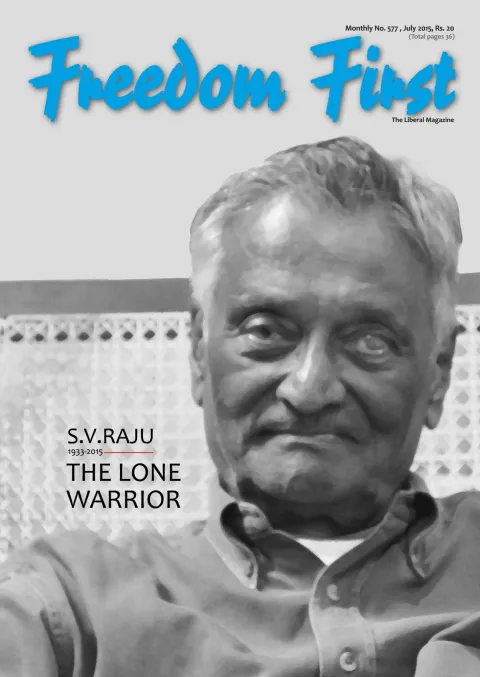
Freedom First
Summary
This is No. 577 (July 2015) of Freedom First, the 64th year of the Bombay-based liberal monthly founded by Minoo Masani. The issue is dedicated almost entirely to the memory of S. V. Raju, the magazine’s long-serving editor and, before that, Executive Secretary of the Swatantra Party, who died in 2015. A publisher’s note explains that with Raju gone and print resources exhausted, this is effectively the end of the print edition of Freedom First, which will continue only online — a fact that gives the whole issue an elegiac, valedictory character. Roughly two-thirds of the pages are personal and political tributes from family, colleagues and fellow liberals (Vivek Raju, Nitin G. Raut, Y. Sivaji, Sharad Joshi, Minoo Adenwalla, Ronald Meinardus, V. Krishna Moorthy and a page of shorter notes from friends), tracing Raju’s role as the administrative backbone of the Swatantra Party from 1959, his later stewardship of Freedom First and the Indian Liberal Group, and his lifelong advocacy for free markets, the Tibetan cause and constitutional liberalism against the ‘diktat’ of compulsory socialism in Indian party registration law.
The remainder of the issue continues Freedom First’s regular mix: Sunil Bhandare’s economic column on the 2015-16 growth outlook and RBI policy; Ashok Karnik’s ‘Point Counter Point’ feature debating Modi’s first year, AAP’s anti-corruption unit, India-Pakistan cricket and a jail-corruption story; B. Ramesh Babu on the escalating Sino-American confrontation over ‘manufactured’ islands in the South China Sea; the concluding Part III of Usha Thakkar’s scholarly history of the Swatantra Party’s rise and fall in Gujarat; two book reviews (of Ashok Karnik’s own book on Indian intelligence, and of Raju’s last authored book on businessman D. N. Patodia); and an ‘Educating Adults’ section with essays on mortality, university examination reform, and a light aviation anecdote. The issue closes with a short tribute to Raju’s decades of activism for Tibetan freedom.
Essays
Truly, The Complete Man
By Vivek Raju
Raju’s elder son Vivek offers a domestic counterpoint to the political tributes elsewhere in the issue, portraying his father as ‘the Complete Man’ beyond his public role. He recounts Raju’s difficult childhood (his mother died when he was four; he was raised by an uncle in Bombay), his 1961 marriage to Kumud, a nurse he met while hospitalised, and the modest 350-sq-ft Chembur home the family built from nothing. The piece emphasises Raju’s non-interfering, listening temperament as a father, his wide-ranging tastes in music and film, and his deep personal debt to Minoo Masani, in whose circle (Rajaji, N. G. Ranga, Sir Homi Mody and others) the 26-year-old Raju found his political vocation as Executive Secretary of the newly formed Swatantra Party.
- Raju’s mother died when he was four; he was raised by an uncle after his father remarried, an experience his son says shaped his lifelong need for a stable family and home.
- He married Kumud, a nurse at KEM Hospital, in 1961; the marriage and home life were described as the ‘backbone’ of his intellectual and political career.
- At 26, in 1959, he became Executive Secretary of the fledgling Swatantra Party, a role decisively shaped by exposure to Rajaji, Minoo Masani and other founding figures.
- Minoo Masani is described as Raju’s biggest influence, held in the highest regard for integrity and clarity of thought.
- The son describes Raju as non-interfering with his children’s career choices, including supporting a move from a corporate career to non-profit work.
- The essay frames Raju’s public passions (liberalism, Swatantra, Freedom First) as inseparable from, and secondary to, his identity as a devoted family man.
S. V. Raju: A Political Rishi
By Nitin G. Raut
Nitin G. Raut’s tribute casts Raju as the indispensable but self-effacing administrator behind the Swatantra Party’s public-facing leaders. It traces his tenure as Executive Secretary from 1959 to 1974, his frugality and refusal of government perks even when the Party held power in Orissa, his role safeguarding Party funds and the Maharashtra unit’s assets after the national organisation dissolved, and his unsuccessful legal challenge to the law compelling parties to swear allegiance to ‘socialism’ to gain Election Commission recognition. The essay credits Raju with keeping the liberal idea alive through Freedom First after Swatantra’s practical demise, cautiously welcoming Narendra Modi’s 2014 victory as a long-delayed vindication of Swatantra’s economic vision.
- Raju became Executive Secretary of the Swatantra Party in 1959 at age 26 and served until 1974.
- In the 1967 Lok Sabha elections the Party won 44 seats (its historic high) and briefly co-governed Orissa; Raju refused government cars, guesthouses and other perks as a matter of principle.
- When a faction sought to merge the Maharashtra Swatantra Party into the Bharatiya Lok Dal, Raju’s unit refused, retaining its premises in hope of reviving a liberal party.
- Raju filed a pending writ petition in the Bombay High Court challenging Section 29(A) of the Representation of the People Act, which requires parties to commit to ‘socialism’ for Election Commission registration.
- The essay frames Raju’s shift of focus to Freedom First after 1992, when Narasimha Rao partially embraced free-market reforms, as vindication of the Swatantra free-market critique.
- Raju lived simply in a two-and-a-half room MHADA flat in Chembur to the end of his life.
Raju Lived for a Cause
By Y. Sivaji
Y. Sivaji, a former Rajya Sabha MP and founder of Shetkari Sanghatana, recalls a 60-year association with Raju going back to the founding of the Swatantra Party in 1959. He credits Raju with sustaining Swatantra’s liberal seed through the Project for Economic Education after the Party’s practical collapse, helping found the Swatantra Bharat Paksha (SBP) in 1994 with Shetkari Sanghatana, and supporting Sivaji’s farmer-debt advocacy that contributed to the Government of India’s 2008 waiver of Rs. 65,000 crore in farm debt. Sivaji closes by describing Raju as a humble ‘loner’ who carried the liberal cause to the end, ahead of a nation only now catching up to the LPG (liberalisation, privatisation, globalisation) vision of Rajaji, Masani and Ranga.
- Sivaji first encountered Raju through the Swatantra Party in the mid-1960s and maintained the friendship through the 1994 founding of the Swatantra Bharat Paksha (SBP).
- Raju helped organise the SBP’s founding gathering (28 May 1994, Bharatiya Vidya Bhavan, Mumbai) where Ram Jethmalani disputed the Party’s attempt to exclude ‘socialism’ from the Constitution’s Preamble.
- Raju supported Sivaji’s 1995 Shetkari Sanghatana workshops and helped organise the SBP’s 1995 Maharashtra Assembly election campaign using Swatantra-era publicity material.
- A 2004 Guntur meeting organised at Raju’s encouragement on agricultural indebtedness fed into the Government of India’s 2008 waiver of Rs. 65,000 crore in farmers’ debt.
- Raju’s insistence connected the Indian Liberal Group to the Friedrich Naumann Foundation and the International Liberal Organization in Germany.
- The essay frames Rajaji, Masani and Ranga’s free-market vision as prophetic, since it was only adopted decades later, often reluctantly, under the banner of LPG reforms.
Memories of S. V. Raju
By Sharad Joshi
Sharad Joshi, the farmers’ leader and founder of Shetkari Sanghatana, recounts how Raju travelled to Ambethan in January 1994 to connect Shetkari Sanghatana’s free-market farmer politics with the dormant seed of Rajaji’s Swatantra Party, resulting in the formation of the Swatantra Bharat Paksha (SBP). He credits Raju with facilitating the SBP’s 1994 founding convention at Nagpur, its 1995 Maharashtra Assembly campaign, and Joshi’s own international liberal networking, including representing the Indian Liberal Group at a Friedrich Naumann Foundation-organised meeting in Germany and a 1995 Pune workshop attended by then finance minister Manmohan Singh.
- Shetkari Sanghatana’s free-market philosophy on agricultural pricing led it to seek out the dormant Swatantra Party, discovering Raju as custodian of its ‘seed’ under Masani’s blessing.
- Raju helped publish a collection of Joshi’s articles (‘Answering Before God’) through the Project for Economic Education, of which he was Executive Director.
- The Swatantra Bharat Paksha (SBP) was founded on 28 May 1994 at Bharatiya Vidya Bhavan, Mumbai, and formally launched at a November 1994 Nagpur convention.
- The SBP contested and lost the 1995 Maharashtra Assembly elections, using Swatantra-era publicity material and cartoons prepared by Raju.
- Raju’s insistence connected Joshi to the Friedrich Naumann Foundation and enabled his participation in a 1995 Pune workshop on economic reforms and agriculture attended by finance minister Manmohan Singh.
- Raju continued soliciting Joshi’s writing after Joshi became a Rajya Sabha MP, including on euthanasia and the women’s reservation bill.
S. V. Raju: A Personal Tribute
By Minoo Adenwalla
Professor Minoo Adenwalla, an American academic who first met Raju in 1967 while researching the Swatantra Party on a Ford Foundation grant, recalls Raju’s warmth and generosity as Party Secretary during the Party’s 1967 heyday, and their friendship’s revival decades later once Raju became editor of Freedom First. The essay notes Raju’s continuing frustration with the slow pace of India’s economic reforms even as the country moved toward positions Swatantra had long advocated, and records that Raju’s final editorials cautiously welcomed Narendra Modi’s 2014 victory as an opportunity for Swatantra’s economic vision, long championed by Masani, Rajaji and Nani Palkhivala.
- Adenwalla met Raju in 1967 through Rustom Cooper while researching the Swatantra Party on an Associated Colleges of the Midwest/Ford Foundation grant.
- Raju gave Adenwalla extensive access to party literature and leaders during the Party’s peak as the second-largest party in the Lok Sabha.
- Contact lapsed when Raju left for the Middle East in 1980 and resumed only in 1998 via Nani Palkhivala, after Raju had returned and become editor of Freedom First.
- Adenwalla contributed articles to Freedom First over subsequent years and met Raju again in 2004 and 2006.
- Raju remained critical of the slow pace of economic reform and continued government dominance of economic policy even as India moved toward Swatantra’s positions.
- Raju’s last editorials cautiously welcomed Narendra Modi’s 2014 election victory as a long-awaited opportunity for economic liberalisation.
My First and Only Meeting with S. V. Raju
By Ronald Meinardus
Ronald Meinardus, Regional Director (South Asia) of the Friedrich Naumann Foundation for Freedom, recalls his only meeting with Raju shortly after arriving in India, describing him as ‘the personification of liberalism in India’ with a decades-long relationship with the Foundation. Raju spoke of his commitment to Tibet as a matter of principle even amid difficulty, and presented recent issues of Freedom First covering Narendra Modi’s rise, explaining his qualified support for Modi as the right man for the moment, though not for his party.
- Meinardus’s Foundation had a decades-long partnership with Raju and the Indian Liberal Group, representing India at international liberal fora.
- Raju told Meinardus his association with the Friedrich Naumann Foundation dated back to 1963.
- Raju described his life’s mission as pushing an open society based on minimum government and maximum freedom in the Indian context.
- Raju maintained a visible commitment to the Tibetan cause, meeting Meinardus in an office with a large Tibetan flag.
- Raju expressed cautious, conditional support for Narendra Modi (‘We need somebody who after years of inaction is giving us action… But not his party’) shortly before his death.
- Mint editor Niranjan Rajadhyaksha’s obituary of Raju is quoted describing the moral courage required to fight a losing battle.
My First and Last Meeting with S. V. Raju
By V. Krishna Moorthy
V. Krishna Moorthy, CEO of Parivarthan, Mysore, describes a five-decade association with Freedom First beginning as a college student, including an early book review for founder Minoo Masani and, after retirement, more regular contributions solicited and ruthlessly but valuably edited by Raju. He recounts his sole in-person meeting with Raju on 29 November 2014 at his Fort-area office, a nearly two-hour conversation covering the founding of the Swatantra Party, the state of parliamentary debate, and Raju’s plans for future issues, ending with a gift of Raju’s own book on D. N. Patodia. Raju’s final correspondence, in May 2015, forwarded the magazine’s Subhas Chandra Bose issue with a joking note about his own illness.
- Moorthy’s association with Freedom First began in the early 1960s as a Mysore college student and continued as a contributor after Minoo Masani first invited him to review a book.
- After a 25-year gap, Moorthy resumed writing for Freedom First around 2010, including a review of S. Gurumurthy’s book on black money commissioned by Raju.
- Raju edited Moorthy’s overlong submissions firmly but effectively, always improving the final published piece.
- Moorthy’s only in-person meeting with Raju was on 29 November 2014, a nearly two-hour discussion covering Swatantra’s founding and current affairs including the Swachh Bharat Abhiyan.
- Raju gave Moorthy a parting gift: his own book, ‘How Businessmen Can Enrich Public Life: D. N. Patodia – Reflections.’
- Raju’s last communication to Moorthy, on 2 May 2015, forwarded the May 2015 Freedom First issue on Subhas Chandra Bose; the April 2015 issue was his last as editor.
Tributes from Friends
A compilation of brief tributes from readers, colleagues and institutions — including Sameer Wagle, Keki J. Patel, Adi H. Doctor, Dr. T. Hanuman Chowdary, Dr. Jyoti Marwah, the Board of LiberalsIndia for Good Governance, and businessman Jaitirth (Jerry) Rao — converge on a common portrait of Raju as humble, dedicated, intellectually rigorous and unswervingly committed to liberal values despite decades without personal reward or public recognition, in contrast to the more prominent, sometimes difficult personalities of Masani, Ranga and Rajaji.
- Multiple contributors emphasise Raju’s humility and lack of pretension despite his decades at the centre of the Swatantra Party and Indian liberal movement.
- Dr. T. Hanuman Chowdary credits Raju’s sense of time and discipline to Minoo Masani’s influence, and his persistence in publishing Freedom First despite financial constraints.
- The Board of LiberalsIndia for Good Governance recalls Raju walking roughly two kilometres to a board meeting a month before his death despite frail health.
- Jaitirth (Jerry) Rao’s boxed tribute contrasts Masani’s flamboyance, Ranga’s one-dimensionality and Rajaji’s crankiness with Raju’s steady, unglamorous role as the ‘backbone’ of Swatantra.
- Several contributors describe Raju as a mentor to younger liberals and students who wrote for Freedom First.
Economy’s Trouble Spots and A Way Forward
By Sunil S. Bhandare
Economist Sunil S. Bhandare surveys India’s economy in mid-2015, arguing that despite a headline GDP growth rate of 7.3% in 2014-15 — an apparent improvement on the previous year and briefly surpassing China’s quarterly rate — the recovery remains fragile and below potential. He details the RBI’s cautious 25-basis-point rate cuts (cumulative 75 bps since January 2015) and downgraded growth forecast, a global backdrop of slow and uneven recovery (US contraction, Eurozone quantitative easing, Chinese deceleration), and domestic trouble spots including negative agricultural growth, weakening merchandise exports, a shrinking foreign-trade share of GDP, and declining savings and investment ratios. He closes with a five-point policy agenda: implementing 2015-16 budget reforms including GST, consolidating diplomatic-economic gains, further monetary easing contingent on inflation control, executing infrastructure investment plans, and coordinated delivery on ‘Make in India.’
- Real GDP growth was 7.3% in 2014-15, up from 6.9% in 2013-14, but the RBI has downgraded its 2015-16 growth forecast from 7.8% to 7.6% while raising its inflation projection to 6% by January 2016.
- Agricultural GVA growth turned negative (-1.1% and -1.4%) in the last two quarters of 2014-15, compounding concerns over a below-average monsoon forecast and El Nino risk.
- Manufacturing growth accelerated to 7.1% in 2014-15 from 5.3%, but industrial production and infrastructure output numbers do not yet confirm a robust recovery.
- Foreign trade as a share of GDP fell from 55.6% (2012-13) to 47.1% (2014-15), driven partly by falling oil prices but also by contracting exports and stagnant investment imports.
- Gross fixed capital formation as a share of GDP fell from 31.9% (2012-13) to 30% (2014-15), reflecting a broader multi-year decline in savings and investment ratios.
- Bhandare recommends implementing GST and other 2015-16 budget reforms, further monetary easing tied to inflation control, execution of infrastructure investment plans, and delivery on ‘Make in India,’ including scrapping a proposed 1% inter-state GST sales tax and liberalising multi-brand retail FDI.
Point Counter Point
By Ashok Karnik
In this recurring feature, Ashok Karnik presents paired ‘point’ and ‘counter-point’ perspectives on four current issues: Narendra Modi’s first year in power, the Delhi AAP government’s proposed expansion of its Anti-Corruption Branch, the prospect of resuming India-Pakistan cricket ties, and a controversial media report alleging a jailed 1993 Mumbai bomb-blasts accused ran a business from Arthur Road jail. Across the entries, Karnik’s format deliberately withholds a single verdict, instead laying out the strongest case on each side to let readers form their own judgment.
- On Modi’s first year, the ‘point’ argues public faith in Modi persists despite unfulfilled promises and confused, ideologically slanted media commentary; the ‘counter-point’ argues no government could have delivered on election-era hype and highlights unresolved risks from Hindu-right activism (Ghar Wapsi, Ram Mandir, beef ban) and the Land Acquisition Bill.
- On AAP’s proposed Anti-Corruption Branch expansion, the ‘point’ questions why Delhi needs such surveillance capacity given limited police powers; the ‘counter-point’ argues the ACB is AAP’s only offensive tool given no control over Delhi Police, but warns of danger in targeting Union government offices.
- On cricket with Pakistan, the ‘point’ notes financial incentives for the Pakistan Cricket Board and BCCI dependence on government sentiment; the ‘counter-point’ argues undeclared war conditions (daily border incursions) make resumption naive and risky.
- On the Arthur Road jail story, the ‘point’ argues Indians tend to believe rumours reflecting badly on public institutions given prior scandals; the ‘counter-point’ argues the story implies systemic failure across the police escort, jail authorities and anti-terrorist squad, and questions where accountability lies.
- The feature’s title and standing rubric frame it explicitly as a tool for considered opinion rather than editorial advocacy.
Foreign Relations in the 21st Century: “Manufactured Sovereignty” in South China Sea
By B. Ramesh Babu
B. Ramesh Babu analyses the escalating confrontation between China and the United States over China’s large-scale island-building in the disputed Spratly Islands of the South China Sea, situating it within decades of overlapping territorial claims among Vietnam, Malaysia, Brunei, the Philippines and Taiwan. He traces the diplomatic history from a 2002 ASEAN non-binding restraint agreement, through China’s accelerated dredging after Xi Jinping’s 2009 rise, to 2015 flashpoints including Chinese warnings of ‘war’ if reclamation is obstructed, near-confrontations with American surveillance aircraft, a Chinese policy shift toward ‘open seas protection,’ and expanded Chinese nuclear-missile capability (MIRVs). The essay situates this alongside a more assertive Japan under Shinzo Abe and a renewed ten-year US-Japan defence treaty, and closes by urging the US and its allies to counter China’s rise before it consolidates a fait accompli.
- China created a roughly 2,000-acre artificial island in the disputed Spratly Islands’ Mischief Reef through large-scale sand dredging.
- A 2002 ASEAN-China non-binding agreement to ‘exercise restraint’ broke down after 2009, when dredging operations scaled up massively under President Xi Jinping.
- In May 2015 China’s top diplomat warned of ‘war’ if island reclamation were obstructed, while its Foreign Minister called China’s South China Sea claims ‘unshakeable.’
- American P-8A Poseidon surveillance flights near Chinese construction sites drew repeated warnings from the Chinese navy in May 2015; the US sent ships into nearby international waters by June 2015.
- China’s 2013 unilateral air defence identification zone over the South China Sea, defied by US B-52 flights, and its 2015 policy shift toward ‘open seas protection’ and re-engineered multi-warhead (MIRV) missiles signal a long-term challenge to American hegemony.
- Japan under Shinzo Abe adopted a more assertive ‘proactive pacifism,’ renewing its US defence alliance for ten years in April 2015 partly in response to Chinese pressure over the Senkaku/Diaoyu islands.
- The essay notes a parallel Chinese charm offensive toward India (trade, investment, a proposed trilateral partnership with Russia) even as it presses claims in the South China Sea and over Arunachal Pradesh.
The Swatantra Party in Gujarat: A Shooting Star (Part III)
By Usha Thakkar
In the concluding part of a three-part scholarly history, Usha Thakkar traces the Swatantra Party’s decline in Gujarat from its impressive 1967 electoral showing to its total collapse by 1972. She attributes the fall to factional and caste-based rifts (particularly between Kshatriya and Patidar communities), personality clashes among leaders including Masani, Dandekar, Piloo Mody, H. M. Patel and Bhaikaka, disputes over election tickets and candidate selection, damaging internal crises such as the 1968 Rajya Sabha nomination fight, mass MLA resignations following Jaydeepsinhji’s 1970 departure, and the Party’s failure to build a genuine grassroots organisational base, relying instead on ex-rulers, bureaucrats and disaffected Congressmen with incompatible motives. The essay closes by crediting the Party with real, if short-lived, achievements in opposition politics and legitimising caste-based electoral competition in Gujarat, and cites S. V. Raju’s own 2009 assessment that Swatantra, unlike most post-independence parties, at least persisted in some form.
- The Swatantra Party captured all Lok Sabha and Assembly seats in Sabarkantha district in 1967 largely through the political weight of the ex-ruler of Idar, but internal cohesion soon collapsed.
- Traditional Kshatriya-Patidar rivalry, disputed candidate selections, and resentment of ‘outsider’ central leaders (Masani, Dandekar, Piloo Mody, C. C. Desai) weakened the Gujarat unit from within.
- A 1968 Rajya Sabha nomination dispute — in which rebel U. N. Mahida defeated the Party’s official candidate Babubhai Vaidya — exposed the Party’s lack of internal discipline and led senior leaders including Bhaikaka, Jaydeepsinhji and Masani to resign their posts.
- In 1971, following Congress splits and Indira Gandhi’s landslide mid-term election victory, the Swatantra Party’s Gujarat strength collapsed from 66 seats to 11, and it won zero of 168 assembly seats in the 1972 elections.
- A section of the Party finally merged into the Bharatiya Lok Dal under Charan Singh in 1974; a writ petition against the compulsory-socialism registration requirement, filed by the late L. R. Sampat and S. V. Raju in 1996, remained pending.
- The author’s conclusion frames the Party’s rapid rise and rapid decline as two sides of the same failure to invest in party-building, alongside a wide but incompatible social coalition of landlords, peasants, ex-rulers, businessmen and disaffected Congressmen.
Book Review: Intelligence – An Insider’s View by Ashok Karnik
By Reviewed by Suresh C. Sharma
Brig. Suresh C. Sharma reviews ‘Intelligence — An Insider’s View’ by Ashok Karnik, a 37-year Intelligence Bureau veteran, praising it as an objective, non-autobiographical account of India’s security and intelligence issues rather than a self-justifying memoir. The review summarises the book’s treatment of the 1962 China war and the IB/RAW split that followed, its rejection of claims that intelligence agencies serve ruling-party interests, its critical view of the Panchsheel Agreement’s cost to Tibet, and its analysis of terror threats, human-rights criticism of security forces, and intelligence failures around 26/11 and Kargil, alongside excerpts from Freedom First articles on security and governance including the Headley trial and Afzal Guru’s execution.
- Karnik’s book is described as objective and non-autobiographical, addressing India’s lack of a practice of declassifying historical intelligence records.
- The book argues IB personnel were exposed to risk without protection when ordered to man forward observation posts before the 1962 Chinese attack in NEFA and Ladakh.
- The 1962 debacle led to the creation of separate IB (internal) and RAW (external) intelligence organisations; Rajiv Gandhi’s attempt to broaden the IB’s mandate is said to have failed.
- The book criticises the Panchsheel Agreement as having sacrificed Tibet and India’s vital interests, and argues China has never conceded territory in border negotiations.
- Karnik argues 26/11 intelligence was ignored on the excuse it was ‘non-actionable,’ and that a book called ‘Siege’ claims the US gave 26 prior warnings about the Mumbai attack.
- The review notes the book’s second part excerpts Freedom First articles on security, governance and corruption, including the Headley trial, Afzal Guru’s 2013 execution, and the Kandahar hijacking hostage exchange.
Book Review: How Businessmen Can Enrich Public Life – D. N. Patodia - Reflections by S. V. Raju
By Reviewed by Peter Greenhalgh
Peter Greenhalgh reviews S. V. Raju’s last authored book, ‘How Businessmen Can Enrich Public Life — D. N. Patodia — Reflections’ (2014), a curated collection of speeches and reminiscences of businessman-parliamentarian D. N. Patodia compiled and annotated by Raju. The review praises the book’s five-section structure covering inter-state/federal relations, Tibet and Russia, the ‘Third Industrial Revolution,’ Indian business opportunities and challenges, and appendices of FICCI-era speeches, noting Patodia’s prescient criticism of Planning Commission failures, over-regulation and state control of the economy, whose relevance the reviewer connects to Prime Minister Modi’s ‘Make in India’ campaign. A closing reader’s comment from Dr. N. Bhaskara Rao further praises Raju’s editorial achievement and Patodia’s contribution to public life.
- The book compiles and annotates decades of speeches by D. N. Patodia, an eight-decade witness to and participant in India’s economic and political change.
- Patodia was FICCI President in 1985 and is credited with reform initiatives during a period when the Indian economy was recognised as stagnating relative to Asian neighbours.
- The book criticises Planning Commission Five-Year Plan failures, agricultural neglect, bank nationalisation inefficiencies, and the costs of the India-USSR rupee-rouble trade relationship.
- Patodia’s liberal economic views from the 1960s-1980s, then far from the mainstream, are described as vindicated by subsequent economic liberalisation and the ‘Make in India’ campaign.
- The reviewer’s suggested improvements include adding an index, clarifying acronyms for younger and foreign readers, and better distinguishing DNP’s voice from S. V. Raju’s editorial commentary.
- A closing reader’s comment from Dr. N. Bhaskara Rao calls the book an ‘unusual’ and enriching achievement that exposes lapses in Indian policy and deserves wide readership among parliamentarians.
Educating Adults: Life and Death
By Firoze Hirjikaka
Prompted by S. V. Raju’s sudden death from a minor infection, Firoze Hirjikaka reflects on mortality and the proper use of free will in life, arguing that death is beyond human control but life is not. He criticises superstition, ritualistic bargaining with God, and the pursuit of wealth, status and prestige at the expense of family relationships, arguing that the quality of an afterlife (however conceived) depends entirely on how one treats others in this life, not on rituals, pilgrimages or wealth.
- Raju’s sudden death from a minor, non-life-threatening infection is presented as illustrating that death, unlike life, is entirely outside human control.
- The essay criticises superstition, idol-worship of gold and jewellery, and transactional bargaining with God through pilgrimages or rituals as squandering the gift of free will.
- It argues one’s fate in an afterlife (whatever form that takes) depends entirely on how one treats other people during life, not on religious observance.
- The essay warns against relentless pursuit of money, status and career at the cost of family relationships, describing regret that can surface too late, around age 70.
- It concludes that funeral rituals and disposal-of-the-dead controversies are ultimately for the comfort of the living, not the deceased.
- The recurring advice is to live each day mindfully, make amends promptly, and avoid harbouring grudges.
Educating Adults: Examination Reforms at the Bachelors’ Level
By R. W. Desai
R. W. Desai argues that rampant, television-exposed cheating has made India’s university examination system a farce that stricter enforcement cannot fix without turning teachers into unwilling disciplinarians. He proposes a dual-track bachelor’s degree: a conventional ‘B.A. by examination’ and a new ‘B.A. examination free’ available to students who maintain 80% lecture attendance, arguing this would remove the incentive to cheat, better serve students uninterested in competitive-exam preparation, and protect institutions from graduates whose credentials were obtained dishonestly, while acknowledging the market value of the new degree remains untested.
- Widespread, televised cheating incidents have exposed the failure of India’s university examination system despite invigilation.
- Desai argues policing students is properly the job of specialised testing bodies (UPSC, CAT, CLAT, etc.) with resources to enforce discipline, not university teachers.
- He proposes creating a ‘B.A. examination free’ degree requiring only 80% lecture attendance, alongside the conventional ‘B.A. by examination.’
- Students caught cheating in the examination track would be transferred to the examination-free track as a deterrent.
- Desai acknowledges the market value of the proposed ‘examination free’ degree is speculative and unprecedented, inviting critical responses.
- He argues the reform would remove the temptation to cheat while still preparing motivated students for competitive tests via coaching institutes.
Educating Adults: A Doctor in the Air: Ancient Aviator Anecdote
By Cecil Parker
Retired Air Vice Marshal Cecil Parker recounts a light anecdote about air force squadron medical officers, focused on a newly posted ‘Doc’ in 1970 who was initially uncomfortable in his role and unpopular for his teetotal strictness, until Parker arranged his first-ever flight in a Hunter trainer aircraft under a little-known IAF regulation allowing medical officers an air-experience sortie. The Doc later served loyally through the 1971 Indo-Pak war despite an injury, and the two stayed in touch over subsequent decades as the Doc became a senior medical specialist.
- Air force squadron medical officers report both to a Senior Medical Officer and their unit’s commanding officer, a dual structure that can confuse new recruits from civilian medical colleges.
- A newly posted ‘Doc’ in 1970 was initially resented by young officers for his strict, teetotal stance and unfamiliarity with squadron culture, prompting some good-natured mischief.
- Parker arranged the Doc’s first-ever flight using a little-known IAF regulation entitling medical officers to an air-experience sortie, after which the Doc became more relaxed and popular.
- During the 1971 Indo-Pak war, the Doc stayed with the squadron on the tarmac at Pathankot despite a leg injury, proving a valuable asset.
- Parker later gifted the Doc a set of flying overalls with a squadron crest, which the Doc was not formally entitled to but had requested.
- Decades later the two reconnected in the NCR, where the Doc had become a senior specialist and consultant, with three daughters, two in the medical profession.
S. V. Raju: A Staunch Supporter of the Tibetan Cause
A short unsigned tribute describes S. V. Raju’s four-decade role as a founder of Friends of Tibet, Bombay, and a tireless organiser of Mumbai events supporting Tibetan freedom, including his final public appearance on World Human Rights Day (10 December 2014) despite ill health. Colleagues Sethu Das and Rohit Singh, and Tibetan poet-activist Tenzin Tsundue, pay tribute to Raju’s steady support, with the Rangzen Conference’s May 2015 four-point declaration on Tibetan freedom dedicated to his memory.
- Raju founded Friends of Tibet, Bombay, in the 1960s and remained active in organising Mumbai events on the Tibetan cause for roughly 40 years.
- His last public appearance on the cause was at a World Human Rights Day event on 10 December 2014, where he spoke at length despite ill health.
- Tibetan poet-activist Tenzin Tsundue dedicates the declaration of the International Rangzen Conference (New Delhi, May 2015) to Raju’s memory.
- The Rangzen Conference’s four-point commitment covers the Tibetan freedom struggle, the situation inside Tibet, Tibetan unity, and garnering international support.
- Tenzin Tsundue and fellow Tibetans planned to light one hundred butter-lamps for Raju’s soul’s journey into the next life.
Generated by the v1.5 extraction pipeline. Awaiting editorial review.
Metadata and summary are AI-extracted from the source PDF and reviewed for editorial accuracy. The original work is available via the Read PDF tab above (where present); paragraph-level citation inside the PDF is deferred to a future engagement.