book · biography
M. R. Pai
The Story of an Uncommon Common Man
By S. V. Raju
M.R. Pai Foundation, Mumbai · Mumbai · 2008
107 pages
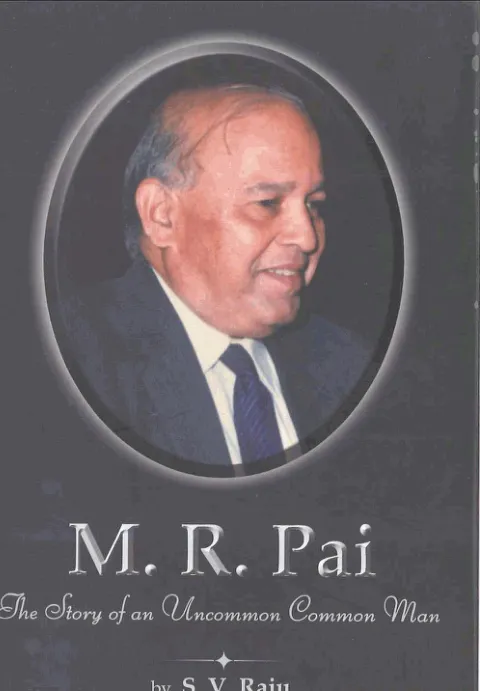
M. R. Pai
By S. V. Raju
Summary
In the rendered pages (front matter plus the opening chapters of a 107-page biography), S. V. Raju introduces M. R. Pai as an ‘uncommon common man’ and explains why he undertook the book: invited by Gita Pai and S. Divakara, Raju found that what he knew of his friend of over four decades was only ‘the proverbial tip of the iceberg.’ The Foreword (by Ajay Piramal, Chairman of the M.R. Pai Foundation) and the authorial Introduction frame Pai as a one-man consumer movement and a builder of the Forum of Free Enterprise rather than a conventional public figure, and Raju states his aim is to tell the story plainly and let readers draw their own lessons.
The chapters seen in the rendered pages trace Pai’s origins and early life. Chapter 1 (‘Mangalore’s Ranganna’) sets him among the Gowd Saraswat Brahmins of coastal Karnataka, records his birth at Manjeshwar on 7 May 1931, and portrays the boy ‘Ranganna’ as quiet, studious, an avid amateur photographer and an early writer who circulated a handwritten Kannada neighbourhood newsletter; a youthful nationalist and socialist who would later become a champion of free enterprise. Chapter 2 (‘The Choice of a Vocation’) follows him from Presidency College, Chennai, to a sub-editor’s post at The Times of India and a first-class journalism Master’s from UCLA earned by working his way through. Chapter 3 (‘Managing the Family’) covers his 1955 move to Mumbai, his 1958 marriage to Gita, and his role as the head of a household Raju describes as liberal and harmonious.
Key points
-
In the rendered pages the work is established as a single-author biography of M. R. Pai written by S. V. Raju, with a Foreword by Ajay Piramal and an authorial Introduction.
-
Raju, who knew Pai for over forty years through the Forum of Free Enterprise, calls the biography a ‘re-discovery of a very unusual person.’
-
Chapter 1 (‘Mangalore’s Ranganna’) traces Pai’s GSB origins, his birth at Manjeshwar on 7 May 1931, and his childhood as ‘Ranganna’ in a Mangalore joint family.
-
The young Ranganna is depicted as quiet and studious, a keen amateur photographer, and an early writer who circulated a handwritten Kannada neighbourhood newsletter.
-
In his early years he was a nationalist (influenced by Mahatma Gandhi, an admirer of Subhas Chandra Bose) and a socialist who later became a champion of free enterprise while remaining a staunch nationalist.
-
Chapter 2 (‘The Choice of a Vocation’) covers his graduation from Presidency College, Chennai, a sub-editor post at The Times of India in Mumbai, and a first-class journalism Master’s from UCLA.
-
Chapter 3 (‘Managing the Family’) describes his 1955 move to Mumbai, his 1958 marriage to Gita, and his role as head of a ‘liberal and harmonious’ household.
-
The rendered pages cover only chapters 1-3 of ten; the consumer activism, Forum work, and spiritual chapters lie beyond this chunk.
Generated by the v1.5 extraction pipeline. Awaiting editorial review.
Metadata and summary are AI-extracted from the source PDF and reviewed for editorial accuracy. The original work is available via the Read PDF tab above (where present); paragraph-level citation inside the PDF is deferred to a future engagement.