book · collected works
Natural Order
Essays Exploring Civil Government & The Rule of Law
396 pages
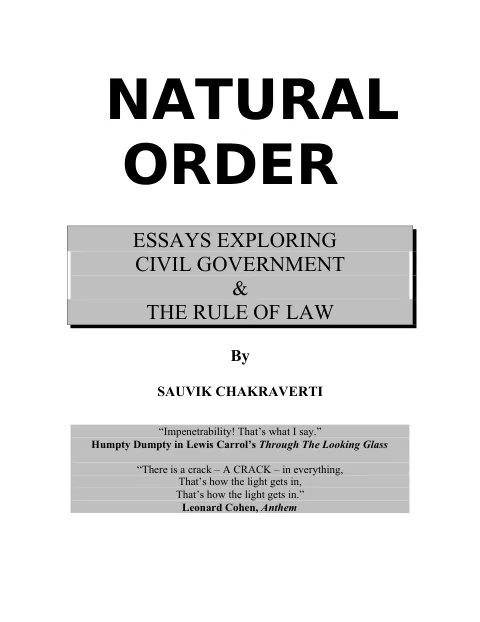
Natural Order
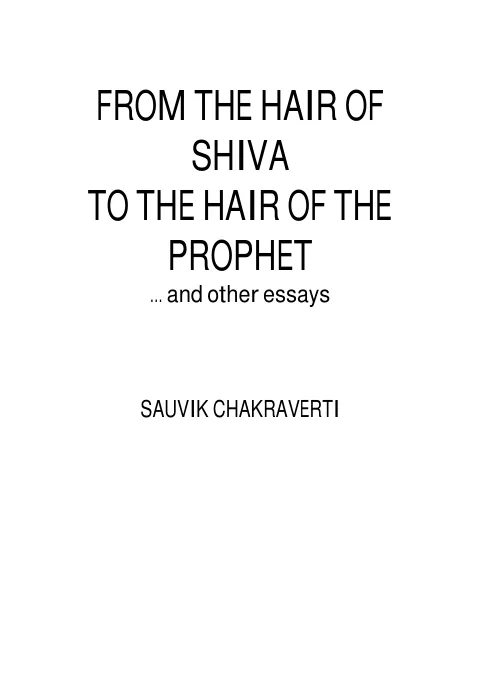
By SAUVIK CHAKRAVERTI
Summary
In the rendered pages (cover, dedication ‘To Varuna’, contents, the Introduction and the opening of Chapter One), Sauvik Chakraverti sets out a classical-liberal manifesto on civil government and the rule of law. The Introduction (‘The Historical Setting of this Volume’) diagnoses, in the rendered pages, a ‘quiet crisis… a crisis of legitimacy’ in the socialist Indian state: a government that ‘does not know how to govern,’ that taxes the productive to ‘teach the unlettered’ while courts and police fail and over 100,000 people die yearly on ‘India’s anarchical streets.’ Chakraverti argues that India ‘aped English institutions without the liberal ideals upon which they are based,’ and proposes to trace how the rule of law emerged in England — a lineage running, in the rendered pages, from John Locke through the Scottish Enlightenment to Hayek, with Peter Bauer, Hernando de Soto and B. R. Shenoy cited as defenders of liberal ideals for the Third World.
In the rendered pages, Chapter One (‘The Presumption of Natural Order’) develops the book’s central idea: that a spontaneous order exists in society independent of any single will. Pointing to crowded commercial streets — Delhi’s Chandni Chowk, London’s Oxford Street — where order persists without ‘posses of armed policemen,’ Chakraverti casts Homo Economicus as a ‘rule-following animal’ whose market is a ‘complex, competitive and impersonal’ order anterior to all government. Echoing Hayek’s dictum that ‘what cannot be known cannot be planned,’ he frames central planning and socialism as an ‘abuse of reason’ and a ‘false and absurd social science,’ and defines good government as that which preserves the self-ordering market rather than preying on it with the ‘evil eye.‘
Key points
-
In the rendered pages the work is a single-author classical-liberal book of essays by Sauvik Chakraverti, dedicated ‘To Varuna’.
-
The Introduction diagnoses a ‘crisis of legitimacy’ in the socialist Indian state that ‘does not know how to govern’.
-
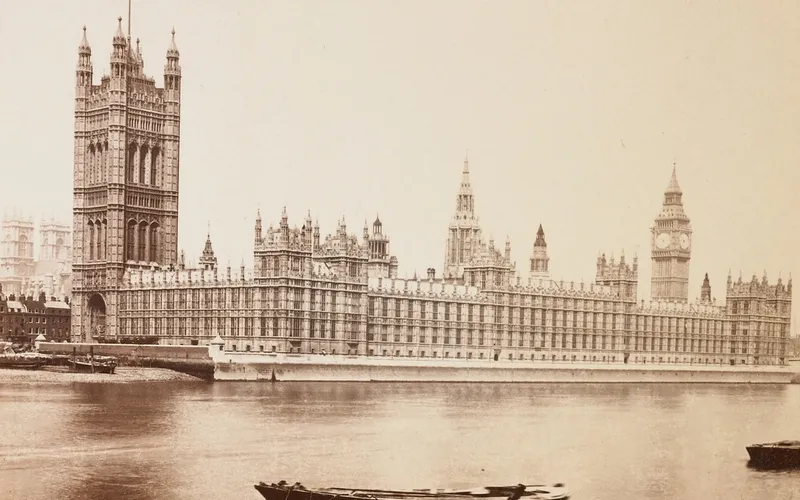
Chakraverti argues India adopted English (Westminster) institutions without the liberal ideals underpinning them.
-
He traces a liberal lineage from John Locke through the Scottish Enlightenment to Hayek, invoking Bauer, de Soto and B. R. Shenoy.
-
Chapter One advances the thesis of a spontaneous ‘natural order’ existing independently of any single human will.
-
He illustrates order with crowded commercial streets that function without policing, casting man as a ‘rule-following animal’.
-
He attacks central planning and socialism as an ‘abuse of reason’ and a ‘false and absurd social science’, citing Hayek.
-
Good government, he argues in the rendered pages, preserves the market order; bad government preys on it with the ‘evil eye’.
Generated by the v1.5 extraction pipeline. Awaiting editorial review.
Metadata and summary are AI-extracted from the source PDF and reviewed for editorial accuracy. The original work is available via the Read PDF tab above (where present); paragraph-level citation inside the PDF is deferred to a future engagement.