pamphlet
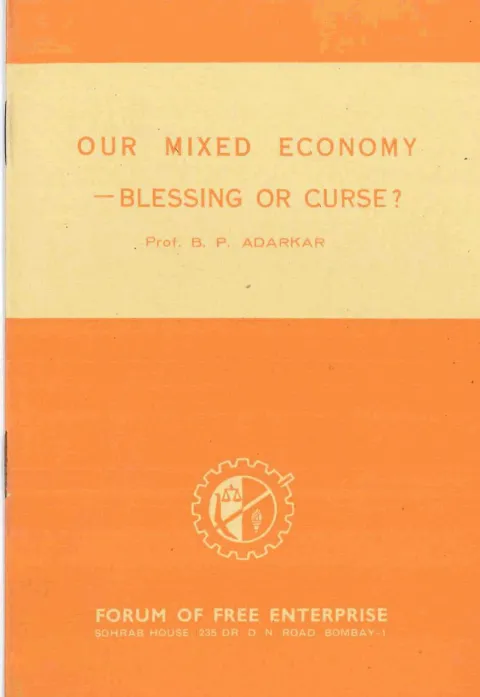
Our Mixed Economy: Blessing or Curse?
Published by M. R. Pai for the Forum of Free Enterprise, "Sohrab House", 235 Dr. Dadabhai Naoroji Road, Bombay-1, and printed by H. Narayan Rao at H. R. Mohan & Co. (Press), 9-B Cawasjee Patel Street, Bombay-1 · Bombay · 1971
17 pages
Our Mixed Economy: Blessing or Curse?
By Prof. B. P. Adarkar
Summary
Our Mixed Economy: Blessing or Curse? is a Forum of Free Enterprise pamphlet reproducing a speech delivered on 23 November 1971 by Prof. B. P. Adarkar — formerly Economic Adviser in the Ministries of Labour, Finance and External Affairs and later Minister at the Indian Embassy in Bonn, West Germany. Adarkar opens with the claim that the capitalism Marx attacked in Das Kapital, the capitalism of the 18th and 19th centuries, is “dead long ago, dead as the Dodo.” In modern democracies, he argues, capital no longer exploits labour — if anything labour now exploits capital; everyone can be a capitalist through the joint-stock principle as a shareholder; extensive Social Insurance protects people “from the womb to the tomb”; and steeply progressive taxation already transfers wealth from rich to poor. What he calls the “New Capitalism” therefore delivers both production and welfare more effectively than communism, whose prescriptions he judges hopelessly out-of-date.
Against this backdrop he indicts India’s Mixed Economy and “socialistic pattern of society” as “neither fish nor fowl” — a hybrid compromise that has secured the country the worst of both worlds, the defects of capitalism and communism without the merits of either. Invoking Nehru’s own 1956 caution against “lopping off” the private sector, and quoting Keynes, Milton Friedman, Rajagopalachari and J. R. D. Tata, he contrasts India’s controls with the free-enterprise “economic miracles” of West Germany (Ludwig Erhard’s Wirtschaftswunder, a Phoenix risen from the ashes), Japan, and the Asian success stories of Hong Kong, Singapore and Malaysia. Mrs. Indira Gandhi’s insistence that social justice matters more than prosperity, he counters, is a false antithesis when 40 to 75 million Indians are unemployed and prices are soaring.
The bulk of the pamphlet documents public-sector failure — losses running into crores despite closed markets and monopoly pricing, chronic under-capacity working, and non-technical ICS/IAS management — across steel, hydro-electric projects, telephones, the State Trading Corporation, a new diamond corporation and the nationalised banks. The private sector, by contrast, is the suppressed “Cinderella,” strangled by red tape, the “Red Books” of import-export control, industrial licensing, the Monopoly Commission and the MRTP Act, all of which he says entrench Big Business and breed black money and corruption. He attacks excessive and arbitrary taxation — a top income-tax rate of 97.5 per cent, the wealth tax, and proposed ceilings on property — as the punishment a “thoughtless Government” inflicts on incentive itself, and likens the debt-laden public sector to the demon Bhasmasura who reduces all he touches to ashes.
Adarkar stops short of demanding that the public sector be scrapped, proposing instead a seven-point reform: consolidate the units that work, confine the State to strategic industries, de-nationalise inefficient concerns through the capital market, cut the labyrinth of controls and licensing, overhaul the tax system, concentrate government on infrastructure, and think in terms of “floors” rather than “ceilings” — enriching the poor directly instead of impoverishing the prosperous. Since the private sector accounts for roughly 87 per cent of employment, he argues, freeing it, on the pragmatic lines of Lee Kuan Yew’s Singapore, is the real key to jobs, prosperity and social justice alike.
Key points
-
A Forum of Free Enterprise pamphlet reproducing a speech Prof. B. P. Adarkar delivered in Bombay on 23 November 1971; Adarkar was a former Economic Adviser (Labour, Finance, External Affairs) and Minister at the Indian Embassy in Bonn.
-
Core thesis: classical 18th–19th-century capitalism is “dead as the Dodo”; in modern democracies everyone can be a capitalist via the joint-stock principle, social insurance guards “from the womb to the tomb,” and progressive taxation already redistributes wealth.
-
Condemns the Mixed Economy / “socialistic pattern of society” as “neither fish nor fowl” — a hybrid that gives India the worst of both capitalism and communism.
-
Holds up West Germany’s Wirtschaftswunder under Erhard, Japan, Hong Kong, Singapore and Malaysia as free-enterprise miracles, and cites Nehru’s 1956 warning against abolishing the private sector.
-
Details public-sector failure — losses in crores, under-capacity working, weak non-technical management — in steel, power, telephones, the State Trading Corporation, a diamond corporation and nationalised banks.
-
Argues the private sector is a strangled “Cinderella,” throttled by licensing, the “Red Books” of import-export control, the Monopoly Commission and the MRTP Act, which favour Big Business and breed corruption.
-
Attacks excessive taxation (a 97.5% top income-tax rate, the wealth tax, property ceilings) as destroying incentive and generating black money; likens the debt-laden public sector to the demon Bhasmasura.
-
Proposes a seven-point reform — consolidate viable units, confine the State to strategic sectors, de-nationalise loss-makers, liberalise controls and taxes, focus on infrastructure, and provide “floors” not “ceilings” — citing Lee Kuan Yew’s Singapore as the pragmatic model.
Ingested 2026-07-21 from the CCS source archive. AI-drafted summary awaiting editorial review.
Metadata and summary are AI-extracted from the source PDF and reviewed for editorial accuracy. The original work is available via the Read PDF tab above (where present); paragraph-level citation inside the PDF is deferred to a future engagement.