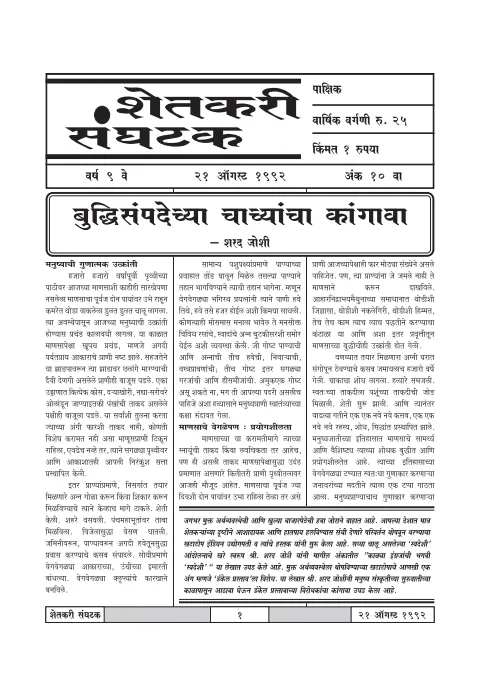
periodical issue
Shetkari Sanghatak
शेतकरी संघटक
Śetkarī Saṅghaṭak
By शरद जोशी
संपादक, मुद्रक, प्रकाशक सुरेशचंद्र म्हात्रे; मालक — मोहन विठारीलाल परदेशी; मुद्रण स्थळ — चाकण प्रिंटिंग प्रेस, चाकण · Chakan, Pune · 1992
8 pages
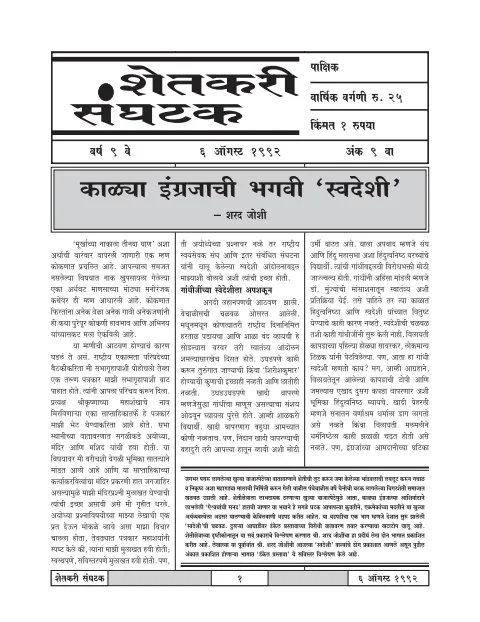
Shetkari Sanghatak
Summary
This is the 6 August 1992 issue (Year 9, Issue 9) of the Marathi fortnightly शेतकरी संघटक (Shetkari Sanghatak), the organ of Sharad Joshi’s Shetkari Sanghatana. In the rendered pages the issue is built around a single polemical theme — a critique of ‘swadeshi’ economic nationalism just as India’s liberalisation was beginning. Sharad Joshi’s front-page lead, ‘काळ्या इंग्रजाची भगवी स्वदेशी’, attacks the Sangh/BJP brand of swadeshi as a saffron reincarnation of colonial mercantilism that strangles farmers. The same argument is carried by satellite pieces: Siraj Shaikh’s ‘स्वदेशीवाल्यांनो, डोळे उघडून प्या’, a reproduced editorial on liberalising the dairy economy (‘दुधाला मोकळा वारा लागू द्या’), a satirical fable ‘कथा, देशी कामगारांची’ mocking anti-computer protectionism, a commentary on President Shankar Dayal Sharma (‘असमर्थ राष्ट्रपती?’) with a table of developing-country external debt from the World Development Report 1992, and Vijay Jawandhia’s protest that a Rs. 50/quintal cotton bonus betrays growers. In the rendered pages the issue’s argumentative centre is a free-trade, anti-protectionist defence of the farmer against ‘swadeshi’ as a new form of internal colonial exploitation.
Key points
-
This 6 August 1992 issue (Year 9, Issue 9) of the Marathi fortnightly Shetkari Sanghatak, organ of Sharad Joshi’s Shetkari Sanghatana, is built around a sustained critique of ‘swadeshi’ economic nationalism just as Indian liberalisation began.
-
Sharad Joshi’s front-page lead, translated as ‘The Saffron Swadeshi of the Black Englishman’, attacks the Sangh Parivar and BJP’s brand of swadeshi as a saffron reincarnation of European mercantilism that strangles the Indian farmer.
-
Joshi distinguishes Gandhian swadeshi from its 1990s revival, equates protectionism with the mercantilism that once enriched England, France and Germany, and dismisses swadeshi advocates as ‘soldiers dragged along behind the times’.
-
Siraj Shaikh’s companion piece, ‘Swadeshi-mongers, Open Your Eyes and Drink’, invokes the Quit India movement of 9 August 1942 and Gandhi’s own swadeshi and gram-swaraj programme to argue that protectionism dressed as patriotism harms ordinary producers.
-
The issue also reproduces an editorial arguing for liberalising the dairy economy, titled ‘Let Fresh Air Reach the Milk Trade’, calling for opening dairy markets rather than continued state control.
-
A satirical fable, ‘The Story of Indigenous Workers’, mocks protectionist opposition to computers, while a commentary on President Shankar Dayal Sharma questions his effectiveness alongside a table of developing-country external debt drawn from the World Development Report 1992.
-
Vijay Jawandhia protests that a cotton bonus of only Rs. 50 per quintal betrays growers, reinforcing the issue’s free-trade, anti-protectionist defence of the farmer against ‘swadeshi’ as a form of internal exploitation.
Essays
काळ्या इंग्रजाची भगवी ‘स्वदेशी’
By शरद जोशी
Sharad Joshi’s front-page lead, ‘काळ्या इंग्रजाची भगवी स्वदेशी’ (The saffron ‘swadeshi’ of the black Englishman), is a sustained Marathi polemic against the swadeshi economic nationalism then being championed by the Sangh Parivar and BJP as India liberalised. Joshi distinguishes Gandhi’s swadeshi from its 1990s revival, argues that ‘swadeshi’ protectionism is a saffron reincarnation of the very mercantilism (Mercantilism) by which England, France and Germany once enriched themselves at others’ expense, and contends that closing markets behind a swadeshi wall ultimately strangles the Indian farmer (‘शेतकऱ्यांचा गळा घोटणारी स्वदेशी’). He casts the swadeshi camp as ‘soldiers dragged along behind the times’ (कालमागून फरफटणारे शिलेदार) and defends open markets and exports as the farmer’s interest. The essay runs across the issue’s opening pages.
- Attacks 1990s ‘swadeshi’ economic nationalism as distinct from, and a betrayal of, Gandhian swadeshi.
- Equates protectionist swadeshi with European mercantilism that enriched some nations at others’ expense.
- Argues swadeshi walls ultimately strangle the Indian farmer.
- Defends open markets and exports as the farmer’s true interest.
- Frames swadeshi advocates as out of step with the times.
Essay 2
‘स्वदेशी वाल्यांनो, डोळे उघडून प्या’ (Swadeshi-mongers, open your eyes and drink), a signed piece by Siraj Shaikh of Sangamner (Nagar), extends the lead essay’s critique. Invoking 9 August 1942 (Quit India) and Gandhi’s swadeshi-and-gram-swaraj programme, Shaikh argues that the contemporary swadeshi slogan misreads both history and economics, and that protectionism dressed as patriotism harms ordinary producers. The piece continues past page 4 in the rendered set.
- Builds on the lead essay’s anti-protectionist argument.
- Invokes Quit India (9 August 1942) and Gandhian swadeshi to contrast with the modern slogan.
- Argues protectionism-as-patriotism harms ordinary producers.
Generated by the v1.5 extraction pipeline. Awaiting editorial review.
Metadata and summary are AI-extracted from the source PDF and reviewed for editorial accuracy. The original work is available via the Read PDF tab above (where present); paragraph-level citation inside the PDF is deferred to a future engagement.