periodical issue
Shetkari Sanghatak
शेतकरी संघटक
By sharad-joshi, sharad-joshi, सौ. इंदिरा भानुदास पाटील, sharad-joshi
पाक्षिक शेतकरी संघटक — मालक : मोहन विहारीशीलाल पारदेशी; संपादक, मुद्रक, प्रकाशक : सुरेशचंद्र म्हात्रे; मुद्रण स्थळ : गणेश प्रिंटर्स, ६९२, बुधवार पेठ, पुणे - २ · Pune · 1995
8 pages
Shetkari Sanghatak
Summary
This is the 21 February 1995 issue of Shetkari Sanghatak (शेतकरी संघटक), the Marathi-language fortnightly of the Shetkari Sanghatana, Year 11 Issue 18. The issue is built around the upcoming Maharashtra Vidhan Sabha elections of February 1995 and the newly formed Swatantra Bharat Paksha (Free India Party) led by Sharad Joshi, the farmers’-movement leader. The lead piece is a compiled transcript of Joshi’s campaign speeches arguing that the freedom won in 1947 was incomplete because state planning, the licence-permit-quota regime, and forced cooperative cartels have replaced foreign rulers with domestic looters. Other items include the full election manifesto of the Swatantra Bharat Paksha, an appeal by Sou. Indira Bhanusu Patil for uncontested gram-panchayat elections by women, an interview with Dr. Appasaheb Pawar declaring the cooperative sector obsolete, a sidebar questioning caste reservations through the Mandal Commission, and a back-page open letter from Joshi to the party’s candidates announcing the start of “the decisive phase of the freedom struggle.” The volume’s argumentative center is a classical-liberal, free-market reframing of the agrarian movement: hostility to Nehruvian planning, cooperative sugar-baron politics, and the Congress, Janata, BJP, and Shiv Sena alike, paired with demands for free agricultural markets, an end to land ceilings, privatization of public enterprises, and devolution of power to ordinary cultivators.
Key points
-
This is the 21 February 1995 issue of Shetkari Sanghatak, Year 11 Issue 18, the Marathi-language fortnightly of the Shetkari Sanghatana, built around the upcoming Maharashtra Vidhan Sabha elections.
-
The lead piece is a compiled transcript of Sharad Joshi’s campaign speeches, drawn from his address at Umarkhed, Yavatmal, arguing that state planning left the 1947 freedom struggle incomplete.
-
Joshi compares American farm support prices with Indian procurement rates, claiming Indian farmers receive only 28 to 32 per cent of world prices for cotton, sugarcane and food grains.
-
Joshi attacks the Maharashtra cooperative sugar lobby and Sharad Pawar’s politics as a privatised cartel paying cultivators as little as two rupees a kilo for sugarcane.
-
The issue carries the full election manifesto of the newly formed Swatantra Bharat Paksha, calling for free agricultural markets and abolition of the licence-permit-quota regime.
-
The manifesto also demands repeal of Maharashtra’s land-ceiling and tenancy laws and privatisation of state-run banks, corporations and public-sector enterprises.
-
Sou. Indira Bhanusu Patil contributes an appeal titled ‘Let us conduct gram-panchayat elections without contest,’ urging women to use reserved panchayat seats for village consensus rather than partisan contest.
-
Other items include an interview with Dr. Appasaheb Pawar declaring the cooperative sector obsolete and a sidebar questioning caste reservations under the Mandal Commission.
Essays
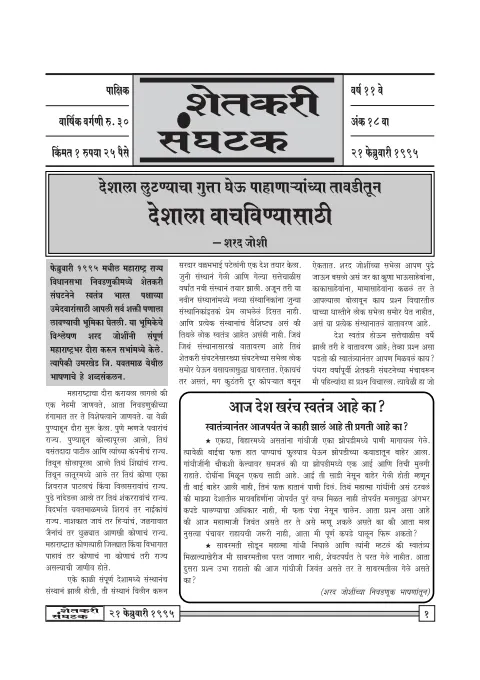
देशाला लुटण्याच्या गुप्ता घेऊ पाहाणाऱ्यांच्या तावडीतून देशाला वाचविण्यासाठी
By शरद जोशी
Sharad Joshi’s lead essay “देशाला वाचविण्यासाठी” (“To save the country”) is a compiled transcript of speeches he delivered across Maharashtra during the February 1995 Vidhan Sabha election campaign, with the printed version drawn specifically from his address at Umarkhed, district Yavatmal. Joshi argues that the freedom won in 1947 from the British was never extended to the ordinary citizen because Vallabhbhai Patel’s unification of princely states was followed by Nehru’s, Indira Gandhi’s, the Janata and V. P. Singh governments’ continuation of a planning-licence-permit regime that exploited farmers and labourers. He sets out a sustained critique of agricultural price policy from 1980 onward, comparing American support prices to Indian procurement prices, and accuses Sharad Pawar’s cooperative-sugar lobby of having turned Maharashtra into a privatised fiefdom of cartels, dealers, traders, and middlemen rather than a free market. The piece treats Congress, BJP, Shiv Sena and Janata Dal as variants of the same statist arrangement and concludes that only a renewed swatantrya-ladha (freedom struggle), now waged through the Swatantra Bharat Paksha, can restore economic liberty to the cultivator.
- Frames the 1995 Vidhan Sabha election as a continuation of the unfinished 1947 freedom struggle — independence transferred sovereignty but not liberty to the ordinary citizen.
- Reads the Nehru-Indira-Janata-V. P. Singh-Narasimha Rao continuum as a single planning regime that systematically depressed agricultural prices.
- Compares American farm support prices with Indian procurement rates to argue that Indian farmers are paid 28-32 percent of world prices for cotton, sugarcane, and food grains.
- Attacks the Maharashtra cooperative sugar lobby and Sharad Pawar’s politics as a privatised cartel — “two-rupees-a-kilo” sugarcane rates while traders profit.
- Treats Congress, BJP, Shiv Sena, and Janata Dal as interchangeable variants of the same statist arrangement, identifying the Swatantra Bharat Paksha as the only authentic free-market alternative.
आज देश खरंच स्वतंत्र आहे का?
By शरद जोशी (निवडक भाषणांतून)
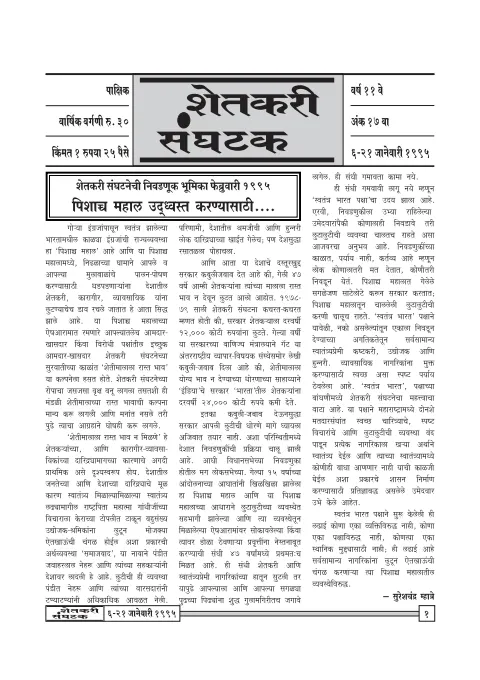
The “स्वतंत्र भारत पक्ष — जाहीरनामा” (Swatantra Bharat Paksha Manifesto) is the new party’s full election platform for the February 1995 Maharashtra Vidhan Sabha elections. It opens by declaring that the inequality, poverty, and corruption of Indian society arise not from a shortage of capital, knowledge, or effort but from a state-planning model that obstructs the people’s economic and social freedom. Organised under headings — economic and industrial policy, land policy, banking, public-sector services, civil liberties, and social reform — the manifesto proposes free markets for agricultural produce with abolition of compulsory levy and the licence-permit-quota regime, scrapping of land-ceiling and tenancy restrictions, privatisation of state-run banks and corporations, repeal of preventive-detention provisions, and a programme of education and rural development that places the cultivator and the worker at the centre.
- Diagnoses Indian poverty as a product of state planning and the licence-permit-quota raj rather than scarcity of resources.
- Calls for free markets in agricultural produce and abolition of compulsory procurement and levy systems.
- Demands repeal of the Maharashtra land-ceiling and tenancy laws so that cultivators can hold and trade land freely.
- Programmes the privatisation of public-sector banks, corporations, and state enterprises.
- Combines economic liberty with explicit civil-liberties commitments — repeal of preventive-detention powers and protection of press and personal freedoms.
स्वतंत्र भारत पक्ष — जाहिरनामा : महाराष्ट्र विधानसभा निवडणूक, फेब्रुवारी १९९५
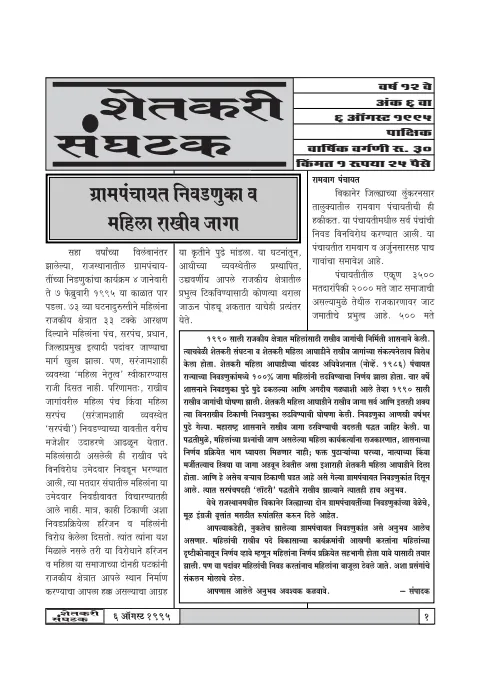
Sou. Indira Bhanusu Patil of Vinte Pir, Tal. Chopda, Dist. Jalgaon, writes “ग्रामपंचायतींच्या निवडणुका बिनविरोध करू या” (“Let us conduct gram-panchayat elections without contest”), arguing that village politics has become so disfigured by faction, money, and liquor that the only way to restore democratic legitimacy is for villages to choose their panchayat slates by consensus rather than competition. She appeals specifically to the Shetkari Mahila Aghadi (the farmers’ women’s wing) to use the seats reserved for women under the new panchayat-raj amendments as an opportunity for collective village deliberation rather than partisan combat, and frames uncontested election as both a moral and a strategic instrument for cultivator self-government.
- Frames uncontested gram-panchayat elections as a remedy to factionalism, money-power, and liquor in village politics.
- Appeals to the Shetkari Mahila Aghadi to use reserved women’s seats as a vehicle for consensus-based selection rather than partisan contest.
- Treats the women’s-reservation provisions of the new panchayat-raj amendments as a strategic opening for cultivator self-government.
ग्रामपंचायतींच्या निवडणुका बिनविरोध करू या
By सौ. इंदिरा भानुदास पाटील
An interview headlined “सहकारक्षेत्र आता उपयोगाचे नाही” (“The cooperative sector is no longer useful”) with Dr. Appasaheb Pawar (excerpted from a Vaikunth Mehta Institute discussion of 18 February 1995) argues that the cooperative model has outlived its purpose. In an environment where private and corporate firms can do everything that cooperatives once did — and do it without political capture — sustaining the parallel cooperative apparatus only entrenches a class of intermediaries between the cultivator and the market. Pawar’s intervention reinforces the issue’s central economic argument: that the post-1991 reforms must extend to agriculture’s most protected institutional form.
- Argues that the historical justification for the cooperative sector has lapsed once private firms can operate freely in agriculture.
- Locates the cooperative apparatus as an obstacle, not an aid, to the cultivator in a liberalised economy.
- Aligns Pawar’s institutional critique with the manifesto’s call to dismantle parastatal structures.
साक्षात्कार! सहकारक्षेत्र आता उपयोगाचे नाही
By डॉ. आप्पासाहेब पवार
The back-page address by Sharad Joshi to the Swatantra Bharat Paksha candidates, headlined “स्वातंत्र्य लढ्याचा निर्णायक भाग सुरू झाला आहे…” (“The decisive phase of the freedom struggle has begun…”), congratulates the party’s nominees for entering the February 1995 Maharashtra Vidhan Sabha contest under the banner of an explicitly classical-liberal alternative. Joshi explains that the Shetkari Sanghatana’s decision to enter electoral politics through the new party flows directly from the limits of agitational pressure on an entrenched planning regime, calls on candidates to campaign on the party’s manifesto rather than on personalities or caste, and frames the present election as the opening battle in a longer institutional struggle to complete the unfinished business of 1947.
- Reframes the 1995 Maharashtra Vidhan Sabha election as the decisive phase of an ongoing freedom struggle.
- Explains the Shetkari Sanghatana’s move from agitation to electoral politics through the Swatantra Bharat Paksha.
- Instructs candidates to campaign on the manifesto rather than on caste or personality.
Generated by the v1.5 extraction pipeline. Awaiting editorial review.
Metadata and summary are AI-extracted from the source PDF and reviewed for editorial accuracy. The original work is available via the Read PDF tab above (where present); paragraph-level citation inside the PDF is deferred to a future engagement.