periodical issue
शेतकरी संघटक
Shetkari Sanghatak
By sharad-joshi, इंद्रजीत भालेकर, sharad-joshi, इंद्रजीत भालेकर, इंद्रजीत भालेकर, sharad-joshi, प्रा. ज. न. स. फरांदे, sharad-joshi, मोरेश्वर टेमुर्डे, संयोजक, स्वतंत्र भारत पक्ष, महाराष्ट्र, sharad-joshi
SHETKARI SANGHATAK (Marathi Fortnightly), Regd. No. 39926/83. संपादक, मुद्रक, प्रकाशक: सुरेशचंद्र म्हात्रे. प्रकाशन स्थळ व पत्रव्यवहाराचा पत्ता: अंगारस्थळ, मु. पो. आंबेठाण (४१० ५०१), ता. खेड, जि. पुणे. मुद्रण स्थळ — गणेश प्रिंटर्स, ६९२, बुधवार पेठ, पुणे - २. पाक्षिक शेतकरी संघटक मालक - मोहन विशाललाल चांदपुरीदेसी. · Pune · 1995
12 pages
शेतकरी संघटक
Summary
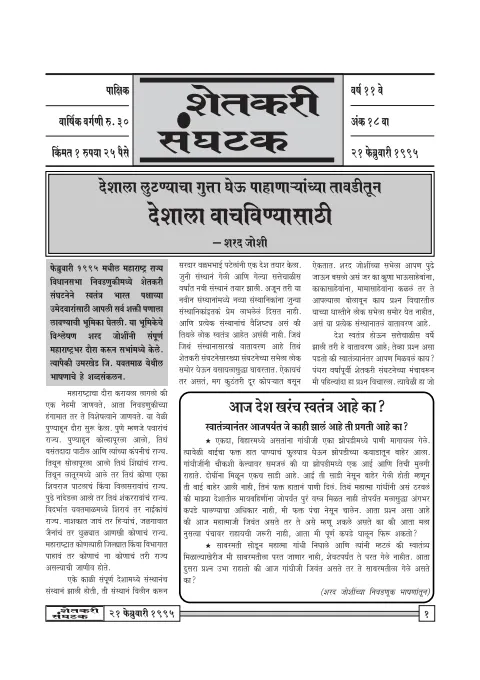
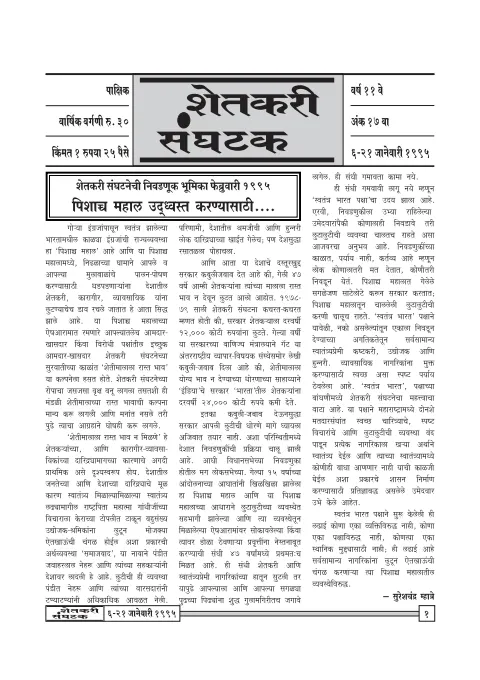
This is a 12-page issue of the Marathi fortnightly Shetkari Sanghatak (शेतकरी संघटक, Year 11, Issue 17, 6–21 January 1995), the in-house periodical of Sharad Joshi’s Shetkari Sanghatana. The issue is built around a single political event: the launch of the Swatantra Bharat Paksha — the Sanghatana’s electoral wing — and its manifesto for the February 1995 Maharashtra Vidhan Sabha elections. The lead editorial by Sureshchandra Mhatre, titled ‘पिशाच महाल उद्ध्वस्त करण्यासाठी’ (‘To demolish the demon palace’), frames the election as a campaign to dismantle the Nehruvian licence-permit state that has, in the editor’s reading, hollowed out the farmer, the trader and the small entrepreneur alike.
The centrepiece of the issue is the formal election manifesto (jahirnama, pp. 6–7) of Swatantra Bharat Paksha. It is structured under four heads — कायदा व सुव्यवस्था (law and order), शासनयंत्रणेत काटछाट (slashing the apparatus of government), आर्थिक सुधारणा (economic reforms), and सुधारणेचे उपाय (reform measures) — and reads as a classical-liberal programme: a five-year freeze on new social legislation, repeal of obsolete laws, codification into four codes, abolition of the entire ‘aahe-re/naahi-re’ (haves/have-nots) interventionist apparatus erected in the name of socialism, restoration of property rights to farmers, dismantling of state monopolies in production and trade, an end to the licence-permit-quota raj on a ‘zero-decision day,’ and the death penalty for corruption, custodial rape and breach of public trust. The manifesto is paired with an authorised list of Swatantra Bharat Paksha candidates across roughly 270 Maharashtra constituencies (pp. 8–10), signed by Moreshwar Tembhurde (Patil) as the state co-ordinator.
Surrounding the manifesto the issue carries several supporting articles. A ‘calculate it yourself’ table (p. 4) tallies, crop by crop and quintal by quintal, the gap between government procurement prices and what Sharad Joshi’s organisation calls a fair price between 1983 and 1993, headlined ‘इंडिया सरकार तुमचे देणे लागते’ (‘the India Government owes you’). Prof. G. N. S. Pharande argues that the Shetkari Sanghatana is capable of forming a single-party government. A ‘dhawta aadhava’ (running report) summarises the Sanghatana’s activities since its Nagpur convention — the women’s session, the founding meeting of Swatantra Bharat Paksha at Pune on 28 December 1994, the Chinchwadi agitation on a sand-dredging permit, and a closing piece (p. 11) on the killing of a Sanghatana worker, Maroti Namale, in Nanded district during a confrontation with East India Company-style settler exploitation. Two boxed columns by Sharad Joshi — ‘फार नको, तीन वर्ष पुरेत’ (p. 3), ‘सरकार यही समस्या है’ (p. 10) and ‘समाजवादाचे ओझे फेकून द्या’ (p. 11) — restate the core argument: the answer to India’s misery is not to patch the Nehruvian system but to throw off fifty years of socialism in six months. Marathi poet Indrajeet Bhalerao contributes three short lyric pieces — ‘दुःख शेतकरी माउलीचं’, ‘दुःख शिकत्या शेतकरीपुत्रांचं’ and ‘कुणी रोविली पहार, गावामध्ये?’ — that translate the political programme into the elegiac register of agrarian loss. The back-cover house advertisement closes with the slogan ‘स्वतंत्र भारत पक्ष ● स्वच्छ विचार ● स्पष्ट भाषा’ (‘Swatantra Bharat Party — clean thought, clear speech’).
Key points
-
Special issue of Shetkari Sanghatak built around the launch of Swatantra Bharat Paksha (Sharad Joshi’s electoral vehicle) and its February 1995 Maharashtra Vidhan Sabha campaign.
-
Full election manifesto (jahirnama) printed on pp. 6–7, organised under law-and-order, slashing of state machinery, economic reform, and reform measures.
-
Manifesto programme is classical-liberal: repeal of obsolete laws, dismantling of the ‘aahe-re/naahi-re’ regulatory apparatus, restoration of property rights to farmers, end to the licence-permit-quota raj on a ‘zero-decision day,’ and codification of the legal corpus into four codes.
-
Authorised candidate list spans roughly 270 Maharashtra Assembly constituencies (pp. 8–10), signed by state co-ordinator Moreshwar Tembhurde (Patil).
-
Lead editorial by Sureshchandra Mhatre frames the election as a campaign to demolish the ‘demon palace’ (पिशाच महाल) of the Nehruvian permit state.
-
Crop-by-crop ledger (p. 4) for 1983–1993 quantifies the gap between government procurement prices and what the Sanghatana calls a fair price, with the headline ‘इंडिया सरकार तुमचे देणे लागते’ (‘the India Government owes you’).
-
Three boxed Sharad Joshi columns argue that the country’s misery cannot be fixed by repairing the Nehruvian system; the burden of fifty years of socialism must be thrown off, not patched.
-
Coverage of a ‘dhawta aadhava’ (running report) since the Nagpur convention: the women’s session, the founding meeting of Swatantra Bharat Paksha at Pune on 28 December 1994, and the Chinchwadi sand-dredging agitation.
-
Page 11 reports the killing of Sanghatana worker Maroti Namale in Nanded district and frames it as the ‘cruelty of Indian colonisers’.
-
Three short Marathi lyric poems by Indrajeet Bhalerao translate the political programme into an agrarian-elegiac register.
Generated by the v1.5 extraction pipeline. Awaiting editorial review.
Metadata and summary are AI-extracted from the source PDF and reviewed for editorial accuracy. The original work is available via the Read PDF tab above (where present); paragraph-level citation inside the PDF is deferred to a future engagement.