periodical issue
Shetkari Sanghatak
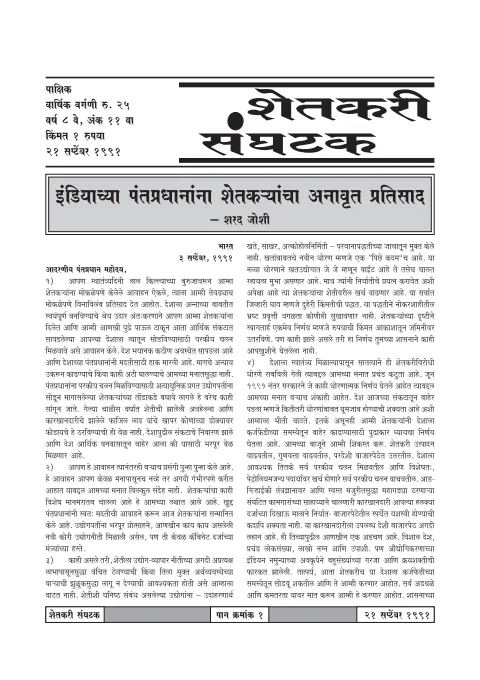
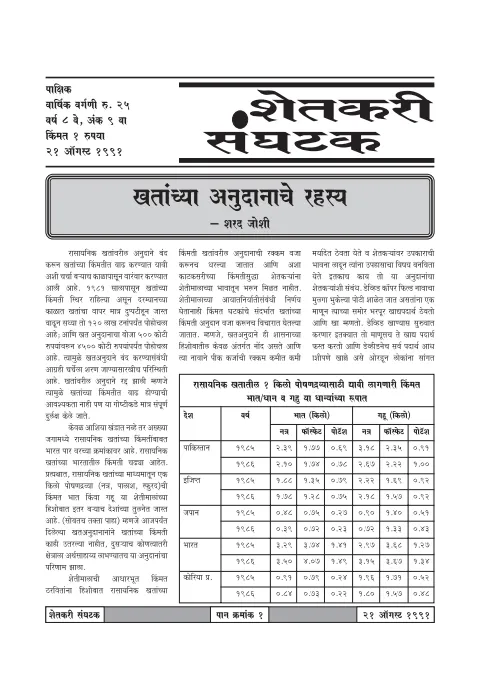
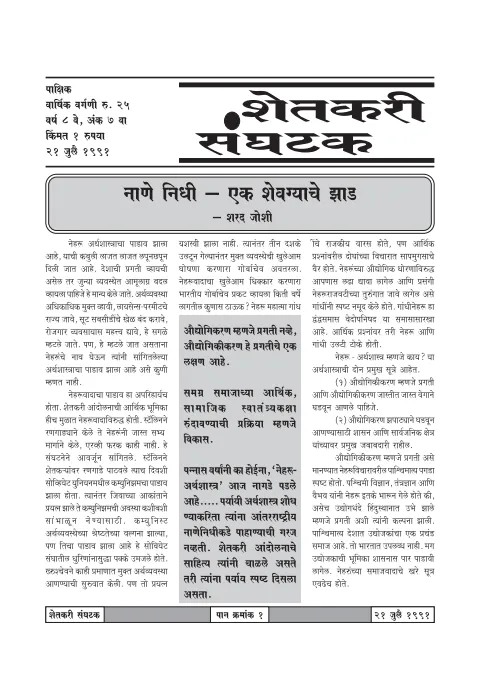
Year 8, Issue 7 — 21 July 1991
शेतकरी संघटक
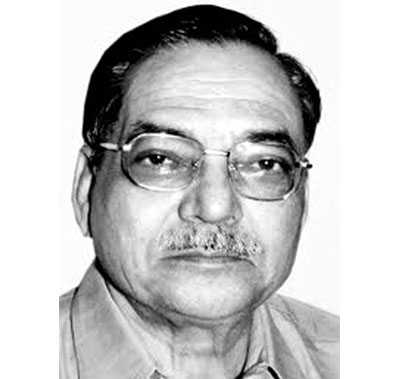
By sharad-joshi, देवराम अंभुरे, गणेशनगर, जि. अहमदनगर, बबरुवाहन रसाळे, वाकळी, जि. लातूर, sharad-joshi, सौ. संध्या इंगोले, यवतमाळ
पाक्षिक शेतकरी संघटक — मालक: मोहन विहारीलाल पारेशी; संपादक, मुद्रक, प्रकाशक: सुरेशचंद्र म्हात्रे; मुद्रण स्थळ: चाकण प्रिंटिंग प्रेस, चाकण; प्रकाशन स्थळ व पत्रव्यवहाराचा पत्ता: ११४०/५६ विश्रामबाग, पुणे ४११ ००५ · Pune · 1991
12 pages
Shetkari Sanghatak
Summary
This is the July 21, 1991 fortnightly issue (Year 8, No. 7) of शेतकरी संघटक (Shetkari Sanghatak), the Marathi bulletin of the Shetkari Sanghatana farmers’ movement, edited and printed at Chakan with Surechandra Mhatre as editor and Mohan Vihari Naresh as owner. The issue is dominated by two pieces from Sharad Joshi: a front-page editorial ‘नाणे निधी — एक शेवग्याचे झाड’ (‘The IMF — A Drumstick Tree’) arguing that the foreign-exchange crisis is symptomatic of the collapse of Nehruvian planning, and the third installment (‘लेखांक ३’) of his serialised ‘राष्ट्रीय कृषिनीती’ (National Agricultural Policy), translated into Marathi by Gopalrao Parande. Around these sit a letter to the editor from Devram Ambhure of Ganeshnagar, a short verse ‘झेंडा लुटला गेला’ by Babuvahan Rishale, an instalment of a translated piece titled ‘गरीबांची गरीबी वाढविणारा श्रीमंती मदतीचा हात’ which draws on Graham Hancock’s ‘Lords of Poverty’ to critique foreign aid, and a short reportage ‘प्रश्न : हरियाणातील शेतकरी बायांचा’ by Sandhya Engle of Yavatmal on the condition of Haryana’s farm women. Across these pieces the issue advances a single argumentative centre: that India’s 1991 crisis is the bankruptcy of Nehruvian socialism, that turning to the IMF is a quick-yielding ‘drumstick tree’ rather than a structural cure, and that real development must come from agricultural liberalisation, freer markets, and an end to the state’s extractive treatment of the peasantry.
Key points
-
Sharad Joshi’s front-page editorial, framed around the image of the IMF as a drumstick tree, reads the 1991 foreign-exchange crisis as confirmation that Nehruvian economic planning has collapsed.
-
Joshi distinguishes industrialisation, which he treats as a mere symptom, from development, which he defines as the growth of a whole society’s economic and social freedoms.
-
Joshi argues the Nehruvian state extracted surplus from agriculture through manipulated terms of trade, leaving rural India impoverished under decades of planning.
-
Joshi dismisses the IMF loan as a quick yield of foreign exchange rather than a structural cure, proposing an export-oriented, agriculture-led open economy instead.
-
The third instalment of Joshi’s serialised National Agricultural Policy, translated into Marathi by Gopalrao Parande, sets out a Life-support Programme covering land use, soil conservation and irrigation reform.
-
That instalment further addresses mechanisation, seed and varietal development, and diversification into dairy, fisheries and horticulture as parts of the same agricultural programme.
-
A reader’s letter from Devram Ambhure of Ganeshnagar endorses Joshi’s framing of liberalisers versus socialists but warns the Sanghatana has not prepared its activists to seize the new opening.
-
Babuvahan Rishale’s short verse laments that Gandhi’s promised village-republic flag was looted away before it could be unfurled amid the empty stomachs of the famished.
Essays
नाणे निधी – एक शेवग्याचे झाड
By शरद जोशी
Sharad Joshi’s front-page editorial frames the 1991 balance-of-payments crisis as the long-foretold defeat of ‘नेहरू अर्थशास्त्र’ (Nehruvian economics). He argues that the world has already conceded the failure of closed, command-style economies — Russia under Gorbachev and China under Deng have abandoned the model — and that India’s intelligentsia is only now admitting, shyly and partially, what Shetkari Sanghatana’s literature has said for years: that industrialisation is a symptom of progress, not progress itself, and that genuine development is the expansion of a whole society’s economic and social freedoms. Joshi attacks the equation of Nehruvian planning with national self-respect, accuses the Nehruvian state of having extracted from agriculture through manipulated terms of trade, and dismisses the IMF loan as a ‘शेवग्याचे झाड’ — a quick-yielding drumstick tree that yields a few foreign-exchange pods but is no substitute for the structural alternative of an export-led, agriculture-centred open economy. He contrasts this with Gandhi’s village-self-sufficiency model and with the Shetkari Sanghatana programme of remunerative prices and freedom from state controls, arguing that the latter, not IMF conditionality, is the real exit from the crisis.
- Reads the 1991 foreign-exchange crisis as confirmation that Nehruvian planning has collapsed, not merely stumbled.
- Distinguishes ‘industrialisation’ from ‘development’, defining development as the growth of a whole society’s economic and social freedoms.
- Holds that the Nehruvian state extracted surplus from agriculture through rigged terms of trade, leaving rural India impoverished.
- Treats the IMF loan as a ‘drumstick tree’ — a quick yield, not a structural cure for the foreign-exchange crunch.
- Argues that an export-oriented, agriculture-led open economy is the real alternative, one the Shetkari Sanghatana literature has long set out.
बांधावरील पत्रव्यवहार: त्यांचे पाप त्यांच्या पदरात घालायला पुन्हा कंबर कसावी लागणार
By देवराम अंभुरे, गणेशनगर, जि. अहमदनगर
A letter to the editor (‘बांधावरील पत्रव्यवहार’) dated 8 July 1991 from Devram Ambhure of Ganeshnagar (Ahmednagar district), addressed to Sharad Joshi. Ambhure responds to a recent Shetkari Sanghatak piece headlined ‘हे पाप तुमचे आहे’ (‘This sin is yours’). He accepts the diagnosis that the liberalisers and saamyavadis sit in opposite trenches but warns Joshi that the Sanghatana itself has not built the cadre or the psychological readiness among farmers needed to convert the new opening into actual gains; he urges new training programmes and the recruitment of fresh activists, even as he reaffirms loyalty to the movement.
- Reader endorses Joshi’s framing that liberalisers and socialists are in opposing trenches.
- Warns that Shetkari Sanghatana has not prepared its activists to capitalise on the new policy opening.
- Calls for new training programmes and a fresh wave of recruits.
- Closes with a personal pledge of continued allegiance to the movement.
झेंडा लुटला गेला
By बबरुवाहन रसाळे, वाकळी, जि. लातूर
A short Marathi verse ‘झेंडा लुटला गेला’ (‘The flag was looted away’) by Babuvahan Rishale of Wakli (Latur district). The poem laments that while readers are still reciting the dry historical credentials of past nationalists, the Nehruvian state has hollowed out the village republics Gandhi promised — the flag of Gandhi’s gram-swarajya was looted before it could even be unfurled in the empty stomachs of the famished.
- Treats the gap between the rhetoric of nationalist history and the lived hunger of villagers.
- Casts the Nehruvian decades as the moment Gandhi’s village-republic flag was ‘looted’.
राष्ट्रीय कृषिनीती — लेखांक ३: जीवनाधार कार्यक्रम अभियान धरती
By शरद जोशी (मराठी भाषांतर: श्री गोपालराव पारुडे, पुणे)
The third instalment (‘लेखांक ३’) of Sharad Joshi’s serialised ‘राष्ट_ीय कृषिनीती’ (National Agricultural Policy), translated into Marathi from Joshi’s English original by Gopalrao Parande of Pune. This instalment sets out a programmatic ‘जीवनाधार कार्यक्रम’ (‘Life-support Programme’) labelled ‘अभियान धरती’ and is organised into numbered policy clauses (roughly clauses 43–69) covering land use, soil conservation, rainfed farming, mechanisation, seed and varietal development, fertiliser and energy use, irrigation reform, food supply, dairy and poultry, fisheries, horticulture and forestry, and the diversification of farm income. The dominant themes are: ending the state’s extractive treatment of agriculture; consolidating fragmented holdings and lifting ceilings that block efficient land use; redirecting subsidies away from large irrigation projects toward rainfed farming and groundwater recharge; modernising input supply through farmer-cooperatives rather than state monopolies; and treating the farmer as an entrepreneur with full pricing and marketing freedom rather than as a ward of the state.
- Lays out ‘अभियान धरती’, a land-and-livelihood programme that frames rural policy as life-support rather than welfare.
- Calls for repeal or restructuring of land-ceiling and tenancy laws that block efficient consolidation and leasing.
- Reorients irrigation investment from mega-projects toward rainfed farming, watershed development and groundwater recharge.
- Pushes mechanisation, modern seeds, balanced fertiliser and electricity supply for farms via cooperative and private channels, not state monopoly.
- Frames dairy, poultry, fisheries, horticulture and forestry as commercial diversification routes for the farm household, with the farmer treated as entrepreneur.
गरीबांची गरीबी वाढविणारा श्रीमंती मदतीचा हात
The opening instalment (marked ‘क्रमशः’ — ‘to be continued’) of a translated piece titled ‘गरीबांची गरीबी वाढविणारा श्रीमंती मदतीचा हात’ (‘The rich man’s helping hand that deepens the poor man’s poverty’). It surveys the multi-billion-dollar industry of bilateral and multilateral aid from rich countries to the poor, anchored on Graham Hancock’s ‘Lords of Poverty’, and argues that under the slogan of ‘international health and development’ the aid apparatus has become a self-serving employment scheme for Western consultants and a political instrument that hollows out recipient states. Specific examples include Somalia, where aid-funded experts drew salaries 50 times those of local cabinet ministers; the World Bank’s resort-style meetings; and US food aid that is described as politically conditional rather than charitable.
- Frames foreign aid as a rich-country industry that perpetuates rather than relieves poverty in the recipient countries.
- Cites Graham Hancock’s ‘Lords of Poverty’ as the source for figures on aid-worker salaries and lifestyles.
- Argues that food aid and project aid are deployed as instruments of donor political influence.
- Marked ‘क्रमशः’ — explicitly a first instalment of a longer translation.
प्रश्न: हरियाणातील शेतकरी बायांचा
By सौ. संध्या इंगोले, यवतमाळ
A short reportage piece by Sandhya Engle of Yavatmal recounting a 3 May 1991 visit by a delegation of two women and five men from Maharashtra, Gujarat and Andhra Pradesh to Haryana, where they were detained by police on suspicion of being agitators while travelling to a Shetkari Sanghatana programme. The piece focuses on what the delegation observed of Haryana farm women — their long working day milking buffaloes from 4 a.m., the absence of literacy and of any meaningful leisure, the brutality of domestic life behind the appearance of agricultural prosperity, and the conclusion that the women themselves do not yet articulate their condition as a problem. Engle closes with a citation of an Economic Times report that traces the persistent poverty of farm labour to the trap of land-ceiling laws preventing leasing.
- Personal reportage by a Sanghatana woman activist on a visit to Haryana farm villages.
- Sketches the long, unrelieved working day of farm women in supposedly prosperous Haryana.
- Argues that the deepest barrier is that the women themselves have not yet named their condition as a grievance.
- Ends by linking landless-labour poverty to land-ceiling laws that block leasing-in.
Generated by the v1.5 extraction pipeline. Awaiting editorial review.
Metadata and summary are AI-extracted from the source PDF and reviewed for editorial accuracy. The original work is available via the Read PDF tab above (where present); paragraph-level citation inside the PDF is deferred to a future engagement.