periodical issue
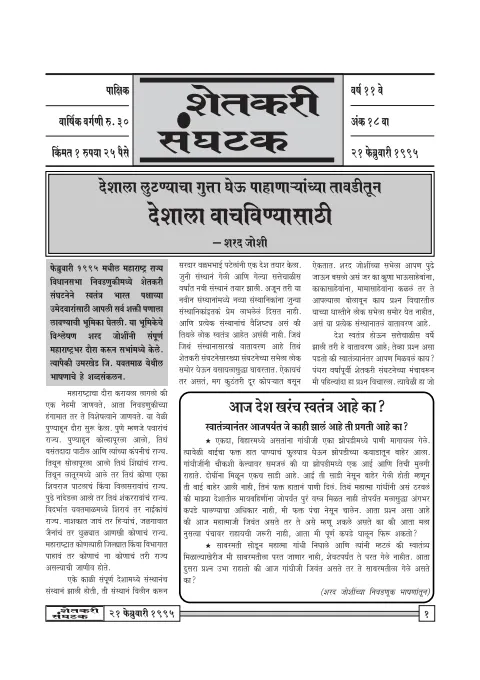
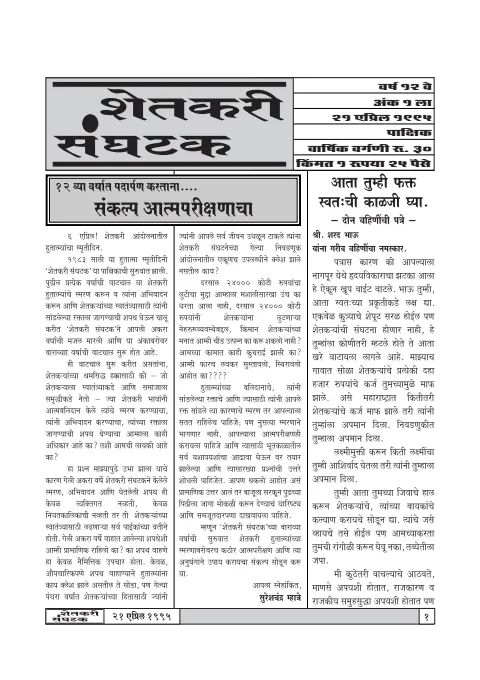
Shetkari Sanghatak
शेतकरी संघटक
By sharad-joshi, श्री. भानुदास पाटील, धोपडा
शेतकरी संघटक, अंगारमळा, मु./पो. आंबेठाण, ता. खेड, जि. पुणे · Ambethan, Khed, Pune · 1995
8 pages
Shetkari Sanghatak
Summary
This is the 21 March 1995 fortnightly issue of Shetkari Sanghatak (शेतकरी संघटक), Vol. 11, No. 19, the Marathi-language organ of the Shetkari Sanghatana farmers’ movement and the newly formed Swatantra Bharat Paksha. The issue is anchored by a long polemical essay from movement founder Sharad Joshi titled ‘महात्माजींचा पराभव’ (Mahatmaji’s Defeat), a heterodox reading of Gandhian thought that argues Gandhi’s economic and village-development vision was buried by Nehruvian socialism rather than carried forward, and that Joshi sees himself as a legitimate inheritor of Gandhi’s ‘sarvodaya’ impulse via the farmers’ movement. The remainder of the eight-page issue mixes movement news (Punjab–Haryana farmers burning wheat in Delhi to protest procurement prices), a women’s-front profile of activist Jayashree Rajput who chased off loan-recovery officers in Chopda taluka, an obituary for the elder brother of martyr Babu Genu, a column on the new Swatantra Bharat Paksha MLAs in the Maharashtra Vidhan Sabha (Wamanrao Chatap and Dilip Borse), Aesop’s-fable retellings deployed as political parables, a critique of farm-loan certificates (‘हा साप आणि ही काठी’), and a closing health bulletin reporting that Sharad Joshi’s condition is improving rapidly after timely treatment.
Key points
-
Sharad Joshi’s lead essay ‘Mahatmaji’s Defeat’ opens with his admission that he never met Gandhi in person, having reached Wardha a day after Gandhi’s departure.
-
Joshi rejects the caricature of Gandhi as an anti-modern village-romantic, presenting Gandhian thought as a ‘dynamic’ tradition compatible with technology and development.
-
Joshi argues that Gandhi’s economic vision was not carried forward but effectively buried by Nehru’s post-1947 capture of the Congress under Soviet-style socialist cover.
-
He poses three rhetorical questions about why the poor still wear mill cloth instead of khadi, why sarvodaya has not arrived after forty-seven years, and why villages are emptier than before.
-
Joshi positions the Shetkari Sanghatana and the newly formed Swatantra Bharat Paksha as the legitimate contemporary inheritors of Gandhi’s village-development vision.
-
A news report describes farmer leaders from the Bharatiya Kisan Union burning wheat in Delhi on 15 March 1995 to protest procurement prices set well below the cost of production.
-
The report cites an outstanding forty-eight thousand crore rupees in central-government dues owed to Indian farmers as the underlying grievance behind the protest.
-
The issue carries a women’s-front profile of activist Jayashree Rajput, who chased off loan-recovery officers in Chopda taluka, alongside a critique of farm-loan certificates likening them to a snake and a stick.
-
A closing health bulletin reports that Sharad Joshi’s condition was improving rapidly following timely treatment, reassuring the movement’s readership about their leader’s wellbeing.
Essays
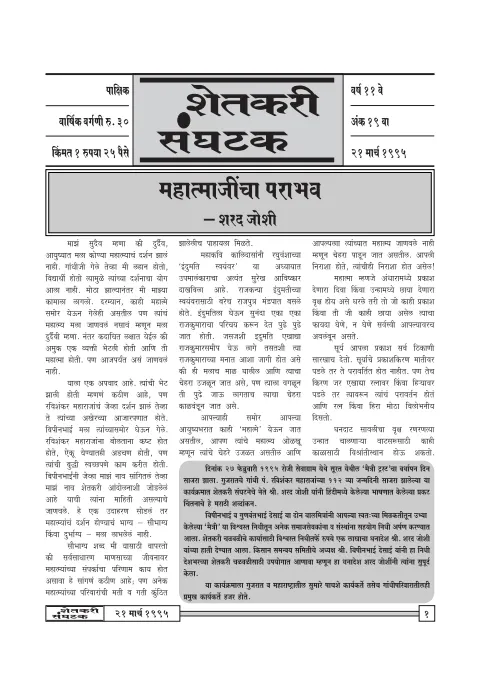
महात्माजींचा पराभव
By शरद जोशी
Sharad Joshi’s lead essay ‘महात्माजींचा पराभव’ (Mahatmaji’s Defeat) opens with the disarming admission that he never had the personal darshan of any mahatma — including Gandhi, whom he reached Wardha to meet a day too late. From that personal frame he launches into a substantive defence and reinterpretation of Gandhi against what he calls the ‘socialist’ betrayal of Gandhi’s economic vision. Joshi rejects the standard charge that Gandhi was anti-modern or village-romantic; he reads Gandhi’s worldview as a ‘dynamic’ (gatishil) tradition that valued svadeshi, self-reliance and decentralisation but did not foreclose technology or development. The killing-blow, he argues, came not from Gandhi’s death but from Nehru’s post-1947 capture of the Congress and the imposition of a Soviet-style socialist economic line, which used Gandhi’s name as cover while gutting the practical village-economy programme.
Joshi then poses three rhetorical questions Gandhi might have asked his successors: why are the poor still wearing imported (or mill) cloth instead of khadi; why has sarvodaya not arrived after forty-seven years; and why are the villages Gandhi died for emptier and more wretched than before. He answers that the Nehruvian elite kept Gandhi’s vocabulary while pursuing the opposite policy — a fraud he describes using the epistemic frame ‘doesn’t know that doesn’t know’. The essay closes by positioning the Shetkari Sanghatana / Swatantra Bharat Paksha movement as the actual contemporary vehicle of Gandhian village-uplift, currently campaigning in Gujarat and Maharashtra against the unfinished business of agrarian liberation.
- Joshi opens with a candid admission that he never met any mahatma in person, reframing Gandhi-talk away from darshan-piety toward intellectual succession.
- He rejects the caricature of Gandhi as anti-modern village-romantic and presents Gandhian thought as a ‘dynamic’ tradition compatible with technology and development.
- He argues Gandhi’s economic-ideological line was not preserved but assassinated by Nehru and the Congress after 1947 under socialist cover.
- He poses three questions Gandhi would supposedly ask today — about cloth, about sarvodaya, and about depopulated villages — to indict the post-Independence trajectory.
- He uses an epistemic frame (‘doesn’t know that doesn’t know’) to characterise the post-Nehruvian intellectual establishment’s blindness to its own betrayal of Gandhi.
- He positions the Shetkari Sanghatana and the new Swatantra Bharat Paksha as the legitimate contemporary inheritors of Gandhi’s village-development vision.
स्वतंत्र भारत पक्षाला मतदारांनी का नाकारले?
By संपादक, शेतकरी संघटक
A boxed news report titled ‘पंजाब हरियानाच्या किसानांनी दिल्लीमध्ये गहू जाळून निषेध नोंदविला’ (Punjab and Haryana farmers register protest by burning wheat in Delhi). On 15 March 1995, under the banner of the Bharatiya Kisan Union, farmer leaders Bhupinder Singh Maan, Sardar Vallabh Singh Rajewal, Karnal Singh Miyowara (Punjab), Kehar Singh and Sanjeev Pramatrik (Haryana), and Vipin Desai (U.P. Kisan Samanvay Samiti) gathered at Delhi’s Khilji Pradesh Kisan Manch to burn wheat in protest at procurement prices set ₹150–250 per quintal below the cost of production, against an outstanding ₹48,000 crore in dues owed by the central government to Indian farmers.
- On 15 March 1995 farmers from Punjab, Haryana and U.P. ritually burned wheat in Delhi to protest below-cost procurement prices.
- The protest was convened by the Bharatiya Kisan Union and named six farmer leaders coordinating across northern states.
- The report frames a ₹48,000 crore central-government debt to Indian farmers as the underlying grievance.
- Punjab’s procurement price was put at only ₹150 per quintal more than ten years earlier; Haryana’s at only ₹250 above cost.
पंजाब हरियानाच्या किसानांनी दिल्लीमध्ये गहू जाळून निषेध नोंदविला
A column titled ‘इसापनीती’ तील काही कथा (Some tales from Aesop’s fables) retells short fables — ‘दुबळे बोल’ (Weak words), ‘निर्बुद्ध आनंद’ (Stupid joy), ‘राजकारणाची रीत’ (The way of politics), ‘स्वतःचे संरक्षण प्रथम’ (Self-protection first), ‘धनी बदलला तरी नशीब तेच’ (Even if the master changes, the fate stays), ‘घुबडाचा सल्ला’ (The owl’s advice), ‘खोटी कळकळ’ (False concern) and ‘उतावळा विचार’ (Hasty thought) — each ending in a sharp political moral. They are clearly placed as parables for movement politics: hollow public oaths, the gullibility of the protected, the futility of changing masters when the system is unjust, and the hazards of rushing into collective decisions without thought.
- Aesop’s fables are deployed as political parables, not as children’s literature.
- Each short tale closes on a one-line moral aimed at movement workers and ordinary villagers.
- Recurring targets are empty public commitments, false sympathy, and the trap of merely swapping rulers.
‘इसापनीती’तील काही कथा
A report by Bhanudas Patil of Chopda headlined ‘कर्जवसुली अधिकाऱ्यांना घरात कोंडून धमकावण्याचा जयश्री राजपूत या शूर महिला कार्यकर्तीचा पराक्रम’ narrates how, on 11 February 1995 in Nagalwadi village (Jalgaon district, Chopda taluka), Shetkari Sanghatana woman activist Jayashree Rajput locked loan-recovery officers inside a house and confronted them, forcing them to leave the village without attaching any farmer’s property. The piece celebrates her as the leading edge of the Shetkari Mahila Aghadi tactic of using women’s collective courage to physically block coercive farm-loan recovery.
- On 11 February 1995 at Nagalwadi, woman activist Jayashree Rajput locked loan-recovery officers inside a house to stop coercive recovery.
- The action is reported as a victory of the Shetkari Mahila Aghadi (Farmers’ Women’s Front) line.
- It is filed under the signature of Bhanudas Patil, Chopda — a recurring district correspondent for the paper.
कर्जवसुली अधिकाऱ्यांना घरात कोंडून धमकावण्याचा जयश्री राजपूत या शूर महिला कार्यकर्तीचा पराक्रम
By श्री. भानुदास पाटील, धोपडा
Short obituary headlined ‘हुतात्मा बाबू गेनूच्या थोरल्या भावाचे निधन’ (Death of the elder brother of martyr Babu Genu), recording the passing of Shrimant Kashalu Kushaba Said of Mahalunge-Padwal, the elder brother of independence-era martyr Babu Genu (who died on 12 December 1930 resisting foreign cloth on Mumbai’s streets). The note ties the family to ongoing Shetkari Sanghatana movement work in the region.
- Records the death of the elder brother of martyr Babu Genu of Mahalunge-Padwal.
- Reiterates Babu Genu’s 12 December 1930 martyrdom resisting foreign cloth.
- Treats the obituary as a movement-history link, not merely a private bereavement.
बेअकली गाढव
An editorial-style piece headlined ‘लेखाजोखा प्रमाणपत्रे — हा साप आणि ही काठी’ (‘Account certificates — this is the snake and this is the stick’) argues that the central government’s claim of having spent ₹48,000 crore on Indian farmers is itself an indictment, since the ‘rate’ (rant) sample shows the money never reached farmers. The piece urges Shetkari Sanghatana workers to use these very government certificates as political weapons against the regime that issued them, and recommits the movement’s MLAs to a sustained parliamentary fight on procurement-price honesty.
- Frames the government’s own farmer-expenditure certificates as self-incriminating evidence.
- Calls on Sanghatana cadre to weaponise the state’s audited figures against the state.
- Links the column to a sustained Vidhan Sabha campaign by the movement’s newly elected MLAs.
हुतात्मा बाबू गेनूच्या थोरल्या भावजयींचे निधन
A short notice ‘स्वतंत्र भारत पक्षाचे दोन आमदार महाराष्ट्र विधानसभेत’ announces that the Swatantra Bharat Paksha — the political wing newly spun out of the Shetkari Sanghatana — has won two seats in the February 1995 Maharashtra Vidhan Sabha elections, with Adv. Wamanrao Chatap (Rajura, Chandrapur district) and Dilip Borse (Baglan, Nashik district) entering the Assembly. The piece, signed by Sureshchandra Mhatre, frames the win as the start of a parliamentary front for the farmers’ movement, directed by Sharad Joshi.
- Swatantra Bharat Paksha wins two Maharashtra Assembly seats in the February 1995 polls.
- The two MLAs are Adv. Wamanrao Chatap (Rajura, Chandrapur) and Dilip Borse (Baglan, Nashik).
- The notice frames the Vidhan Sabha foothold as a parliamentary extension of Shetkari Sanghatana’s extra-parliamentary campaign.
- Sharad Joshi is named as the political-strategic head; the dispatch is signed by Sureshchandra Mhatre.
लेखाजोखा प्रमाणपत्रे — ‘हा साप आणि ही काठी’
By सुरेशचंद्र म्हात्रे
A health bulletin on page 8 headlined ‘वेळीच वैद्यकीय उपचार झाले — शरद जोशी यांची प्रकृती वेगाने सुधारते आहे’ (Timely medical treatment was given — Sharad Joshi’s health is improving rapidly) reports that, after four months of growing concern, Joshi was finally hospitalised on 11 March 1995. The piece details his recent campaign tour through Maharashtra and Gujarat ahead of the February 1995 Vidhan Sabha elections, his collapse on the night of 26–27 February at Wardha, and the chain of doctors and party workers (Adv. Sham Aptekar, Dr Aziz Khan, Dr Vasantrao Bande and others) who organised diagnosis, ECG, an MRI in Mumbai on 15 March, and stabilising treatment. It closes by warning workers that he is recovering but must not be pressed back into campaigning immediately.
- Sharad Joshi’s health had been a worry for four months before formal hospitalisation on 11 March 1995.
- He fell ill on the night of 26–27 February at Wardha while on the post-election review tour.
- Treatment was organised in Pune and Mumbai with ECG and MRI, by a named circle of doctors and party workers.
- The note ends with a movement-discipline message asking workers not to drag him back into campaigning prematurely.
Generated by the v1.5 extraction pipeline. Awaiting editorial review.
Metadata and summary are AI-extracted from the source PDF and reviewed for editorial accuracy. The original work is available via the Read PDF tab above (where present); paragraph-level citation inside the PDF is deferred to a future engagement.