periodical issue
Shetkari Sanghatak
शेतकरी संघटक
मालक : मोहन विहारीलाल पारेख; मुद्रण स्थळ : गणेश प्रिंटर्स, ६९३, बुधवार पेठ, पुणे - २; संपादक, मुद्रक, प्रकाशक : सुरेशचंद्र म्हात्रे; SHETKARI SANGHATAK (Marathi Fortnightly), Regd. No. 39926/83 · Pune · 1994
8 pages
Shetkari Sanghatak
Summary
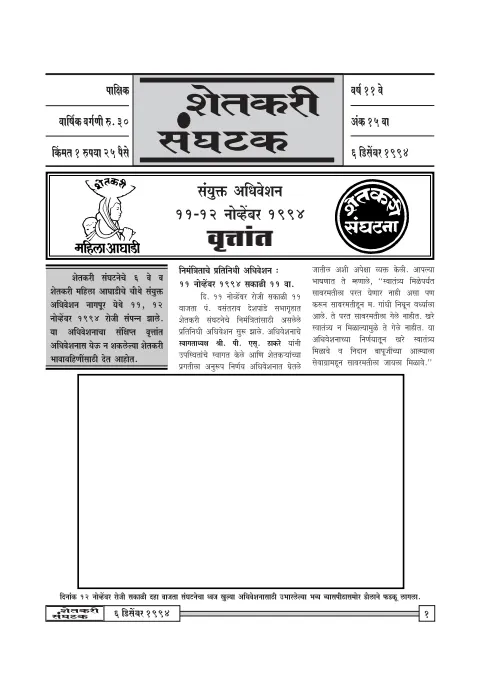
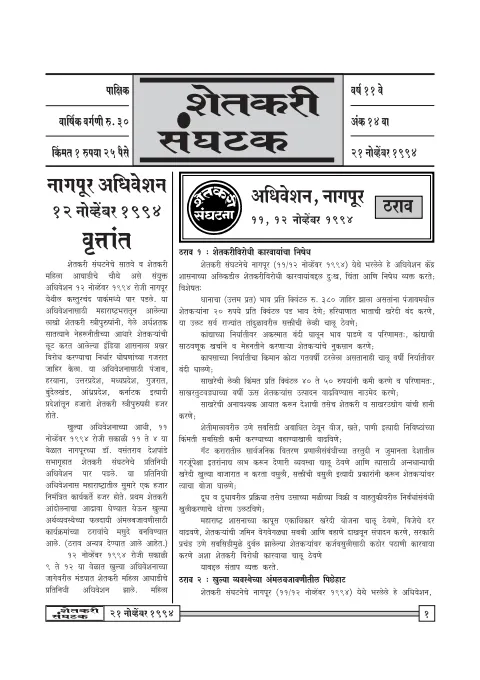
Shetkari Sanghatak, the Marathi fortnightly of the Shetkari Sanghatana (Volume 11, Issue 14, dated 21 November 1994), gives over the entire issue to a vrittānt (proceedings report) of the joint seventh session of the Shetkari Sanghatana and the fourth session of the Shetkari Mahila Aghadi (its women’s wing), held at Kasturchand Park in Nagpur on 11–12 November 1994 — supplemented by a reprinted Loksatta editorial of 14 November 1994 (titled ‘Shetkaryanche Awahan’ / ‘The Farmers’ Challenge’), a tour calendar of district-level women’s sessions led by Sharad Joshi, and a back-page call to action.
Two parallel streams of resolutions (ठराव) structure the political content. The Sanghatana stream opens with a condemnation of the state government’s anti-farmer interventions (Resolution 1) and a charge that the liberalisation promised by Delhi has been blocked on the ground (Resolution 2): the resolutions demand cotton procurement parity with Punjab (where rates of Rs.3,800 per quintal are cited), removal of levies on rice and sugar at Rs.40–50 per quintal, freeing of dairy procurement, and an end to discrimination against Sanghatana-aligned co-operatives. The Mahila Aghadi stream rejects the Maharashtra government’s women’s policy as a bureaucratic imposition handed down without consultation (Resolution 1), backs the village women’s daru-dukan-bandi (liquor-shop closure) agitation as a flagship campaign (Resolution 2), affirms women’s full participation in the open economy (Resolution 3), endorses the loan-waiver agitation (Resolution 4), and reasserts Lakshmi Mukti — the programme of transferring family land titles into women’s names — as the front’s central long-term project (Resolution 5).
The reprinted Loksatta editorial reads the Nagpur convention as a passage from constituency-style negotiation to a sharper farmer–state confrontation, and credits the Sanghatana with producing an explicitly farmer-political identity that cuts across both Congress and the BJP–Shivsena alliance. The closing back page announces a Maharashtra-wide rasta roko (road blockade) for 1 December 1994 around three demands — a renunciation of Nehruvian policy (including the symbolic removal of Nehru, Indira Gandhi and Rajiv Gandhi portraits from farmer households), the rasta roko itself, and full opening of trade — and is followed by a calendar of district Mahila Aghadi sessions from 7 December 1994 to 9 January 1995, each addressed by Sharad Joshi.
Key points
-
Single-issue report of the joint seventh session of the Shetkari Sanghatana and the fourth session of the Shetkari Mahila Aghadi, held at Kasturchand Park, Nagpur on 11–12 November 1994.
-
Sanghatana resolutions demand implementation of the liberalised market regime in farm output: cotton parity with Punjab (Rs.3,800/quintal cited as benchmark), removal of rice and sugar levies, freeing of dairy procurement, and the end of state discrimination against Sanghatana-aligned co-operatives.
-
Shetkari Mahila Aghadi rejects the Maharashtra government’s women’s policy as imposed without consultation, and reasserts Lakshmi Mukti — putting family land in women’s names — as its central programme.
-
The Mahila Aghadi backs the village women’s liquor-shop closure (daru-dukan-bandi) agitation as a flagship organisational campaign.
-
A reprinted Loksatta editorial of 14 November 1994, ‘Shetkaryanche Awahan’, reads the Nagpur gathering as a turn from issue-politics to identity-politics for the farmer constituency, distinct from both Congress and the BJP–Shivsena alliance.
-
The back page calls for a Maharashtra-wide rasta roko (road blockade) on 1 December 1994 and lists a symbolic demand: remove portraits of Nehru, Indira Gandhi and Rajiv Gandhi from farmer households as a public renunciation of Nehruvian policy.
-
A district tour of Mahila Aghadi sessions from 7 December 1994 to 9 January 1995, covering Nanded, Bhandara, Gadchiroli, Chandrapur, Wardha, Yavatmal, Amravati, Akola, Buldhana, Jalna, Beed, Osmanabad, Solapur, Sangli, Kolhapur, Satara, Sindhudurg, Ratnagiri, Aurangabad, Jalgaon, Dhule and Nashik, each addressed by Sharad Joshi, is published alongside the proceedings.
Generated by the v1.5 extraction pipeline. Awaiting editorial review.
Metadata and summary are AI-extracted from the source PDF and reviewed for editorial accuracy. The original work is available via the Read PDF tab above (where present); paragraph-level citation inside the PDF is deferred to a future engagement.