periodical issue
Shetkari Sanghatak
Vol. 11, No. 12, 21 October 1994
शेतकरी संघटक — वर्ष ११ वे, अंक १२ वा, २१ ऑक्टोबर १९९४
Shetkari Sanghatak — Varsh 11 ve, Ank 12 va, 21 October 1994
By sharad-joshi, आमदार सौ. सरोज काशिकर, अध्यक्षा, शेतकरी महिला आघाडी, अजय अनमोल, महासचिव, किसान युनियन (U.P.)
संपादक, मुद्रक, प्रकाशक: सुरेशचंद्र म्हात्रे; मालक - मोहन विद्यार्थीराज वरदेसे; मुद्रण स्थळ: गणेश प्रिंटर्स, ६९२, बुधवार पेठ, पुणे - २ · Pune · 1994
8 pages
Shetkari Sanghatak
Summary
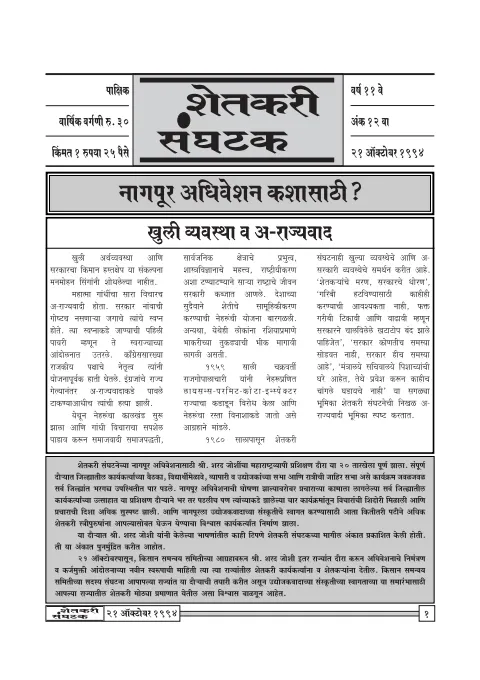
This 21 October 1994 issue of the Marathi fortnightly Shetkari Sanghatak (Year 11, Issue 12) is built around the run-up to the Sixth Convention of the Shetkari Sanghatana at Kasturchand Park, Nagpur on 12 November 1994. Sharad Joshi opens the issue with the lead essay ‘खुली व्यवस्था व अ-राज्यवाद’ (Open System and Anti-Statism), arguing that liberalisation is not Manmohan Singh’s invention but a return to Gandhi’s anti-statist instincts that Nehru’s planning had buried, and that the 1980 Shetkari Sanghatana movement was always rooted in this anti-statist (अ-राज्यवादी) economics. The issue then carries supporting editorials on what government has become versus what it should be, a defence of competition and experience as the only real teachers (citing Ayn Rand and Art Buchwald), a fifteen-year retrospective on the Sanghatana, and a sidebar arguing that ‘open system is a path, not a stage’. The women’s-policy plank is anchored by MLA C. Saroj Kashikar (president, Shetkari Mahila Aghadi) in a long critique of the Maharashtra government’s June 1994 women’s policy; Ajay Anmol of the U.P. Kisan Union contributes a Hindi marching-poem ‘आजादी की सेना फिर तैयार करो’. Sharad Joshi’s accounting circular for the convention, news of the release of Prakash Pohare and other activists from Akola, and the joint Mahila Aghadi–Sanghatana convention announcement on the back cover round out the number.
Key points
-
Sharad Joshi’s front-page editorial ‘खुली व्यवस्था व अ-राज्यवाद’ argues that economic liberalisation is not Manmohan Singh’s invention but a return to Mahatma Gandhi’s anti-statist instincts that Nehru’s central planning had buried.
-
Joshi traces a lineage from Khrushchev’s 1956 critique of Stalinist economics to the Shetkari Sanghatana’s own 1980 charter identifying the state, not market failure, as the farmer’s chief adversary.
-
He reframes garibi-hatao welfarism as a project that perpetuates dependency and positions the coming Sixth Convention at Kasturchand Park, Nagpur, on 12 November 1994 as a declaration of anti-statist agrarian liberalism.
-
An unsigned editorial contrasts what government has become with what it should be, arguing essential economic functions like agriculture and trade work best when left outside conscious state direction, as with the body’s autonomic functions.
-
A companion piece cites Ayn Rand and Art Buchwald to defend open competition and lived experience as the only real teachers, dismissing moral objections to competition’s casualties.
-
A fifteen-year retrospective on the Shetkari Sanghatana contrasts its ‘समृद्ध भारत’ (rich peasant) demand with the rival ‘गरीब विचार’ (poor-peasant) ideology of conventional politicians.
-
MLA C. Saroj Kashikar, president of the Shetkari Mahila Aghadi, contributes a long critique of the Maharashtra government’s June 1994 women’s policy.
-
Ajay Anmol of the U.P. Kisan Union contributes the Hindi marching-poem ‘आजादी की सेना फिर तैयार करो’, and the issue reports the release of activist Prakash Pohare from Akola.
Essays
नागपूर अधिवेशन कशासाठी? / खुली व्यवस्था व अ-राज्यवाद
Sharad Joshi’s front-page editorial argues that an open economy with minimal state interference is not Manmohan Singh’s innovation but the recovery of an older Indian instinct: Mahatma Gandhi’s whole worldview, Joshi insists, was अ-राज्यवादी (anti-statist), and the first step away from it was Nehru’s choice of Soviet-style central planning after independence. He traces a lineage from Khrushchev’s 1956 critique of Stalinist economics through the Shetkari Sanghatana’s own 1980 stance that the state itself is the chief problem for the farmer, rejecting both Nehruvian planning and the garibi-hatao welfare frame that ‘pretends to protect the poor’ while keeping them captive to babudom. The piece sets up the Nagpur convention as a public articulation of the Sanghatana’s anti-statist agrarian liberalism.
- Open economy and minimum state are not Manmohan Singh’s invention — Gandhi was already अ-राज्यवादी (anti-statist).
- Nehru’s adoption of Soviet planning was the first wrong turn that the Sanghatana now seeks to reverse.
- The Shetkari Sanghatana’s 1980 charter already identified the state — not market failure — as the farmer’s chief adversary.
- Garibi-hatao welfarism is reframed as a ‘garib hatao’ (eliminate the poor) project that perpetuates dependency.
- The Nagpur convention is positioned as the public declaration of the Sanghatana’s open-economy / anti-statist line.
सरकार कसे आहे?
An unsigned twin editorial on page 2 contrasts ‘what government has become’ with ‘what government ought to be’. The first column catalogues the open-ended list of things citizens have been told only the state can do — feed crops, run schools and hospitals, employ everyone, build housing, supply jobs, even decide what to wear and eat — and observes that under every regime, regardless of ideology, the state has only grown. The second column argues by analogy with the human body: just as essential involuntary functions (breathing, circulation) are best left to the body’s autonomic system and conscious meddling damages them, so too the essential functions of an economy — agriculture, industry, trade, communication, education — must be left out of government’s hands. The right-hand sidebar ‘समर्थनां संरक्षण पांगळेच करणार’ argues that protective price-support regimes only cripple farmers and that competitive market discipline is the precondition for agricultural revival.
- Under every regime — left, right or centre — the Indian state has only expanded its remit.
- An analogy with autonomic bodily functions: essential economic functions work best when government does not ‘consciously’ direct them.
- Government’s only legitimate roles are police, military and external security.
- Support-price regimes do not protect farmers — they make them dependent and stunted.
- The Sanghatana frames market discipline, not state subsidy, as the path to peasant strength.
सरकार कसे असावे?
Page 3 carries two unsigned essays. The first, ‘अनुभव आणि स्पर्धा यांच्यासारखे गुरू नाहीत’ (There are no teachers like experience and competition), defends open competition against the moralism of socialist critics; it cites American novelist Ayn Rand and humourist Art Buchwald to argue that the question is not whether competition produces casualties but whether any alternative system has ever fed and clothed people as well. The second, ‘पिशाचमहालात घुसून पिशाचांना हकला’ (Drive the demons out by entering the demon’s palace), is a fifteen-year retrospective on the Shetkari Sanghatana: every great victory has had two faces — a positive achievement and a negative reaction. The piece distinguishes the Sanghatana’s ‘rich peasant’ (समृद्ध भारत) demand from the rival ‘poor peasant’ (गरीब विचार) ideology of conventional politicians and prepares the reader for the Nagpur convention’s hard line on poverty-mongering politics.
- Open competition and lived experience are framed as the only real teachers — moral objections to competition are dismissed.
- Ayn Rand and Art Buchwald are invoked as Western voices for the same anti-collectivist view.
- The Sanghatana’s fifteen-year history is read as a series of two-faced victories — every win produced a backlash.
- The Sanghatana’s प्रोस्पेरस-Bharat / ‘rich peasant’ line is contrasted with the ‘गरीब विचार’ (thoughts of the poor) line of mainstream politics.
- The retrospective positions the Nagpur convention as a renewal rather than a culmination.
समर्थांना संरक्षण पांगळेच करणार
A short, dense sidebar on page 4 — ‘खुली व्यवस्था टप्पा नव्हे, मार्ग आहे’ (The open system is not a stage, it is a path) — counters both Marxist-style and Gandhian utopian readings of liberalisation. There is no end-state called ‘an open economy’, the writer argues: history never had one, the present does not contain one, and the future will not produce one either; what is possible is movement toward openness, which is what the Sanghatana means by खुली व्यवस्था. Suffering and dislocation are not the system’s failures — they are intrinsic to human life, and the open system is simply the route that allows individuals’ creative energies to find use and reduce that suffering at the margin.
- There is no historical or future end-state of ‘open economy’ — only a direction of travel.
- Marxist utopia and Gandhian Ram Rajya are both rejected as imagined end-states.
- Pain and dislocation are framed as native to human life, not as failures of the market.
- The open system is defined as the path that lets individual creativity and skill be put to use.
अनुभव आणि स्पर्धा यांच्यासारखे गुरु नाहीत
A Hindi marching-poem by Ajay Anmol, Mahasachiv of the Kisan Union (U.P.), titled ‘आजादी की सेना फिर तैयार करो’ (Prepare the army of independence again). Across seven verses the poet calls on the rural poor to re-enlist in a second freedom struggle — this time against the heirs of the freedom movement: the Nehruvian planners whose policy lets thieves dance over the heads of the people, the licence–quota–permit raj, and the socialist coalition that, the poet says, has converted independence into a fresh slavery. The closing verse calls for breaking caste-and-creed walls, throwing out forged scriptures of sin (पाप की दुनिया में गंगा को मैला कर दो), and lighting open-system lamps in every village.
- Frames liberalisation as a ‘second freedom struggle’ that must be fought by the kisan.
- Names the Nehruvian licence-quota-permit raj as the new occupier.
- Calls socialism a doctrine of inflation and queueing-up for half-rations.
- Closes with an anti-communal verse demanding caste and religious walls be torn down.
- Signed: Ajay Anmol, Mahasachiv, Kisan Union (U.P.) — extends the Sanghatana’s reach into a north-Indian Hindi register.
पिशाचमहालात घुसून पिशाचांना हकला
MLA C. Saroj Kashikar, president of the Shetkari Mahila Aghadi, audits Maharashtra Chief Minister Sharad Pawar’s much-publicised women’s-policy declaration of 22 June 1994 and finds it largely false. She argues the state’s women’s-development apparatus — committees, corporations, training centres set up since 1990 — has stayed paper-thin: ten percent of local budgets earmarked for women have not actually been spent for women, and most schemes have been routed through male-dominated bureaucracies. Atrocities and violence against women, dowry deaths and police complicity are catalogued, and a programme of reform is proposed: independent women’s local bodies with real budgets, legal reform, economic uplift, supportive administration, media engagement, and partnership with voluntary and non-state institutions. The piece ends framing autonomy and competition (स्वयंस्फूर्त) — not state tutelage — as the genuine route to women’s economic dignity.
- Sharad Pawar’s June 1994 women’s-policy declaration is judged largely cosmetic.
- The 10% local-body budget earmark for women has not, in practice, reached women.
- Atrocities, dowry deaths and police complicity are catalogued as evidence of policy failure.
- Real reform requires autonomous women’s bodies, independent budgets and legal reform — not new state corporations.
- Voluntary and non-state institutions are framed as essential partners; the Sanghatana model of self-organisation is implicit.
- Aligns women’s-policy critique with the issue’s larger anti-statist line.
खुली व्यवस्था टप्पा नव्हे, मार्ग आहे
Sharad Joshi issues a circular to all district presidents (जिल्हाप्रमुख) of the Shetkari Sanghatana setting out the four heads under which accounts for the Sixth Nagpur Convention must be rendered: village fund (गावनिधी), reception-committee membership fees, convention fund (अधिवेशन निधी) and souvenir-advertisement fees. Receipts must be presented in person at the convention venue on 11 November 1994 by 6 pm; uncertified receipts will not be distributed for the next round. The page also carries a brief news item on the release of activist Prakash Pohare and twenty other karyakartas — including Ravsaheb Kabe, Nalinitai Gavle of the Shetkari Mahila Aghadi, and C. Indirabai Nandurkar — who had been arrested on 21 September during the Akola district anti-liquor-shop agitation at Murtizapur. A boxed promo for Shetkari Prakashan booklet no. 20, ‘गरीब विचार’ (Thoughts on Poverty), priced at Rs 10, sits alongside a small slogan-box: ‘सरकार हवे’ (government wanted — only to punish those who block the producer’s path to the consumer) versus ‘सरकार नको’ (government not wanted).
- Four accounting heads are defined for the Nagpur convention: village fund, reception-committee membership, convention fund, souvenir-ad fees.
- Hard deadline: receipts must be in by 6 pm on 11 November 1994.
- Prakash Pohare and twenty other karyakartas were jailed on 21 September during the Akola anti-liquor agitation at Murtizapur.
- Shetkari Mahila Aghadi office-bearers Nalinitai Gavle and Indirabai Nandurkar were among those arrested.
- A new booklet ‘गरीब विचार’ (Thoughts on Poverty) is announced as Shetkari Prakashan publication no. 20.
Generated by the v1.5 extraction pipeline. Awaiting editorial review.
Metadata and summary are AI-extracted from the source PDF and reviewed for editorial accuracy. The original work is available via the Read PDF tab above (where present); paragraph-level citation inside the PDF is deferred to a future engagement.