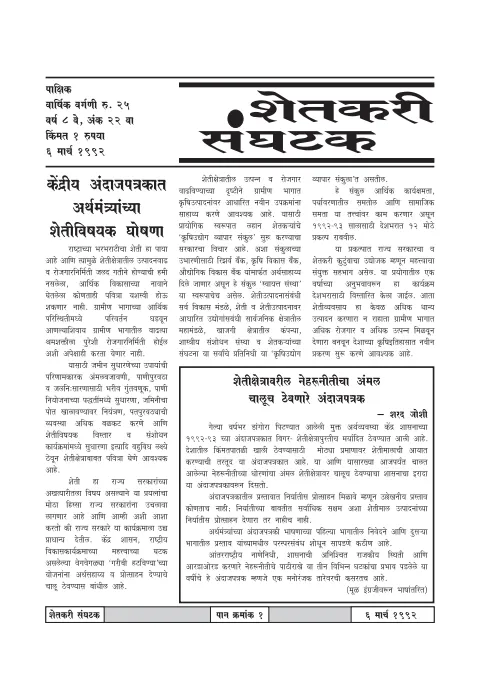
periodical issue
शेतकरी संघटक
Shetkari Sanghatak
By sharad-joshi, कृषी अर्थ प्रबोधिनी, श्री रवी काशीकर, वर्धा, श्री प्रकाश पोहरे, अकोला, श्री श्रीकांत तराळ, अमरावती
मालक: मोहन विहारीलाल परदेशी; संपादक, मुद्रक, प्रकाशक: सुरेशचंद्र पांडुरंग म्हात्रे; मुद्रण स्थळ: गणेश प्रिंटर्स, ६९२, सदाशिव पेठ, पुणे - २; प्रकाशन स्थळ: अंगारमळा, मु. पो. आंबेठाण, ता. खेड, जि. पुणे ४१० ५०१; Regd. No. 39926/83 · Ambethan, Khed, Pune · 1992
8 pages
शेतकरी संघटक
Summary
This 6 October 1992 issue of Shetkari Sanghatak (शेतकरी संघटक) — Year 9, No. 13, the Marathi fortnightly of the Shetkari Sanghatana — is built around Sharad Joshi’s lead editorial calling for a ‘second leap’ (दुसरी छलांग) of the farmers’ movement: beyond merely demanding price relief and opposing Nehruvian planning, the Sanghatana must articulate an affirmative free-market programme and a new method of agitation, or, Joshi warns, the defeat of Nehruvianism will yield no victory for Bharat. Several news pieces show the movement enacting this Nehru-critique in the street: on Gandhi Jayanti (2 October 1992) volunteers ritually burned copies of ‘Nehru’s policy’ at Sevagram (Mahatma Gandhi’s ashram), Akola, and Amravati, where the local ‘Nehru Maidan’ was simultaneously renamed ‘Mahatma Jotiba Phule Maidan’. The issue also carries an Indian Express reprint on gender discrimination as a cause of poverty, a short item on chemical/pesticide residues in food, an announcement that a Krishi Arth Prabodhini economic-condition survey of farmers will be serialised from 21 October 1992, news of impending wage and electricity-tariff increases for agriculture, the live-subscriber list as of 1 August–1 October 1992, a Karyakarini meeting notice, and the statutory ownership declaration of the periodical.
Key points
-
This 6 October 1992 issue, Year 9, No. 13, leads with Sharad Joshi’s editorial calling for a second leap beyond price-relief demands toward a positive free-market programme, quoting his book Prachalit Arthavyavasthevar Nava Prakash-2.
-
Joshi argues that demanding lower input prices and higher output prices keeps the movement inside the subsidy logic it originally set out to attack, and urges mobilising traders and small industry into a coalition.
-
On Gandhi Jayanti, 2 October 1992, volunteers ritually burned copies of Nehru’s policy at Sevagram, Akola and Amravati, where the local Nehru Maidan was simultaneously renamed Mahatma Jotiba Phule Maidan.
-
A reprinted Indian Express report, drawing on fieldwork with rural women in Andhra Pradesh, frames gender discrimination in wages and land access as a structural cause of rural poverty.
-
A consumer-side notice reports that pesticide residues found in an Indo-Asian chemical company’s tea, dal and ghee triggered a distributor boycott, with a Kolhapur firm reportedly losing 1,500 quintals of dal.
-
The issue announces a Krishi Arth Prabodhini household-economy survey of farmers across 21 districts, to be serialised from 21 October 1992 and grounded in Joshi’s Chaturang Sheti framework.
-
The masthead and organisational notices record the periodical’s live-subscriber list for August to October 1992 alongside a notice of an upcoming Karyakarini committee meeting.
Essays
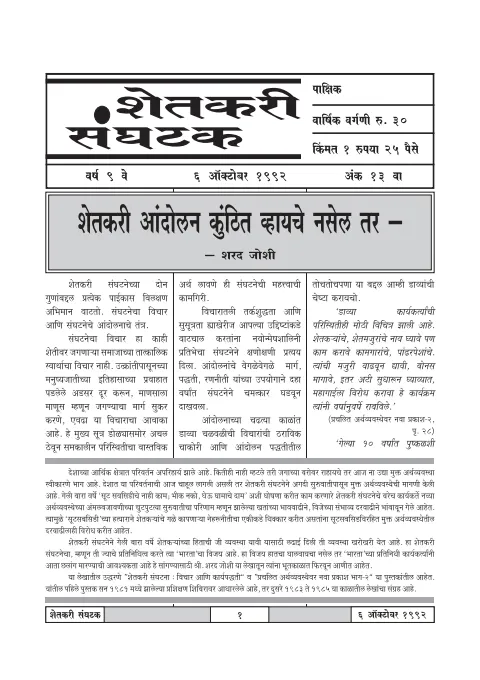
शेतकरी आंदोलन कुंठित व्हायचे नसेल तर –
By – शरद जोशी
Joshi’s lead editorial (in Marathi) argues that the Shetkari Sanghatana’s first ‘leap’ — securing remunerative prices and exposing the exploitative anatomy of the ‘India’-versus-‘Bharat’ economy — has run its course. The 1991 liberalisation and the global shift away from controlled economies have, in his reading, conceded the Sanghatana’s economic critique in principle, yet the agitation has lately become reactive and ritualised: cane-charges, morchas, and price-rollback demands repeated without an organising vision. The ‘second leap’ he proposes drops the price-relief-by-State template altogether and asks the movement to build a positive free-market constituency, drawing into it open-market traders, small entrepreneurs, and others whom the old Nehruvian dispensation forced into bondage; without this affirmative turn, he writes, even Nehruvianism’s collapse will not translate into Bharat’s victory. The essay quotes liberally from his book Prachalit Arthavyavasthevar Nava Prakash-2 to ground the argument in a longer body of work.
- The Sanghatana’s two assets — its ideology and its agitation technique — both need overhaul to survive the post-liberalisation moment.
- Demanding lower input prices and higher output prices keeps the movement inside the very subsidy logic it set out to attack.
- The ‘India vs Bharat’ framing remains valid, but the membership of each camp has shifted as State capitalism collapses.
- A ‘second leap’ must mobilise open-market traders, small industry, and other Nehruvian losers into a positive free-market coalition.
- Defeating Nehruvianism is not the same as winning for Bharat; without a constructive programme the victory will be lost.
शेतकरी संघटक : आजीव वर्गणीदार (१ ऑगस्ट ते १ ऑक्टोबर १९९२)
A reprint from the Indian Express of 14 July 1992 reporting on a study (by Jodi Jenkinson of the Andhra-Pradesh-based ‘Wolthab’ association) that frames gender discrimination as a primary engine of poverty. Drawing on fieldwork with rural women in Andhra Pradesh, the piece argues that unequal access to wages, training, agricultural extension, and legal protection holds household incomes down; female labourers report lower pay than male counterparts for the same work and are routinely sidelined in landholding and credit decisions. The summary concludes that liberation from this discrimination is itself a poverty-alleviation programme.
- Frames women’s subordination, not aggregate scarcity, as a structural cause of rural poverty.
- Cites field evidence of wage gaps and exclusion from training and extension services.
- Calls for women’s economic independence as an anti-poverty lever in its own right.
शेतकरी संघटना : कार्यकारिणी बैठक
A short consumer-side notice (Marathi) reporting that, after a Mumbai Indo-Asian chemical company allegedly mixed pesticide residues into tea-leaf, dal, and ghee through a network in Maharashtra, Gujarat, and Madhya Pradesh, distributors are now reluctant to handle its goods. The piece frames the market reaction as proof that consumers themselves penalise poisoning, with one Kolhapur firm reportedly losing 1,500 quintals of dal and 3,000 kg of dyes to the boycott.
- Pesticide-laced foodstuffs from an Indo-Asian chemical supplier trigger a distributor-led boycott in three states.
- Frames the boycott as a market-discipline response, not requiring fresh regulation.
- Concrete loss figures (1,500 quintal dal; 3,000 kg dye) cited to show that bad practice is punished commercially.
स्त्रियांच्या बाबतीतील पक्षपात गरीबीचे कारण
By (इंडियन एक्स्प्रेस, १४/७/९२ वरून)
A house notice from Krishi Arth Prabodhini announcing that, to mark the conclusion of the Sanghatana’s first 12 years (1980–1992), a comparative household-economy survey of farmers across 21 districts has been compiled and will be serialised in Shetkari Sanghatak starting with the 21 October 1992 issue. The piece lists participating districts (Pune, Latur, Beed, Chandrapur, Jalna, Nanded, Parbhani, Osmanabad, Kolhapur, Sangli, Satara, Yavatmal, Ahmednagar, Nashik, Dhule, Jalgaon, Raigad, plus three Karnataka and Gujarat districts) and credits Sharad Joshi’s ‘Chaturang Sheti’ framework as the survey’s intellectual scaffold.
- Twelve-year retrospective survey of farmers’ household economy across 21 districts.
- Serialisation begins in the 21 October 1992 issue and runs fortnightly.
- Methodologically anchored in Sharad Joshi’s ‘Chaturang Sheti’ (four-fold farming) schema.
विषारी अन्नाला मागणी नाही
Field report from Wardha district (correspondent: Ravi Kashikar) on a 2 October 1992 programme in which Shetkari Sanghatana cadre, gathered on the grounds of Mahatma Gandhi’s Sevagram Ashram, ritually burned copies of ‘Nehru’s policy’ (नेहरूनीतीचे पुस्तक) before a crowd of roughly 1,500. Office-bearers including district president Subhash Agrawal, Shetkari Mahila Aghadi leader Sumantai Agrawal, and Kisor Bhopalkar (district vice-president) led the proceedings; Sharad Joshi sent a message but did not attend. The piece notes pointedly that no opposition was registered locally despite the symbolic provocation.
- Choice of Gandhi’s own ashram for a Nehru-policy burning underlines the movement’s claim to Gandhian moral inheritance.
- Local turnout of about 1,500 with district-level leadership and the women’s wing on stage.
- Absence of any organised counter-protest is reported as itself politically significant.
शेतकऱ्यांची आर्थिक परिस्थिती (पहाणी)
By कृषी अर्थ प्रबोधिनी
Field report from Akola (correspondent: Prakash Pore) on a parallel Gandhi-Jayanti burning of Nehru’s economic-policy text in the city. The programme drew several thousand farmers and townspeople; the report records the procession, the public address, and the absence of any administrative or political obstruction. The Akola piece consciously frames the act as an extension of Gandhian moral protest rather than a partisan attack.
- Replicates the Sevagram template in a major Vidarbha town on the same day.
- Crowd reportedly in the thousands, drawn from both rural and urban constituencies.
- Frames itself as Gandhian moral protest, not partisan agitation.
शेतमजुरांची मजुरी वाढणार
Field report from Amravati (correspondent: Shrikant Taral) on a 2 October 1992 gathering of around 1,500 women farmers and 3,000 male farmers at the city’s Nehru Maidan, which the meeting then renamed ‘Mahatma Jotiba Phule Maidan’. Office-bearers including district president Sanjay Kole and women’s leader Kumudini Patil presided; speakers framed the renaming as a repudiation of Nehruvian agricultural policy and a public reclaiming of Phule’s anti-caste, pro-cultivator legacy. The report notes that the local administration did not interfere with either the renaming or the accompanying burning of Nehru-policy literature.
- Mass meeting of roughly 4,500 farmers, with women’s wing leading the dais.
- Public renaming of Nehru Maidan to Mahatma Jotiba Phule Maidan stages a substitution of liberal-agrarian Phule for statist Nehru as patron saint of the cultivator.
- Administration’s non-intervention is read as tacit acquiescence.
Generated by the v1.5 extraction pipeline. Awaiting editorial review.
Metadata and summary are AI-extracted from the source PDF and reviewed for editorial accuracy. The original work is available via the Read PDF tab above (where present); paragraph-level citation inside the PDF is deferred to a future engagement.