periodical issue
Shetkari Sanghatak
Marathi Fortnightly — Year 8, Issue 11
शेतकरी संघटक
By sharad-joshi, शेतकरी, sharad-joshi
पाक्षिक शेतकरी संघटक — मालक: मोहन विहारीलाल पारेखी; संपादक, मुद्रक, प्रकाशक: सुरेशचंद्र म्हात्रे; प्रकाशन स्थळ व पत्रव्यवहाराचा पत्ता: १२४७/५५ विश्वजीवन, पुणे ४११ ००५ · Pune · 1991
8 pages
Shetkari Sanghatak
Summary
This is the September 21, 1991 issue of Shetkari Sanghatak (शेतकरी संघटक), a Marathi fortnightly published by the Shetkari Sanghatana movement and edited by Sureshchandra Mhatre. The eight-page issue carries three pieces, all by Sharad Joshi (शरद जोशी), the movement’s founder, written in the weeks immediately following the Narasimha Rao government’s economic liberalization announcement of July 1991. The lead piece is an “open response” from farmers to the new Prime Minister, listing ten concrete demands on what a credible liberalisation must do for agriculture. The second piece is Joshi’s preface to the Marathi edition of the “National Agricultural Policy” document drafted by the Devi Lal–chaired advisory committee under V. P. Singh’s government and shelved by the Chandrashekhar and Narasimha Rao governments. The third piece, marking twelve years of the Shetkari Sanghatana, is a reflective essay arguing that the agitational phase (the “embers”) has done its work and that the movement now needs an intellectual and educational flame, anchored by Jefferson’s dictum that eternal vigilance is the price of freedom. The argumentative centre of the issue is a classical-liberal critique of the Nehru-Mahalanobis development model and an insistence that genuine liberalisation must dismantle monopoly procurement, price controls, export restrictions and the urban bias that have impoverished Indian farmers.
Key points
-
This 21 September 1991 issue (Vol. 8, No. 11) carries three pieces, all by Sharad Joshi, written weeks after the Narasimha Rao government’s July 1991 liberalisation announcement.
-
The lead item is an open letter from farmers to the Prime Minister setting out ten demands, including full freedom to export agricultural produce and removal of quantitative export caps and bans.
-
It also calls for licensing small, farm-linked processing units such as oilseed, poultry and dairy plants in rural areas, and for abolishing the procurement regime that holds farm prices below world levels.
-
Joshi’s preface to the Marathi edition of the ‘National Agricultural Policy’ recounts how the Devi Lal-chaired advisory committee, on which he himself sat, drafted the policy under V. P. Singh’s government in March 1990 before it was shelved by the Chandrashekhar and Narasimha Rao governments.
-
He presents the Marathi edition, published through Janashakti/Shetkari Prakashan, as a reference text for farmer-activists to use against continuing official policy drift.
-
The third essay, marking twelve years of the Shetkari Sanghatana, argues the movement’s agitational ‘embers’ have done their work and that an intellectual and educational ‘flame’ is now needed, invoking Jefferson’s dictum that eternal vigilance is the price of freedom.
-
Across all three pieces, Joshi names the Nehru-Mahalanobis development model as the structural source of the bias against Indian agriculture that liberalisation must reverse.
Essays
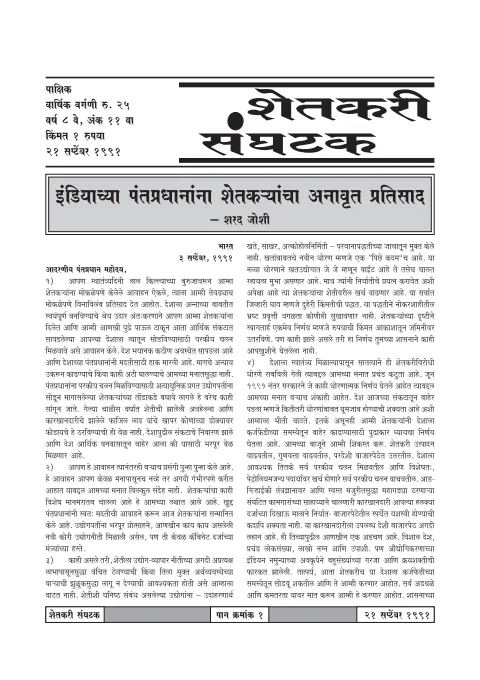
इंडियाच्या पंतप्रधानांना शेतकऱ्यांचा अनावृत प्रतिसाद
By शरद जोशी
Datelined “भारत, ३ सप्टेंबर, १९९१” (India, 3 September 1991), this is Sharad Joshi’s open letter from Indian farmers to the Prime Minister of “India” — a rhetorical split he uses throughout the piece to distinguish urban-bureaucratic India from rural Bharat. Joshi welcomes the announced shift away from the controlled economy as overdue, but warns that without specific agrarian content the new policy will once again ride on farmers’ backs. He sets out ten concrete demands: full freedom to export agricultural produce; removal of quantitative caps and bans on farm exports; an industrial policy that lets small farm-linked processing units (oilseeds, poultry, dairy) come up in rural areas; abolition of the licensing and procurement regime that holds farm prices below world levels; review of the land-ceiling laws and other restrictions on farmers’ property rights; reform of agricultural finance and credit; removal of discriminatory taxation; freedom for cooperatives and farmer-owned trading firms; investment in rural infrastructure rather than urban subsidies; and an end to the long-standing Nehru-Mahalanobis policy bias that treats agriculture as a residual sector to be squeezed for industrialisation. The piece reads as the Shetkari Sanghatana’s policy brief for the post-1991 moment.
- Frames the new economic policy as a long-overdue retreat from the controlled economy but warns it must not again be financed by squeezing farmers.
- Uses Joshi’s signature “India vs Bharat” framing — addressing the letter to the Prime Minister of “India” on behalf of “Bharat’s” farmers.
- Demands full freedom to export agricultural produce and the abolition of quantitative caps, minimum-export-price floors, and outright bans.
- Calls for an industrial policy that licences small agro-processing units (oilseed, poultry, dairy) to come up in rural areas instead of being concentrated in protected urban industry.
- Demands review of land-ceiling laws and restoration of farmers’ full property rights over their land.
- Names the Nehru-Mahalanobis development model as the source of the structural bias against agriculture that the new policy must explicitly reject.
- Reads as Shetkari Sanghatana’s ten-point policy brief on what genuine liberalisation should mean for rural India.
राष्ट्रीय कृषिनीती — मराठी आवृत्तीची प्रस्तावना
By शेतकरी (editorial note attributes preface to श्री. शरद जोशी)
Joshi’s preface to the Marathi edition of the “National Agricultural Policy” (राष्ट्रीय कृषिनीती) document. He narrates the document’s institutional history: in March 1990 the V. P. Singh-led Janata Dal government set up an Agricultural Advisory Committee chaired by Deputy Prime Minister Chowdhury Devi Lal, on which Joshi himself sat as a representative of the farmers’ movement. The committee finalised a new National Agricultural Policy, but the Janata Dal government fell, the brief Chandrashekhar government did nothing with it, and the incoming Narasimha Rao government quietly shelved it. The preface argues that the document remains the most coherent statement of what a liberalised agricultural regime should look like, and that the Shetkari Sanghatana is publishing the Marathi edition (through Janashakti / Shetkari Prakashan) precisely so that farmer-activists can wield it as a reference text against the official policy drift. The piece is signed “शेतकरी” but the sidebar explicitly identifies Sharad Joshi as the author of the preface.
- Recounts that the Devi Lal-chaired Agricultural Advisory Committee was set up by V. P. Singh’s government in March 1990 with eleven members, including Joshi himself.
- Documents how the report was orphaned: the Janata Dal government fell, Chandrashekhar’s interim government ignored it, and the Narasimha Rao government formally shelved it.
- Argues the policy document remains the clearest blueprint for what a liberalised agricultural regime should look like — abolition of monopoly procurement, free pricing, freedom to export.
- Names the Nehru-Mahalanobis model as the structural cause of agriculture’s neglect in successive Five-Year Plans.
- Positions the Marathi edition as a study text for the Shetkari Sanghatana cadre, to be used as a counter-document against official policy drift.
- Signed “शेतकरी” but explicitly attributed to Sharad Joshi by the editorial sidebar.
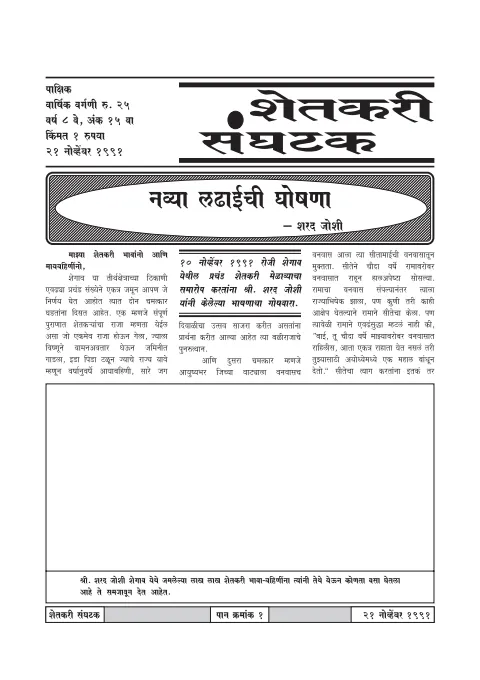
अंगाराने कार्य केले आता ज्योत हवी
By शरद जोशी
Titled “अंगारानें कार्य केलें आता ज्योत हवी” (“The embers have done their work — now we need a flame”), this is Joshi’s reflective essay marking twelve years of the Shetkari Sanghatana. He recounts that the agitational phase — burning sugarcane fields, blockading highways, going to jail — succeeded in putting farmers’ demands on the national agenda, but that an agitation alone cannot replace the institutional and intellectual work the movement now needs. To explain why, he reaches for Thomas Jefferson’s dictum, printed in capitalised English in the body of the Marathi text: ETERNAL VIGILANCE IS THE PRICE OF FREEDOM. He situates the Shetkari Sanghatana in a longer Maharashtrian reform lineage running through Jyotirao Phule and the Satyashodhak Samaj, and contrasts the movement’s agrarian-liberal vision with two failed paradigms — the Nehru-Mahalanobis state-planning model and the Maoist peasant-revolution model of which Mao Zedong is the named exemplar. He also separates the movement’s economic-liberalism from Mahatma Gandhi’s village-self-sufficiency vision. The essay closes by calling for a new intellectual phase — the “flame” — built around the Janashakti reading movement (जनशक्ती वाचक चळवळ) and sustained study, so that the next twelve years of the Sanghatana are anchored in ideas, not only protest.
- Twelve-year retrospective on the Shetkari Sanghatana, written as the movement transitions from street agitation to ideological consolidation.
- Argues the “embers” of agitation have done their work; the movement now needs a “flame” — sustained intellectual and educational work to defend the gains.
- Invokes Thomas Jefferson’s “ETERNAL VIGILANCE IS THE PRICE OF FREEDOM” — printed in English capitals inside the Marathi text — as the operative principle for this next phase.
- Places the Sanghatana in a Maharashtrian reform lineage descending from Jyotirao Phule and the Satyashodhak Samaj.
- Distinguishes the Sanghatana’s agrarian-liberal vision from both the Nehru-Mahalanobis planning model and the Maoist peasant-revolution model.
- Separates the movement from Mahatma Gandhi’s village-self-sufficiency programme, arguing farmers need market integration, not village autarky.
- Identifies the Janashakti reading movement (जनशक्ती वाचक चळवळ) as the institutional vehicle for the new “flame” phase.
Generated by the v1.5 extraction pipeline. Awaiting editorial review.
Metadata and summary are AI-extracted from the source PDF and reviewed for editorial accuracy. The original work is available via the Read PDF tab above (where present); paragraph-level citation inside the PDF is deferred to a future engagement.