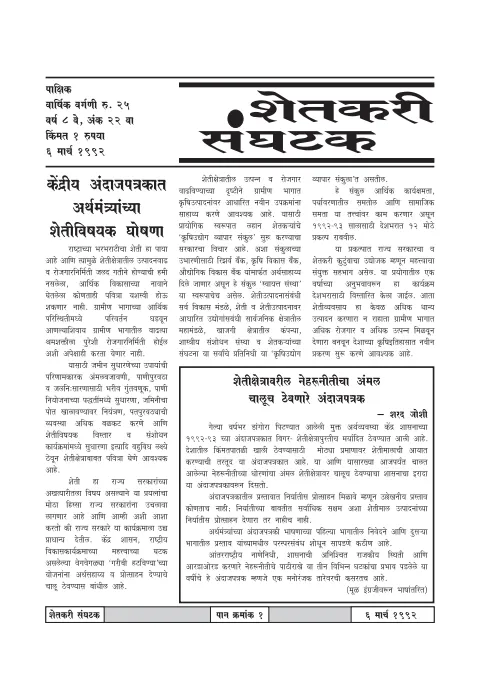
periodical issue
Shetkari Sanghatak
शेतकरी संघटक
By sharad-joshi, sharad-joshi, अमृत नारायण भिंदे, डॉ. केशव पंडितराव देशमुख, sharad-joshi, sharad-joshi, श्री. भा. के. वेलिंग, sharad-joshi, sharad-joshi, अंकित केसरळीकर
पाक्षिक शेतकरी संघटक | मालक — मोहन विहारीलाल परदेशी | मुद्रण स्थळ — चाकण प्रिंटिंग प्रेस, चाकण | संपादक, मुद्रक, प्रकाशक — सुरेशचंद्र म्हात्रे | फोन: चाकण ५०५६२ | प्रकाशन स्थळ: ११४७/६६ विश्वजीवन, पुणे ४११ ००५ · Pune · 1992
8 pages
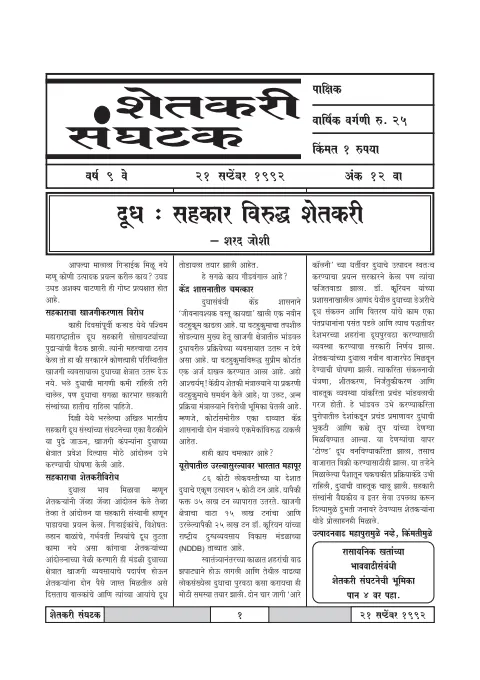
Shetkari Sanghatak
Summary
This 21 September 1992 issue of the Marathi fortnightly Shetkari Sanghatak (year 9, number 12) is the house organ of Shetkari Sanghatana, the farmers’ movement led by Sharad Joshi. The eight rendered pages are dominated by two long policy interventions by Joshi himself — a front-page essay arguing that India’s milk surplus is the work of price liberalisation rather than the cooperative-and-NDDB apparatus, and a long position paper on the August 1992 fertilizer price hike titled ‘Subsidy is not the answer — no alms, we want the price of our sweat.’ The issue also carries field news from the Nagpur and Nanded propaganda tour, an announcement cancelling the Majghar farm-display, a reader-survey form on farmers’ economic condition, a ‘सं. न. वि. वि.’ letters column with short pieces by Sharad Joshi and others on farm taxation, four-fold (chaturang) farming, the prohibition campaign in Gadchiroli and the Sindhudurg loan-waiver, and two back-page columns — Joshi’s ‘उत्पन्नाची उलटी गंगा’ (the inverted Ganga of farm income) and Akhil Kesarsaikar’s testimonial on quitting chemical fertilisers. The argumentative centre throughout is the same: farmers prosper when policy clears markets and gets out of the way; cooperatives, subsidies, parastatals and the urban-biased terms of trade are the problem, not the cure.
Key points
-
Sharad Joshi’s lead essay ‘दूध : सहकार विरुद्ध शेतकरी’ (Milk: Cooperative versus Farmer) attacks a resolution by Maharashtra cooperative-dairy leaders to keep private players out of milk as protection of a political cartel.
-
Joshi reads India’s post-1991 milk surplus as a response to price liberalisation rather than an achievement of the NDDB-anchored cooperative system, quoting Dr. Verghese Kurien on the model’s dependence on monopoly.
-
He cites Supreme Court interpretation of Operation Flood and the central essential-commodities law as instruments letting the centre override state-level dairy liberalisation, and calls for an open market where farmers may sell to private buyers.
-
In a second position paper responding to the August 1992 fertilizer price hike, Joshi rejects both the price increase and the underlying principle of fertilizer subsidy itself.
-
He argues the subsidy is captured mainly by manufacturers and by irrigated-belt farmers in five or six states such as Punjab, Haryana and Tamil Nadu, not by the dryland majority.
-
Joshi cites India’s per-hectare fertilizer use as still far below European levels and frames public-sector fertilizer plants as high-cost incumbents whose losses have been used to justify the subsidy.
-
He replaces the demand for cheaper inputs with a demand for output prices at world parity, summarised in the phrase ‘घामाचे दाम’ (the price of our sweat).
-
A separate news report covers the Sanghatana’s propaganda tour through Nagpur and Nanded districts, including village meetings and a Mahatma Gandhi Jayanti pandal, run jointly with the Shetkari Mahila Aghadi.
Essays
दूध : सहकार विरुद्ध शेतकरी
By Sharad Joshi
Sharad Joshi’s lead essay ‘दूध : सहकार विरुद्ध शेतकरी’ (Milk: Cooperative versus Farmer) attacks the official line that India’s white revolution is a triumph of cooperative dairying. Reviewing a meeting of Maharashtra cooperative-dairy leaders that resolved to keep private players out of milk, Joshi argues the real driver of the milk surplus has been the 1991-92 price liberalisation: when farm-gate prices rose under the new economic regime, supply jumped — not because of NDDB, Operation Flood or the कोऑपरेटिव्ह घराणी (cooperative dynasties).
The piece walks through three planks: (a) co-operatives are simply private parastatals controlled by politically-connected milk barons who use farmers’ money to crush competition; (b) the Supreme Court’s reading of Operation Flood, and the central ‘Jeevanvyavak vastu kayda’ food-essentials law that lets the centre overrule states in milk policy, both protect this incumbents’ cartel; (c) Dr. Kurien’s own admissions — quoted by Joshi — show the cooperative model has needed coercive monopoly to survive. Joshi cites European, U.S. and Gujarati surplus comparisons to argue that competitive private dairies, not the NDDB-anchored cooperative pyramid, are what made milk cheap and plentiful for the consumer, and demands an open-market regime where farmers may sell to whoever pays.
- Frames Maharashtra cooperative-dairy leaders’ anti-private-sector resolution as protecting a political cartel, not farmers.
- Reads the post-1991 milk surplus as a price-response, not a cooperative achievement.
- Quotes Dr. Verghese Kurien to argue that the cooperative model only survived through state-backed monopoly.
- Cites Supreme Court interpretation of Operation Flood and the central essential-commodities Act as instruments that override state-level liberalisation.
- Calls for an open-market dairy regime in which farmers may sell to private buyers, not just cooperative federations.
नागपूर व नांदेड जिल्ह्यातील प्रचारयात्रा जोमात
By Sharad Joshi
‘सूट सबसिडीचे नाही काम, भीक नको, घेऊ घामाचे दाम’ is Joshi’s response to the August 1992 central decision to roll back fertilizer subsidies and then partially restore them under farmer-organisation pressure. The Shetkari Sanghatana position is unusual on the Indian agrarian left-right map: Joshi rejects both the price rise AND the subsidy itself. Subsidies, he argues, are a transfer to fertilizer manufacturers and to large irrigated farmers in five or six states, not to the dryland majority; they also conceal the real structural problem, which is that the state-set output price for foodgrains is suppressed below the import-parity price.
Joshi works through (a) which farmers actually consume the subsidy (the highly-irrigated belts of Punjab, Haryana, Tamil Nadu, Andhra and western Uttar Pradesh, with India’s per-hectare fertilizer use still far below European levels); (b) why the subsidy props up inefficient public-sector fertilizer plants whose costs are several times the import price; and (c) why the right demand is not cheaper inputs but the freedom to sell outputs at world prices. The piece closes by linking the fertilizer fight to the wider liberalisation moment of 1991-92 and warning that without output-price liberty, farmers will keep being asked to accept charity — ‘भीक’ — instead of fair payment for their labour.
- Rejects both the August 1992 fertilizer price hike AND the principle of fertilizer subsidy.
- Argues the subsidy is captured by manufacturers and by irrigated-belt farmers in five or six states, not the dryland majority.
- Provides per-hectare fertilizer-use comparisons with European countries to show India’s overall use is still low.
- Frames public-sector fertilizer units as high-cost incumbents whose losses justify the subsidy.
- Replaces the demand for cheap inputs with the demand for output prices at world parity — ‘घामाचे दाम’ (the price of our sweat).
खतांच्या भाववाढीबाबत शेतकरी संघटनेची भूमिका — सूट सबसिडीचे नाही काम भीक नको, घेऊ घामाचे दाम
By शरद जोशी
A short organisational news piece, ‘नागपूर व नांदेड जिल्ह्यातील प्रचारयात्रा जोमात’ (The propaganda tour through Nagpur and Nanded districts is in full swing), reports on Shetkari Sanghatana’s field campaign through the two districts in early September 1992. It names the सेविका-सेवक training schedule, lists the village stops and meeting tents (including a Mahatma Gandhi Jayanti pandal), tracks the organisation’s penetration into the village-level cadre and notes that the campaign is being run jointly by the Shetkari Sanghatana and the Shetkari Mahila Aghadi. The piece reads as an internal accountability report for the readership rather than as argumentative writing.
- Reports the early-September 1992 Shetkari Sanghatana propaganda tour through Nagpur and Nanded districts.
- Lists training sessions for cadres and village meeting venues, including a Mahatma Gandhi Jayanti tent.
- Notes joint conduct of the tour with the Shetkari Mahila Aghadi women’s wing.
- Functions as a movement-internal accountability report for subscriber-members.
माजघर शेती प्रदर्शन रद्द
By माजघर शेती प्रदर्शन कार्यालय, आंदेगाव
The ‘स. न. वि. वि.’ letters column on page 7 bundles five short pieces. Amrut Narayan Dinde (Brahmanwadi) writes against agricultural taxation, arguing that any income-tax-style cess on farm produce would compound the price-suppression farmers already suffer. Sharad Joshi himself contributes ‘चतुरंग शेतीला पर्याय नाही’ (There is no alternative to four-fold farming), defending the Sanghatana’s diversified-farming model against critics. Dr. Keshav Vasantrao Deshmukh (Dongarshelki, Akola) thanks the movement for taking up the Chaturang programme. Dr. Ashok Beng (Gadchiroli) writes on ‘दारू दुकान बंदी’ — the prohibition of liquor shops — in tribal Gadchiroli district. Sh. M. K. Behre (Sindhudurg) asks why the central loan-waiver has not reached farmers in Sindhudurg, arguing that 600 farmers in that district have been excluded from the benefits available across the rest of the country.
- Letter-writers ask for movement positions on farm taxation, the chaturang farming model, prohibition, and the central loan-waiver.
- Dinde frames farm taxation as compounding price-suppression rather than redistributing wealth.
- Joshi defends ‘चतुरंग शेती’ (four-fold/diversified farming) as the only viable alternative for Indian agriculture.
- Dr. Ashok Beng reports on tribal-area prohibition demands from Gadchiroli.
- Behre flags 600 Sindhudurg farmers being denied loan-waiver benefits as discriminatory non-implementation.
शेतकऱ्यांची आर्थिक परिस्थिती : प्रश्नावली संबंधी
By Sharad Joshi
‘उत्पन्नाची उलटी गंगा’ (The inverted Ganga of income) is Joshi’s back-page column tying the issue’s themes together. Using village-level income figures and showing how rural per-capita output and consumption have fallen from 1959 through 1988, he argues that the terms of trade between the village and the city run upstream — wealth flows from village to city rather than the other way around. He invokes Nehruvian developmentalism as the policy frame that set this current, and points to specific Gandhian rural-development promises that, in his reading, have been hollowed out by urban-industrial extraction.
- Argues that India’s rural-urban terms of trade form an ‘inverted Ganga’ — wealth flows out of villages to cities.
- Uses per-capita village income time-series from 1959 to 1988 as the evidence base.
- Locates the policy source of the inversion in the Nehruvian developmental settlement.
- Reads Gandhian village-economy promises as unkept.
स. न. वि. वि. — शेतीवरील कर
By अमृत नारायण भिंदे, ब्राह्मणवेल (परभणी)
Akhil Kesarsaikar (Nanded) writes ‘रासायनिक खतांचा त्याग’ (Renouncing chemical fertilizers), a first-person testimonial. He reports that on his forty-acre holding he has stopped using chemical fertilizers and shifted to organic methods, and details the yield trajectory, soil-health outcomes, and the financial maths that — in his account — make the organic switch viable for farmers who can afford the transition. The piece runs as movement testimony rather than as systematic agronomy and sits alongside Joshi’s ‘उत्पन्नाची उलटी गंगा’ as a back-page bookend on the fertilizer-policy theme that ran through the issue.
- First-person account of fully renouncing chemical fertilizers on a 40-acre holding.
- Reports yield, soil and financial outcomes from the organic transition.
- Positioned as movement testimony reinforcing the issue’s wider critique of the fertilizer-subsidy regime.
Generated by the v1.5 extraction pipeline. Awaiting editorial review.
Metadata and summary are AI-extracted from the source PDF and reviewed for editorial accuracy. The original work is available via the Read PDF tab above (where present); paragraph-level citation inside the PDF is deferred to a future engagement.