periodical issue
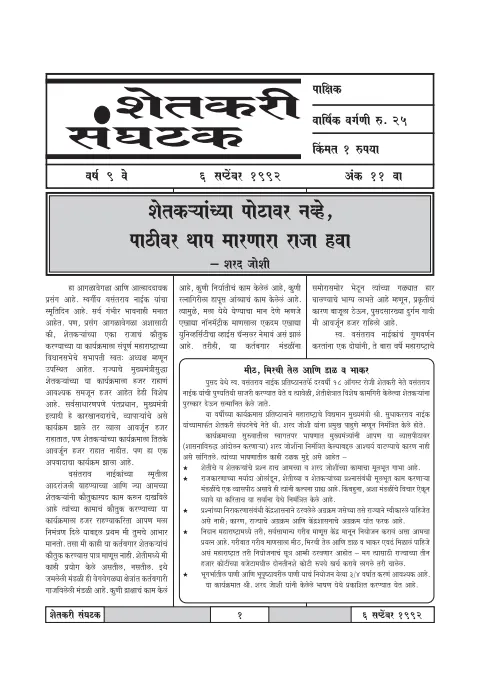
Shetkari Sanghatak
Vol. 9, No. 11 (6 September 1992)
शेतकरी संघटक
By sharad-joshi, गो. ह. आगाशे
पाक्षिक शेतकरी संघटक | मालक — मोहन बिहारीलाल परदेशी | मुद्रण स्थळ — चाकण प्रिंटिंग प्रेस, चाकण | संपादक, मुद्रक, प्रकाशक: सुरेशचंद्र म्हात्रे (फोन: द्वारा ५०६८२) | ६ व २१ तारखेला प्रसिद्ध होतो. | प्रकाशन स्थळ: ११८७/६६ शिवाजीनगर, पुणे ४११ ००५. | English imprint on page 16: 'SHETKARI SANGHATAK (Marathi Fortnightly), Regd. No. 39926÷A83, September 6, 1992; Posted at Market Yard, PSO, Pune 37; PNCW 281, Licence to post without prepayment No. 87.' · Pune · 1992
16 pages
Shetkari Sanghatak
Summary
This 6 September 1992 issue of the Marathi fortnightly शेतकरी संघटक (Shetkari Sanghatak, Year 9, No. 11) — the masthead organ of Shetkari Sanghatana — is dominated by a long signed essay from Sharad Joshi explaining why he declined to attend the first anniversary of the Vasantrao Naik Smruti Pratishthan despite a personal invitation from Maharashtra Chief Minister Sudhakarrao Naik. The piece functions as a polemical audit of the late Vasantrao Naik’s agricultural and dairy record (Roshanara cotton variety, the 1980 cotton monopoly procurement scheme, Operation Flood’s Aarey/Dudh Mahapur extension to Maharashtra) and frames the Sanghatana’s enduring grievance against the Nehruvian state-controlled price regime for farm produce. The same Nehruvian-policy thread runs through the rest of the issue: a report on the Krutisamiti (action committee) meeting at Nanded on 24–25 August 1992, news reports of the symbolic burning of Nehru-policy effigies on 9 August (Kranti Din) at Javalgaon and Nanded, an editorial on India’s medal-less Barcelona Olympics linking sports failure to per-capita poverty, a piece on the cotton/wheat/milk import policy of Narasimha Rao’s government titled “केंद्र सरकारचे पुन्हा, येरे माझ्या मागल्या”, G. H. Agashe’s analysis of the economics of foreign milk-powder imports, the Kharif 1992–93 minimum support price table, the launch of a household-level survey of farmer economic conditions (1980 vs 1992 baselines) by Shetkari Sanghatak, and a back-cover commentary on P. V. Narasimha Rao’s 15 August 1992 Red Fort speech.
Key points
-
The issue’s lead essay by Sharad Joshi, an open reply to Chief Minister Sudhakarrao Naik, explains his refusal to attend the first anniversary of the Vasantrao Naik Smruti Pratishthan.
-
Joshi blames the 1980 burning of Roshanara cotton crops on a variety promoted during Vasantrao Naik’s tenure, citing it as a founding grievance of the Shetkari Sanghatana.
-
The essay describes the Maharashtra State Cotton Monopoly Procurement Scheme as a transfer of roughly two hundred crore rupees from farmers to the Congress party fund and the cotton-ginning lobby.
-
Joshi reads Operation Flood’s Dudh Mahapur dairy extension as a device to depress domestic milk prices through subsidised foreign milk-powder imports, harming independent dairy growers.
-
Joshi insists the Sanghatana’s demand is not a higher administered price but the complete withdrawal of the state’s administered-price regime for farm produce.
-
An unsigned editorial reads India’s medal-less performance at the 1992 Barcelona Olympics as a downstream effect of socialist economic policy rather than a coaching or talent deficit, cross-tabulating the medal table by per-capita income.
-
The editorial notes that the 815 Barcelona medals were shared among just 30 countries drawn overwhelmingly from richer income bands, with populous low-income countries such as India virtually absent.
-
A report on the Shetkari Sanghatana’s 24-25 August 1992 Nanded action-committee meeting, presided over by Shankar Dhondge, lists a programme including outreach for the Lakshmi Mukti women’s land-rights initiative.
-
The issue also records the symbolic burning of Nehru-policy effigies at Javalgaon and Nanded on 9 August, marked locally as Kranti Din.
Essays
शेतकऱ्यांच्या पोटावर नव्हे, पाठीवर थाप मारणारा राजा हवा
By शरद जोशी
Sharad Joshi’s lead essay, “शेतकऱ्यांच्या पोटावर नव्हे, पाठीवर थाप मारणारा राजा हवा” (We need a king who pats farmers on the back, not one who punches their stomach), is framed as an open reply to Maharashtra Chief Minister Sudhakarrao Naik, who had personally invited Joshi to speak at the first anniversary of the Vasantrao Naik Smruti Pratishthan. Joshi explains that he had to decline because he cannot endorse the public memory of Vasantrao Naik as a farmers’ champion. He proceeds, with the explicit reluctance of someone speaking ill of a recently deceased Maharashtra leader, to itemise four grievances: the failed Roshanara cotton variety that left growers’ fields charred in 1980; the Maharashtra State Cotton Monopoly Procurement Scheme that, in Joshi’s account, transferred ₹200 crore of farmer wealth to the Congress treasury and the ginning lobby (he names “मोदी” of cotton ginning); the Aarey/Dudh Mahapur dairy extension that crushed independent dairy growers by importing subsidised foreign milk powder; and the state’s artificial fixing of low procurement prices for salt, chillies, oil, and grain. The essay reframes the demand of the Sanghatana as not subsidy or sympathy but parity-price freedom (“खुल्या बाजारपेठेच्या अर्थव्यवस्थेचा फायदा”), and ends with Joshi’s refusal to be the political guest of a government whose dispensation he sees as continuous with Nehruvian agricultural socialism.
- Joshi declines the Vasantrao Naik Smruti Pratishthan invitation and uses his refusal letter as occasion for a public critique of Naik’s agricultural legacy
- He attributes the 1980 burning of Roshanara cotton crops to Naik-era variety promotion and uses it as the founding grievance that built the Shetkari Sanghatana
- The Maharashtra State Cotton Monopoly Procurement Scheme is presented as a transfer of roughly ₹200 crore from farmers to the Congress party fund and the cotton-ginning lobby (“मोदी”)
- Operation Flood / Dudh Mahapur is read as a deliberate device to depress domestic milk prices through subsidised foreign milk-powder dumping
- Joshi insists the farmer demand is not a higher administered price but withdrawal of the administered-price regime itself
ऑलिंपिकमधील अपयशाच्या निमित्ताने -
An unsigned editorial, “ऑलिंपिकमधील अपयशाच्या निमित्ताने”, uses India’s medal-less performance at the 1992 Barcelona Olympics as a hook for a structural argument about economic poverty and Olympic underachievement. Cross-tabulating the medal table by per-capita-income brackets — rich, upper-middle, lower-middle, and poor — the piece shows that the 30 countries that share the 815 Barcelona medals are overwhelmingly drawn from the first three bands, while populous low-income countries (India is the clearest case) are virtually absent. The article reads Olympic failure not as a coaching or talent deficit but as a downstream effect of socialist economic policy that has held Indian household incomes below the threshold at which mass sporting infrastructure becomes viable, and explicitly rejects the comforting nationalist excuses (“मदर तेरेसा” etc.) that are routinely offered in the Indian press after every Games.
- Among the 30 countries that won the 815 Barcelona medals, the richest four nations alone account for a disproportionate share
- The 24 countries with per-capita GDP between $500 and $2,490 win essentially nothing in absolute terms relative to their populations
- India’s failure is read as a poverty effect, not a sports-administration effect
- The piece dismisses the post-Games consolations (Mother Teresa, spirituality, etc.) routinely deployed in Indian commentary
- Olympic performance is offered as a public-facing diagnostic of the cost of the planned-economy model
शेतकरी संघटना : कृतिसमिती बैठक वृत्तांत — नांदेड दि. २४/२५ ऑगस्ट १९९२
A reporting block, “शेतकरी संघटना : कृतिसमिती बैठक वृत्तांत नांदेड दि. २४/२५ ऑगस्ट १९९२”, lists the action-programme adopted by the Shetkari Sanghatana’s action committee at its 24–25 August 1992 Nanded meeting under the presidency of Shankar Dhondge: (i) collection of letters of farmer Sitaram Maharaj on the Sita Sheti agricultural experiment; (ii) plot-level outreach for the Lakshmi Mukti programme on women’s land rights; (iii) a renewed condemnation of central-government Nehruvian policy; (iv) call for a Krantidin Bhavyatra rally on 1 September and 2 October 1992; (v) a fundraising drive for the organisation’s life and annual subscriptions; and (vi) a 10 November 1992 annual general body meeting. The page also reports the symbolic burning of effigies of “Nehru-policy” at multiple district centres on 9 August (Kranti Din), with one fuller account of the Nanded burning ceremony presided over by Shankar Dhondge.
- Six-point action programme adopted at Nanded action committee meeting on 24–25 August 1992
- Krutisamiti chaired by Shankar Dhondge; meeting open to all district-unit chairs and conveners
- Krantidin Bhavyatra fixed for 1 September and 2 October 1992 across districts
- Effigies of Nehru-policy ritually burnt at Javalbazar, Nanded and listed outlying centres on 9 August 1992
- An annual general meeting set for 10 November 1992
नांदेड येथे क्रांतिदिनी नेहरूधोरण पुतळ्याचे दहन
“केंद्र सरकारचे पुन्हा, येरे माझ्या मागल्या” (literally, “Central government again — oh my, here it comes from behind”) argues that the Narasimha Rao government’s 1991–92 “reforms” have, in practice, returned Indian agricultural trade to its pre-liberalisation administered-price regime. The piece walks through the cotton sector — where the 1980 monopoly-procurement architecture has effectively been restored at chief-minister level — and the wheat sector, where Punjab’s bumper surplus has been left without remunerative price support while Canadian wheat is imported at a higher cost. It tracks the contradiction in dairy: the National Dairy Development Board, the Ministry of Agriculture and the Reserve Bank approve a third tranche of Operation Flood (Dudh Mahapur) financed by the World Bank, importing foreign milk powder to depress the domestic price. The essay reads the cumulative pattern as “मुक्त अर्थव्यवस्थेची भाषा तोंडावर ठेवून नेहरूनीतीची डंडा अधिक उंच उगारणे” — raising the Nehruvian baton higher while mouthing the language of the free market.
- Punjab wheat surplus left without remunerative procurement price; Canadian wheat imported at higher cost
- Restored cotton-monopoly-style procurement in Maharashtra at administered prices
- Third tranche of Operation Flood (Dudh Mahapur) approved with World Bank financing for foreign milk-powder imports
- The piece names this “मुक्त अर्थव्यवस्थेची भाषा तोंडावर ठेवून नेहरूनीतीची डंडा” — free-market language, Nehruvian stick
- Imports of edible oil and milk powder presented as direct income transfers away from Indian farmers
नेहरूधोरण प्रतिमेचे दहन (जवळाबाजार)
By प्रेषक: रामकिशन अप्पा रुद्राळे, जवळाबाजार
G. H. Agashe’s signed analytical column, “आयातीमागे कोणते अर्थशास्त्र आहे?” (What economics lies behind the imports?), examines the Narasimha Rao government’s new economic policy on milk and dairy products. Agashe takes Dr. Amrita Patel’s defence of the imports in The Economic Times (4 August 1992) and reframes the question: if the new policy explicitly excludes “दूध आणि दुग्धजन्य पदार्थ” (milk and dairy products) from liberalisation, the policy is being run not for farmers but for non-farm industries. He argues that what is being protected by imports is not consumer welfare but the bargaining position of urban dairy industries against the Indian farmer.
- Frames Operation Flood imports as a policy that excludes milk from liberalisation deliberately
- Reads Dr. Amrita Patel’s Economic Times defence (4 August 1992) as concession that the policy is industry-facing, not farmer-facing
- Identifies the beneficiary of the import policy as the non-farm dairy-processing lobby
एक उंदीर मारण्यास १४ रू. ४५ पैसे
A two-page announcement and full questionnaire, “शेतकऱ्यांची आर्थिक परिस्थिती : एक पाहणी”, launches a Sanghatana-led household survey comparing farmer balance-sheets between 1980 and 1992. The questionnaire records farm size, household size by gender, livestock, water source, crops, debt and savings, and a long checklist of consumption goods (milk, ghee, fruit, eggs, meat; electric light, radio, television, cycle, motorcycle; toothpaste, soap, kerosene, alcohol, newspaper/magazine; children’s clothing categories). The 40/50-year-old farmer of 1980 is being asked to mark each item as ho/nahi (yes/no) for both years. Responses are to be returned by 20 September 1992 to the editorial address at Angarmal, Khed, Pune.
- Survey instrument built on a 1980-vs-1992 comparison sheet for the same household
- Captures landholding, debt, savings, consumption baskets and clothing items as ho/nahi binary across two years
- Designed as evidence base for the Sanghatana’s claim of farmer-income stagnation under the Nehruvian price regime
- Returns invited by 20 September 1992 at the editorial address (Angarmal, Khed, Pune)
Generated by the v1.5 extraction pipeline. Awaiting editorial review.
Metadata and summary are AI-extracted from the source PDF and reviewed for editorial accuracy. The original work is available via the Read PDF tab above (where present); paragraph-level citation inside the PDF is deferred to a future engagement.