speech
SOME LESSONS OF A DECADE OF PLANNING
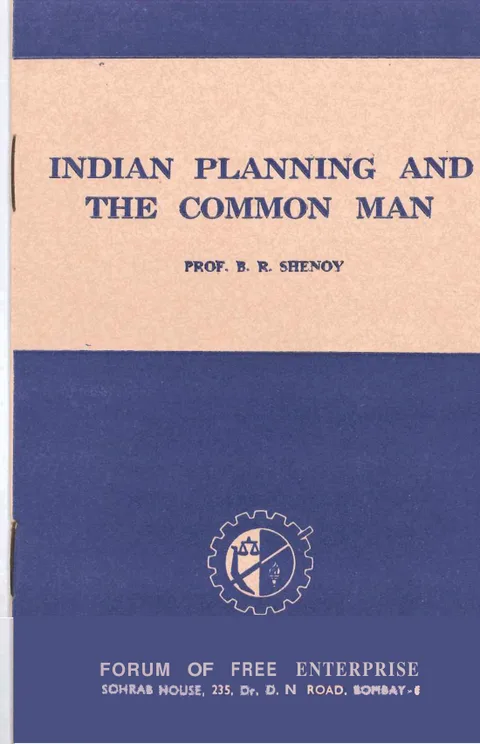
By R. K. Amin
Published by M. R. Pai for Forum of Free Enterprise, "Sohrab House", 235 Dr. Dadabhai Naoroji Road, Bombay 1, and printed by P. A. Raman at Inland Printers, 55 Gamdevi Road, Bombay 7. · Bombay · 1961
8 pages
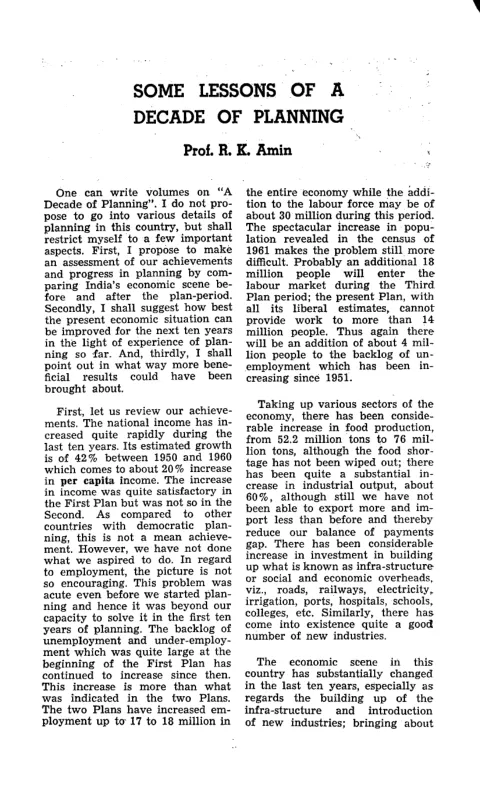
SOME LESSONS OF A DECADE OF PLANNING
By Prof. R. K. Amin
Summary
Prof. R. K. Amin’s address, delivered under the auspices of the Forum of Free Enterprise in Bombay on April 13, 1961, audits the first decade of Indian planning and asks what could have been done better. He concedes real achievements — a 42% rise in national income between 1950 and 1960, roughly 20% growth in per capita income, substantial increases in industrial output and exports, infra-structural building (roads, railways, electricity, irrigation, ports, hospitals, schools, colleges), better statistics, and visible if uneven progress on agriculture and family planning. But the backlog of unemployment and under-employment has actually grown, the food problem has been a ‘great part’ of resource and policy attention, and an additional 18 million job-seekers are about to enter the labour market under the Third Plan.
Against that ledger, Amin presses three lines of critique. First, the philosophy of planning has drifted: the original objective of a Welfare State and a Mixed Economy was quietly converted into a ‘socialistic pattern of society’ and then a ‘socialist economy’, while industrial policy now travels under the name of a ‘pragmatic approach’. Second, the technique of planning has become rigid, top-heavy, and politicised — site selection of irrigation and other projects is driven by ‘political pressure’, the Planning Commission’s own Panel of Economists has been disregarded, Prof. B. R. Shenoy’s dissent ignored, and Chief Ministers haggle with the Prime Minister over State Plans. Third, the plan has leaned too heavily on foreign aid, deficit financing, and over-ambitious targets; Amin urges flexibility, prudent monetary policy, attention to social and economic overheads (health, education, agricultural productivity), and disciplined use of resources.
The closing pages mount an explicitly classical-liberal defence. Drawing on Burke, Keynes, Adam Smith, McCulloch, Viner, Carlyle, Bentham and Hume, Amin argues that the classical economists were neither apostles of laissez faire in a vulgar sense nor mere advocates of the mercantile class; their case for economic freedom and private property rested on universal benevolence, the impracticality of forced equality, and the practical superiority of voluntary co-ordination. Socialism, he warns, may ‘work in a state of universal benevolence’ but India has not attained that stage, and ‘equality by the same violence by which it was established’ would summon ‘an army of inquisitors and executioners’. The lessons of the decade, accepted soon enough, can still rescue Indian planning.
Key points
-
Frames the speech as a stocktaking of the first decade of Indian planning (1950–1960) so lessons can guide the next ten years.
-
Acknowledges concrete achievements: national income up 42%, per-capita income up ~20%, big industrial-output gains, exports up, balance of payments more comfortable after the Second Plan, and substantial infrastructure build-out.
-
Identifies persistent failures: unemployment and under-employment have grown, the food problem absorbed disproportionate resources, and 18 million additional job-seekers will enter the Third Plan labour market.
-
Diagnoses a drift in the philosophy of planning — from Welfare State and Mixed Economy to ‘socialistic pattern of society’ and then ‘socialist economy’ — and a parallel softening of industrial policy under the label ‘pragmatic approach’.
-
Criticises the technique of planning: rigid targets, over-ambition, neglect of co-ordination, expert advice ignored (Panel of Economists, B. R. Shenoy’s Note of Dissent), and project-siting decided by ‘political pressure’ rather than economic considerations.
-
Warns against excessive deficit financing and foreign aid, urging flexibility, monetary stability, and investment in social and economic overheads — health, education, agricultural productivity.
-
Defends private property and economic freedom on classical-liberal grounds, citing Burke, Keynes, Adam Smith, McCulloch, Viner, Carlyle, Bentham and Hume, and rejects the caricature of classical economists as advocates of one class.
-
Argues that socialism presupposes universal benevolence that does not yet exist in India, and that forcing equality requires coercive machinery — ‘an army of inquisitors and executioners’.
Generated by the v1.5 extraction pipeline. Awaiting editorial review.
Metadata and summary are AI-extracted from the source PDF and reviewed for editorial accuracy. The original work is available via the Read PDF tab above (where present); paragraph-level citation inside the PDF is deferred to a future engagement.