speech
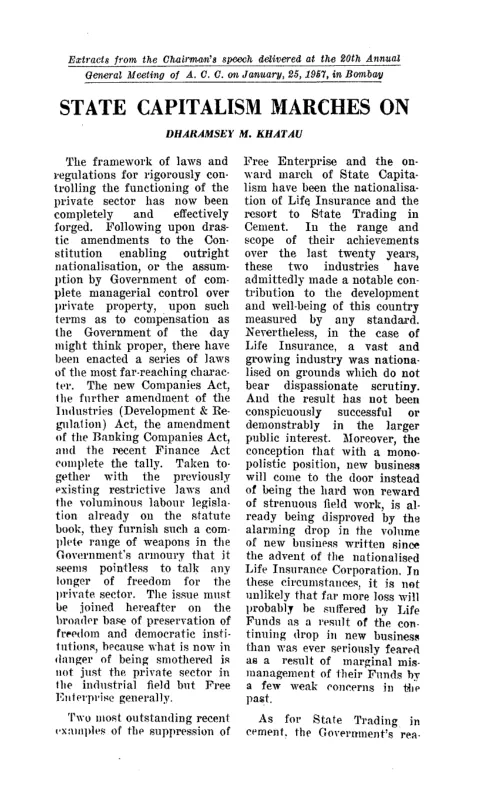
STATE CAPITALISM MARCHES ON
THE FORUM OF FREE ENTERPRISE, "Sohrab House", 235, Dr. Dadabhai Naoroji Road, BOMBAY 1. · Bombay · 1957
4 pages
STATE CAPITALISM MARCHES ON
By DHARAMSEY M. KHATAU
Summary
This pamphlet reproduces extracts from Dharamsey M. Khatau’s chairman’s speech at the 20th Annual General Meeting of A.C.C. (Associated Cement Companies), delivered in Bombay on 25 January 1957 and circulated by the Forum of Free Enterprise. Khatau argues that the legal scaffolding for a free private sector — once “properly forged” — has been rapidly dismantled by a succession of statutes: the new Companies Act, the Industries (Development & Regulation) Act, the amendment of the Banking Companies Act, the new Finance Act, and the surrounding labour legislation. Taken together, he says, these laws no longer leave room for freedom for the private sector, and the issue can no longer be postponed to a vaguer debate about “preservation of freedom and democratic institutions”.
He then takes two case studies to show the trend. First, the nationalisation of Life Insurance: an industry that had grown vigorously and served the public conspicuously well has been taken over despite the absence of any clear public-interest case, with new business already lower than before the Life Insurance Corporation came in. Second, State Trading in cement — for which Khatau supplies a detailed narrative. The Government refused the industry’s price-equalisation proposals, and instead used the State Trading Corporation of India to import and distribute cement, fixing the cost-plus selling price for the producers and routing all sales through agents of the STC. Khatau argues that this regime is not technically necessary — the “cement gap” could have been bridged through industry-led price equalisation — and that, by inserting the State as compulsory middleman in a basic productive industry, it inflicts a “grave injury” on free enterprise.
The closing pages widen the lens. Khatau warns that the Industrial Policy Resolution’s promise of an “honourable balance” between State Enterprise and Free Enterprise is being violated in practice, since the building blocks of a socialist pattern are not being laid “on the foundations of a democratic Constitution.” He approvingly cites the Prime Minister’s own statement that individual freedom matters because society wants “the creative and adventurous spirit of man to grow,” and he notes that East European experience shows socialism is compatible with “all-powerful organisation impinging upon individual liberties with heavy-handed bureaucracy and regimentation.” The pamphlet ends with a defence of free enterprise as a “legitimate and vital function” within a democracy and as the foundation on which the Constitution rests.
Key points
-
Khatau frames a four-page chairman’s address around the thesis that “State Capitalism” — not socialism per se — is marching on in India through statutes that progressively narrow the private sector’s room to operate.
-
He lists the new Companies Act, the Industries (Development & Regulation) Act, the amendment to the Banking Companies Act, the Finance Act, and the voluminous labour legislation as cumulative “weapons in the Government’s armoury” against free enterprise.
-
He treats the nationalisation of Life Insurance as a case where a vigorously growing and publicly trusted industry was absorbed without a dispassionate showing of public-interest necessity, and notes that new business is already lower under the L.I.C.
-
On cement, he narrates how the industry warned the Government of a “cement gap” as early as September 1955, offered to import and distribute cement without profit, and proposed price-equalisation through an industry pool — proposals rejected in favour of State Trading via the State Trading Corporation of India.
-
He argues the State Trading scheme is “a serious infringement of the right to freedom of trade in a democratic society” because the cement gap could have been resolved without inserting the State as compulsory middleman in a basic productive industry.
-
He cites Nehru’s own warning about the “tragic consequences of unbalanced planning in an authoritarian manner in East European countries and elsewhere” to call for a balanced approach between State Enterprise and Free Enterprise.
-
He invokes the Industrial Policy Resolution as the official promise of an “honourable balance” and contends that the cement nationalisation breaches both that resolution and the broader idea of building socialism on the foundations of a democratic Constitution.
-
The closing argument is constitutional: free enterprise is not merely tolerated political sufferance but a vital component of the democratic foundation, and must be “positively encouraged to thrive by appropriate incentives and reliefs whenever needed.”
Generated by the v1.5 extraction pipeline. Awaiting editorial review.
Metadata and summary are AI-extracted from the source PDF and reviewed for editorial accuracy. The original work is available via the Read PDF tab above (where present); paragraph-level citation inside the PDF is deferred to a future engagement.