speech
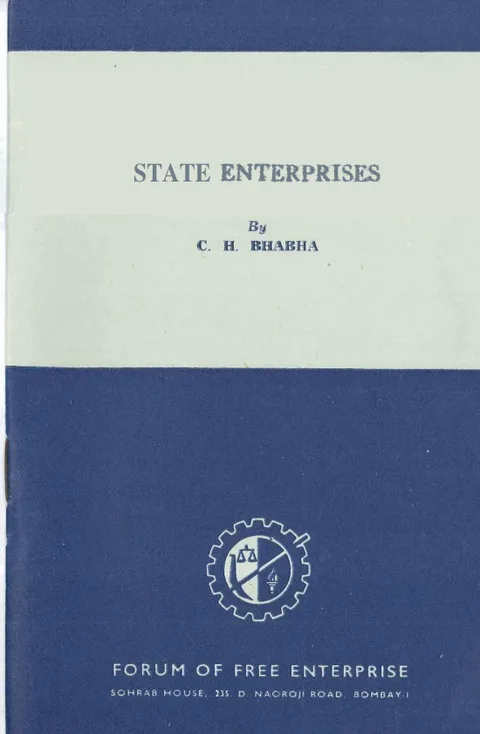
State Enterprises
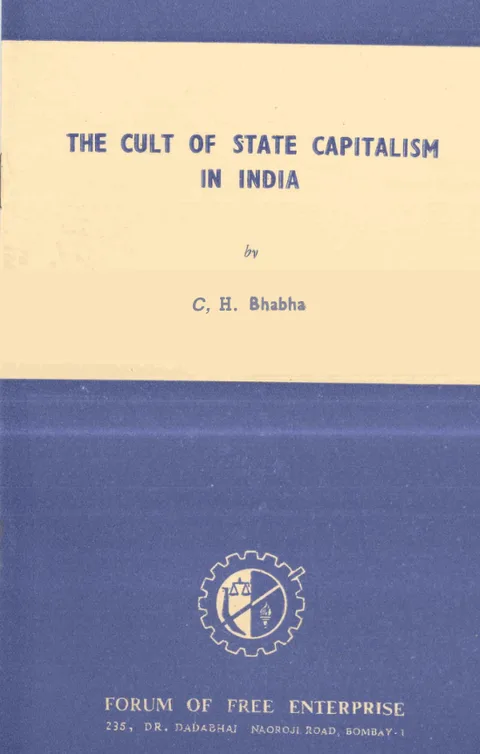
By C. H. Bhabha
FORUM OF FREE ENTERPRISE, SOHRAB HOUSE, 235, D. NAOROJI ROAD, BOMBAY-1 · Bombay · 1956
8 pages
State Enterprises
By C. H. BHABHA
Summary
This pamphlet prints the text of a talk on “State Enterprises” delivered by C. H. Bhabha at the Rotary Club, Bombay, on September 18, 1956, and issued by the Forum of Free Enterprise. Speaking during the Second Five-Year Plan, Bhabha offers what he frames as the “dispassionate observations of a spectator” on the rapid expansion of the public sector. He argues that although the Constitution recognises and guarantees the right to own private property, in practice India’s leaders treat private ownership with suspicion while encouraging only “the ownership of political power and patronage,” and that the State is plunging into ventures normally outside the proper ambit of a democratic government.
The bulk of the talk is a sustained critique of how state enterprises are governed and managed. Bhabha catalogues the legal privileges these undertakings enjoy: the omnibus Section 620 clause in the new Companies Act exempting them from many provisions, exemptions from rent-control and labour laws, and special treatment that he calls unfair to private competitors. He attacks the personnel problem—“square pegs in round holes,” nepotism, recommendatory letters and semi-directives from politicians and bureaucrats, frequent transfers of key staff, and the demoralising dominance of the Secretariat over enterprise managers. He notes that these public corporations are registered as Private Limited Companies, shielding their profit-and-loss accounts from public scrutiny, and that audits by the Auditor-General are too superficial to expose mismanagement, citing an instance of an asset order “costing over a million pound sterling” placed with an inexperienced supplier.
Bhabha closes by warning that the perfunctory parliamentary scrutiny of these enterprises makes their claimed independence “merely a mockery,” and by invoking a new “Socialistic Pattern” definition of democracy that he fears can be turned against the common man. In conclusion he quotes Mahatma Gandhi at length on his fear of the growing power of the State, the State as “violence in a concentrated and organised form,” and the preference for trusteeship and voluntary organisation over state-ownership. The work is complete in the rendered pages, ending with the delivery note and printer’s colophon.
Key points
-
Text of a talk by C. H. Bhabha delivered at the Rotary Club, Bombay, on September 18, 1956, published by the Forum of Free Enterprise.
-
Bhabha argues that while the Constitution guarantees private property, India’s leaders in practice distrust private ownership and privilege only political power and patronage.
-
He critiques the Second Five-Year Plan’s elevation of the Public Sector and the relegation of the private (“People’s”) sector to a degraded position.
-
Legal privileges of state enterprises are itemised: Section 620 of the new Companies Act exempting them from many provisions, plus exemptions from rent-control and labour laws unavailable to private firms.
-
He details a personnel critique—patronage appointments, nepotism, ‘square pegs in round holes,’ frequent transfers, and domination by the Secretariat over enterprise managers.
-
State corporations are registered as Private Limited Companies, hiding their profit-and-loss accounts from public scrutiny, and Auditor-General scrutiny is dismissed as perfunctory and prone to ‘whitewashing.’
-
Bhabha cites a case of an order for an asset ‘costing over a million pound sterling’ placed with an inexperienced supplier as an example of unsound decisions injected by non-officials.
-
The talk concludes with extended quotations from Mahatma Gandhi expressing fear of state power, the State as concentrated violence, and a preference for trusteeship and voluntary organisation over state-ownership.
Generated by the v1.5 extraction pipeline. Awaiting editorial review.
Metadata and summary are AI-extracted from the source PDF and reviewed for editorial accuracy. The original work is available via the Read PDF tab above (where present); paragraph-level citation inside the PDF is deferred to a future engagement.