speech · memorial lecture
The Application of Science and Technology to Socio-Economic Development
FORUM OF FREE ENTERPRISE, SOHRAB HOUSE, 235 DR D. N. ROAD, BOMBAY-1 · Bombay · 1971
28 pages
Part of A. D. Shroff Memorial Lecture
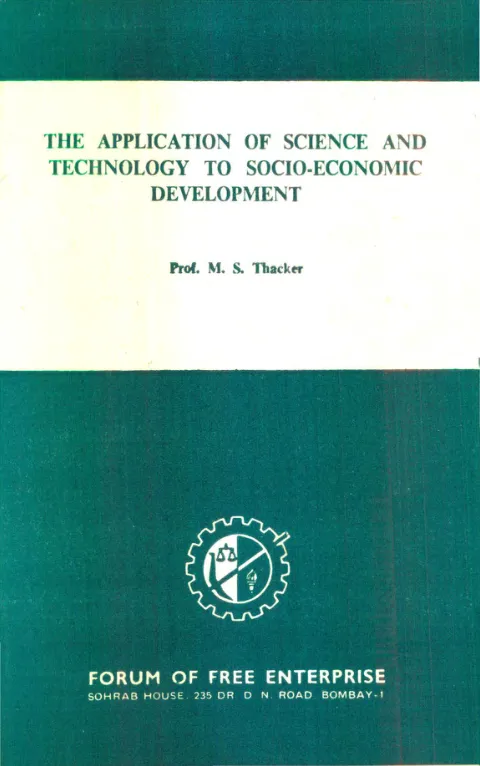
The Application of Science and Technology to Socio-Economic Development
By Prof. M. S. Thacker
Summary
Delivered as the Sixth A. D. Shroff Memorial Lecture under the auspices of the Forum of Free Enterprise on 28th October 1971, Professor M. S. Thacker’s address surveys how science and technology have come to shape national economies and asks what policy posture an under-industrialised India should adopt. Thacker — at the time Director of the Indian Institute of Science, a member of the Planning Commission and Chairman of the UN Conference on the Application of Science and Technology for Developing Areas — opens by recalling his 1963 Geneva address and tracks the historical drift in which technology, long indebted to craft practice, finally fused with basic science through industrial laboratories, two World Wars, and the deliberate entry of Western governments into research funding.
The argument then turns from history to policy. Thacker presses the case that the social benefits of a technology may not equal its social costs, that the ‘distributive justice’ of who pays and who benefits is now itself a question (he cites pollution, traffic congestion and the brain-drain — 39,000 Indian scientific and technical personnel abroad by 1967), and that India’s controversies of the 1950s over heavy engineering and atomic reactors stemmed from confusing private cost-benefit with social cost-benefit calculations. He rejects autarky in scientific ideas but insists that imported technology must be adapted to Indian conditions, citing Japan’s pairing of imports with heavy domestic R & D — a discipline he says India has failed at, with private-sector R & D expenditure at roughly 7% of the total against 36–74% in advanced economies.
The lecture endorses the CASTASIA (UNESCO, Delhi 1968) recommendation that Asian governments aim for R & D expenditure of 1% of GNP by 1980, reproduces the conference’s ten-point science-policy preamble in full, and returns to the dual-track question of big versus small industry, arguing that ‘big’ industries are necessary but require a ‘dense cluster of small but efficient industries’ as ancillary suppliers and customers. Thacker closes the rendered portion by reasserting that human resources are the pivotal investment, that profitability is not opposed to socialist objectives (citing Yugoslavia, Czechoslovakia and Poland), and that the assumed equation between labour-intensive technology and job creation is a ‘conceptual confusion’ — a jet plane, he notes, may generate more jobs than a bullock cart.
Key points
-
Frames the lecture as a continuation of Thacker’s 1963 UN Geneva address, surveying how science and technology have moved from peripheral curiosities to the central engine of national economic and security policy.
-
Traces three historical phases: the unsystematic application of mechanical inventions, the rise of commercial industrial laboratories in the West, and the post-WWII entry of Governments into basic research funding.
-
Argues that beneficial impacts of technology have come with significant social costs — pollution, urban sprawl, brain-drain, military destructiveness — and calls for ‘social accounting’ that captures total societal costs and benefits.
-
Distinguishes private from social cost-benefit calculations: India’s 1950s controversies over heavy engineering projects and atomic reactors confused the two, and many public-sector projects retain ‘social profitability’ even when private returns are low.
-
Rejects exclusion of foreign science but demands selective import with adaptation: cites Japan’s pairing of technology imports with intense domestic R & D (e.g. 22-24% R & D effort on chemical technology imports of similar magnitude) against India’s 6% on non-electrical machinery and 4% on electrical machinery.
-
Cites the Institute of Applied Manpower Research’s 1971 figure of 39,000 Indian scientific and technical personnel abroad in 1967 (17% of engineers, 11% of doctors, 9% of scientists), framing brain-drain as a sunk training cost the country is failing to recoup.
-
Reproduces verbatim the ten-point science-policy preamble recommended by the UNESCO-sponsored CASTASIA conference (Delhi, 1968), including the 1%-of-GNP R & D target by 1980 and the principle of ‘endogenous development’.
-
Closes by reasserting human resources as the pivotal investment, defending profitability as compatible with socialist objectives, and challenging the ‘conceptual confusion’ that equates labour-intensive technology with maximum job creation.
Generated by the v1.5 extraction pipeline. Awaiting editorial review.
Metadata and summary are AI-extracted from the source PDF and reviewed for editorial accuracy. The original work is available via the Read PDF tab above (where present); paragraph-level citation inside the PDF is deferred to a future engagement.