pamphlet
The Budget versus The People
By M. R. Masani, N. Dandeker, Dahyabhai V. Patel, M. Ruthnaswamy, S. S. Mariswamy
Swatantra Party · Bombay · 1965
34 pages
Part of Swatantra Party
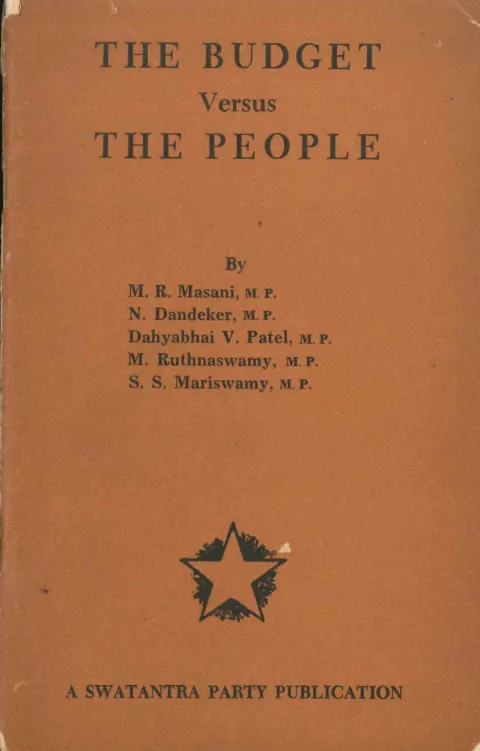
The Budget versus The People
By M. R. Masani, N. Dandeker, Dahyabhai V. Patel, M. Ruthnaswamy and S. S. Mariswamy (Swatantra Party)
Summary
The Budget versus The People is a Swatantra Party pamphlet collecting the speeches delivered by five of the party’s Members of Parliament during the March 1965 debate on the Union Budget for 1965-66. Speaking in the Lok Sabha and the Rajya Sabha, M. R. Masani, N. Dandeker, Dahyabhai V. Patel, M. Ruthnaswamy and S. S. Mariswamy mount a sustained classical-liberal attack on the Congress government’s budget. While conceding a few welcome measures — relief in income-tax, an excise concession, encouragement to foreign equity capital and the simplification of income-tax tables — they argue that the budget fails the three tests Masani sets out: its effect on prices and the stability of the currency, its effect on the foreign-exchange crisis, and its effect on economic growth.
Masani’s speech, the longest, argues that the budget is inflationary: public spending remains unchecked, plan and non-development expenditure keep rising, fresh customs and regulatory duties feed a “cost-push” spiral, and the government leans on deficit financing and what he calls the “PL-480 racket” — using American food-aid counterpart funds twice over, once as grain and again as money. He contends that the foreign-exchange shortage is “synthetic,” manufactured by a decade of inflationary policy that has halved the rupee’s real value (which he documents from free-market quotations), and warns that devaluation is “round the corner.” He calls the budget anti-growth for dealing a “body-blow” to the corporate sector through punitive taxes — sur-tax, dividend tax and a capital-gains tax on bonus shares — and a tax “ceiling” he dismisses as a fraud, for turning entrepreneurs into “rentiers” and “coupon clippers,” and for starving the capital market. He denounces loss-making nationalised undertakings, the Planning Commission’s “bookish intellectuals” and communist “fellow-travellers,” the drift towards becoming a “Soviet economic satellite,” and the “dangerous innovation” of the executive taking power to levy taxation by decree; his remedies include halving direct and indirect taxes and converting the Third Plan into a seven-year plan.
The other speakers broaden the indictment. N. Dandeker judges the budget by the standard of the “ordinarily intelligent” common citizen, showing that real incomes have fallen by roughly ten per cent even as money incomes rose, that indirect taxation and the rising cost of living steadily erode the ordinary family’s income, and that the ostensible Rs. 10-crore surplus is in reality a large deficit once PL-480 borrowings and Reserve Bank funding of Treasury Bills are stripped out; he urges measures to revive the near-collapsed capital market. Dahyabhai V. Patel argues that India has become “the most taxed nation in the world,” with confiscatory estate duty (raised to 85 per cent), gift, wealth and corporate taxes that in some cases exceed the assessee’s whole income, destroying investor confidence and deterring foreign capital, and he pleads for relief to lower-income groups and an end to wasteful expenditure. M. Ruthnaswamy attacks taxation designed as forced saving — which mops up the savings that citizens might otherwise make themselves — questions the aid India gives abroad while itself dependent on aid, and criticises the income-tax department’s “third-degree” raids and the government’s sweeping licence-and-permit powers. S. S. Mariswamy sets the budget against the looming Fourth Plan, “the Sword of Damocles,” predicts heavier taxation the following year, and digresses into the politics of Kerala and the need for integrity in public life.
Published by V. Raju for the Swatantra Party from its Bombay office and priced at fifty paise, the pamphlet is a compact statement of the party’s free-market opposition to Nehruvian planning and heavy taxation in mid-1960s India.
Key points
-
A Swatantra Party pamphlet reproducing the March 1965 parliamentary speeches of five party MPs — M. R. Masani, N. Dandeker, Dahyabhai V. Patel, M. Ruthnaswamy and S. S. Mariswamy — against the Union Budget for 1965-66.
-
Masani frames three tests — effect on prices and the currency, on the foreign-exchange crisis, and on growth — and argues the budget fails all three.
-
Central charge: the budget is inflationary through unchecked public spending, higher customs and regulatory duties, deficit financing and the “PL-480 racket” of reusing food-aid counterpart funds as money.
-
Argues the foreign-exchange shortage is artificial and that inflationary policy has halved the rupee’s real value, warning that devaluation is imminent.
-
Attacks punitive corporate taxation (sur-tax, dividend tax, capital-gains tax on bonus shares) and a tax “ceiling” dismissed as a fraud, which he says turn entrepreneurs into rentiers and starve the capital market.
-
Condemns loss-making nationalised undertakings, the Planning Commission’s “fellow-travellers,” fears of India becoming a “Soviet economic satellite,” and the executive’s move to levy taxation by decree.
-
Dandeker shows the ordinary man’s real income has fallen about ten per cent and that the claimed Rs. 10-crore surplus is really a large deficit; Patel calls India “the most taxed nation in the world” with confiscatory duties.
-
Proposed remedies: halve direct and indirect taxes, prune wasteful plan expenditure, convert the Third Plan into a seven-year plan, and revive the capital market.
Ingested 2026-07-21 from the CCS source archive. AI-drafted summary awaiting editorial review.
Metadata and summary are AI-extracted from the source PDF and reviewed for editorial accuracy. The original work is available via the Read PDF tab above (where present); paragraph-level citation inside the PDF is deferred to a future engagement.