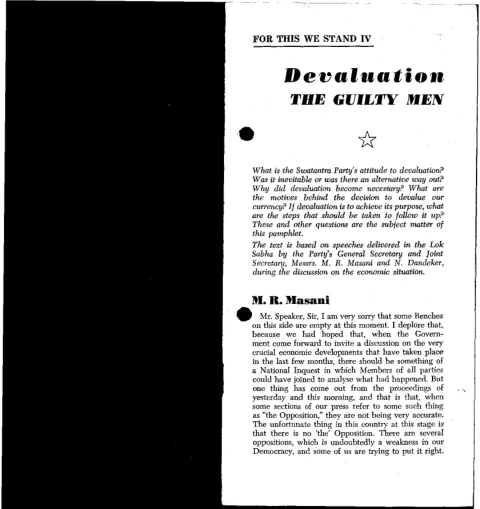
Devaluation: The Guilty Men
By M. R. Masani and N. Dandekar (Swatantra Party)
Summary
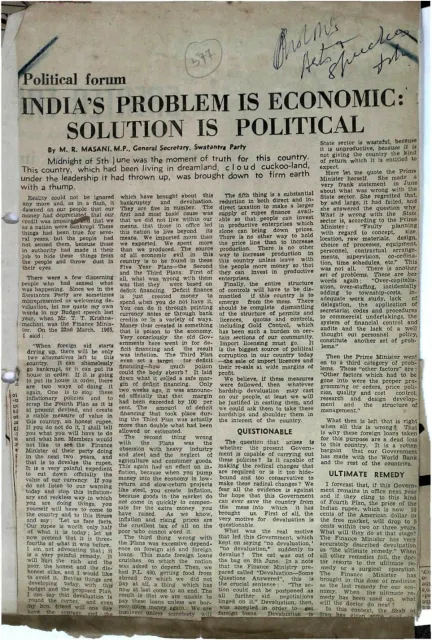
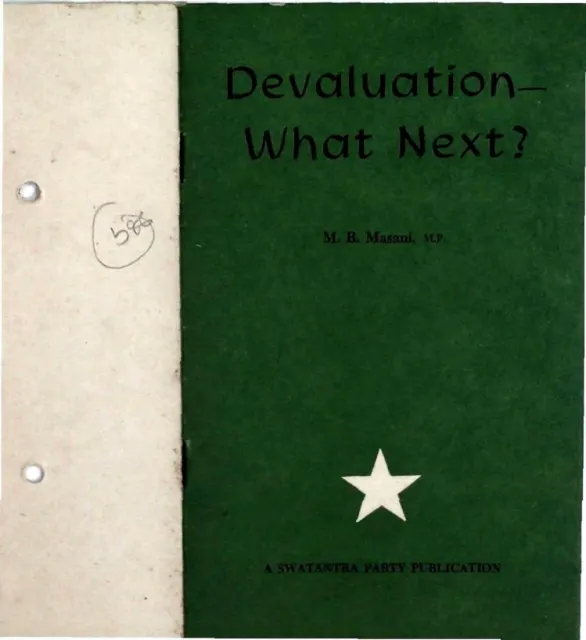
Devaluation: The Guilty Men is a Swatantra Party pamphlet — the fourth in the party’s “For This We Stand” series — reproducing two speeches delivered in the Lok Sabha on 27 July 1966 during the debate on the economic situation that followed the devaluation of the Indian rupee on 6 June 1966. In the first speech, M. R. Masani frames the midnight of 5 June as a “moment of truth” at which a country “living in dreamland” was brought down to earth by the reality that its money had depreciated, its credit was impaired and it was, in effect, bankrupt — facts he says those in authority had long hidden from the people. He recalls that economists such as Professor B. R. Shenoy and his party chief Rajaji had warned for years, and that in his own 1965 budget speech he had forecast, against a dismissive T. T. Krishnamachari, that the rupee would soon be cut roughly in half — which is precisely what happened.
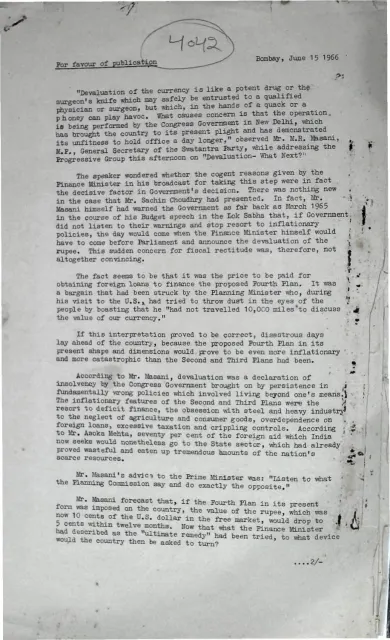
Masani insists the real question is not whether devaluation is “good or bad” — it is a neutral instrument, like a surgeon’s knife, useful only if a qualified hand uses it to treat a real disease rather than to tide over a crisis while bad habits persist — but what caused the collapse and how to ensure the sacrifice is not wasted in a second devaluation. He lists five causes: living beyond the nation’s means through the deficit financing of the Second and Third Five Year Plans (“created money” that acts as “poison” and breeds inflation); an obsession with heavy industry and steel at the expense of agriculture and consumer goods; excessive dependence on foreign aid and PL 480 food; over-taxation that drained money from productive private hands into unproductive government coffers; and a thicket of controls and import licences that Shenoy called “the biggest portfolio of political patronage.” The “guilty men” of the title are the architects of these policies — Krishnamachari and the Planning Commission’s Marxists and fellow-travellers — and the Nehru-era “Stalinists” (Menon, Malaviya) now trying to shift the blame.
Against this, Masani sets out the party’s constructive amendment: a binding commitment to end deficit financing, drastic cuts in non-developmental spending, foreign loans confined to emergency imports and infrastructure, consolidation of existing projects and postponement of the Fourth Five Year Plan, deep reductions in direct and indirect taxation to free capital for productive investment, and the dismantling of the whole apparatus of permits, licences, quotas and import controls. He argues the government devalued not out of repentance but as the price of continued foreign aid — quoting an official note that “the action could not be postponed as all further aid negotiations hinged on it” — and calls the bargain a rotten one struck to save a “wretched” Fourth Plan whose money would flow largely into a wasteful State sector. He forecasts a further fall of the rupee to five US cents within two or three years unless policy changes, and concludes that the only real remedy is political: the removal of a government he says has never commanded a majority of the popular vote.
In the second speech, N. Dandekar draws on the Finance Ministry’s own Supplement to the Economic Survey to document what he calls a state of “economic shambles” across every sector — a national-income growth rate among the lowest of the underdeveloped countries, foodgrain imports climbing year on year, falling industrial growth, a dead capital market, savage taxation and concealed deficit financing, and a balance-of-payments crisis exploited by “Smart Alecs” through import-export frauds. Reviewing the five alternatives before the government — doing nothing (“Indonesia”), a closed statist economy (“Russia”), drastic deflation, a floating rupee, or devaluation — he accepts devaluation as the only possible decision, but only as an honest declaration of insolvency by a debtor determined to mend his ways; devaluation, he insists, is merely the first step of a long treatment, without which the economy is destined for a “Greek tragedy.” He closes with the party’s specific proposals — economies of at least Rs 500 crores across all governments’ budgets, a three-year freeze on public expenditure, tax cuts and repayment of inflationary Reserve Bank borrowings, and a budget planned for a surplus rather than a deficit — reinforced by a quotation from the Reserve Bank Governor on judging a plan by what is possible rather than merely desirable.
Key points
-
A Swatantra Party pamphlet (“For This We Stand” No. IV) reproducing two Lok Sabha speeches of 27 July 1966, debating the 6 June 1966 devaluation of the rupee.
-
Masani calls the devaluation a “moment of truth” exposing a bankruptcy long hidden from the public, and recalls his own 1965 forecast — dismissed by T. T. Krishnamachari — that the rupee would be roughly halved.
-
He treats devaluation as a neutral instrument (a “surgeon’s knife”), shifting the argument to what caused the collapse and how to avoid a repeat.
-
Lists five causes of the bankruptcy: deficit financing of the Second and Third Plans, neglect of agriculture for heavy industry, dependence on foreign aid and PL 480, over-taxation, and strangling controls and import licences.
-
Names the “guilty men” — Krishnamachari, Planning Commission Marxists (Mahalanobis, V. K. R. V. Rao), and Nehru-era “Stalinists” (Menon, Malaviya) — and argues the real motive for devaluation was to secure foreign aid, not reform.
-
Swatantra’s remedies: end deficit financing, cut spending and taxation, restrict foreign loans, postpone the Fourth Five Year Plan, and dismantle permits, licences, quotas and import controls.
-
Dandekar uses the government’s own Economic Survey supplement to document “economic shambles” — low growth, rising food imports, falling industrial output, a dead capital market and a balance-of-payments crisis.
-
Dandekar accepts devaluation only as an honest first step out of insolvency, urging Rs 500 crores of budget economies, a three-year expenditure freeze, tax cuts and a surplus budget.
Ingested 2026-07-21 from the CCS source archive. AI-drafted summary awaiting editorial review.
Metadata and summary are AI-extracted from the source PDF and reviewed for editorial accuracy. The original work is available via the Read PDF tab above (where present); paragraph-level citation inside the PDF is deferred to a future engagement.