
edited volume · anthology
The Companies Amendment Bill 1972
Published by M. R. PAI for the Forum of Free Enterprise, "Sohrab House," 235, Dr. Dadabhai Naoroji Road, Bombay-400001 and printed by Michael Andrades at Bombay Chronicle Press, Sayed Abdullah Brelvi Road, Fort, Bombay-400001 · Bombay · 1972
19 pages
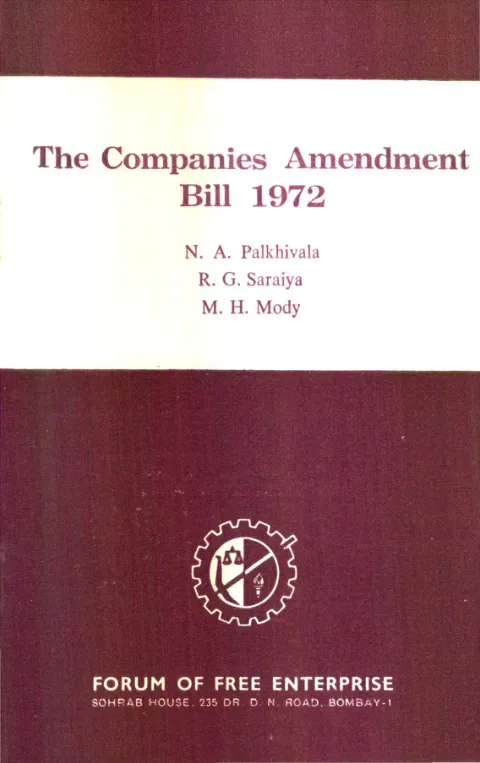
The Companies Amendment Bill 1972
Summary
Published by the Forum of Free Enterprise (Bombay) in 1972, this slim booklet collects three addresses delivered between September and October 1972 — N. A. Palkhivala’s public lecture of 15 September, and discussion-meeting talks by R. G. Saraiya and M. H. Mody on 10 October — attacking the Companies (Amendment) Bill 1972. The three speakers, drawn from constitutional law, banking and the accounting profession respectively, share a single argumentative centre: that the Bill imposes a degree of governmental control over the day-to-day life of the corporate sector unknown anywhere else in the world, and that its provisions on take-over bids, deemed-public-company status, auditor rotation, compulsory dividend distribution and benami holdings will hit small and medium enterprise hardest while substituting bureaucratic discretion for judicial determination.
Key points
-
Published by the Forum of Free Enterprise in 1972, this booklet collects three addresses delivered between September and October that year attacking the Companies (Amendment) Bill 1972.
-
N. A. Palkhivala’s lecture, “Provisions Detrimental to Public Interest,” calls the Bill a “bureaucratic seizure of all levers of power” whose stated public-interest purpose is contradicted by nearly every operative clause.
-
Palkhivala argues the loosened “same management” definition would deem unrelated companies grouped over a single shared director, and that any private company holding ten per cent of a public company’s capital would itself become public.
-
Palkhivala objects to the three-year cap on auditor tenure and to the transfer of judicial powers over diversification and registered-office shifts from the courts to the Government.
-
R. G. Saraiya, who chaired the Banking Commission, questions Clause 5’s deemed-public-company test of Rs. 25 lakhs paid-up capital and Rs. 50 lakhs turnover as sweeping in small companies where no public interest is involved.
-
Saraiya invokes the Banking Commission’s own recommendation that private companies accepting non-cheaqueable deposits from shareholders need not be regulated, and warns Rural Bank subsidiaries would be crippled under the public-company regime.
-
M. H. Mody, a chartered accountant, contrasts the Bill’s lack of prior expert study with the Bhabha Commission and Daftary and Shastry Committee at home and the Cohen and Jenkins Committees in Britain.
-
Mody criticises the haste of a public-comment period extended by only fifteen days and, citing the UK’s City Code on Take-over Bids, argues legitimate take-over activity should be encouraged rather than throttled by Sections 108A to 108G.
Essays
Provisions Detrimental to Public Interest
By N. A. Palkhivala
N. A. Palkhivala’s opening lecture, ‘Provisions Detrimental to Public Interest’, frames the Bill as a ‘bureaucratic seizure of all levers of power’ whose stated public-interest purpose is contradicted by every operative clause. He attacks the redefinition of ‘same management’ (so loose that companies that have never heard of each other will be deemed grouped), the de facto extinction of private companies (any private company holding 10% of a public company is itself converted into a public company), the cumbersome prospectus requirement for accepting deposits, the dividend restriction on accumulated past profits, the three-year cap on auditor tenure, and most reprehensible to him, the transfer of judicial powers (over diversification, registered-office shifts, etc.) from the courts to the Government — replacing ‘bureaucratic bungling for a fair and judicial determination’.
- The Bill imposes corporate-sector control unknown to any other country in the world.
- The ‘same management’ definition is so distorted that unrelated companies will be deemed grouped because of a single shared director.
- Private companies will be virtually extinguished: any private company holding 10% of a public company’s paid-up capital is itself converted into a public company.
- The three-year cap on auditor tenure is a gratuitous interference with shareholder choice that will substitute mediocrity for meritocracy in the accountancy profession.
- The Bill takes away the powers of the courts in various fields and vests them in the Government, undermining the separation of the judiciary and executive.
Small and Medium Companies Will be Hit
By R. G. Saraiya
R. G. Saraiya — a co-operator and industrialist who chaired the Banking Commission — works clause by clause through the Bill’s implications for small and medium enterprise. On Clause 5 (Sec. 43A), he doubts that any public-interest purpose is served by making companies with paid-up capital of Rs. 25 lakhs and turnover of Rs. 50 lakhs into ‘deemed public companies’, and questions the compliance costs and Government recurring expenditure of Rs. 10 lakhs per annum (which he predicts will balloon to Rs. 50 lakhs or Rs. 1 crore). He invokes the Banking Commission’s own recommendation that private limited companies accepting non-cheaqueable deposits from shareholders need not be regulated, and argues that rural banks set up as subsidiaries of commercial banks should not be straitjacketed by the public-company regime. On Clauses 4, 8, 11 & 12, he attacks the substitution of Central Government decisions for court decisions as a breach of the separation of judiciary and executive. He fears the cumulative effect on private-limited shares will be reduced marketability and discouragement of the investment market, and concludes that the legislation will positively discourage small and medium companies while burdening large ones with armies of chartered accountants, company secretaries and labour-law specialists.
- Clause 5’s deemed-public-company test (Rs. 25 lakh paid-up capital, Rs. 50 lakh turnover) would sweep in small companies with under 50 shareholders where no public interest is involved.
- The Banking Commission’s own recommendation — that private companies and firms accepting non-cheaqueable deposits from shareholders/partners be excluded from regulation — is incompatible with the Bill’s prospectus requirement.
- Rural Banks proposed as subsidiaries of commercial banks would be crippled by being forced under the public-company regime; special legislation, not the Companies Act, is the right vehicle.
- Clauses 4, 8, 11 and 12 substitute Central Government decisions for those of the courts, breaching the separation of judiciary and executive.
- Clauses 4B and 10 (new sections 108A–108F) will restrict investment in public limited shares, reduce marketability, and ultimately discourage the investment market.
- The net effect will be to discourage small and medium companies and burden large ones with a thicket of compliance professionals, diverting talent from production.
Detailed Study of Implications is Necessary
By M. H. Mody
M. H. Mody, a chartered accountant, argues that company law is too complex a field to be amended without prior expert study, and that this Bill is unprecedented in being moved without one. He contrasts it with the Bhabha Commission and Daftary & Shastry Committee at home and the Cohen and Jenkins Committees in the United Kingdom, all of which preceded major amendments to the Companies Act. He criticises the haste — an initial 15-day public-comment window extended by another 15 days — and the poor quality of drafting. Drawing on the UK take-over experience after the London Stock Exchange’s failed efforts and the City Code on Take-over Bids, he argues that legitimate take-over activity should be encouraged, not throttled by hastily drafted Sections 108A–108G, and that the appointment-of-auditors provision (three-year rotation, Government approval where Government’s interest exceeds 25%) strikes at the independence of the accounting profession itself. The Registrar of Companies’ new powers of search and seizure under Section 209A — modelled on a court of law — extend the inspection regime far beyond reasonable bounds. The amendments, he concludes, are ‘the beginning of the ultimate emasculation of the accounting profession’.
- Every major amendment to company law in India and the UK has historically been preceded by expert-body study (Bhabha, Daftary & Shastry, Cohen, Jenkins); the 1972 Bill is unique in having none.
- Only 15 days of public comment were initially allowed — extended by another 15 — for legislation ‘so complex that by no stretch of imagination can this be considered as an adequate period’.
- The UK City Code on Take-over Bids, evolved by merchant bankers after the London Stock Exchange’s failed gentlemen’s agreement, shows that take-over regulation requires expertise — not the Bill’s blunt sections 108A–108G.
- The proposed three-year rotation of auditors and Government approval for appointments where its stake exceeds 25% strikes at the independence of the accounting profession.
- Section 209A confers on the Registrar of Companies the powers of a court of law to carry out searches and seizures — an unprecedented extension of inspection authority.
Generated by the v1.5 extraction pipeline. Awaiting editorial review.
Metadata and summary are AI-extracted from the source PDF and reviewed for editorial accuracy. The original work is available via the Read PDF tab above (where present); paragraph-level citation inside the PDF is deferred to a future engagement.
People in this work
Related across the archive
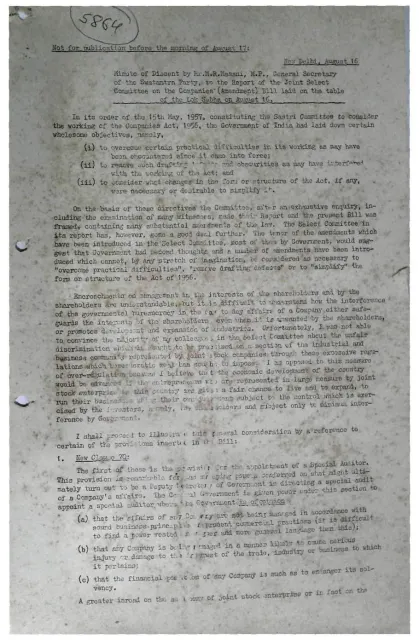 Primary workMinute of Dissent
 Primary workRights, Duties & Obligations of Company Directors
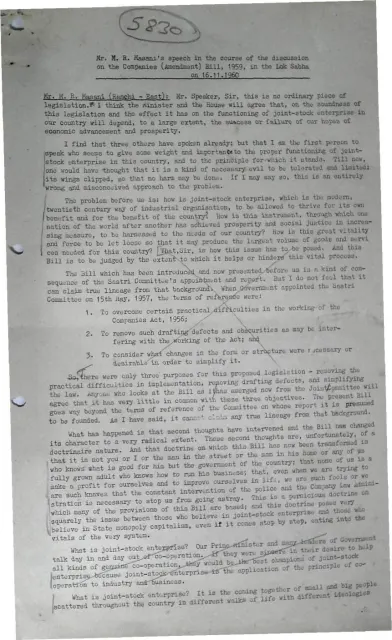 Primary workMr. M. R. Masani's speech in the course of the discussion on the Companies (Amendment) Bill, 1959, in the Lok Sabha on 16.11.1960
 ExcerptCrushing Burden of Taxation - Nani Palkhivala
 ExcerptSTATE MONOPOLIES AND THE CITIZEN IN A DEMOCRACY