speech
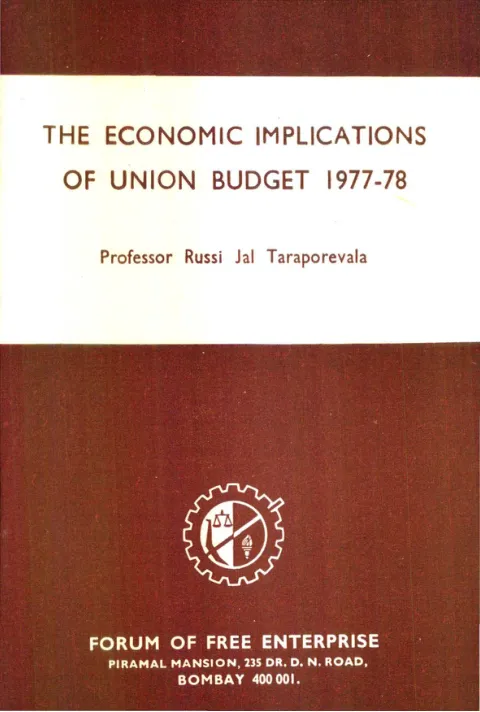
THE ECONOMIC IMPLICATIONS OF UNION BUDGET 1977-78
FORUM OF FREE ENTERPRISE, PIRAMAL MANSION, 235 DR. D. N. ROAD, BOMBAY 400 001. · Bombay · 1977
40 pages
THE ECONOMIC IMPLICATIONS OF UNION BUDGET 1977-78
By Professor Russi Jal Taraporevala
Summary
Professor Russi Jal Taraporevala’s pamphlet, based on a public lecture delivered under the auspices of the Forum of Free Enterprise in Bombay on 22 June 1977, analyses the first Union Budget presented by the new Janata Party Government. He sets the budget against an economy that had slipped back into recession after the 1976-77 monsoon failure, and reads it as the inaugural fiscal statement of the first non-Congress regime at the Centre. Taraporevala welcomes the Janata Party’s election-manifesto rejection of the “old Soviet style planning which had been adopted by the Congress Party since 1956” and its reorientation toward agriculture, rural development, and small-scale, cottage, and khadi industries along “the lines of Gandhian ideas”.
In the rendered pages, Taraporevala works systematically through the macroeconomic backdrop the budget inherits: stagnating national income and per-capita product; a sharp fall in agricultural and foodgrain output after the 1975-76 record; uneven industrial growth with sick public-sector giants like the National Textile Corporation, Coal India, and the Fertiliser Corporation registering massive losses; a stubborn unemployment crisis; rising prices; an inflationary surge in money supply; and a comparatively buoyant external position with foreign-exchange reserves at roughly Rs. 4,000 crores and a slight trade surplus. Drawing repeatedly on the Finance Minister H. M. Patel’s budget speech and the Government’s “Economic Survey”, he treats their diagnoses as broadly correct but uses them to indict the previous twenty-five years of “gigantic monopolistic public sector enterprises”.
On policy, he highlights the budget’s most market-friendly moves — tax concessions to encourage efficient private managements to take over sick units, and the gradual introduction of “more competition by way of a more liberal import policy” using imports of selected capital goods as a tool to discipline domestic prices. The chunk ends in the “Budgetary Position” and “Plan Outlays” sections, where Taraporevala argues that by drawing more aggressively on special borrowings from the Reserve Bank of India against forex reserves, the Finance Minister could have converted the Rs. 202-crore deficit into a Rs. 198-crore surplus and cut direct and indirect taxes; the budget therefore “missed a unique opportunity of presenting a surplus budget”. A heterodox aside argues that, given high skilled unemployment, “one of the best exports which India can effect is that of human beings”, endorsing emigration to the Gulf and elsewhere as a way to generate inward remittances.
Key points
-
Reads the 1977-78 Union Budget as the first fiscal statement of the new Janata Party Government, presented against a recession-hit economy following the 1976-77 monsoon failure.
-
Endorses the Janata manifesto’s rejection of “Soviet style planning” adopted by the Congress Party since 1956 and its turn toward rural development, small-scale industry, and Gandhian decentralisation.
-
Provides a systematic sectoral diagnosis — stagnant national income, declining agricultural output, uneven industrial growth, depressed cotton textiles and jute, and structural unemployment — by collating data from “The Economic Survey” and the Finance Minister’s speech.
-
Indicts the public sector for chronic losses (NTC, Coal India, Fertiliser Corporation of India) and welcomes the budget’s tax concessions encouraging efficient private managements to nurse sick industrial units back to health.
-
Praises the announcement of a “more liberal import policy” — including imports of selected capital goods without scrutiny from the indigenous angle — as a tool for cost-discipline and international competitiveness.
-
Identifies excessive money supply growth (17.1% in 1976-77) and accumulation of net foreign exchange assets as principal drivers of inflation, but treats the buoyant Rs. 4,000-crore reserves and slight trade surplus as the economy’s only “rosy aspect”.
-
Makes the heterodox case that emigrant labour is one of India’s best exports because the remittances flowing back to dependants buttress the foreign-exchange position.
-
Argues the budget could and should have been recast as a surplus budget by drawing Rs. 1,200 crores in special borrowings from the RBI against forex reserves, enabling tax cuts and higher rural developmental outlays — the Finance Minister having “missed a unique opportunity”.
Generated by the v1.5 extraction pipeline. Awaiting editorial review.
Metadata and summary are AI-extracted from the source PDF and reviewed for editorial accuracy. The original work is available via the Read PDF tab above (where present); paragraph-level citation inside the PDF is deferred to a future engagement.