periodical issue
The Indian Libertarian
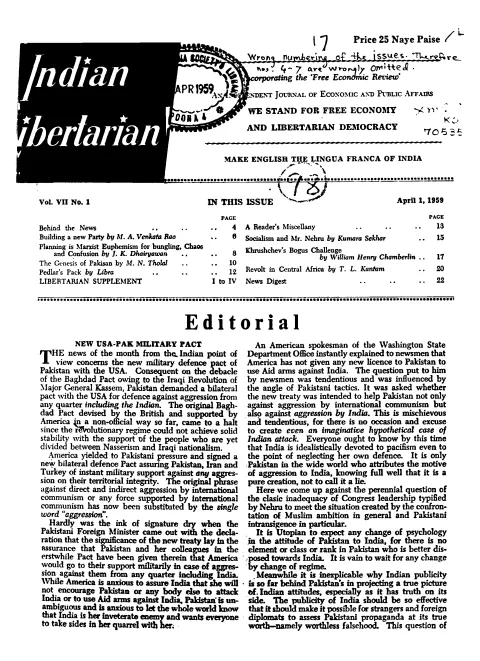
Independent Journal of Free Economy and Public Affairs — Vol. VII No. 1, April 1, 1959
By MA Venkata Rao, J. K. Dhairyawan, M. N. Tholal, G N Lawande
The Indian Libertarian, Arya Bhuvan, Sandhurst Road, Bombay—4 · Bombay · 1959
28 pages
The Indian Libertarian
Summary
This 1 April 1959 number of The Indian Libertarian (Vol. VII, No. 1) — the Bombay-based fortnightly that stands, as its masthead declares, for free enterprise and libertarian democracy — opens with a multi-pronged editorial against the newly-signed United States–Pakistan military pact, the renewed Chinese aggression in Tibet that has ‘ignored Panchsheel again’, and the proposed transfer of Berubari to East Pakistan, which a unanimous West Bengal Legislature has condemned. A ‘Behind the News’ column scrutinises Colonel Nasser’s apparent retreat in the face of Iraqi Communist activity and the parallel rumbling in Tibet against Mao Tse-tung’s regime. M. A. Venkata Rao argues at length for a new all-India opposition party built on decentralisation, free enterprise, and Gandhian social justice; J. K. Dhairyawan attacks ‘planning’ as a Marxist euphemism for bungling, chaos, and confusion; M. N. Tholal opens a long historical examination of the genesis of Pakistan, drawing chiefly on Maulana Azad’s India Wins Her Freedom; and the satirical column ‘Pedlar’s Pack’ takes its swipes at the international scene. The inserted four-page Indian Libertarian Supplement carries Prof. G. N. Lawande’s critique of the Third Five Year Plan as a utopian measure and Adib’s defence of the private sector against Mr. Nehru’s expanding public sector. The issue closes with a Reader’s Miscellany of aphorisms, the ‘Did You Know’ illustrated factoids by Scio, and the opening instalment of K. Kumara Sekhar’s reflection on ‘Socialism and Mr. Nehru’. Across its contributions the issue presents a remarkably unified classical-liberal challenge to Nehruvian planning, to the Soviet bloc abroad, and to Pakistan’s new alignment with American military power on India’s borders.
Key points
-
The lead editorial condemns the newly signed United States-Pakistan military pact as folding Pakistan into the American defence ring around Soviet Russia rather than offering genuine local protection.
-
The editorial also protests renewed Chinese aggression in Tibet as proof that Panchsheel has been ignored again, and backs the West Bengal Legislature’s unanimous rejection of the Berubari transfer to East Pakistan.
-
M. A. Venkata Rao argues for a new all-India opposition party built on democratic decentralisation, free-enterprise economics, and Gandhian social justice, warning that without one politics will narrow to Congress and the Communists.
-
J. K. Dhairyawan attacks Nehruvian economic ‘planning’ as nothing more than a Marxist euphemism for bureaucratic bungling, chaos, and confusion in the management of the economy.
-
M. N. Tholal opens a long historical examination of the genesis of Pakistan, drawing chiefly on Maulana Azad’s memoir India Wins Her Freedom.
-
The inserted Indian Libertarian Supplement carries Prof. G. N. Lawande’s critique of the Third Five Year Plan as a utopian measure and Adib’s defence of the private sector against Nehru’s expanding public sector.
-
A ‘Behind the News’ column reads Colonel Nasser’s apparent retreat as a response to Iraqi Communist activity, alongside parallel unrest in Tibet against Mao Tse-tung’s regime.
-
The issue closes with a Reader’s Miscellany of aphorisms, illustrated ‘Did You Know’ factoids by Scio, and the opening instalment of K. Kumara Sekhar’s reflection on ‘Socialism and Mr. Nehru’.
Essays
New US–Pak Military Pact
The unsigned editorial runs four headed sections. ‘New US–Pak Military Pact’ argues that the Washington–Karachi bilateral defence agreement, signed in the aftermath of an Iraqi coup that the magazine reads as a Communist-style adventure, is presented to Pakistanis as protection from foreign attack and from local communism but in reality folds Pakistan into the American defence ring around Soviet Russia. ‘Border Affairs on the East’ and ‘Panchsheel Ignored Again’ link China’s renewed pressure on the north-eastern frontier and on Tibet with the bankruptcy of the ‘five principles’ rhetoric and call for stronger Indian preparedness. ‘Transfer of Berubari Opposed Unanimously’ reports that the West Bengal Legislative Assembly has unanimously rejected the Nehru–Noon agreement transferring the Berubari Union to East Pakistan, and the editorial endorses that opposition as a constitutional and federal point of principle.
- Reads the new US–Pakistan military pact as drawing Pakistan into the American ring around Soviet Russia rather than as genuine local defence.
- Treats the contemporaneous Iraqi political upheaval as a warning of Communist adventurism on India’s western flank.
- Frames Chinese pressure on the north-east and on Tibet as definitive evidence that Panchsheel has collapsed in practice.
- Backs the West Bengal Legislative Assembly’s unanimous rejection of the transfer of Berubari to East Pakistan.
- Establishes the issue’s editorial line: classical-liberal vigilance against both Soviet-aligned and Pakistan-aligned military encroachments on Indian sovereignty.
Editorial
An unsigned ‘Behind the News’ column titled ‘Nasser in Reverse Gear?’ reads the rapid shifts in Cairo’s posture towards Iraq and the Soviet bloc as a sign that Colonel Nasser is no longer the confident pan-Arab champion of the previous year. The piece tracks Nasser’s quarrel with the Kassem regime in Baghdad, his cooling relations with Mr. Khrushchev, and his attempt to reassert Egyptian leadership through speeches and diplomatic gestures, before turning in its second half to ‘Turmoil in Tibet’. That section reports the open Tibetan rising against Chinese rule, the suspected role of the Panchen Lama in Peking’s calculations, and the magazine’s view that Mao Tse-tung’s regime has miscalculated the depth of Tibetan religious and national feeling.
- Reads Nasser’s manoeuvres against Iraq’s Kassem regime as a tactical retreat rather than fresh pan-Arab confidence.
- Sees a widening rift between Cairo and Moscow as Khrushchev tilts toward the new Iraqi government.
- Treats the Tibetan rising as proof that Mao’s regime has badly misread Tibetan religious nationalism.
- Frames both stories — Arab and Tibetan — as evidence of the limits of Communist-bloc influence at the periphery.
Building a New Party
By M. A. Venkata Rao
M. A. Venkata Rao makes the issue’s central political case: that the deteriorating performance of the Congress government and the absence of a credible opposition together require the formation of a new all-India party. He sketches the consensus across liberal, Gandhian and Sarvodaya circles that the Praja Socialist Party and the existing right-of-Congress parties are too small, too sectional and too compromised to bear the load. His proposed platform combines democratic decentralisation, social justice secured through free economy rather than state ownership, support for the cooperative movement among small producers, and what he calls patriotism as the motive force capable of binding such a coalition together. He warns that without a new party the choice in Indian politics will narrow to Congress and the Communists.
- Argues that neither the Praja Socialist Party nor existing right-of-Congress groups can play the role of a national opposition.
- Proposes a platform of democratic decentralisation plus free-enterprise social justice as the new party’s organising idea.
- Treats agricultural cooperatives among small holders as compatible with classical-liberal principles, in opposition to state collectivisation.
- Identifies ‘patriotism’ rather than narrow ideology as the binding motive force of the proposed opposition.
- Warns that without a new party Indian politics will collapse into a Congress–Communist binary.
Planning is Marxist Euphemism for Bungling, Chaos and Confusion
By MA Venkata Rao
J. K. Dhairyawan’s short polemic, under the standing rubric ‘The tyranny of words’, argues that ‘planning’ as used by the Government of India is a Marxist euphemism that disguises bungling, chaos and confusion in matters of food, finance and industry. He suggests that the word has been borrowed from Communist vocabulary without its rigour, that it serves to deflect criticism by lending an air of scientific intention to policies whose actual results have been shortages and corruption, and that liberal opinion must contest the language of planning as vigorously as it contests its substance.
- Treats ‘planning’ as a borrowed Marxist label that hides administrative incompetence.
- Argues that the prestige of the word disarms opposition to specific failures.
- Calls for liberal critics to attack the vocabulary of planning as a political project, not just its outcomes.
The Genesis of Pakistan
By M. N. Tholal
M. N. Tholal opens what reads as a serialised historical essay on how Pakistan came into being. Using Maulana Abul Kalam Azad’s India Wins Her Freedom as his principal source, he traces the early electoral politics of the Muslim League, the role of communal electorates introduced under Lord Curzon, the manoeuvres of the Aga Khan and other notables, and the Congress’s repeated tactical misjudgements in dealing with Mr. Jinnah. The argument running through the instalment is that Pakistan was not the inevitable creation of Muslim demand but the product of specific Congress failures and British constitutional choices, with successive missions — including Sir Stafford Cripps’s — closing off rather than opening alternatives. The narrative is carried over to page 14 of the issue.
- Takes Maulana Azad’s India Wins Her Freedom as the main lens on how Pakistan was generated.
- Treats Curzon-era communal electorates as a structural cause of later partition politics.
- Reads the Cripps Offer and Congress’s response to it as a decisive missed chance to prevent Pakistan.
- Argues against the view that Pakistan was the natural outcome of Indian Muslim sentiment.
- Frames the partition story as a record of Congress tactical errors as much as of Muslim League ambition.
Pedlar’s Pack
By Libra
The satirical column ‘Pedlar’s Pack’, signed by ‘Libra’, moves through a string of international items in the magazine’s house tone. It mocks the inflated language of summitry, considers Mr. Khrushchev’s posture in Berlin and his German diplomacy, registers the death of Dag Hammarskjold’s hopes for a quiet General Assembly, and sketches the unpredictability of Mr. Macmillan’s Moscow visit. The column treats Cold War summit ritual as a theatre in which the West repeatedly volunteers concessions in exchange for nothing more solid than reassurance.
- Treats summitry as ceremonial theatre that benefits the Soviet side more than the Western powers.
- Reads Mr. Macmillan’s Moscow trip with weary scepticism.
- Uses caricature and aside rather than sustained argument — a libertarian fortnightly’s version of the political column.
Utopian Measure
By Prof. G. N. Lawande, M.A.
In the Indian Libertarian Supplement, Prof. G. N. Lawande’s ‘Utopian Measure’ attacks the unfolding Third Five Year Plan as a Utopian construct rather than a workable economic programme. He argues that the food problem has worsened despite — and partly because of — heavy planning; that ‘democratic planning’ has become a meaningless slogan covering the inability of the Congress leadership to think outside a Marxist frame; and that the social-justice rhetoric attached to the plans masks a steady transfer of economic decision from individuals and cooperatives to the state. He contrasts the achievements of the cooperative movement at the village level, where it has grown without state direction, with the failures of state-administered targets.
- Diagnoses the Third Five Year Plan as Utopian rather than pragmatic.
- Argues the food crisis has been deepened, not solved, by planning.
- Reads ‘democratic planning’ as a slogan hiding centralisation.
- Endorses voluntary cooperatives but opposes state-administered collectivisation.
Public and Private Sectors
By G N Lawande
‘Public and Private Sectors’, signed by ‘Adib’, is a sustained defence of Indian private enterprise against the steady expansion of the public sector. Adib reminds readers that under the colonial regime private capital — without state direction — placed India eighth among the world’s industrial nations, and argues that the moral case against private profit advanced by Mr. Nehru does not survive contact with the comparative record of state-run undertakings. He surveys industries where public-sector ventures have under-performed their private counterparts, and concludes that classical-liberal first principles, not socialist sentiment, ought to govern the next phase of Indian industrial policy.
- Cites pre-Independence India’s industrial standing as evidence of private enterprise’s productivity.
- Treats Mr. Nehru’s moral critique of profit as a slogan that the comparative record refutes.
- Documents under-performance in public-sector undertakings against equivalent private firms.
- Calls for explicit classical-liberal principles to frame industrial policy in the next plan.
A Reader’s Miscellany
‘A Reader’s Miscellany’ is the issue’s column of selected aphorisms, news cuttings, and one-line commentaries — a regular feature in which the editors curate quotations from Dr. C. P. Ramaswamy Iyer, F. Scott Fitzgerald, Walter Pater and others, alongside short barbed paragraphs on Indian politics, Marvin Liebman’s anti-Communist activity in the United States, and the daily conduct of public men. The function of the column is editorial commentary by indirection — a way of placing liberal touchstones beside the day’s headlines without writing a separate article.
- Mixes literary aphorism with current-affairs commentary.
- Quotes Western liberal sources alongside Indian public figures.
- Operates as oblique editorial voice through selection rather than argument.
Socialism and Mr. Nehru
By K. Kumara Sekhar B.A.
‘Socialism and Mr. Nehru’ by K. Kumara Sekhar opens what reads as a longer piece interrogating the elasticity of the term ‘socialism’ as Pandit Nehru uses it. The author argues that the Prime Minister’s socialism has changed in content several times since independence, has been redefined to accommodate whatever the Congress government has actually done, and now functions less as a programme than as a permanent justification for state expansion. Production, the author insists, is the precondition of any distribution worth quarreling over, and Nehru’s ‘socialism’ as practised has subordinated production to symbolism.
- Argues that ‘socialism’ in Nehru’s mouth has no stable content.
- Treats production, not redistribution, as the first economic question.
- Reads Indian socialism as ex-post rationalisation of Congress policy choices.
- Opens what is signalled as a multi-part argument continued in subsequent issues.
Generated by the v1.5 extraction pipeline. Awaiting editorial review.
Khrushchev’s Repeat Challenge
No summary was extracted for this article. Listed for completeness.
Metadata and summary are AI-extracted from the source PDF and reviewed for editorial accuracy. The original work is available via the Read PDF tab above (where present); paragraph-level citation inside the PDF is deferred to a future engagement.