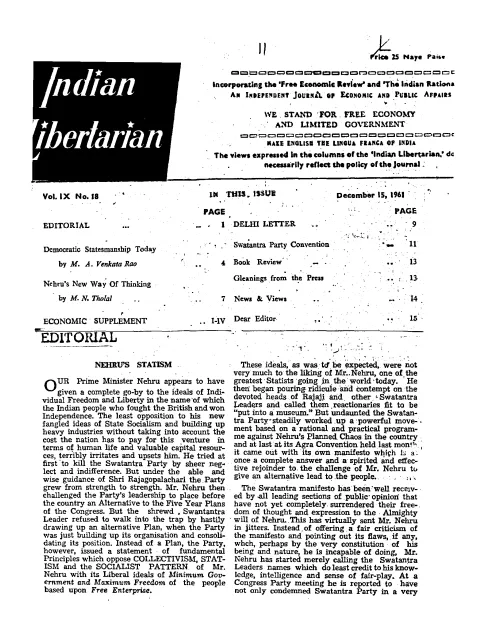
periodical issue
The Indian Libertarian
Independent Journal of Free Economy and Public Affairs
By MA Venkata Rao, M. N. Tholal, J. M. Lobo Prabhu
Edited by D. M. Kulkarni B.A.,LL.B., for the Libertarian Publishers Private Ltd. Printed by G. N. Lawande, at G. N. Printers, Indra Bhuvan, Tadwadi, Bombay 2, and published by him at the office of the Libertarian Publishers (Private) Ltd., 26, Durgadevi Road, Bombay 4. · Bombay · 1962
16 pages
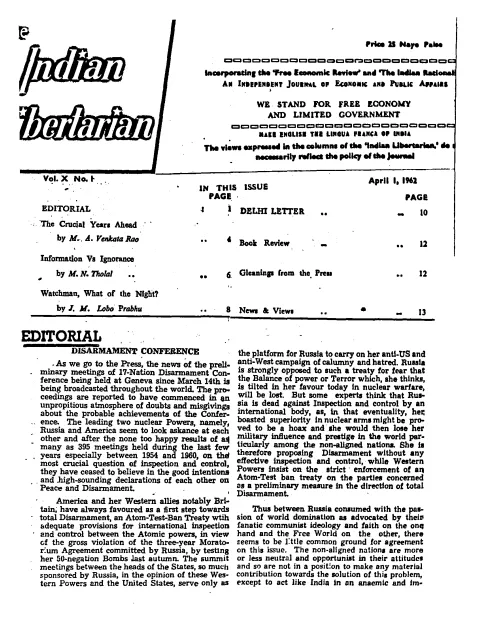
The Indian Libertarian
Summary
Volume X, Number 1 of The Indian Libertarian — a Bombay fortnightly that ‘stands for free economy and limited government’ and campaigns for English as the lingua franca of India — frames the months after the 1962 general elections as a moment of testing for Indian constitutional liberalism. An unsigned editorial surveys the Geneva Disarmament Conference, the widening Sino-Soviet rift, and the integration of Goa, while ‘Here and There’ sketches domestic news. Bylined essays by M. A. Venkata Rao, M. N. Tholal and J. M. Lobo Prabhu interrogate the post-election Congress hegemony, defend freedom of information against Nehru’s qualifications, and warn that the constitutional ‘watchman’ has fallen asleep. The Delhi Letter mocks Nehru’s foreign and Punjab policy; a Book Review notes a fresh American study of Indian Communism; and ‘Gleanings from the Press’ and ‘News & Views’ compile dissenting voices from Biju Patnaik, Rajaji, the Ahmedabad Citizens’ Conference and the Dalai Lama. Taken together, the issue articulates the journal’s classical-liberal idiom: hostility to one-party Congress dominance, scepticism of planning, defence of free speech and federal pluralism, and steady alignment with the West in the Cold War.
Key points
-
Volume ten, number one of The Indian Libertarian, dated 1 April 1962, frames the months after the 1962 general elections as a test of Indian constitutional liberalism against Congress’s post-election hegemony.
-
The unsigned editorial reports Russia treating the Geneva disarmament talks as a propaganda exercise while the West insists on adequate inspection of an Atom-Test-Ban Treaty, and welcomes the constitutional integration of Goa, Daman and Diu into the Union.
-
M. A. Venkata Rao’s ‘Information Vs Ignorance’ reads the election results as a chastening verdict on Congress dominance, welcoming Swatantra, the Praja Socialist Party, Jana Sangh and the Communists as a credible parliamentary check on executive power.
-
In another essay Venkata Rao argues democracy requires a contestable two-bloc politics rather than a permanent ruling party, and calls for dismantling the sectarian identification of Congress with the national interest.
-
M. N. Tholal’s ‘Watchman, What of the Night?’ attacks Nehru’s claim, made at a UN seminar, that the principle of ‘truth at all costs’ can be misused, arguing suppression by states is the true threat to public reason.
-
Tholal points to Cuba’s abolition of free elections as proof of what follows when governments escape the discipline of an informed electorate.
-
J. M. Lobo Prabhu, a retired ICS officer, warns that Congress’s renewed majority hollows out the Constitution’s role as watchman against arbitrary power, and closes on Lincoln’s reminder that an uneducated electorate risks ‘dangerous franchise.’
-
The Delhi Letter portrays Nehru as a pettifogging Prime Minister on Berlin, NATO and the Punjabi Suba agitation, while a book review notes a fresh American study of Indian Communism and Gleanings from the Press compiles dissent from Biju Patnaik, Rajaji and the Dalai Lama.
Essays
Disarmament Conference
The unsigned editorial bundles four short pieces. ‘Disarmament Conference’ reports on the 17-Nation conference at Geneva, arguing that Russia is using the meetings as a propaganda platform to embarrass the United States while America and Britain insist on adequate inspection of an Atom-Test-Ban Treaty. ‘The Chinese Puzzle’ reads the widening Sino-Soviet split through Chinese resentment of de-Stalinisation and Moscow’s tactical disengagement from Asia. ‘Goa Integration With India’ welcomes the Goa, Daman and Diu Integration Amendment Bill as the constitutional completion of liberation. ‘Here and There’ surveys domestic news, including Mr. Lal Bahadur Shastri’s denial that the Congress is drifting toward a single-party state.
- Russia is treating Geneva disarmament talks as a propaganda exercise; the West holds firm on inspection.
- Sino-Soviet friction is rooted in ideological and territorial divergence between Beijing and Moscow.
- The editorial endorses the constitutional integration of Goa, Daman and Diu into the Union.
- Lal Bahadur Shastri’s reassurances cannot conceal Congress’s drift toward one-party dominance.
The Crucial Years Ahead
By M. A. Venkata Rao
M. A. Venkata Rao reads the 1962 general election results as a chastening verdict on the Congress’s two-decade dominance. He welcomes the emergence of four credible opposition forces — Swatantra, the Praja Socialist Party, Jana Sangh and the Communists — and urges them to function as a serious parliamentary check rather than as spoilers, while pressing the ruling party to surrender its sectarian identification of national interest with party programme. The essay frames the years ahead as a test of whether India can build a self-correcting two-bloc politics on constitutional foundations rather than slide further into single-party planning.
- Congress retains a majority but has lost its claim to be the sole vehicle of the national interest.
- Four opposition parties now form a credible parliamentary check on executive overreach.
- Constitutional democracy requires a contestable two-bloc politics, not a permanent ruling party.
- Sectarian identification of party with state must be dismantled if pluralism is to survive.
Information Vs Ignorance
By MA Venkata Rao
M. N. Tholal attacks Mr. Nehru’s claim — made at a UN Seminar on Freedom of Information — that the principle of ‘truth at all costs’ can be misused. Tholal argues the inverse: suppression and selective disclosure by states are the principal threat to public reason, and a citizen’s right to know is the precondition of a free order. He links the argument to Cuba, where, he says, the abolition of free elections proves what happens when governments are released from the discipline of an informed electorate.
- Freedom of information is a constitutional, not a managerial, value.
- State control over what may be reported corrodes the citizen’s capacity to consent.
- Cuba, on Tholal’s reading, shows the end-state of restricted-information regimes.
- Nehru’s qualifications on press freedom are a danger sign for Indian liberty.
Watchman, What of the Night?
By J. M. Lobo Prabhu I.C.S. (Retd)
J. M. Lobo Prabhu, a retired ICS officer, reads Congress’s renewed legislative majority as a warning rather than a mandate. The Constitution, he argues, was designed to function as a watchman against arbitrary power, but is being slowly hollowed out by patronage politics and by parties that confuse themselves with the State. The essay calls on the press, the judiciary and civic associations to play the role the founders assigned them, and closes with a Lincoln epigraph on the contested meaning of ‘liberty’ — warning that universal franchise without an informed electorate degenerates into ‘dangerous franchise’.
- An entrenched majority is a constitutional danger as much as a political mandate.
- Press and judiciary must serve as the constitutional watchman over executive power.
- Universal franchise without an educated electorate risks degenerating into ‘dangerous franchise’.
- Lincoln’s reminder that ‘liberty’ is contested supplies the essay’s polemical anchor.
Delhi Letter — Our Pettifogging Prime Minister
By From Our Correspondent
The Delhi Letter, by an unnamed correspondent, savages Mr. Nehru’s recent Rajya Sabha pronouncements on Berlin, NATO, the Cold War, and Master Tara Singh’s Punjabi Suba agitation. The Prime Minister is portrayed as a pettifogger — pedantic, indecisive, and prone to undermine his own ministers’ decisions. The correspondent reads Nehru’s discomfort with NATO and his accommodation of Khrushchev as evidence of an instinctive tilt toward Soviet positions, and argues that the Punjab crisis has been mishandled by a centre that prefers slogans to settlement.
- Nehru’s Rajya Sabha replies betray indecision and an instinct to defer to Moscow.
- Foreign-policy non-alignment has shaded into reflexive anti-NATO posturing.
- Domestic crises — Punjab in particular — are being mismanaged from the centre.
- The premiership has become a cult of personal pettifoggery rather than statesmanship.
Book Review
A short notice on ‘Communism in India’ by Gene D. Overstreet and Marshall Windmiller commends the authors for a thorough, documentary history of the Communist Party of India and its strategic alignments with Moscow. The reviewer notes the book’s value in tracing how planning ideology and Soviet sympathies entered Indian government through advisers around Mahalanobis, and reads Professor Galbraith’s recent remarks as a sign that even sympathetic Western liberals have begun to question the Nehru government’s planning regime.
- Overstreet and Windmiller’s history of the CPI is welcomed as a documentary corrective.
- Planning ideology and Soviet methods entered Indian statecraft through advisers around Mahalanobis.
- The reviewer reads Galbraith’s recent assessments as Western disenchantment with Indian planning.
Gleanings from the Press
‘Gleanings from the Press’ opens with Orissa Chief Minister Biju Patnaik’s startling charge that the Congress had become ‘totalitarian’, a confession the Liberals seize on as evidence from inside the ruling party itself. Adjacent items reprint editorial calls for fiscal restraint and warn against the use of administrative power to penalise critical newspapers.
- Biju Patnaik publicly described the Congress as ‘totalitarian’, a remark the Liberals turn against the ruling party.
- The column foregrounds press freedom and fiscal restraint as the test cases for the new government.
News & Views
‘News & Views’ assembles a long miscellany. FICCI is reported as concerned about runaway municipal expenditure under civic heads. A new Parliamentary Board of the Swatantra Party is announced. Rajaji’s bitter allegations against the Congress are reprinted alongside the Ahmedabad Citizens’ Conference call to retain English as a link language, the Dalai Lama’s appeal for Indo-Chinese mediation, and a note on the Liberal opposition’s plans for the territorial army.
- FICCI flags municipal extravagance as a fiscal-policy concern.
- A Swatantra Party Parliamentary Board is constituted with senior liberal-nationalist figures.
- Rajaji’s renewed broadside against Congress methods is reprinted at length.
- The Ahmedabad Citizens’ Move presses for English as a working link language.
- The Dalai Lama is reported to have offered to mediate between India and China.
Generated by the v1.5 extraction pipeline. Awaiting editorial review.
Essay 8
No summary was extracted for this article. Listed for completeness.
Metadata and summary are AI-extracted from the source PDF and reviewed for editorial accuracy. The original work is available via the Read PDF tab above (where present); paragraph-level citation inside the PDF is deferred to a future engagement.