periodical issue
The Indian Libertarian
Incorporating the 'Free Economic Review' — Independent Journal of Economic and Public Affairs
The Indian Libertarian, Arya Bhavan, Sandhurst Road, Bombay 4 · Bombay · 1958
28 pages
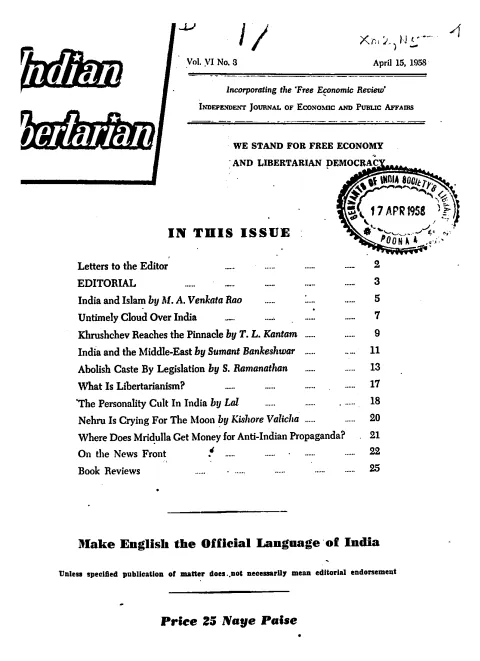
The Indian Libertarian
Summary
The April 15, 1958 issue of The Indian Libertarian (Vol. VI No. 3), the Bombay-based ‘Independent Journal of Economic and Public Affairs’ that bears the standing masthead ‘We Stand For Free Economy And Libertarian Democracy’, collects an editorial, eight signed and unsigned essays, news columns and book reviews around three preoccupations visible in the rendered pages: the unsettled Arab world after the Egypt-Syria Union and the Iraq-Jordan federation; the Nehru government’s domestic stumbles (the Mundhra-LIC affair, the personality cult around the Prime Minister, talks with Pakistan); and a programmatic defence of libertarian and rationalist positions on the Indian condition, including a manifesto for the legislative abolition of caste and a primer titled ‘What Is Libertarianism?’. Contributors in the rendered pages include M. A. Venkata Rao on Hindu-Muslim co-existence, T. L. Kantam on Khrushchev’s consolidation of power, Sumant Bankeshwar on India’s Middle-East policy, S. Ramanathan on caste, the columnist ‘Lal’ on the personality cult, and Kishore Valicha on Nehru and Pakistan.
The issue’s argumentative centre is suspicion of statism in all its forms — Nehruvian planning at home, Khrushchevite consolidation in Moscow, Nasserite pan-Arabism abroad — paired with an insistent classical-liberal vocabulary of individual rights, rule of law and free economy. Recurring polemical targets are the Congress establishment (especially around the Mundhra disclosures and the LIC), Soviet ‘collective leadership’, and what the editors call the ‘personality cult’ in Indian politics.
Key points
-
The 15 April 1958 issue of The Indian Libertarian, Vol. VI No. 3, collects an editorial, eight signed and unsigned essays, news columns and book reviews under the standing masthead “We Stand For Free Economy And Libertarian Democracy.”
-
Reader letters address the Kashmir situation and Sheikh Abdullah, expressing concern over Pakistan’s border conduct and calling for a firmer Indian policy.
-
The unsigned editorial reads the new United Arab Republic and the Iraq-Jordan federation as evidence that events in Arab Asia are moving toward a dramatic issue, warning of a possible collision between Soviet and Western interests.
-
The editorial also attacks the Centre’s conciliatory overtures toward Sheikh Abdullah and Pakistan while welcoming Vice-President Radhakrishnan’s franker public statements on Indo-Pakistan relations.
-
M. A. Venkata Rao’s essay, “India and Islam,” argues India still has not come to terms with Islam after a millennium of contact, and calls for a “realistic philosophy of common citizenship” rather than communal formulas.
-
“Untimely Cloud Over India” treats Finance Minister T. T. Krishnamachari’s resignation over the Mundhra-LIC affair as a structural scandal exposing the dangers of an overgrown public sector.
-
T. L. Kantam’s “Khrushchev Reaches the Pinnacle” traces the Soviet succession struggle since Stalin’s 1953 death through Malenkov’s tenure and the “collective leadership” of Bulganin and Khrushchev.
Essays
Letters to the Editor
The Letters column carries reader correspondence on the dangers posed to India by the Kashmir position and on a campaign to ‘stoop to conquer the Sheikh’ (Abdullah). One letter argues that India has been led into the present complications over Kashmir by treating it as a special case, and another reader urges firmness against Pakistan’s incursions on the border. The letters set up themes the editorial then takes up at length.
- Reader letters on the Kashmir situation and Sheikh Abdullah
- Concern about Pakistan’s border conduct
- Calls for firmer Indian policy
EDITORIAL
The unsigned editorial opens with ‘Changes in the Arab World’, reading the new United Arab Republic (Egypt-Syria) and the Iraq-Jordan federation as evidence that ‘Events in Arab Asia are moving fast towards their dramatic issue’, with President Nasser as the polarising figure and a Third World War on the horizon if Soviet and Western interests collide in the region. The piece is sceptical of Nasser’s pan-Arab ambitions and warns that India’s non-alignment leaves it unprepared for the consequences. The editorial then turns inward: a section on ‘Robber Troubles With Pakistan’ protests border raids; ‘Tips For Pakistan’ offers sardonic advice on its internal politics; ‘Premature Confession’ and ‘Stooping To Conquer The Sheikh’ attack the Centre’s overtures to Sheikh Abdullah; and ‘Dr. Radhakrishnan and Pakistan’ welcomes the Vice-President’s recent address on Indo-Pakistan relations as a more honest tone than the Prime Minister’s.
- Treats the UAR and Iraq-Jordan federation as the prelude to a wider Arab confrontation
- Warns of great-power collision over the Middle East
- Attacks the Centre’s conciliatory line toward Sheikh Abdullah and Pakistan
- Welcomes Vice-President Radhakrishnan’s franker public statements
India and Islam
By MA Venkata Rao
M. A. Venkata Rao argues that ‘one of the historic failures of the Indian people has been the inability to come to terms with Islam’ despite a millennium of close association on Indian soil, and that the post-Partition Republic still has not solved the problem at the level of common consciousness. The essay distinguishes Hinduism’s pluralist, philosophical temper from what Rao calls Islam’s more uniform and legalistic theology, and proposes that genuine co-existence will come not from political formulas but from a ‘realistic philosophy of common citizenship’ that recognises the moral and metaphysical concerns the two traditions share. He warns against both Hindu communalism and the temptation to placate Muslim sentiment for short-term electoral reasons.
- Argues India still has not come to terms with Islam after a millennium of contact
- Contrasts Hindu pluralism with what Rao reads as Islamic legalism
- Calls for a ‘realistic philosophy of common citizenship’ rather than communal formulas
- Criticises both Hindu communalism and electoral appeasement of Muslim opinion
Untimely Cloud Over India
‘Untimely Cloud Over India’ treats the resignation of Finance Minister T. T. Krishnamachari over the Mundhra-LIC affair as a symptom of deeper damage to Indian public life. The unsigned piece traces the chain of events by which Life Insurance Corporation funds were used to support the speculator Haridas Mundhra, and reads Krishnamachari’s reluctant exit as confirmation that the Congress monopoly on power has begun to corrode both the standards of administration and the credibility of the cabinet system. The article presses the case for parliamentary accountability and warns that the affair is not a one-off lapse but the predictable consequence of an overgrown public sector.
- Reads the Mundhra-LIC affair as a structural, not personal, scandal
- Argues the Krishnamachari resignation came too late and too grudgingly
- Treats the episode as evidence against an expanding public sector
- Calls for stricter parliamentary control over public investment institutions
Khrushchev Reaches the Pinnacle
By T. L. Kantam
T. L. Kantam reads Khrushchev’s elevation to the Premiership as the close of a succession struggle that began with Stalin’s death in 1953. The essay tracks the sequence — Malenkov’s brief tenure as Premier, the ‘collective leadership’ of Bulganin and Khrushchev, the expulsion of Molotov, Kaganovich, Malenkov and Pervukhin from the central committee, and now Bulganin’s effective demotion — and concludes that Khrushchev has now achieved a personal monopoly comparable to Stalin’s. Kantam treats the episode as confirmation that Soviet collective leadership is a myth, that the Twentieth Congress’s denunciation of the cult of personality has produced a new cult, and that the same totalitarian logic drives both phases.
- Sets Khrushchev’s rise against the post-Stalin succession contest
- Reads ‘collective leadership’ as a transitional fiction
- Tracks the removal of Molotov, Kaganovich, Malenkov and Pervukhin
- Argues a second cult of personality has replaced the first
India and the Middle-East
By Sumant S. Bankeshwar
Sumant Bankeshwar argues that Indian public opinion is poorly informed on the Middle East and that New Delhi’s policy of supporting the Arab states against Israel has been driven less by analysis than by anti-imperial reflex and domestic communal arithmetic. He surveys the 1948 war, the Suez crisis, the formation of the United Arab Republic and the Iraq-Jordan response, and contends that India’s pro-Arab tilt has neither advanced peace nor secured reciprocal goodwill, while ignoring Israel’s record as a small democracy in a region of authoritarian regimes. The essay ends by urging a more balanced posture that does not subordinate India’s foreign policy to its internal Muslim politics.
- Critique of Indian foreign-policy ignorance on the Middle East
- Argues India’s pro-Arab tilt reflects domestic communal calculation
- Defends Israel as a democracy among authoritarian neighbours
- Calls for a balanced rather than reflexively anti-Israeli line
Abolish Caste By Legislation
By S. Ramanathan
S. Ramanathan, founder of the Indian Rationalist Association and former Madras minister, issues a manifesto for the legislative abolition of caste, co-signed by Hindu, Muslim, Christian, Parsi and other intellectuals. The essay treats caste as ‘the most important problem that confronts the people of India to-day’, argues that what began as a functional division has hardened into a hereditary religious institution that disfigures public life, and rejects the gradualist view that caste will dissolve on its own under economic change. Ramanathan presses the case that the State has the same standing to abolish caste by statute that it had to abolish untouchability or sati, and presents the technical mechanism — a prohibition on marriages within the same caste, framed as an attack on endogamy, ‘the essence of caste’. The manifesto closes with a draft signature page and a public appeal.
- Frames caste as India’s first-order political problem
- Treats endogamy, not occupation, as the structural mechanism of caste
- Argues for legislative prohibition of intra-caste marriage
- Rejects gradualism as a response to a hereditary hierarchy
- Signed across communities, presented as a public manifesto
What Is Libertarianism?
An unsigned primer defines libertarianism as a politics built on the preservation of liberty, glossed as ‘the absence of coercion of a human being by any other human being’. The essay distinguishes liberty from licence, places the libertarian inheritance in a lineage that runs through Tocqueville, and sketches three propositions: that nature has equipped human beings for liberty; that liberty must be defined negatively, as the absence of coercion; and that the rights of man — life, liberty and property — are anterior to the State, which exists to secure them. The piece treats civil liberty, free economy and rule of law as facets of a single position rather than separate doctrines.
- Defines liberty as the absence of coercion
- Roots the doctrine in a Tocquevillean liberal lineage
- Treats civil liberty, free economy and rule of law as a single position
- Asserts that rights of man precede the State
The Personality Cult In India
By Lal
Writing under the pseudonym ‘Lal’, the columnist contends that the Mundhra-LIC scandal has exposed a deeper sickness in Indian public life: the personality cult around Jawaharlal Nehru, which has hollowed out the institutions of parliamentary scrutiny. The essay argues that the Prime Minister’s prestige is now used to deflect rather than answer the affairs of state, that admirers refuse to credit any failure to him while attributing every achievement to him personally, and that the result is a country in which one man’s reputation has substituted for institutional accountability. The piece reaches back to Gandhi’s role in independence-era politics and to Jinnah’s contrasting rationalism to argue that India has now lost the habit of holding its leaders to account.
- Reads Mundhra as the visible symptom of a deeper institutional failure
- Treats the Nehru cult as the obstacle to parliamentary accountability
- Contrasts current deference with earlier rationalist nationalism
- Argues admirers attribute every success and no failure to Nehru personally
Nehru Is Crying For The Moon
By Kishore Valicha
Kishore Valicha attacks Nehru’s renewed overtures to Pakistan as a wishful exercise — ‘crying for the moon’ — that ignores Pakistan’s own democratic deficit and its sponsorship of sabotage and propaganda inside India. The piece argues that Pakistan’s repeated postponement of its constitution and its drift toward dictatorship make it a poor partner for the kind of sentimental friendship Nehru is offering, and that Pandit Pant’s recent statements compound the error by underplaying the security threat. The essay closes by linking the Pakistan policy to the wider personality-cult problem: Nehru’s foreign policy, like his domestic record, is shielded from criticism by his prestige.
- Treats Nehru’s Pakistan overture as ‘crying for the moon’
- Highlights Pakistan’s deferred constitution and democratic deficit
- Charges Pakistan with sabotage and anti-Indian propaganda inside India
- Links foreign-policy unrealism to the Nehru personality cult
Generated by the v1.5 extraction pipeline. Awaiting editorial review.
Metadata and summary are AI-extracted from the source PDF and reviewed for editorial accuracy. The original work is available via the Read PDF tab above (where present); paragraph-level citation inside the PDF is deferred to a future engagement.