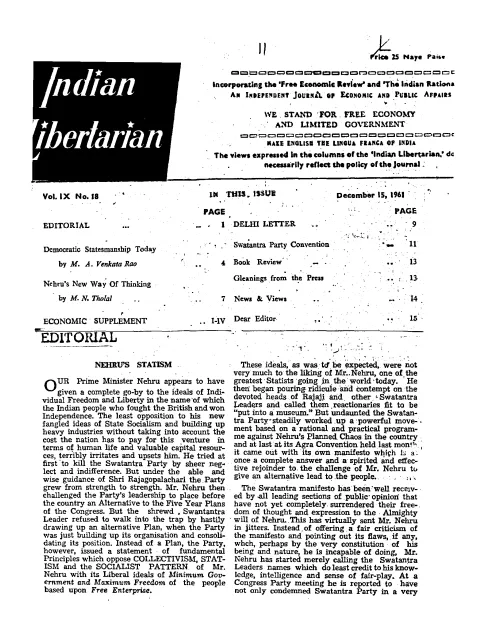
periodical issue
The Indian Libertarian
Independent Journal of Free Economy and Public Affairs
By MA Venkata Rao, G N Lawande, A Ranganathan
THE LIBERTARIAN PUBLISHERS (PRIVATE) LTD., Post Box No. 1900, Arya Bhuvan, Sandhurst Road, Bombay 4 · Bombay · 1960
24 pages
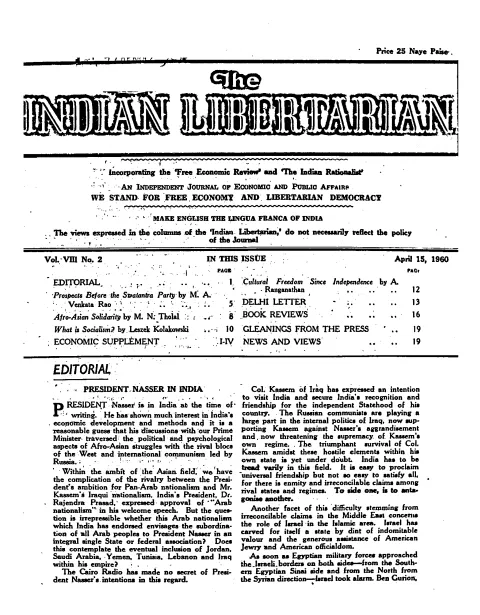
The Indian Libertarian
Summary
The Indian Libertarian Vol. VIII No. 2 (April 15, 1960) is a fortnightly issue of the Bombay-based liberal-libertarian periodical that opens with a long editorial on President Nasser’s expanding influence across the Arab world and India’s diplomatic response, followed by feature essays on the newly founded Swatantra Party, Afro-Asian solidarity, the meaning of socialism, an Economic Supplement defending free enterprise, and a survey of cultural freedom in republican India. The issue knits together international affairs (Nasser, the South African race war, French atomic tests in the Sahara, the Tibet question), domestic politics (Swatantra versus Congress, Krishna Menon’s defence policy, the Bombay High Court’s ruling on the Governor’s order), and the standing classical-liberal preoccupations of the journal — defending free economy against the Planning Commission’s controls, criticising the drift of Nehruvian foreign policy, and warning against the erosion of cultural and intellectual liberty under what its writers see as Congress orthodoxy.
Key points
-
The unsigned editorial reads President Nasser’s consolidation of authority across the Arab world as evidence that India’s cultivation of Egypt has produced little reciprocal support on Kashmir or other Indian concerns.
-
It also endorses H. M. Patel’s parliamentary criticism of defence preparedness and questions Krishna Menon’s leadership, alongside condemning French nuclear testing in the Sahara.
-
The editorial reads the Sharpeville massacre and South Africa’s racial regime as a defining moral test for the Afro-Asian bloc and the Commonwealth.
-
M. A. Venkata Rao’s ‘Prospects Before the Swatantra Party’ argues that the Prime Minister’s evident anxiety about the new party proves India finally has a coherent liberal opposition grounded in free economy and constitutional restraint.
-
Venkata Rao invokes Hayek and Mises to place the Swatantra programme within the international classical-liberal revival and rejects the charge that Indian liberalism is an imperial import.
-
M. N. Thakur’s ‘Afro-Asian Solidarity’ calls the slogan one that ‘cannot bear a moment’s scrutiny’, arguing Arab states have consistently backed Pakistan over India on Kashmir at the United Nations.
-
Thakur cites the Security Council’s voting record on Kashmir and the Sino-Indian border crisis as proof that professed Afro-Asian unity has not translated into practical support for India.
-
The journal reprints Polish philosopher Leszek Kolakowski’s essay ‘What Is Socialism?’, a text set in type in Warsaw in 1957 but never published there, which enumerates by negation what socialism is not.
Essays
EDITORIAL — President Nasser in India
The unsigned editorial ‘President Nasser’ surveys the consolidation of Nasser’s authority over the United Arab Republic and his shifting relations with Iraq, Jordan, Syria, Sudan, Saudi Arabia, Tunisia and Israel. It argues that Nasser’s brand of Arab nationalism — bolstered by a propaganda apparatus and pan-Arab ambition — has become the dominant force in West Asia, that India’s friendship with Egypt has so far yielded little political return, and that smaller Arab states fear absorption into the UAR. Adjacent editorial notes cover Mr. H. M. Patel’s critique of defence policy and Krishna Menon’s stewardship, the Bombay High Court decision on the Governor’s order touching the Bombay-Maharashtra dispute, the South African racial crisis after Sharpeville, the Afro-Asian bloc’s posture at the UN, Pakistan’s proposal for a Lahore–Dacca railway across Indian territory, and Nehru’s condemnation of French atomic tests in the Sahara.
- Frames President Nasser as the central political broker of the Arab world and reads regional realignments through his ambitions.
- Notes that India’s cultivation of Nasser has not produced reciprocal support on Kashmir or other Indian concerns.
- Endorses H. M. Patel’s parliamentary criticism of defence preparedness and questions Krishna Menon’s leadership.
- Treats the Sharpeville massacre and South Africa’s racial regime as a defining moral test for the Afro-Asian bloc and the Commonwealth.
- Condemns French nuclear testing in the Sahara as a violation of African sovereignty and a danger to the world.
Prospects Before the Swatantra Party
By MA Venkata Rao
M. A. Venkata Rao argues that the Swatantra Party has unsettled the Prime Minister and the Congress because it offers, for the first time since independence, a principled democratic alternative grounded in free economy, the dignity of the individual, and constitutional restraint on state power. He defends the party’s twenty-one founding principles, traces its appeal to peasants, traders and middle-class professionals alienated by central planning, and disputes the standard charge that liberalism in India is a relic of imperial rule. Drawing on the classical-liberal tradition — and citing Hayek and Mises as the doyens of post-war economic humanism — he insists that the Swatantra programme is neither reactionary nor capitalist apologetics but a sober attempt to combine political liberty, agrarian dignity and an open economy against the encroaching apparatus of the Planning Commission.
- Reads the Prime Minister’s anxiety about Swatantra as proof that a coherent liberal opposition is now in the field.
- Foregrounds ‘Free Economy’ as the first of the party’s principles, tied to the dignity of the individual.
- Defends the party’s appeal to peasants and small producers facing the cost of planning and statutory price controls.
- Invokes Hayek and Mises to ground the party’s economic position in the international classical-liberal revival.
- Rejects the charge that Indian liberalism is alien or imperial in origin and presents it as a continuous indigenous tradition.
Afro-Asian Solidarity
By M. N. Thakur
M. N. Thabal dismisses the slogan of Afro-Asian solidarity as rhetoric that ‘cannot bear a moment’s scrutiny.’ He argues that the Asian and African states grouped under the slogan share neither political institutions, religious traditions, nor strategic interests, and that the Prime Minister’s diplomacy has tried to keep alive a unity that exists only in declarations. Reviewing Arab nationalism, the Kashmir dispute, the Security Council voting record on the issue, and the Sino-Indian border, he contends that the supposed Afro-Asian bloc has consistently failed to support India where it mattered, and that Pakistan’s lobbying within the bloc has been more effective than New Delhi’s. The piece is a sustained attack on the moral and strategic premises of Nehruvian non-alignment.
- Calls Afro-Asian solidarity a slogan that ‘cannot bear a moment’s scrutiny.’
- Argues that Arab states have backed Pakistan rather than India on Kashmir.
- Treats the Security Council’s voting record on Kashmir as evidence that the Afro-Asian bloc is not reliably with India.
- Reads the Sino-Indian border crisis as further proof that ‘solidarity’ has not produced practical support for India.
- Frames Nehru’s non-alignment as built on sentiment that does not survive contact with hard interest.
What Is Socialism?
By Leszek Kolakowski
The journal reprints an essay by the Polish philosopher Leszek Kołakowski, ‘What Is Socialism?’, presented as a translation of a text that was set in type in Warsaw in 1957 but never published. The essay proceeds as a long, sardonic enumeration of what socialism is not — a list that, by negation, exposes the gap between socialist doctrine and the political practice of the People’s Republics. Each entry begins ‘A society that…’ and ends by denying that such a society can be called socialist: a state in which one group exploits another in the name of the working class, a state in which dissenters are imprisoned, where the citizen has no right to scientific opinion, where philosophy is dictated by the police, and so on. The translated extract carried in this issue runs across pages 10 and 15 of the issue.
- Reprints Kołakowski’s 1957 Polish essay defining socialism by what it is not.
- Structured as a litany — ‘A society which… is not a socialist society’ — that doubles as a critique of the Eastern bloc.
- Uses negation to insist on a moral content for socialism that the state-socialist regimes have abandoned.
- Includes denials of regimes that imprison dissenters, dictate philosophy, or treat citizens as instruments of party power.
- Frames the absence of liberty of opinion as the decisive disqualification of any claim to socialism.
Why Free Economy?
By In the issue
In the issue’s Economic Supplement, Prof. G. N. Lawande opens with ‘Why Free Economy?’ — an argument that economic development in underdeveloped countries has been wrongly identified with the volume of financial resources mobilised through public taxation, public borrowing and deficit finance. Lawande contends that real per-capita income gains follow from the productive use of resources and the institutional setting in which decisions are made, not from the size of state outlays alone. He criticises the Indian habit of treating planning targets as ends in themselves, warns that inflationary deficit finance erodes savings, and argues that an economy organised around private decision-making and market signals — a ‘free economy’ — is the more realistic route to development than further extensions of state direction.
- Distinguishes between the volume of financial resources mobilised by the state and the genuine economic development of a country.
- Argues that real per-capita income, not state outlay, is the proper test of development.
- Treats deficit financing and inflation as silent taxes that erode the saving capacity of ordinary households.
- Defends decentralised, market-based decision-making as the practical alternative to extended state planning.
- Frames the choice between planning and free economy as one about the locus of decision, not merely the level of investment.
ECONOMIC SUPPLEMENT — Why Free Economy? / Economic Chaos—A Way Out / Sound Growth
By G N Lawande
The second Economic Supplement piece, ‘Economic Chaos — A Way Out’ by M. V. Sastry, argues, in the words of its subtitle, that ‘a little planning is as impossible as a little pregnancy.’ Sastry insists that the half-measures favoured by Indian policy — a public sector grafted onto a private economy, statutory controls layered over surviving markets, and a Planning Commission that issues directives while the cabinet improvises — combine the worst features of both regimes. He calls for an honest choice: either full centralisation on the Soviet model, or a thorough turn to a free economy under stable monetary rules and a limited state. The essay reads as a companion piece to Lawande’s, sharpening the political argument that the Indian middle way is unstable.
- Frames Indian economic policy as a half-planned, half-market system that combines the disadvantages of both.
- Argues that ‘a little planning’ is structurally impossible — planning either takes over or fails.
- Treats the Planning Commission’s evolving role as evidence of the instability of the mixed economy.
- Calls for a clear constitutional and political choice between full centralisation and a genuine free economy.
- Links the case for free economy to monetary stability and a restrained, rule-bound state.
Cultural Freedom Since Independence — Recent Trends in Republican India
By A. Ranganathan
A. Ranganathan’s ‘Cultural Freedom Since Independence — Recent Trends in Republican India’ surveys the climate for liberal thought, scholarly enquiry and creative writing in the Republic. He argues that the liberal intelligentsia has lost ground to officially sponsored cultural bodies and to a public mood that confuses uniformity with national purpose. The piece treats episodes of political pressure on writers and academics, the use of state patronage to reward orthodoxy, and the dependence of literary and academic institutions on central funding as evidence that the conditions for cultural freedom have narrowed since 1947. Ranganathan situates the Indian case in the wider international debate on cultural freedom and argues for institutional and intellectual pluralism as the safeguard against drift toward conformity.
- Argues that liberal and cultural values have suffered a steady decline since Independence.
- Treats state patronage of literature and scholarship as a subtle instrument of conformity.
- Reads cultural freedom as inseparable from political and intellectual pluralism.
- Locates the Indian case within the international Congress for Cultural Freedom debate.
- Calls for autonomous institutions as the structural condition for free thought.
DELHI LETTER — Swatantra Alarming Congress & Jan Sangh
By A Ranganathan
The ‘Delhi Letter’, filed by the journal’s correspondent, reports on political currents in the capital. The opening dispatch, ‘Swatantra Alarming Congress & Jan Sangh’, notes that the Swatantra Party’s growth has discomforted both the ruling Congress and the Jan Sangh, and reads the cross-party reaction as a sign of the party’s emerging weight. Subsequent items cover the language question and the controversy over the use of Hindi versus English in administration and Parliament, the Lobsang Tibetan refugee claim of an Everest crossing, and Governor Gadgil’s controversial remarks. The Letter is gossipy in tone but substantive in its tracking of how the new liberal opposition is shifting alignments within the Congress system.
- Reports that the Swatantra Party’s growth is alarming both the Congress and the Jan Sangh.
- Tracks the language debate and resistance to the imposition of Hindi in official business.
- Notes the Lobsang Tibetan refugee episode and its diplomatic background.
- Covers Governor Gadgil’s contested public remarks.
- Treats Delhi politics as a barometer of the wider liberal-conservative realignment underway in 1960.
BOMBAY ROUND UP — Friendly Approach to All Problems
No summary was extracted for this article. Listed for completeness.
BOOKS AND VIEWS / Book Reviews — The Revolt in Tibet (by Frank Moraes)
The Book Reviews section opens with a notice of Frank Moraes’s ‘The Revolt in Tibet’ (Macmillan, 1960; price Rs. 7.50), summarising Moraes’s narrative of the Chinese suppression of the 1959 Tibetan uprising and the flight of the Dalai Lama. The review reads the book as a useful primer on the Sino-Tibetan crisis for Indian readers and as a corrective to officially favoured accounts that played down the implications of Chinese rule for Indian security on the Himalayan frontier.
- Notices Frank Moraes’s ‘The Revolt in Tibet’ as the headline book reviewed in this issue.
- Treats the book as a primer on the 1959 Tibetan uprising and the Dalai Lama’s flight.
- Reads it as a corrective to official Indian accounts of the Sino-Tibetan crisis.
- Connects the Tibet question to Indian frontier security in the Himalayas.
- Recommends the title to readers following the developing China policy debate.
Generated by the v1.5 extraction pipeline. Awaiting editorial review.
Metadata and summary are AI-extracted from the source PDF and reviewed for editorial accuracy. The original work is available via the Read PDF tab above (where present); paragraph-level citation inside the PDF is deferred to a future engagement.