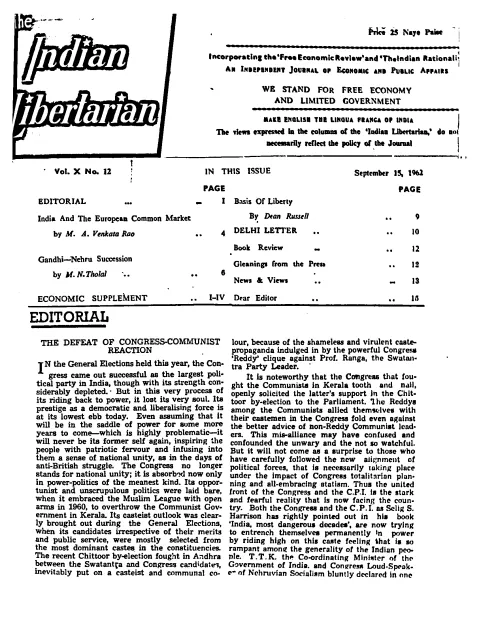
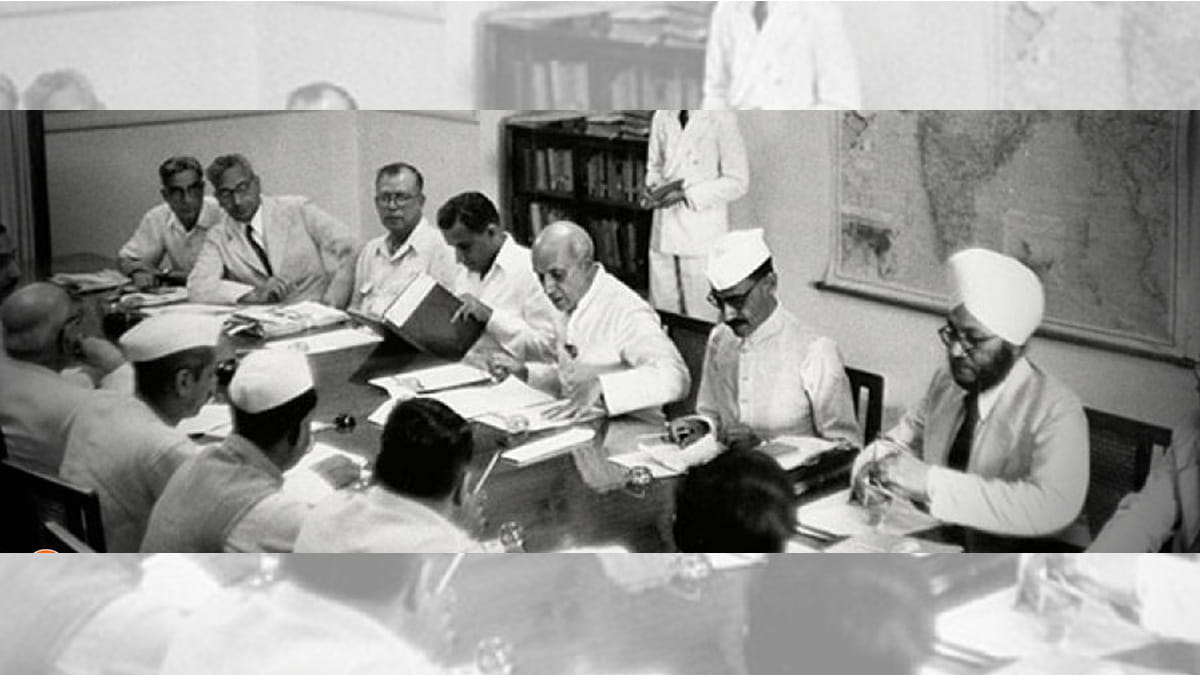
periodical issue
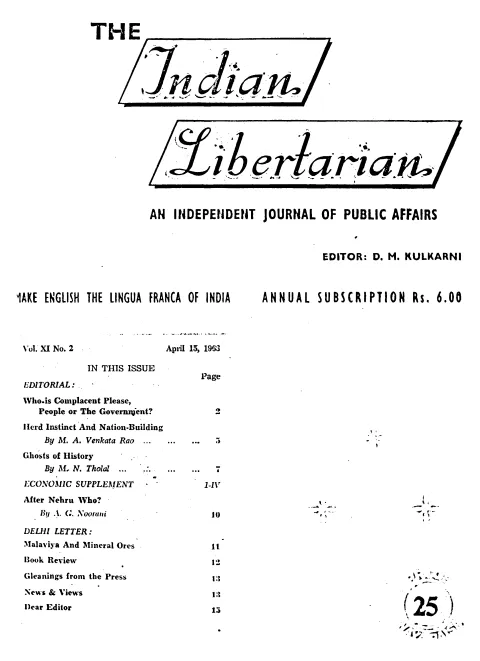
The Indian Libertarian
An Independent Journal of Public Affairs
By MA Venkata Rao, M. N. Tholal
Issued by D. M. Kulkarni on behalf of Libertarian Publishers (Private) Ltd., printed by him at G. N. Printers, 28, Kazi Sayed Street, Bombay-3 and published at Arya Bhuvan, Sandhurst Road, Bombay-4. · Bombay · 1963
20 pages
The Indian Libertarian
Summary
The Indian Libertarian, Vol. XI No. 2 (15 April 1963), is a fortnightly periodical edited by D. M. Kulkarni and issued from Bombay by Libertarian Publishers (Private) Ltd. Its masthead promises ‘An Independent Journal of Public Affairs’ and carries the campaigning slogan ‘Make English the Lingua Franca of India.’ The issue opens with an unsigned editorial replying to President Radhakrishnan’s recent address on complacency, turning the President’s complaint back on the Congress government and faulting it for the Krishna Menon era at the Defence Ministry, zig-zags in non-alignment, and the Ganges river-waters dispute with Pakistan. M. A. Venkata Rao contributes a comparative essay on Russian versus Persian nation-building; M. N. Tholal revisits old All-India Congress Committee resolutions under the heading ‘Ghosts of History.’ A four-page Economic Supplement (folios I-IV) carries Prof. G. N. Lawande on planning and employment, an Australian reprint on ‘Britain, The Giant Invalid,’ and Austen Nazareth on small business as the keystone of developing nations. A. G. Noorani surveys the post-Nehru succession field; a Delhi Letter dissects the K. D. Malaviya mineral-ores controversy; the issue closes with a book review of Acharya Vinoba Bhave’s Democratic Values, a press-gleanings column, news briefs from Geneva, Washington, New York and Guatemala, and a Dear Editor page dominated by the national-language debate.
Key points
-
An unsigned editorial answers President Radhakrishnan’s charge of public complacency by inverting it, arguing the real complacency lies in the Congress government’s own conduct.
-
The editorial reads Radhakrishnan’s address as a tacit admission that central planning has failed and that private enterprise must be relied upon.
-
It attacks the ‘vicious system’ in the Defence Ministry under V. K. Krishna Menon and criticises India’s zig-zags between non-alignment, the Commonwealth and African solidarity.
-
The editorial calls India’s position on the Ganges river-waters dispute with Pakistan feeble and irresolute, and closes with a ‘Food for Thought’ sidebar of liberty quotations from Webster, Burke and Rudolf Rocker.
-
M. A. Venkata Rao’s essay ‘Herd Instinct And Nation-Building’ contrasts the Russian and Persian revolutions to argue that reform cut off from a nation’s own cultural tradition either collapses or must be propped up by force.
-
Venkata Rao draws the lesson that a young nation like India must distinguish between borrowing foreign techniques and importing alien spiritual content, anchoring reform in its own civilisational past.
-
M. N. Tholal’s column ‘Ghosts of History’ revisits 1920s Congress Working Committee resolutions on Bengal, Maharashtra and Muslim representation to argue today’s minority-safeguard and federalism debates are not new.
-
The Economic Supplement carries Prof. G. N. Lawande on planning and employment, an Australian reprint on ‘Britain, The Giant Invalid’, and Austen Nazareth arguing small business is the keystone of developing nations.
-
A. G. Noorani surveys the field of contenders for the post-Nehru succession, while a Delhi Letter examines the K. D. Malaviya mineral-ores controversy and the issue closes with a review of Vinoba Bhave’s Democratic Values.
Essays
EDITORIAL: Who is Complacent Please, People or The Government?
The unsigned editorial answers President Radhakrishnan’s recent charge that the public is complacent by inverting it: the real complacency, it argues, lies in the Congress government’s own conduct. Radhakrishnan’s address is read as an admission that planning has failed and that the economy must lean on private effort, but the editorial contends he stopped short of naming the source of the problem — the ruling party and its leaders. It catalogues recent failures: the people’s swift response to the Chinese aggression contrasted with the government’s slow appeals; the ‘vicious system’ in the Defence Ministry that produced the Krishna Menon debacle; zig-zags between non-alignment, the Commonwealth and African solidarity; and a feeble Indian stance on the Ganges river-waters dispute with Pakistan. The editorial ends by demanding the government ‘set its house in order’ before lecturing citizens on complacency, and prints a sidebar of liberty quotations under the head ‘Food for Thought.’
- Frames President Radhakrishnan’s complaint about public complacency as an indictment that properly belongs to the Congress government itself.
- Reads Radhakrishnan’s address as a tacit admission that central planning has failed and that private enterprise must be relied upon.
- Attacks the ‘vicious system’ in the Defence Ministry under V. K. Krishna Menon as a key example of governmental, not popular, complacency.
- Criticises India’s zig-zags in international alignment between non-alignment, the Commonwealth and African solidarity.
- Calls the Indian position on the Ganges river-waters dispute with Pakistan feeble and irresolute.
- Closes with a ‘Food for Thought’ sidebar of liberty quotations from Webster, Burke, Wendell Phillips, Rudolf Rocker and Howard Ellis.
Herd Instinct And Nation-Building
By MA Venkata Rao
M. A. Venkata Rao argues that successful nation-building cannot rest on a ‘herd instinct’ of mass conformity or on the slavish imitation of European political models. He contrasts two twentieth-century revolutions of supposedly comparable scope — the Russian and the Persian — to show that revolutionary energy uprooted from authentic national culture and tradition either collapses or has to be artificially propped up by force. The Russian Revolution, he holds, succeeded in subordinating individual judgment to a collectivist mass, while the Persian effort sought to graft Western forms onto a society whose religious and cultural inheritance was not yet ready to absorb them. The lesson he draws for India is that a young nation building itself in the shadow of European prestige must distinguish between borrowing techniques and importing alien spiritual content, and must anchor reform in its own civilisational past rather than in herd-driven imitation.
- Treats ‘herd instinct’ as a danger for new nations tempted to imitate European political forms wholesale.
- Contrasts the Russian and Persian revolutions as paired test cases of nation-building.
- Argues that revolutions cut off from indigenous cultural tradition either fail or become coercive.
- Draws a lesson for India about selective borrowing rather than wholesale European mimicry.
- Treats genuine nation-building as requiring continuity with the country’s own civilisational inheritance.
Ghosts of History
By M. N. Tholal
M. N. Tholal’s column ‘Ghosts of History’ revisits long-buried All-India Congress Committee resolutions to argue that today’s Congress and Swatantra Party leaderships are haunted by positions they once took and have since disowned. Tholal walks through the 1924 special session of the Congress and Mahatma Gandhi’s later account of it in India Wins Freedom (he discusses Maulana Azad’s framing as well), and through Working Committee decisions of 1928–29 on Bengal, Maharashtra and Muslim representation. The point is polemical: present-day quarrels about minority safeguards, language and federalism are not new, and the resolutions of the 1920s and 1930s — including ones associated with Mohamed Ali, Subhas Chandra Bose’s brother, and the Bengal leadership — already laid out the trade-offs that contemporary politicians pretend to be discovering. Tholal’s tone is wry; the ‘ghosts’ are old votes that current actors would rather forget.
- Argues that present Congress and Swatantra debates merely revive long-forgotten Working Committee positions.
- Re-examines the 1924 special session of the Congress and Gandhi’s later account in India Wins Freedom.
- Cites Working Committee resolutions of 1928–29 on Bengal, Maharashtra and minority safeguards.
- Names mid-20th-century Congress figures (Mohamed Ali, the Bose brothers, Maulana Azad) as actors in those forgotten decisions.
- Uses the historical record to mock the amnesia of current politicians on minority and federal questions.
ECONOMIC SUPPLEMENT
By G N Lawande
Prof. G. N. Lawande opens the Economic Supplement with an essay arguing that the successive Five Year Plans have been built on unrealistic employment assumptions. He recalls the Planning Commission’s original promise that planned investment would simultaneously raise output and absorb the country’s growing labour force, and shows that even on the Commission’s own figures the absorption of new entrants has fallen badly short. Lawande maintains that the chosen pattern of heavy-industry-led, capital-intensive growth — borrowed from the Soviet experience — is structurally incapable of clearing India’s unemployment backlog, because it produces too few jobs per rupee invested and crowds out the labour-intensive small enterprise that could. He therefore urges a shift toward small and medium industry, agricultural employment and consumer-goods production: a planning strategy aimed first at full employment rather than at a heavy-industrial base whose social benefits are postponed indefinitely.
- Critiques the employment assumptions built into the successive Five Year Plans.
- Argues that Soviet-style heavy-industry-led growth absorbs too little labour per rupee invested.
- Reads even the Planning Commission’s own figures as confessing that job creation has lagged behind population growth.
- Recommends a shift toward small and medium industry and agricultural employment to clear the unemployment backlog.
- Frames full employment, not heavy industry, as the proper first target of Indian planning.
After Nehru Who?
By A. G. Noorani
An unsigned piece reprinted from The Standard (Australia) diagnoses Britain as a ‘giant invalid’ whose post-war decline cannot be hidden by talk of the Common Market. The article traces the long arc of British weakness — the loss of empire, dependence on imported food and raw materials, the welfare state’s tax burden, recurrent sterling crises and the country’s tendency to live above its means — and argues that Common Market entry, far from curing the malady, would simply transfer Britain’s economic guardianship to continental partners. The piece is offered to Indian readers as a cautionary tale about over-reliance on protection, planning and external props rather than productive vigour.
- Reads post-war Britain as economically and morally exhausted despite its formal great-power status.
- Treats Britain’s pursuit of Common Market entry as a symptom of decline, not a cure for it.
- Lists the welfare state, sterling crises and a habit of living above one’s means among the causes of decline.
- Offers the British case as a warning to India about over-reliance on protection and central direction.
DELHI LETTER: Malaviya And Mineral Ores
Austen Nazareth argues that small business is the natural keystone of any developing economy, including India’s. He surveys recent United States Senate findings on the role of small enterprise in American growth, citing the 1957–58 Senate Small Business Committee’s documentation of small firms as drivers of employment, innovation and competitive discipline. He extends the argument to Latin America, Turkey, Pakistan and India: in each case, he contends, the visible bias of credit, foreign-exchange allocation and licensing toward large enterprise has held back the very segment that creates the most jobs per unit of investment. The remedy, in Nazareth’s reading, is not subsidy but the removal of policy discrimination — credit, raw materials and licences distributed on neutral terms — so that the small entrepreneur, the most efficient absorber of labour, can do the heavy lifting of development.
- Treats small business as central, not peripheral, to development strategy.
- Draws on 1957–58 U.S. Senate Small Business Committee findings to make the case.
- Surveys parallel evidence from Latin America, Turkey and Pakistan.
- Argues that Indian credit, foreign-exchange and licensing policy systematically discriminates against small enterprise.
- Recommends neutral policy rather than subsidy as the remedy.
Book Review
A. G. Noorani opens his succession survey with a Laski-style maxim that a great leader’s success is measured by how dispensable he has made himself, and proceeds to ask whether Jawaharlal Nehru has done so. He runs through the obvious candidates — Morarji Desai, Y. B. Chavan, Lal Bahadur Shastri, T. T. Krishnamachari, Indira Gandhi — and assesses each on temperament, factional support inside the Congress, and capacity to hold the party together once the founder is gone. Noorani is sceptical that any single figure commands the breadth Nehru enjoyed and warns that the immediate post-Nehru phase is likely to be one of coalitional bargaining inside the Congress Parliamentary Party rather than a clean handover. The piece is a survey, not a prediction: Noorani avoids endorsing a candidate and instead maps the field.
- Asks whether Nehru has made himself dispensable in the sense Laski recommended.
- Surveys Morarji Desai, Y. B. Chavan, Lal Bahadur Shastri, T. T. Krishnamachari and Indira Gandhi as plausible successors.
- Stresses internal Congress Parliamentary Party dynamics over public popularity.
- Predicts a phase of coalitional bargaining rather than a clean handover.
From Our Correspondent,
The Delhi Letter, signed ‘From Our Correspondent,’ walks through the K. D. Malaviya mineral-ores controversy. The Union Minister for Mines and Oil is accused of behind-the-scenes interference in contract awards relating to mineral exports, and the column tracks the political fallout inside the Congress Parliamentary Party as members demand an explanation. The correspondent reports that the Prime Minister, Jawaharlal Nehru, sought a quick way to defuse the affair, that Lal Bahadur Shastri was drawn in as a senior moderator, and that Acharya Kripalani led the parliamentary attack. The letter situates the affair within the larger pattern of corruption charges that have shadowed the Congress ministry and reads it as a test of the party’s willingness to police its own.
- Reports on the Malaviya mineral-ores affair as a fresh corruption test for the Congress ministry.
- Tracks the dispute through the Congress Parliamentary Party rather than through the floor of the House.
- Notes Nehru’s anxiety to settle the matter quickly and Lal Bahadur Shastri’s role as moderator.
- Identifies Acharya Kripalani as the leading parliamentary critic.
- Reads the episode as symptomatic of recurring ministerial scandals.
s speeches and writings (published by Bharatiya Vidya Bhavan). The reviewer treats Vinoba
A short book review covers Democratic Values, a collection of Acharya Vinoba Bhave’s speeches and writings (published by Bharatiya Vidya Bhavan). The reviewer treats Vinoba’s case for non-violent, decentralised democracy with respect but also with reservation: while welcoming his emphasis on individual moral responsibility and grassroots Sarvodaya organisation, the review questions whether a programme so dependent on voluntary self-government can survive the demands of a modern state with planning, defence and external policy obligations. The notice ends by recommending the volume as an articulate statement of Gandhian political philosophy even for readers who, like the journal, do not share its premises.
- Reviews Democratic Values, a collected volume of Acharya Vinoba Bhave’s speeches.
- Welcomes Vinoba’s stress on individual moral responsibility and decentralisation.
- Questions whether Sarvodaya voluntarism can carry the burdens of a modern state.
- Recommends the book as the clearest available statement of the Gandhian political case.
Gleanings from the Press
The combined ‘Gleanings from the Press’ and ‘News & Views’ pages collect press extracts and short news items. The lead gleaning, ‘Reverence Overdone,’ protests the elaborate ceremonial cultivated around senior politicians; another piece is headed ‘Thank God I Was Tired In India.’ Short news items report from Geneva (a joint Soviet-American test ban proposal), Washington (USA Food to Stand Aside from Free Nations and Kennedy), Moscow (USSR announces Red China detente moves), New York (further private American investment in newly unblocked countries), Guatemala (army units seize power), and on a sharp decline in China’s trade with Red nations. The page also notes a draft bill granting associate status to foreign English-language journalism.
- Carries press extracts under the heading ‘Reverence Overdone’ criticising political ceremony.
- Reports from Geneva on a joint Soviet-American test-ban proposal.
- Reports U.S. food-aid policy positioning toward newly free nations.
- Reports a Soviet announcement on a Red China detente.
- Reports an army seizure of power in Guatemala.
- Reports a sharp decline in China’s trade with other Red nations.
News & Views
No summary was extracted for this article. Listed for completeness.
Dear Editor
No summary was extracted for this article. Listed for completeness.
Essay 11
The Dear Editor page is dominated by the language controversy. A letter signed Nautamlal C. Tejpal argues against forcing Hindi on the southern states and defends the journal’s masthead campaign to make English the lingua franca of India on practical, not ideological, grounds: English is already the working medium of higher education, the courts, the central administration and inter-state business, and an artificial Hindi imposition would deepen southern resentment rather than build national feeling. A short notice from the Libertarian Social Institute, Bangalore, closes the page.
- Devotes the letters page to the national-language controversy.
- Defends English as the de facto working language of higher education, the courts and the centre.
- Reads forced Hindi imposition as deepening southern resentment.
- Carries a closing notice from the Libertarian Social Institute, Bangalore.
Generated by the v1.5 extraction pipeline. Awaiting editorial review.
Metadata and summary are AI-extracted from the source PDF and reviewed for editorial accuracy. The original work is available via the Read PDF tab above (where present); paragraph-level citation inside the PDF is deferred to a future engagement.