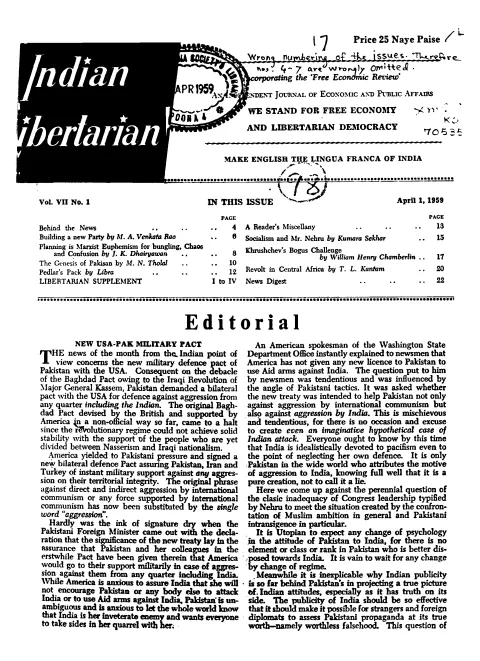
periodical issue
The Indian Libertarian
Independent Journal of Economic and Public Affairs; Incorporating the 'Free Economic Review'
By MA Venkata Rao, M. N. Tholal, Frédéric Bastiat, Om Prakash Kahol, A. D. Shroff
The Indian Libertarian · Bombay · 1958
32 pages
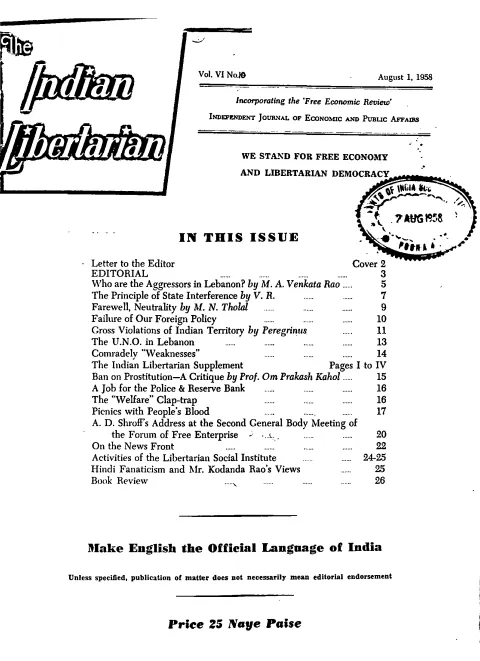
The Indian Libertarian
Summary
The August 1, 1958 issue of The Indian Libertarian (Vol. VI, No. 10) is dominated by two preoccupations: the Cold War crisis in West Asia following the Iraqi coup and the landing of American and British troops in Lebanon and Jordan, and a domestic critique of Nehruvian planning, neutrality and welfare politics. The editorial pairs an alarmist note on alleged Pakistani military infiltration along India’s border with a longer reflection on what Lebanon should teach Indian foreign policy. Contributors M. A. Venkata Rao and M. N. Tholal argue that Nasser-led Arab nationalism is a vehicle of Soviet ‘indirect aggression’ and that Nehru’s neutralism is bankrupt, while Peregrinus, reprinting from the Hindustan Times, catalogues Pakistani border violations in Kashmir.
The issue’s libertarian core appears in V. R.’s ‘The Principle of State Interference’, in the Indian Libertarian Supplement (which carries ‘Wanted: A New Intellectual Elite’ by Chanakya and Frédéric Bastiat’s classic ‘On Stopping Competition’), and in shorter pieces critiquing welfare-state rhetoric, anti-prostitution legislation, and the conduct of the Reserve Bank. The volume thus knits together anti-communism, scepticism of state planning, defence of free competition, and an editorial campaign for English as India’s official language, all framed under the masthead motto ‘We Stand For Free Economy And Libertarian Democracy.‘
Key points
-
The 1 August 1958 issue, Vol. VI, No. 10, is dominated by the Cold War crisis in West Asia following the Iraqi coup and the landing of American and British troops in Lebanon and Jordan.
-
The editorial’s first part alleges that Pakistani embassies and trade missions were used as cover for military reconnaissance inside India, accusing the government of laxity in monitoring foreign personnel.
-
The editorial’s second part, ‘The Lesson of Lebanon for India’, argues that doctrinaire non-alignment leaves small states exposed to Soviet-sponsored indirect aggression and urges India to reinforce its own frontiers.
-
M. A. Venkata Rao reads Nasser-led Arab nationalism as an instrument of Soviet indirect aggression and defends the Anglo-American Lebanon landings as legitimate under the U.N. Charter.
-
Writing as ‘V. R.’, an essay on ‘The Principle of State Interference’ cites Europe’s post-war retreat from state-controlled economies as evidence Indian planners are repeating mistakes already abandoned elsewhere.
-
M. N. Tholal’s ‘Farewell, Neutrality’ argues that the Iraqi coup and Western interventions in Lebanon and Jordan make India’s posture of equidistance a moral pretence, calling on Nehru to abandon it.
-
The Indian Libertarian Supplement carries Chanakya’s ‘Wanted: A New Intellectual Elite’ and Frédéric Bastiat’s ‘On Stopping Competition’ alongside shorter pieces critiquing welfare-state rhetoric and anti-prostitution legislation.
Essays
Letter to the Editor
A short ‘Letters To The Editor’ column collects reader notes on the Forum of Free Enterprise, on the magazine’s coverage of building and economic affairs, and on the Indian Libertarian Service. The exchanges are largely housekeeping — readers commending or correcting recent items — and serve to mark the periodical’s network of liberal correspondents.
- Brief reader correspondence rather than a sustained essay
- References the Forum of Free Enterprise and the Indian Libertarian Service
- Sets a conversational tone before the editorial
EDITORIAL
The editorial runs in two parts. ‘Pakistani Military Within India’s Border’ raises an alarm that Pakistani embassies and trade missions have been used as cover for military infiltration, and that the Government of India has been too lax in monitoring foreign personnel inside the country. The second part, ‘The Lesson of Lebanon for India’, uses the Anglo-American intervention in Lebanon and Jordan as a cautionary tale for Indian neutralism: the Editor argues that a doctrinaire policy of non-alignment leaves small states exposed to Soviet-sponsored ‘indirect aggression’, and that India must rethink its reflexive condemnation of Western action while reinforcing the integrity of its own frontiers.
- Accuses Pakistan of using diplomatic channels for military reconnaissance inside India
- Frames the Lebanon landings as a defensive response to communist-aligned subversion, not aggression
- Argues that Indian neutralism has consistently underestimated indirect Soviet pressure
- Calls for tougher Indian vigilance at the border and at the United Nations
Who are the Aggressors in Lebanon?
By MA Venkata Rao
M. A. Venkata Rao’s lead article asks who the real aggressors are in Lebanon and answers that the visible Arab nationalist actors — Nasser, the Iraqi rebels, and their sympathisers in Beirut — are instruments of a wider pattern of ‘indirect aggression’ coordinated from Moscow. He distinguishes ‘direct’ invasion from the Soviet method of cultivating fifth columns, propaganda fronts and pliant strongmen, and argues that the West’s troop deployments in Lebanon and Jordan are a legitimate response under the U.N. Charter. The piece ends by chastising Indian commentators who reflexively side with Cairo and Damascus, and calls for Asian liberals to ‘refuse to be footballs’ kicked between the two blocs.
- Defines ‘indirect aggression’ as the characteristic Soviet method of the late Cold War
- Reads Nasser’s pan-Arabism as a vehicle for Soviet expansion rather than authentic nationalism
- Defends the Anglo-American landings as defensive and treaty-based
- Criticises Indian public opinion for moral equivalence between Washington and Moscow
The Principle of State Interference
By V. R.
Writing under the initials V. R., the author surveys the record of state intervention in Europe and India and argues that the case for sweeping state direction of economic life has weakened, not strengthened, with experience. He notes that the post-war reaction against state-controlled economies in Europe shows that even socialist parties have had to retreat from the maximalist programme, and warns that India’s planners are repeating mistakes already abandoned elsewhere. The piece distinguishes legitimate regulation — defence, basic infrastructure, rule of law — from the steady expansion of bureaucratic control over prices, production and distribution that, in his view, undermines initiative and produces shortages.
- Frames state interference as a question of degree, not principle
- Cites the European post-war retreat from planning as evidence that intervention has limits
- Argues that Indian planning is following a path Europe is abandoning
- Defends a narrow role for the state: defence, infrastructure, law
Farewell, Neutrality
By M. N. Tholal
M. N. Tholal bids ‘farewell’ to Indian neutrality, arguing that events in West Asia have made non-alignment indefensible. Surveying the Iraqi coup, the U.S. landing in Lebanon and the British intervention in Jordan, he contends that the Egyptian-led Arab nationalist bloc has aligned with Moscow in everything but name, and that India’s continued posture of equidistance is now a moral pretence. He calls on Nehru to abandon the pose of arbiter between the blocs and to acknowledge that the freedom of small states in the region depends on Western military presence.
- Treats the Iraqi coup as a Soviet-aligned event, not an indigenous revolt
- Argues neutrality has become a euphemism for de facto sympathy with Nasser
- Calls for an explicit Indian repudiation of non-alignment
- Defends the legality and necessity of the Anglo-American landings
Failure of Our Foreign Policy
Reprinted from the Baker Herald, this short item argues that Indian foreign policy has visibly failed: New Delhi backed the Egyptian side in Suez, refused to condemn Soviet action in Hungary, and now finds itself isolated as the Arab world drifts deeper into the Soviet orbit. The author asks whether Indian diplomacy serves any clear national interest and concludes that ‘do we serve our national interest?’ is the question Indian opinion most urgently needs to confront.
- Catalogues recent Indian diplomatic choices as a string of misjudgements
- Argues India has gained neither influence in the West nor leverage with Moscow
- Asks whether neutrality has produced any concrete national gain
Gross Violations of Indian Territory
By Peregrinus
Writing under the byline ‘Peregrinus’ (reprinted from the Hindustan Times), the author documents what he calls a fresh wave of Pakistani territorial incursions: tribal raids on Indian border posts, the lobbing of mortar fire at Indian patrols, and statements from Pakistani leaders, including Prime Minister Firoz Khan Noon, that have escalated the rhetoric over Kashmir. The piece argues that India’s restrained official response has encouraged further provocations and presses Nehru’s government to put the country on a clearer war footing in the disputed areas.
- Documents a sequence of recent armed incidents along the Pakistan border
- Cites Pakistani prime ministerial statements as evidence of state-level intent
- Argues that Indian restraint has been read as weakness
- Calls for a tougher and more public Indian posture on Kashmir
The U.N.O. in Lebanon
Reprinted from Thought, ‘The U.N.O. in Lebanon’ examines the role of the United Nations in the Lebanese crisis. The author argues that the U.N. observer mission, while necessary, was structurally unable to prevent the cross-border infiltration from the United Arab Republic that prompted the American landing, and that Secretary-General Hammarskjold’s insistence on the limits of the observers’ mandate effectively left the Lebanese government no option but to call for outside help. The piece reads the episode as evidence that the U.N. can monitor but not deter committed Cold War subversion.
- Treats the U.N. observer mission as well-intentioned but operationally toothless
- Argues Hammarskjold’s procedural caution forced Lebanon toward Washington
- Frames the crisis as a stress test the U.N. did not pass
- Concludes that small states cannot rely on Turtle Bay against committed proxy aggression
Comradely “Weaknesses”
Also reprinted from Thought, ‘Comradely “Weaknesses”’ is a sardonic note on intra-communist score-settling. The author observes that the Soviet press is now publishing critiques of Yugoslav ‘revisionism’ and of internal Communist Party deviations that, only months ago, would have been unsayable, and argues that the spectacle confirms the libertarian thesis that totalitarian systems produce permanent purges rather than stable agreement.
- Reads Soviet polemics against Tito as a fresh purge cycle rather than ideological debate
- Treats the ‘weaknesses’ frame as a euphemism for political elimination
- Argues the episode discredits the claim of Communist internal democracy
The Indian Libertarian Supplement (incl. “Wanted: A New Intellectual Elite” by Chanakya and “On Stopping Competition” by Frederic Bastiat)
The four-page Indian Libertarian Supplement carries two principal articles. ‘Wanted: A New Intellectual Elite’ by Chanakya argues that the West’s social crisis is being fed by Marx-Leninist ideology and that India urgently needs a counter-elite — intellectuals trained to defend property, the rule of law and individual initiative against the Plan-and-Five-Year-Plan orthodoxy. Frédéric Bastiat’s ‘On Stopping Competition’ is reprinted (from The Free Trader) and used as a primer in the unseen consequences of protectionism: each tariff or restriction protects a visible producer at the price of an invisible loss to consumers and to the wider economy. Together the two pieces form the supplement’s pedagogical spine — diagnose the missing intellectual class, then hand readers a canonical text in liberal economics.
- Chanakya calls for a self-conscious Indian liberal intelligentsia to contest Marxist hegemony
- Treats the failure of the Western elites to defend free society as a warning to India
- Reprints Bastiat’s ‘broken window’-style argument against protective competition rules
- Pairs domestic strategy (‘build an elite’) with classic theory (‘the seen and the unseen’)
Ban on Prostitution — A Critique
By Prof. Om Prakash Kahol
Prof. Om Prakash Kahol critiques the proposed Suppression of Immoral Traffic legislation by arguing that a blanket ban on prostitution will not eliminate the trade but only drive it underground, into the hands of organised crime and corrupt police. Drawing on comparable experiments in Europe and America, he urges instead a regulatory framework — registration, medical inspection, rescue and rehabilitation — that addresses the women’s livelihoods and the public-health dimension without pretending that criminal sanction alone can dissolve demand.
- Distinguishes the moral case for abolition from the policy case for prohibition
- Predicts that a ban will expand corruption and trafficking rather than reduce prostitution
- Argues from international experience that regulation outperforms criminalisation
- Calls for rescue, rehabilitation and medical oversight as the working policy
A Job for the Police & Reserve Bank
Reprinted from Filmindia, this short note urges the Reserve Bank and the Bombay police to do more to curb the proliferation of unregulated finance and ‘chit fund’ operators that, the author argues, are quietly bleeding small savers. The piece treats consumer protection as a proper, narrow function of the state — in contrast to the broader interventions criticised elsewhere in the issue.
- Identifies unregulated deposit schemes as a small-saver problem
- Argues for a sharper enforcement role for the Reserve Bank
- Aligns consumer-protection with, not against, the libertarian frame
The “Welfare” Clap-trap
Also reprinted from Filmindia, ‘The “Welfare” Clap-trap’ takes apart what the author considers the rhetorical sleight of hand in the government’s ‘welfare state’ branding: ambitious slogans, ministers’ photo-ops and grand five-year promises that, on inspection, deliver neither welfare nor the conditions in which welfare could be earned. The piece reads the welfare label as cover for an expanding bureaucratic class rather than a programme for the poor.
- Treats ‘welfare state’ as a slogan that outruns delivery
- Argues the chief beneficiaries are the administrators, not the beneficiaries on paper
- Reinforces the issue’s broader scepticism of state expansion
Generated by the v1.5 extraction pipeline. Awaiting editorial review.
Metadata and summary are AI-extracted from the source PDF and reviewed for editorial accuracy. The original work is available via the Read PDF tab above (where present); paragraph-level citation inside the PDF is deferred to a future engagement.