periodical issue
The Indian Libertarian
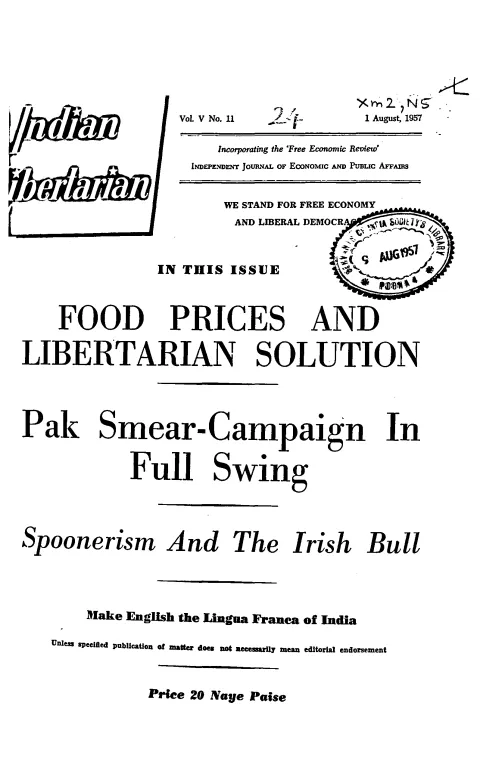
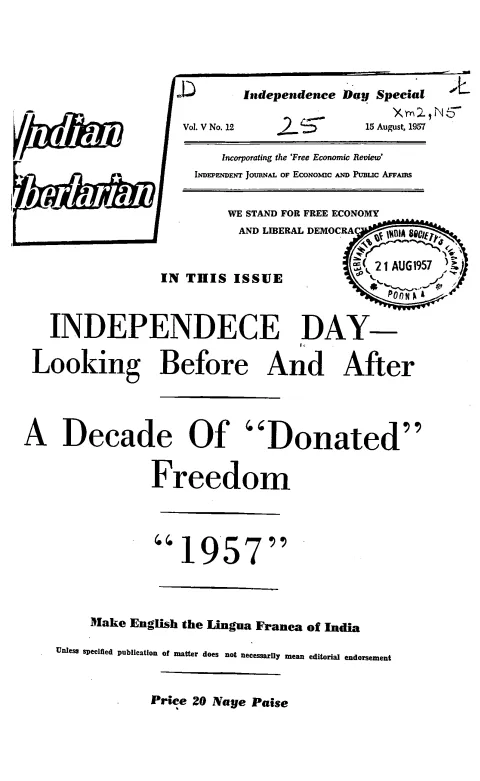
Independent Journal of Economic and Public Affairs — Independence Day Special, Vol. V No. 12, 15 August 1957
By MA Venkata Rao, A Ranganathan
The Indian Libertarian, Arya Bhuvan, Sandhurst Road, Bombay 4. Published on the 1st and 15th of Each month. · Bombay · 1957
24 pages
The Indian Libertarian
Summary
This is the Independence Day Special issue of The Indian Libertarian (Vol. V, No. 12, 15 August 1957), an ‘Independent Journal of Economic and Public Affairs’ edited by Kusum Lotwala and published by the Libertarian Social Institute, Bombay. Across editorials and contributed essays it marks the tenth anniversary of Indian independence as an occasion for stocks-taking rather than jubilation, and it indicts what its contributors see as a slide toward state planning, regimentation and Soviet-style economics under the Second Five Year Plan. The masthead motto ‘We stand for Free Economy and Liberal Democracy’ frames the issue’s argumentative center: M. A. Venkata Rao reads the linguistic-states reorganisation as a warning against the politics of mass passion; J. K. Dhairyawan attacks the very phrase ‘won freedom’ and calls 1947 a ‘donated’ transfer of power; B. S. Sanyal surveys the year 1957 and the totalitarian drift in Kerala; A. Ranganathan examines whether the Constitution’s individual-rights chapter has survived a decade of executive aggrandisement; ‘Sudarshan’ defends a non-aligned but morally serious foreign policy; and K. D. Valicha twice argues — on profits and on strategy — that Indian liberalism must choose private enterprise and Western alignment over fashionable middle paths. A central four-page R. L. Foundation supplement edited by Sanyal carries the issue’s most explicit polemic against socialism, with the line ‘Communism is slavery’ as its rhetorical anchor.
Key points
-
The Independence Day Special issue (Vol. V, No. 12, 15 August 1957), edited by Kusum Lotwala, marks the tenth anniversary of independence as an occasion for stock-taking rather than jubilation, indicting a slide toward state planning under the Second Five Year Plan.
-
The unsigned editorial calls Krishna Menon’s description of British military action in Oman as ‘unfortunate’ an uncalled-for piece of moralising that harms Indo-British amity, and urges an honest accounting of Pakistani objections in the Indus canal-waters dispute.
-
It also treats Major-General Akbar Khan’s plan to recover Kashmir through what it calls subversion as a serious strategic threat the Indian government should not dismiss.
-
M. A. Venkata Rao’s editorial reads the linguistic reorganisation of the states, producing Karnataka and Madhya Pradesh, as a warning that mass passion and ‘fissiparous tendencies’ threaten to override constitutional unity, and proposes English as the federal link language.
-
J. K. Dhairyawan’s ‘A Decade of Donated Freedom’ argues independence was ‘donated’ to India by a Britain exhausted by the Second World War and committed under the Labour government to decolonisation, not ‘won’ by Congress agitation alone.
-
Dhairyawan warns that a people who believe their freedom was earned by satyagraha alone will neither defend it nor confront the costs of socialist drift.
-
B. S. Sanyal reads 1957 as a hinge in which the gains of independence are placed at risk, pointing to the Communist victory in Kerala as a symptom of totalitarian drift.
-
A central four-page R. L. Foundation supplement edited by Sanyal carries the issue’s sharpest polemic against socialism, anchored on the line ‘Communism is slavery.‘
Essays
Essay 0
No summary was extracted for this article. Listed for completeness.
EDITORIAL
By MA Venkata Rao
The unsigned editorial groups three short leaders. The lead piece argues that India has no business condemning the British military action in Oman, calling Krishna Menon’s statement that the action was ‘unfortunate’ an uncalled-for piece of moralising that sets back Indo-British amity. A second leader on the Indus Canal Waters dispute with Pakistan urges that the Planning Commission be obliged to weight Pakistani objections honestly rather than treat the issue as settled. A third notes Major-General Akbar Khan’s plan to recover Kashmir by what the editorial calls ‘subversion’ and warns that the Indian government should treat the proposal as a serious threat.
- Disowns Indian moral commentary on British action in Oman as gratuitous and harmful to Indo-British relations.
- Frames Krishna Menon’s ‘unfortunate’ formulation as the editorial’s principal target.
- Asks for an honest accounting of Pakistani objections in the Indus Canal waters dispute.
- Treats Major-General Akbar Khan’s ‘subversion plan’ for Kashmir as a serious strategic threat.
Independence Day—Looking Before and After
By M. A. Venkata Rao
Venkata Rao opens the issue’s reflective essays by treating the tenth Independence Day as an occasion for sober stocks-taking rather than self-congratulation. He reads the year’s dominant event — the linguistic reorganisation of the States, with Karnataka, the merged Bombay-Hyderabad-Madras-into-Karnataka belt, and Madhya Pradesh emerging — as a tutorial in the dangers of yielding political design to ethnic and linguistic feeling. He warns that mass passion and ‘fissiparous tendencies’ are colonising the constitutional achievement of unity, and he urges that linguistic identity be channelled into cultural rather than political life. He proposes English as the federal link language and a renewed pluralism as the real defence against the Soviet style of regimented unity that he fears Nehruvian policy is approaching.
- The tenth anniversary is for ‘looking before and after’, not jubilation.
- Reorganisation of the States is the year’s defining event and its principal warning.
- Linguistic passion threatens to override constitutional unity.
- English as a federal link language is the practical antidote to language-nationalism.
- Soviet-style enforced unity is the wrong model; pluralist federalism is the right one.
A Decade Of “Donated” Freedom
By J. K. Dhairyawan
Dhairyawan delivers the issue’s sharpest polemic against the nationalist self-image. He argues that Indians have inherited a sentimental and false narrative — that freedom was ‘won’ by the Congress’s non-violent agitation and the Quit India movement — when in reality independence was ‘donated’ to India by a Britain exhausted by the Second World War and ideologically committed, under the Labour government, to decolonisation. The ‘last nail in the coffin of imperialism’ was driven, in his telling, not by the Congress but by external military and economic facts. He treats this misreading as morally corrosive: a people who believe their freedom was earned by satyagraha alone will neither pay the price of defending it nor confront the costs of socialist drift.
- Frames 15 August 1947 as a ‘donated’ transfer of power, not a freedom ‘won’ by mass action.
- Identifies British post-war exhaustion and Labour government policy, not Quit India, as the operative causes.
- Treats the orthodox nationalist narrative as a national self-deception with political consequences.
- Implies that misnaming the past inflates the moral authority of the Congress and underwrites its present policies.
1957
By A Ranganathan
Sanyal uses the year 1957 as a hinge between Indian history and contemporary politics. He sketches a long arc — empire, the renaissance of national life across the religious, economic and political sectors, the achievement of independence — and then sets it against the present, in which he reads totalitarian symptoms in the rise of Communist power in Kerala and in the Centre’s accelerating embrace of state planning. His worry is not merely electoral but civilisational: that India’s encounter with Marxism is producing a body politic in which freedom of association, of enterprise and of thought are being silently surrendered for the promise of equality.
- Reads 1957 as a moment when India’s gains since 1947 are being placed at risk.
- Highlights the Communist victory in Kerala as a domestic warning of totalitarian drift.
- Treats Marx as a live, not historical, influence on Indian political imagination.
- Frames the issue as one of liberty, not only of policy efficacy.
Independence—And After
By A. Ranganathan
Ranganathan asks whether the Constitution of 1950 — with its preambular promises of Justice, Liberty, Equality and Fraternity, its Fundamental Rights chapter, and its checks on executive power — has held up under a decade of socialist-leaning government. He grants the document its ‘revolutionary’ character but argues that the rights it enshrines have been steadily narrowed in practice by parliamentary majorities, executive expansion and a permissive jurisprudence. He treats individual rights and the rule of law not as decorative items but as the substantive content of independence; without them, he warns, India’s freedom is reduced to a flag and an anthem.
- Treats the Constitution’s individual-rights chapter as the real test of independence.
- Reads the preamble’s Justice/Liberty/Equality/Fraternity as binding promises, not rhetoric.
- Argues that a decade of legislation has eroded those rights through amendment and majority politics.
- Frames constitutional liberalism, not socialist redistribution, as the unfinished Indian project.
Supplement of Research Department of R. L. Foundation (includes “Communism, Capitalism or Co-operation”; “Welfarism and Inequality” by B. S. Sanyal; “Profit-Shy Asians” by K. D. Valicha)
By Edited by B. S. Sanyal
The four-page supplement edited by B. S. Sanyal carries the issue’s most explicit theoretical attack on socialism. Its opening piece, ‘Communism, Capitalism or Co-operation’, argues that communism is ‘on the march’ because the welfare democracies are smoothing its path; that ‘socialism is slavery’ because the abolition of private property and the centralisation of economic decision-making destroy the individual’s capacity to choose work, employer or way of life; and that ‘co-operation’ between free citizens, not state direction, is the only humane third way. Two further pieces extend the argument: ‘Welfarism and Inequality’ (Sanyal) contends that welfarism, by stripping incentives, deepens the very inequalities it claims to cure; and ‘Profit-Shy Asians’ (Valicha) argues that the Asian aversion to private profit — and the official rhetoric that legitimises it — is the principal cultural obstacle to Indian growth.
- Frames communism as advancing through the gradual concessions of welfare democracies, not against them.
- Identifies the abolition of private property as the operative mechanism by which freedom is lost.
- Defines ‘co-operation’ between free individuals as the alternative to both unbridled capitalism and the planned state.
- Argues that welfarism produces, rather than reduces, durable inequality.
- Treats Asian distrust of profit as a self-inflicted brake on growth.
Integral Independence
By “Sudarshan”
Writing under the pseudonym ‘Sudarshan’, the author examines what ‘integral independence’ should mean for a republic ten years old. He treats the Cold War as the central horizon of foreign policy and argues that India’s non-alignment has too often slid into postures that benefit one side while the country protests its impartiality. He distinguishes the ‘paradox of East and West’ — where each bloc claims a monopoly on freedom or on equality — from the middle-class productive backbone he says actually sustains Indian society, and argues that integral independence is impossible without an integral economic policy, which in turn is impossible without the defence of profit, private initiative and a working middle class.
- Treats integrity in foreign policy as inseparable from coherence in domestic economic policy.
- Reads the Cold War as a contest in which non-alignment has often masked tilt rather than balance.
- Identifies the middle class as the political and productive backbone of an independent India.
- Frames welfarism and central planning as silent threats to the political independence won in 1947.
Strategy And Vulpine Effluxion
By K. D. Valicha
Valicha’s second piece reads contemporary Indian strategy as a study in evasion. He argues that the government’s public stance — the rhetoric of non-alignment, the courting of both Washington and Moscow, the moralism of Bandung — masks a vulpine (‘fox-like’) manoeuvring that ducks rather than answers the central question of where India belongs in the Cold War. He treats this as a failure of nerve in two registers: a refusal to align openly with the liberal democracies whose constitutional and economic order the Indian republic actually inherits, and a tactical posture that yields concrete advantages to the Soviet bloc while denying that it has done so. The essay closes by calling for an honest strategic doctrine grounded in liberal democracy rather than in postures of moral exception.
- Reads non-alignment in 1957 as evasive rather than principled.
- Argues that India’s strategic posture quietly favours the Soviet bloc.
- Treats the inherited Westminster-constitutional order as a clue to India’s natural alignment.
- Calls for strategic honesty as the precondition of any serious foreign policy.
Indian News Parade
The ‘Indian News Parade’ column collects short political briefs from across India and the world. The Indian items rendered here include the Pakistani Prime Minister’s renewed offer of a no-war pact and rejection of the ‘two-nation’ framing, a Congress MLA’s split with the party in Andhra Pradesh, a Sheikh Abdullah appeal from detention, and Muslim demands in Kerala for a ‘Mahalla’ civic representation. International items include a ‘Moslem Justice’ incident from Beirut, a Soviet aid pledge for India, and notices from the United States. The column functions as a running editorial sampler: each squib carries the journal’s pointed framing.
- Foregrounds the Pakistani Prime Minister’s no-war-pact offer to India.
- Notes a Congress MLA defection in Andhra Pradesh as evidence of intra-party strain.
- Records Sheikh Abdullah’s appeal from detention as a continuing civil-liberties concern in Kashmir.
- Tracks Soviet aid offers to India as Cold War positioning.
Generated by the v1.5 extraction pipeline. Awaiting editorial review.
Metadata and summary are AI-extracted from the source PDF and reviewed for editorial accuracy. The original work is available via the Read PDF tab above (where present); paragraph-level citation inside the PDF is deferred to a future engagement.