periodical issue
The Indian Libertarian
Independent Journal of Free Economy and Public Affairs
By MA Venkata Rao, M. N. Tholal, V. P. Menon, B. R. Shenoy
The Indian Libertarian · Bombay · 1960
24 pages
The Indian Libertarian
Summary
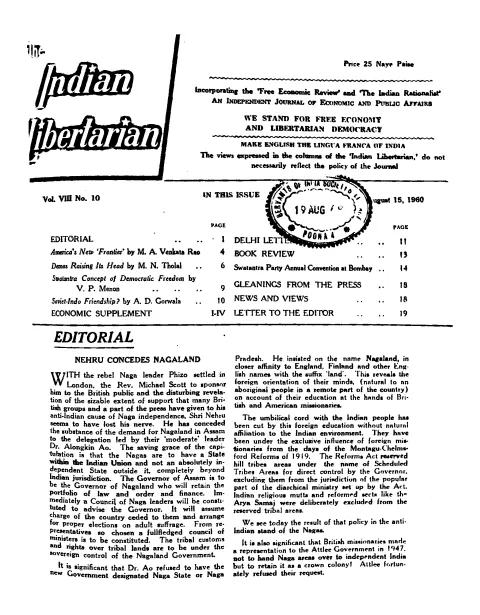
The August 15, 1960 issue of The Indian Libertarian (Vol. VIII, No. 10), an independent Bombay-based journal of economic and public affairs that styles itself as standing for ‘free economy and libertarian democracy’, combines a multi-part editorial with five signed articles, a four-page economic supplement, a Delhi correspondent’s column, a book review, and an extended report on the first annual convention of the newly founded Swatantra Party. The issue’s centre of gravity is the emergence of an organised liberal opposition: V. P. Menon explains Swatantra’s concept of democratic freedom, the convention coverage tracks the party’s resolutions and Rajaji’s leadership, and a sympathetic review presents F. A. Hayek’s The Constitution of Liberty as the philosophical companion to that political project. Around this core, M. A. Venkata Rao reads John Kennedy’s nomination as the opening of a new American ‘frontier’; M. N. Tholal surveys democratic awakenings against authoritarian regimes; A. D. Gorwala questions the depth of Soviet–Indian friendship; G. N. Lawande dissects the private-sector implications of the Third Five Year Plan; and B. R. Shenoy contrasts free and controlled economies through a first-hand visit to East and West Berlin. The Delhi Letter satirises India’s official language politics, while the editorials criticise Nehru’s handling of Nagaland, Macmillan’s African embarrassments, the Russian Security Council vetoes, and de Gaulle–Adenauer rapprochement.
Key points
-
The multi-part editorial welcomes Nagaland’s statehood within the Indian Union but blames British and missionary influence, including support for rebel leader Phizo, for the secessionist demand.
-
The editorial recalls that the Attlee government refused in 1947 to transfer the Naga areas to independent India, and criticises acceptance of the Pay Commission award as fiscally indefensible.
-
Extended coverage tracks the resolutions and Rajaji’s leadership at the first annual convention of the newly founded Swatantra Party, alongside V. P. Menon’s account of the party’s concept of democratic freedom.
-
A sympathetic review presents F. A. Hayek’s The Constitution of Liberty as the philosophical companion to the emerging Swatantra political project.
-
M. A. Venkata Rao’s America’s New Frontier reads John Kennedy’s nomination as opening a Rooseveltian new frontier and treats the Republicans as defenders of decentralisation against federal expansion.
-
M. N. Tholal’s Demos Raising Its Head surveys press-freedom struggles in Pakistan and General Ayub Khan’s difficulties as evidence of a popular tide against authoritarian rule.
-
Tholal draws on John Kenneth Galbraith’s critique of large public services to argue that elaborate state apparatus is no substitute for self-government rooted in personal responsibility.
-
A. D. Gorwala questions the depth of Soviet-Indian friendship, while G. N. Lawande examines the private-sector implications of the Third Five-Year Plan and B. R. Shenoy contrasts free and controlled economies from a visit to East and West Berlin.
Essays
EDITORIAL
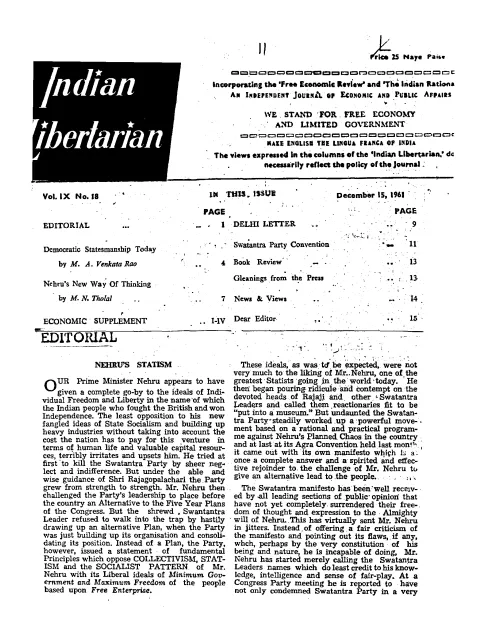
The unsigned editorial pages run a sequence of short pieces on current affairs. ‘Nehru Concedes Nagaland’ welcomes the Government’s decision to constitute Nagaland as a state inside the Indian Union under Naga jurisdiction, but argues that Nehru’s nerve has been shaken by the British support extended to the rebel leader Phizo and to the Rev. Michael Scott’s campaign. The editorial reads the renaming from ‘Naga State’ to ‘Nagaland’ as a concession to a foreign-oriented tribal imagination shaped by missionaries and the Montagu–Chelmsford Reforms of 1919, and revives the charge that the Attlee government refused to transfer the Naga areas to India in 1947. Companion pieces criticise Mr Macmillan’s defeat over Africa, attack the Government’s acceptance of the Pay Commission as an economically untenable concession to organised workers, regret the imposition of Hindi in the South, condemn the Russians’ 86th Security Council veto, treat de Gaulle and Adenauer’s rapprochement as a positive consolidation of Western Europe, and warn that the Congo cauldron has been brought to boil by the very Western retreat that nationalists once demanded.
- Editorial welcomes Nagaland statehood within the Indian Union but blames British and missionary influence for the secessionist demand.
- Reads the renaming ‘Naga State’ → ‘Nagaland’ as a foreign-affinity gesture comparable to England, Finland and Poland.
- Recalls that the Attlee government refused in 1947 to hand the Naga areas to independent India.
- Criticises the Government’s acceptance of the Pay Commission award as a fiscally indefensible bow to organised labour.
- Treats the 86th Soviet veto and Mr Macmillan’s African setback as evidence of failing socialist diplomacy, and welcomes Franco-German consolidation.
- Reads the Congo crisis as the predictable cost of a Western retreat that left no institutional successor.
America’s New ‘Frontier’
By MA Venkata Rao
M. A. Venkata Rao reads Senator John Kennedy’s Democratic nomination as inaugurating a new American ‘frontier’ — a deliberate echo of the New Deal era that began with F. D. Roosevelt. He sketches the Kennedy–Johnson ticket, the Republican response from Nixon and Henry Cabot Lodge, and the international stage on which the campaign unfolds, especially Khrushchev’s diplomacy and the rise of Asian and African states. Venkata Rao argues that Kennedy speaks for an America that has accepted federal expansion at home and global responsibility abroad, while his Republican opponents resist further extensions of central power. The essay treats the contest as a test of whether American liberalism can renew itself without slipping into the planned-economy assumptions that Indian readers of this journal have spent a decade resisting.
- Frames Kennedy’s nomination as the opening of a Rooseveltian ‘new frontier’ in American politics.
- Profiles the Kennedy–Johnson Democratic ticket against the Nixon–Lodge Republican slate.
- Reads the contest in Cold War terms, with Khrushchev’s diplomacy as the external backdrop.
- Treats the Republican Party as the residual defender of decentralisation and limited federal power.
- Notes that American liberalism is being tested by the same statist temptations Indian liberals have spent a decade resisting.
Demos Raising Its Head
By M. N. Tholal
M. N. Tholal surveys what he reads as a worldwide resurgence of demos against authoritarian rule. Beginning with the British proprietors of the Pioneer and the press freedom question in Pakistan, he ranges across the resignation of General Iskander Mirza, the difficulties of General Ayub Khan’s regime, the failure of paternalistic governments to retain popular consent, and the limits of foreign-policy moralism under Eisenhower and Nehru. The essay closes with reflections on the ‘basis of all morality’ and the contrast between democracy and socialism, where Tholal mobilises John Kenneth Galbraith’s critique of large public services to argue that elaborate state apparatus is not a substitute for self-government rooted in personal responsibility.
- Reads recent press-freedom and electoral episodes in Pakistan, Finland and elsewhere as evidence of a popular tide against authoritarian rulers.
- Argues that paternalistic regimes — civil or military — cannot retain popular consent indefinitely.
- Connects the moral basis of liberty to personal responsibility rather than to state benevolence.
- Uses Galbraith on ‘sterile services’ to indict the assumption that more public expenditure equals better government.
- Treats democracy and socialism as ultimately rival theories of human agency.
Swatantra Concept of Democratic Freedom
By V. P. Menon
V. P. Menon’s brief essay sets out the Swatantra Party’s concept of democratic freedom as it was articulated at the Preparatory Convention. He argues that genuine democracy requires both a capacity for compromise and the recognition that no political party can hold a monopoly on truth; on issues outside its fundamental principles, the Swatantra Party therefore grants its members freedom of judgement rather than imposing the rigid discipline that other Indian parties expect. Menon contrasts this Burkean, British-Liberal-style federation of conviction with the centralising democratic centralism of the Congress and reads it as the institutional safeguard of individual liberty within representative government.
- Defines Swatantra’s democratic concept as compromise plus freedom of conscience within a shared core programme.
- Argues that no party can claim a monopoly on truth and that whip-bound discipline corrodes democratic deliberation.
- Locates the model in the British Liberal tradition rather than in Congress-style democratic centralism.
- Treats individual liberty as the institutional product of pluralism inside parties, not just between them.
Soviet-Indo Friendship?
By A. D. Gorwala
A. D. Gorwala questions whether Soviet–Indian friendship rests on shared interests or only on India’s diplomatic convenience. Revisiting the principal Soviet declarations on India since the Stalin years, he argues that Moscow’s posture toward Delhi has tracked its own strategic needs rather than any sympathy for Indian democracy, and that the long-standing Soviet alignment with Beijing on questions affecting Asia must temper Indian gratitude. The essay urges Indian opinion to distinguish between the propagandistic rhetoric of friendship and the underlying record of Soviet votes, statements and arms transfers, particularly when the test cases involve India’s neighbours.
- Treats Soviet professions of friendship for India as instruments of Soviet strategy rather than principled solidarity.
- Traces the principal Soviet statements on India from the Stalin period onward as a test of consistency.
- Argues that the Soviet–Chinese alignment on Asian questions limits how far Indian gratitude should run.
- Asks Indian opinion to read Soviet votes and arms transfers, not rhetoric, when evaluating the relationship.
ECONOMIC SUPPLEMENT (Private Sector and Third Plan by Prof. C. N. Lawande; East and West Berlin: A Study in Free vs. Controlled Economy by Prof. B. R. Shenoy)
The four-page Economic Supplement carries two signed essays. Prof. G. N. Lawande’s ‘Private Sector and Third Plan’ examines the draft outline of the Third Five Year Plan and argues that, despite a rhetorical place for the private sector, the Planning Commission’s framework concentrates economic power in the State, expands public-sector investment beyond what resources can support, and treats the citizen as a planned input rather than a free economic agent. Prof. B. R. Shenoy’s ‘East and West Berlin — A Study in Free vs. Controlled Economy’ reports a first-hand visit to the divided city and uses the visible contrast — bombed-out residential blocks, mean shops and unsmiling guards on the eastern side, prosperous shop windows, plentiful goods and free movement on the western — as a controlled experiment in the relative merits of regulation and freedom. Shenoy reads West German prosperity as evidence that economic liberty, not American aid, is the engine of recovery, and argues that the Berliner’s preference is decided by his feet, not by his politics.
- Lawande argues the Third Plan’s draft outline expands the public sector beyond what India’s resources can sustain.
- Reads the Plan as treating the private sector as a residual rather than a constitutive partner.
- Shenoy recommends a visit to East and West Berlin as a ‘pilgrimage’ for economists wavering on state regulation.
- Reports that the contrast in consumer goods, housing and demeanour is visible at a glance and unmistakable.
- Treats the East–West frontier traffic as a revealed-preference test that controlled economies cannot pass.
DELHI LETTER (Linguistic Lunacy)
The Delhi Letter, signed only ‘From Our Correspondent’, is a satirical column titled ‘Linguistic Lunacy’ that ridicules the central government’s official-language manoeuvres. The columnist tracks the latest disturbances over Hindi imposition in the south, the contradictions in the Home Ministry’s position, and the political costs of treating linguistic identity as a tactical question. The piece argues that the Congress is using language policy as an instrument of patronage and central control, and that the Opposition’s failure to mount a coherent reply has left the field open to administrative improvisation.
- Characterises India’s official-language policy as ‘linguistic lunacy’ produced by tactical Congress positioning.
- Argues that Hindi imposition has been resisted strongly enough in the south to embarrass the Home Ministry.
- Reads the Opposition’s response as too fragmented to capitalise on Congress confusion.
- Treats language as a vehicle for centralising patronage rather than as a cultural question.
BOOK REVIEW (The Constitution of Liberty by F. A. Hayek)
The book review treats F. A. Hayek’s The Constitution of Liberty as the long-awaited positive companion to The Road to Serfdom — a 570-page restatement of the case for liberty under law that the reviewer compares to the great nineteenth-century treatises. The review walks through the book’s three parts (the value of freedom, the constitution of liberty, the welfare-state critique), dwelling especially on Hayek’s account of the rule of law and on his treatment of inflation as a uniquely corrosive species of state intervention. The reviewer recommends the book to Indian readers as the philosophical underpinning for the liberal-libertarian programme that this journal has been carrying for a decade.
- Reads The Constitution of Liberty as the positive counterpart to The Road to Serfdom.
- Highlights Hayek’s account of the rule of law as the heart of the book.
- Treats Hayek’s chapters on inflation and the welfare state as especially relevant to Indian conditions.
- Recommends the book as the philosophical foundation of the Indian liberal-libertarian programme.
Swatantra Party Annual Convention at Bombay
The convention report covers the first annual gathering of the Swatantra Party at Sundarabai Hall, Bombay. It records the deliberations of the General Council, Prof. N. G. Ranga’s presidential warning against ‘Nehru-style communism’, the resolutions unanimously approved, and the press conference at which the party’s leaders accused the Government of creeping bureaucratic socialism, threats to press freedom, and a foreign policy of drift. A separate column reports Rajaji’s concluding address and the press interview he gave on the eve of his departure from Bombay, in which he argued that the Congress has surrendered the language of freedom to managers of the bureaucratic state. The supplementary piece ‘The Freedom That Is Not Free’ applies the same diagnosis to economic policy.
- Reports Prof. N. G. Ranga’s presidential warning against ‘Nehru-style communism’ and the creeping authority of the State.
- Records resolutions on press freedom, public-sector overreach and language policy, all unanimously approved.
- Covers Rajaji’s concluding address and his press interview on the eve of his departure from Bombay.
- Notes Swatantra’s positioning as the principal opposition to Congress’s permit-and-licence system.
- Includes a sidebar ‘The Freedom That Is Not Free’ attacking the rhetoric of economic freedom under planning.
Generated by the v1.5 extraction pipeline. Awaiting editorial review.
Metadata and summary are AI-extracted from the source PDF and reviewed for editorial accuracy. The original work is available via the Read PDF tab above (where present); paragraph-level citation inside the PDF is deferred to a future engagement.