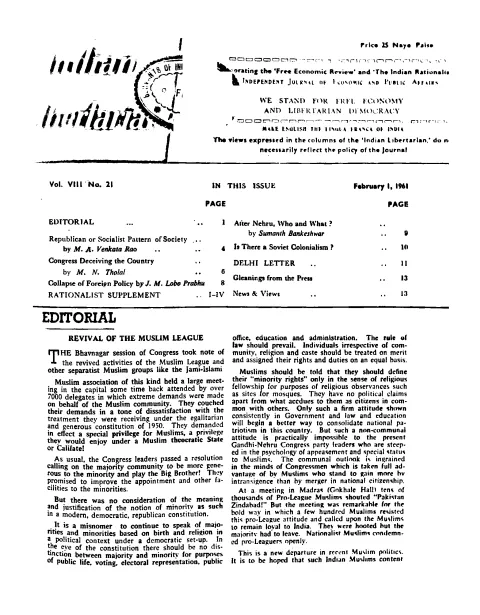
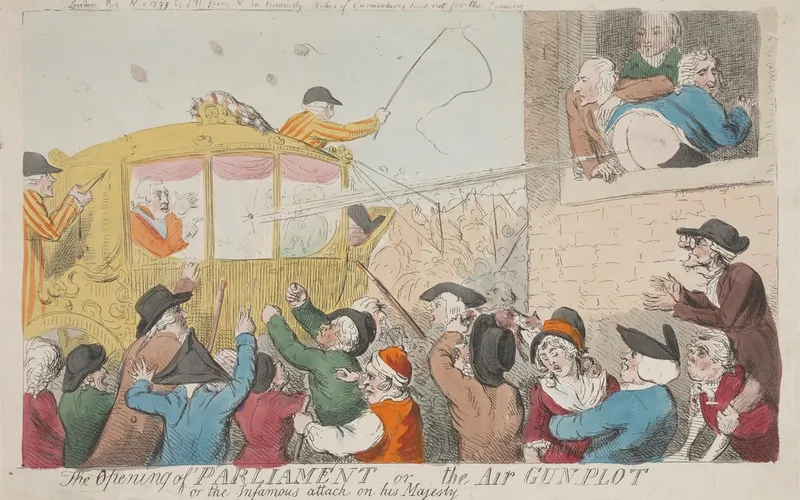
periodical issue
The Indian Libertarian
An Independent Journal of Economic and Public Affairs
By MA Venkata Rao, M. N. Tholal, J. M. Lobo Prabhu
Libertarian Publishers (Private) Ltd., 26, Durgadevi Road, Bombay 4 · Bombay · 1961
16 pages
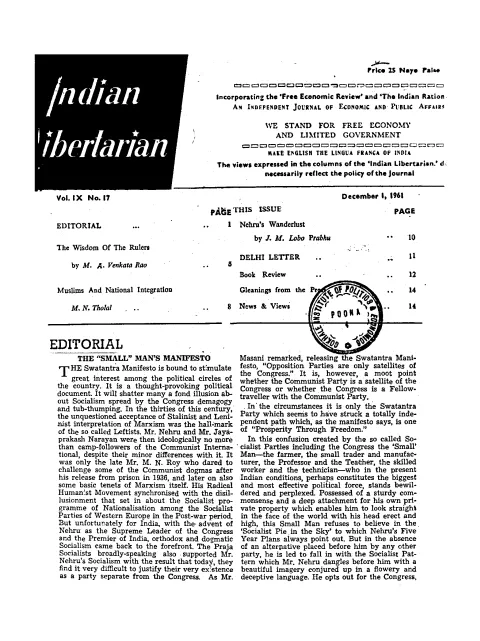
The Indian Libertarian
Summary
This issue of The Indian Libertarian (Vol. IX No. 17, December 1, 1961) is pitched at the eve of the February 1962 general elections and reads as the Forum of Free Enterprise’s case against Nehruvian socialism. The unsigned editorial christens the newly released Swatantra manifesto the ‘Small Man’s Manifesto’ — speaking, it argues, for the farmer, small trader, manufacturer, professor, teacher, skilled worker and technician left bewildered by the Congress’s drift toward Stalinist-Leninist Marxism. M. A. Venkata Rao broadens the polemic into a meditation on what philosophical wisdom and character voters should demand of their rulers, drawing on Plato, Marcus Aurelius, Chanakya and the Indian Shastric tradition. M. N. Tholal continues his series on the place of Muslims in Indian national integration; J. M. Lobo Prabhu mocks Nehru’s foreign travels as a ‘wanderlust’; and a Delhi Letter raises fresh alarm about Chinese incursions in Ladakh. A book review introduces readers to Irving L. Horowitz’s anthology on classical anarchism, while ‘Gleanings from the Press’ covers the Khrushchev–Molotov feud and ‘News & Views’ gathers items on language policy, the Berlin Wall and a Kerala Communist victory. The number closes with the editor’s ‘Panchashila in Action’ note tracking new Chinese posts on the Indian border.
Key points
-
The unsigned editorial christens the newly released Swatantra Party manifesto the “Small Man’s Manifesto,” casting it as the political voice of the farmer, small trader, professor, teacher and technician left homeless by Congress’s socialism.
-
The editorial argues the Praja Socialist Party can no longer justify a separate existence outside Congress, leaving Swatantra as the only genuinely independent opposition ahead of the February 1962 elections.
-
M. A. Venkata Rao’s “The Wisdom of the Rulers” asks what philosophical character voters should demand of leaders, drawing on Plato, Marcus Aurelius, Chanakya and Yajnavalkya alongside the Indian Shastric idea of the Raja’s dharma.
-
Venkata Rao reads Plato’s Republic as the originating model of the totalitarian closed society later inherited by Marxism-Leninism, and defends the family, private property and personal conscience against it.
-
M. N. Tholal’s series “Muslims and National Integration” argues the historical inheritance of the Caliphate and the Sunni-Shia succession dispute produced a habit of looking to a supra-national community of belief rather than the territorial nation.
-
Tholal contends genuine integration requires Indian Muslims to treat religion as personal conscience while accepting the Indian state as their sole political loyalty, weighing the dangers of pan-Islamism and the Ulema’s political role.
-
J. M. Lobo Prabhu mocks Nehru’s foreign travels as a “wanderlust,” while a Delhi Letter raises fresh alarm about Chinese incursions into Ladakh.
-
The issue’s closing “Panchashila in Action” note tracks new Chinese military posts appearing along the Indian border, and a book review introduces Irving L. Horowitz’s anthology on classical anarchism.
Essays
EDITORIAL — The “Small” Man’s Manifesto
The unsigned editorial reads the just-released Swatantra Party manifesto as a manifesto for India’s ‘Small Man’ — the farmer, small trader, manufacturer, professor, teacher, skilled worker and technician — whom the editor sees as the country’s largest and most productive political constituency, yet one rendered politically homeless by the Congress’s slide into what it calls Stalinist-Leninist Marxism. It argues that Nehru and Jayaprakash Narayan, despite differences with M. N. Roy’s Radical Humanist Movement, dragged India’s leadership back to dogmatic socialism after independence, leaving the Praja Socialists indistinguishable from Congress and the small man bewildered by the ‘Socialist Pie in the Sky’ of the Five-Year Plans. The Swatantra programme, the editorial maintains, finally offers this constituency a vehicle for prosperity through freedom. Two companion items — ‘A Welcome Electoral Alliance’ and ‘Here and There’ — extend the argument to the practical work of forging an anti-Congress front and to President Kennedy’s reading of the Sino-Soviet relationship.
- Frames the new Swatantra manifesto as the political voice of India’s productive ‘Small Man’ constituency.
- Diagnoses Nehruvian Congress socialism as a continuation of 1930s Stalinist-Leninist enthusiasm rather than a fresh post-war doctrine.
- Argues the Praja Socialist Party can no longer justify its existence outside the Congress, and that Swatantra is the only genuinely independent opposition.
- Welcomes an emerging electoral understanding among non-Communist opposition parties to consolidate anti-Congress votes.
- Reads Kennedy’s recent remarks on the Soviet-Communist Party Congress as confirming that the Sino-Soviet split is real but limited.
The Wisdom Of The Rulers
By MA Venkata Rao
M. A. Venkata Rao turns the imminent general election into an occasion for a longer reflection on the wisdom and character voters should look for in rulers. Drawing on Plato’s philosopher-king, on Marcus Aurelius, Chanakya, Yajnavalkya and the Indian Shastric idea of the Raja’s dharma, he argues that political competence rests not only on technical knowledge of social and economic conditions but also on a philosophical grasp of human nature, of the difference between appearance and reality, and of the place of order, freedom and dharma in human society. The essay treats Communism as the contemporary heir of Plato’s totalitarian closed-society temptation — rejecting private property, family, religion and personal initiative in favour of an austere collective good — and contrasts it with the Christian and Aristotelian vindication of the family, of conscience and of moderate temporal order. Wisdom in rulers, he concludes, lies in the capacity to hold spiritual ends and political means together without collapsing either into theocracy or into the closed society of Marx and the modern revolutionaries.
- Frames the 1962 election as a moment to ask what wisdom voters should demand of rulers, not merely which programme to endorse.
- Distinguishes technical political knowledge (society, economy, history) from philosophical wisdom about human nature and ultimate ends.
- Reads Plato’s Republic as the originating model of the totalitarian closed society later inherited by Marxism-Leninism.
- Defends the family, private property and personal conscience against Platonic and Communist communism.
- Calls for a synthesis of Indian Shastric and Greek philosophical inheritance in shaping the moral horizon of Indian rulership.
Muslims And National Integration — II
By M. N. Tholal
Continuing a series begun in the previous issue, M. N. Tholal examines what stands in the way of full national integration of Muslims into the Indian polity. He distinguishes between political loyalty and religious solidarity, arguing that the historical inheritance of the Caliphate — and the Sunni/Shia split over the Prophet’s succession — has produced a habit of looking to a supra-national Muslim community of belief rather than to the territorial nation. He surveys the early caliphs from Abu Bakr to Ali, the doctrinal authority claimed by the Ulema and the Quran’s silence on questions of political form, and contends that genuine integration requires Indian Muslims to treat religion as a matter of personal conscience while accepting the Indian state as their sole political loyalty. The essay weighs the dangers of pan-Islamism, the political role of the Ulema, and what Tholal sees as the slow growth of an Indian-Muslim self-understanding compatible with secular nationhood.
- Distinguishes religious solidarity (the umma) from political loyalty to the Indian nation as the crux of integration.
- Reads the Sunni-Shia split as a historical legacy that complicates a clear notion of Muslim political authority.
- Critiques the Ulema’s claim to interpretive authority over both religious and political life.
- Argues that the Quran does not prescribe a single political form, leaving room for accommodation with secular constitutional government.
- Calls on Indian Muslims to treat their religion as personal conscience and reserve political loyalty for the Indian state.
Nehru’s Wanderlust
By J. M. Lobo Prabhu I.C.S. (Retd.)
J. M. Lobo Prabhu mocks Jawaharlal Nehru’s relentless foreign travel — fresh from Belgrade and Moscow, the Prime Minister is now off to the United States and Mexico — as the ‘wanderlust’ of a man who treats himself as the travelling salesman of the world’s problems. The piece needles Nehru’s habit of intervening in distant crises while shrinking from a clear posture on the issues nearest home, especially the Chinese pressure on India’s borders and the Berlin question. Lobo Prabhu argues that the world would be a safer place if a few major powers were left to manage their own affairs without Nehru’s freelancing arbitration, and that the meeting with President Kennedy will only confirm how little leverage India’s neutralist diplomacy actually carries when set against the realities of Cold War alignment.
- Skewers Nehru’s foreign travel as personal ‘wanderlust’ rather than statesmanship.
- Argues that India’s neutralism offers little leverage in real Cold War crises like Berlin.
- Frames the impending Washington meeting with Kennedy as one likely to expose the limits of Nehru’s posture.
- Suggests Nehru sells the world’s grievances abroad while ducking the China question at home.
DELHI LETTER — Chinese At It Again
By (From Our Correspondent)
An unsigned Delhi correspondent reports renewed Chinese pressure along the Indian border, with fresh intrusions and post-construction in Ladakh that contradict reassuring noises from Peking. The letter notes that Indian intelligence had warned of these moves weeks earlier, that the Indian government’s public response remains evasive, and that Parliament has not been given a candid account. The correspondent argues that the official refusal to call Chinese conduct ‘aggression’ has cost India both diplomatic clarity and the moral force needed to mobilise international sympathy, and warns that the gap between Delhi’s rhetoric of Panchashila and Peking’s actual conduct is widening.
- Reports new Chinese intrusions and posts inside Indian territory in Ladakh during August–September.
- Argues that the Indian government’s reluctance to use the word ‘aggression’ is itself a diplomatic cost.
- Suggests Parliament and the public are being kept in the dark about the true scale of Chinese encroachment.
- Reads the disconnect between Panchashila rhetoric and the situation on the ground as a credibility crisis for Indian diplomacy.
Book Review
The Book Review introduces readers to ‘Anarchism: Eleven Exponents of the Anarchist Philosophy,’ edited by Irving L. Horowitz, translated by James J. Martin and published by the Libertarian Book Club of New York. The reviewer summarises the anthology as a guided tour through the classical anti-statist tradition — Stirner, Proudhon, Bakunin, Kropotkin, Benjamin Tucker and the Christian anarchists — and reads it as a useful corrective for Indian readers who have come to identify all opposition to the state with Marxist-Leninist socialism. The review distinguishes individualist (American) from collectivist (European) anarchism, takes the volume seriously as a contribution to political theory rather than dismissing it as eccentric, and uses it to underline the libertarian magazine’s own conviction that the modern state has overreached its moral and economic warrant. It treats anarchism less as a blueprint than as a tradition of warning about the costs of state monopoly over conscience, property and association.
- Reviews Irving L. Horowitz’s anthology ‘Anarchism: Eleven Exponents of the Anarchist Philosophy’ (Libertarian Book Club, New York, 1961, $4.50, 372 pp.).
- Distinguishes American individualist anarchism (Tucker, Warren) from European collectivist anarchism (Proudhon, Bakunin, Kropotkin).
- Reads the classical anarchists as a corrective to identifying anti-statism solely with Marxist-Leninist socialism.
- Treats anarchism as a serious tradition of warning about the moral and economic overreach of the modern state.
Gleanings from the Press
By Molotov Affair
‘Gleanings from the Press’ reproduces commentary on the Khrushchev–Molotov rupture inside the Soviet leadership. Drawing on press accounts of the 22nd Congress of the CPSU, the column reads Khrushchev’s open denunciation of Molotov, Malenkov and the ‘anti-party group’ as a sign that the Soviet system is now devouring its own founders. The piece treats the affair as evidence that totalitarian states cannot manage succession by political means and have no choice but to expel and discredit rivals — a structural defect, the column suggests, of any regime that cannot abide an opposition.
- Reports on the public Khrushchev–Molotov breach during and after the 22nd Congress of the CPSU.
- Reads the affair as proof that totalitarian regimes cannot accommodate political opposition, only purge it.
- Treats the episode as further evidence of the moral exhaustion of Soviet communism.
News & Views
‘News & Views’ is a column of short notes. Items include ‘Friends or Foes’ on President Kennedy’s posture toward neutrals, ‘Pandurangji in U.P.’ on a Sarvodaya tour, ‘Showdown with the Reds’ arguing that the USA must finally meet communist parties on their own terms, a ‘Strange Sentence’ note on the Soviet ‘crimes against the state’ apparatus, items on a Tata-related world-language conference, on a Soviet death sentence for thieving and an American stenotype, and longer notes on the demand for self-determination for Germans (occasioned by the Berlin Wall) and on Dr. N. K. Kunzru’s plea for retaining English in Indian education. The column closes with an editorial ‘Inadequate Attention’ lamenting the deterioration of English-language schooling in India.
- Argues that the United States must confront communist movements politically rather than rhetorically.
- Reads the Berlin Wall as a moral mandate for renewed Western support of German self-determination.
- Joins Dr. N. K. Kunzru in defending the retention of English in Indian education against precipitate switches.
- Treats Soviet criminal-procedure items as quiet evidence of the moral character of the regime.
Generated by the v1.5 extraction pipeline. Awaiting editorial review.
Metadata and summary are AI-extracted from the source PDF and reviewed for editorial accuracy. The original work is available via the Read PDF tab above (where present); paragraph-level citation inside the PDF is deferred to a future engagement.