periodical issue
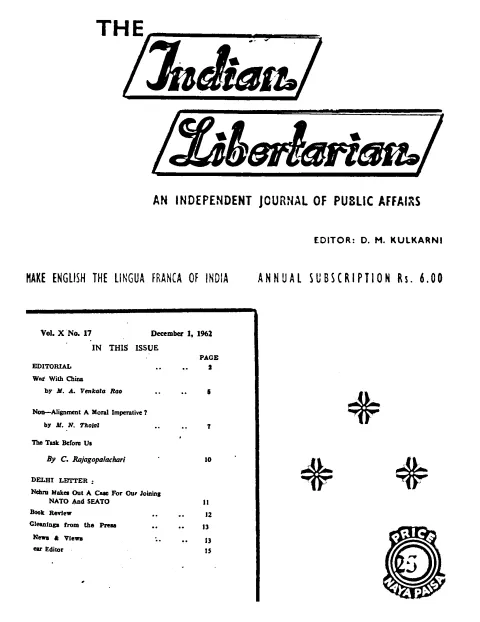
The Indian Libertarian
An Independent Journal of Economic and Public Affairs
The Indian Libertarian · Bombay · 1960
24 pages
The Indian Libertarian
Summary
The February 1, 1960 issue of The Indian Libertarian (Vol. VII No. 25) opens with an editorial on the 65th session of the Indian National Congress at Bangalore (14–18 January 1960), mocking the peacock chosen as the session emblem as a fitting symbol of post-independence Congress ‘pride and vanity, over-decoration and display’ against a backdrop of rising prices, unemployment and the Chinese border crisis. The issue then carries a ‘Democrat’ essay laying out the freshly drafted agricultural policy of the new Swatantra Party — favouring family farms, cooperative marketing, and ceiling limits on land that respect the productive farmer — and M. N. Tholal’s polemic ‘Nehru’s Bluff and Bluster’, which reads the Sino-Soviet treaty as proof that Russian neutrality between China and India is a sham and that Nehru’s mixture of denial and panic over the McMahon Line has weakened India’s bargaining hand. An anonymous leader, ‘Menace From The North’, surveys the Chinese cartographic and territorial assault on Ladakh and NEFA, and the editor reprints a battery of anti-Communist verdicts by Russell, Spender, Silone, Gide and others.
The central Rationalist Supplement (pp. I–IV) carries S. Ramanathan’s protest against the humiliating prasadam-distribution practice at the Tiruchendur temple — directed at the Central Minister of State for Railways, S. V. Ramasami — alongside J. W. N. Watkins’s long account of the show-trial of Hungarian political prisoner Paul Ignotus, and an obituary of M. V. V. K. Rangachari, an early figure of the Indian Rationalist movement. The back half of the issue gathers the Delhi Letter (‘India Out For Conciliation’), commentary on Akali politics and the demand for nonalignment-cum-joint-defence, a review by D. M. Kulkarni of D. P. Mukerji’s Modern Indian Culture, G. N. Lawande’s reading of new Chinese population data, A. Ranganathan’s report on Kerala under Communism and Sri E. B. K. Doss’s piece on the India–Tibet–China triangle. Across its forty short items the issue defines a classical-liberal editorial line — anti-Communist, sceptical of Nehruvian planning and foreign policy, hospitable to Swatantra and to rationalist social reform.
Key points
-
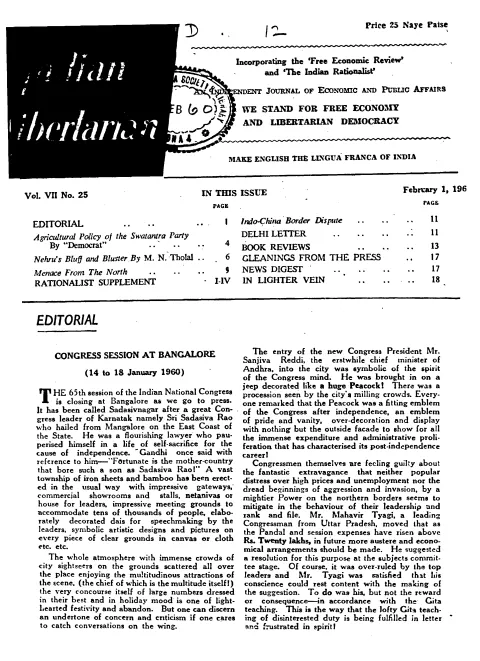
The lead editorial treats the peacock-themed pandal at the 65th Congress session in Bangalore (14-18 January 1960) as an emblem of post-independence Congress vanity, noting session expenses crossed Rs. 20 lakh amid rising prices and unemployment.
-
It records that Mahavir Tyagi’s resolution for Congress economy was initially overruled by top leaders before being formally adopted, and reads N. Sanjiva Reddi’s election as party president as a generational break.
-
Writing as ‘Democrat’, an essay lays out the newly adopted Swatantra Party agricultural policy, which retains the peasant family farm and cooperative marketing while accepting a ceiling on holdings tied to productive use.
-
The Swatantra policy is presented as a middle path between Congress collectivist planning and older landlord-bureaucratic structures rather than as doctrinaire laissez-faire absolutism.
-
M. N. Tholal’s ‘Nehru’s Bluff and Bluster’ argues the new Sino-Soviet treaty proves Russian neutrality between China and India is fictional, criticising Nehru’s vacillation on the McMahon Line.
-
Tholal reprints short anti-communist verdicts from Bertrand Russell, Stephen Spender, Ignazio Silone, John Dos Passos and André Gide to argue India’s official sympathy toward the communist bloc is indefensible.
-
The Rationalist Supplement carries S. Ramanathan’s protest against a prasadam-distribution practice at the Tiruchendur temple directed at Central Minister S. V. Ramasami, alongside J. W. N. Watkins’s account of a Hungarian show trial.
-
Standing departments in the issue include a Delhi Letter on Indian conciliation diplomacy, a review by D. M. Kulkarni of D. P. Mukerji’s Modern Indian Culture, and A. Ranganathan’s report on Kerala under Communist rule.
Essays
EDITORIAL — Congress Session at Bangalore
The unsigned lead editorial reports on the 65th Congress session at Bangalore (14–18 January 1960), treating the peacock-themed pandal and processions as an inadvertent emblem of post-independence Congress vanity and administrative bloat. It notes that session expenses had crossed Rs. twenty lakhs even as food prices and unemployment soared, and that Uttar Pradesh Congressman Mahavir Tyagi’s resolution for economy was ‘over-ruled by the top leaders’ before being formally adopted. The editorial reads the rise of N. Sanjiva Reddi to the Congress presidency as a ‘definite break with the past leadership’ and, drawing on C. D. Deshmukh’s resignation letter, on the ‘Madras lecture’, and on the new President’s own remarks, argues that the corruption of Congressmen is now openly admitted at the top.
- Frames the Bangalore Congress’s elaborate peacock decor as the visual symbol of an over-decorated, hollow ruling party.
- Records concrete data — session expenses above Rs. 20 lakhs — alongside rising food prices, unemployment and the northern-border crisis.
- Reads Sanjiva Reddi’s election (with Indira Gandhi as outgoing president) as a generational break in Congress leadership.
- Treats Deshmukh’s resignation and the ‘Madras lecture’ as breaking the Congress’s silence on ministerial corruption.
- Sets up the issue’s overall posture: sympathetic to anti-Congress liberal alternatives such as the Swatantra Party.
Agricultural Policy of the Swatantra Party
By “Democrat”
Writing under the pen-name ‘Democrat’, the author lays out the agricultural policy newly adopted by the Swatantra Party at its first national convention. Against the All India Agriculturists’ Federation’s preferred drafting committee, the Party’s leadership has overridden the strongest free-market drafts to insist on retaining peasant family-farming, cooperative marketing and processing as the unit of rural reorganisation, while accepting a ceiling on holdings tied to productive use. The piece insists that the Swatantra approach is not laissez-faire absolutism but a ‘middle path’ between Congress collectivist planning and unrestrained landlordism — protecting the cultivating peasant against the State as much as against the older Zamindari order.
- Reports the Swatantra Party’s first national convention adoption of an agricultural policy distinct from Congress collectivism.
- Defends the family farm and cooperative marketing as the social and productive units of rural India.
- Accepts a ceiling on landholdings, but tied to productive cultivation rather than abstract egalitarianism.
- Distinguishes the Swatantra line from doctrinaire laissez-faire and from Congress ‘Joint Cooperative Farming’.
- Presents the policy as defending the peasant from both Congress planning and surviving landlord-bureaucratic structures.
Nehru’s Bluff and Bluster
By M. N. Tholal
M. N. Tholal opens his polemic with the bald claim that ‘Russian neutrality between China and India’ is a fiction now exploded by the latest Sino-Soviet declarations. The argument moves from the Sino-Soviet treaty to Nehru’s vacillating posture on the McMahon Line, charging that India’s Prime Minister has alternated between hollow self-reliance and panic appeals for great-power conciliation. Tholal then turns the article into an anthology, reprinting short verdicts on Communism by Bertrand Russell, Brian Horrocks, C. D. Darlington, Stephen Spender, Ignazio Silone, John Dos Passos and André Gide — each used to argue that India’s official sympathy for the Communist bloc is intellectually indefensible and strategically suicidal.
- Argues the Sino-Soviet treaty proves Russia is not neutral between China and India.
- Reads Nehru’s oscillation on the McMahon Line as evidence of strategic ‘bluff’ rather than principled non-alignment.
- Criticises the official rhetoric of ‘self-reliance’ as cover for diplomatic dependence on conciliation with aggressors.
- Curates a Western anti-Communist anthology (Russell, Silone, Gide, Spender, Darlington, Horrocks) as testimony for Indian readers.
- Aligns The Indian Libertarian editorially with the liberal anti-totalitarian Left of the early Cold War.
Menace From The North
An unsigned leader on the Sino-Indian border surveys the cartographic and military assault from the north. It catalogues the Chinese refusal to accept the McMahon Line, the issuance of revised maps showing large tracts of NEFA and Ladakh as Chinese territory, the new road across the Aksai Chin plateau, and the troop deployments and airstrip construction now visible across the disputed area. The piece argues that India has been slow to grasp the cumulative pattern, treats Communist Chinese expansionism as the long-foreseen threat of the magazine’s editorial line, and warns that diplomatic ‘conciliation’ offers India no shelter from a power now in physical possession of the high ground.
- Catalogues Chinese cartographic and infrastructural moves against Tibet, Ladakh and NEFA.
- Highlights the Aksai Chin highway and the building of military airstrips inside disputed territory.
- Treats the McMahon Line dispute as the visible face of a larger Chinese revisionist programme.
- Reads Nehru-era ‘Hindi–Chini bhai-bhai’ rhetoric as having softened Indian preparedness.
- Calls for clear-eyed recognition that conciliation cannot reverse facts on the ground.
Rationalist Supplement — The Prasadam Incident
By S. Ramanathan
S. Ramanathan, opening the Rationalist Supplement, takes up the controversy at the Tiruchendur temple in the deep South, where the Central Minister of State for Railways, S. V. Ramasami, was scheduled to address a Lawyers’ Conference. A worshippers’ protocol at this particular temple denies devotees direct contact with the prasadam: instead the priests scatter cow-dung-ash, scramble for the leaf-bundles, and require the worshippers to pick up the bundles ‘from a distance’ on pain of being forbidden to approach the idol. Ramasami publicly condemned the practice and refused to receive prasadam under those conditions; Ramanathan defends him, treating the temple custom as a humiliation ‘inconsistent with human rights of equality guaranteed under the Constitution’ and uses the incident to argue for legislative intervention against caste-driven temple practice.
- Reports the Tiruchendur temple’s distinctive prasadam-distribution practice as a humiliating ritual gradation between priests and worshippers.
- Notes S. V. Ramasami’s refusal to receive prasadam under those conditions and his on-the-spot reprimand of the priests.
- Frames the incident as a test case for constitutional guarantees of equality applied to religious institutions.
- Criticises the press’s defence of priestly vested interests against a reforming Minister.
- Calls on the Central Cabinet and Congress High Command to back the Minister against orthodox pressure.
Rationalist Supplement — Political Prisoner in Hungary
By J. W. N. Watkins
J. W. N. Watkins reconstructs the experience of Paul Ignotus, a Hungarian writer and political prisoner in the Stalinist and post-Stalinist period. Watkins describes the texture of the show trial — fantastic confessions extracted by what the article calls Pavlovian conditioning combined with simpler beatings, sleep deprivation, hunger and starvation diets — and the way Hungarian Communist functionaries such as Tibor Szonyi, László Rajk, János Kádár and Imre Nagy in turn became victims of the system they had built. The piece then describes Ignotus’s release after the 1956 thaw and the renewed wave of repression that followed Soviet intervention. Throughout, Watkins uses the Hungarian case to argue that the Communist state’s internal logic produces fear, denunciation and self-cannibalisation regardless of which faction is briefly in power.
- Reconstructs Paul Ignotus’s arrest, fantastic confession, sentencing and imprisonment in Stalinist Hungary.
- Catalogues the rotation of executioners and victims among Hungarian Communist leaders (Rajk, Nagy, Kádár, Szonyi).
- Describes the physical regime of starvation, beatings and sleep deprivation alongside ‘Pavlovian’ psychological pressure.
- Treats the post-1956 fate of survivors as proof that ‘liberalisation’ under Communism is structurally fragile.
- Reads Hungary as a cautionary text for Indian sympathisers of the Communist programme.
Rationalist Supplement — M. V. V. K. Rangachari (obituary tribute)
By Satyam
Reprinting from the New York filing of Manson W. Galvin — described as the foremost military writer in the United States — the piece reports Galvin’s agreement with Nehru that there are only two open courses on the China front: talk with the Chinese, or go to war. Galvin’s analysis stresses terrain, communications, climate and numbers, all of which favour Communist China: the unsettled border problem is judged ‘not a military one, until spring’, when the disputed Ladakh passes open to military movement. The article notes that Indian airlift is incapable of supplying any but the smallest forces at the high altitudes where clashes have occurred, while China can build new roads, parallel railways and airstrips behind its own line.
- Cites U.S. military commentator Manson W. Galvin’s verdict that India faces only two real options on the China front.
- Argues that geography, climate and logistics decisively favour the Chinese side until spring opens the Ladakh passes.
- Quantifies the imbalance — Chinese army strength around 2,50,00,000 against Indian forces of 500,000–600,000 partly semi-military and poorly equipped.
- Treats Indian airlift over the Himalayas as militarily marginal at the altitudes where fighting has occurred.
- Uses an American ‘expert’ voice to back the Libertarian’s own scepticism of Nehru’s reliance on diplomacy.
Indo–China Border Dispute — American Military Expert’s Analysis
By —Swarajya
The Delhi Letter reports on the Soviet President’s reception in Delhi, contrasting the warmth of Indian crowds with the cooler welcome President Eisenhower had received the previous month, and notes the most ominous feature of the visit — President Rajendra Prasad’s framing of Indian foreign policy in language of ‘conciliation’ and ‘appeasement’ rather than peaceful negotiation. The Correspondent reads this as the latest ‘climb-down’ by the Nehru Government and asks who, in fact, is neutral. The piece then expands into a column on Nonalignment and Joint Defence — citing the Akali Dal’s recent electoral victory against the Congress in the Akali Conference and Master Tara Singh — and uses both developments to argue that the official non-alignment line is collapsing under the strain of Chinese pressure and domestic disaffection.
- Contrasts the popular welcome for the Soviet President with the cooler reception given to Eisenhower a month earlier.
- Reads President Rajendra Prasad’s banquet speech as a euphemism — ‘conciliation’ standing in for ‘appeasement’.
- Reports unease in Delhi that the Nehru Government is climbing down before Peking.
- Links the Akali Dal’s local political triumph to broader disenchantment with the Congress.
- Frames the case for ‘Nonalignment and Joint Defence’ as a serious live debate in early 1960.
Delhi Letter — India Out For Conciliation
By (From Our Correspondent)
D. M. Kulkarni reviews D. P. Mukerji’s Modern Indian Culture (Lucknow University, A Sociological Study, India Publishers Pvt. Ltd., 4/12, F. 217, 1942). The review treats the book as one of the few first-rate Indian attempts at a sociological reading of the contemporary cultural scene: it locates the discontinuities between Hindu, Muslim and English cultural inheritances, surveys the entry of modern science and capitalism into a still-traditional economic base, and identifies the resulting cultural disorientation in the Indian middle classes. Kulkarni endorses Mukerji’s argument that any future cultural synthesis must grow out of Indian economic conditions rather than imitate Western models, and recommends the volume as essential reading for students of culture and politics.
- Frames D. P. Mukerji’s Modern Indian Culture as a pioneering sociological study of contemporary India.
- Notes the book’s treatment of Hindu, Islamic and Western cultural strata as the building blocks of any Indian synthesis.
- Highlights Mukerji’s attention to the impact of capitalism and modern science on a traditional economy.
- Endorses the central methodological claim — Indian cultural change must be read from Indian material conditions.
- Recommends the work to readers of politics, sociology and education.
Book Reviews — Modern Indian Culture; Kerala Under Communism
By G N Lawande
G. N. Lawande reads the latest figures on China’s population released in Communist Government statements and Hong Kong sources. He notes that the official figure of around 650 million is widely treated as understated and compares it with Indian census patterns at similar fertility-mortality ratios. The article surveys Chinese demographic policy — the early swing between pro-natalist enthusiasm and a quiet acceptance of birth-control propaganda — and treats China’s population pressure as a structural driver of its expansionism on the northern frontiers, including its absorption of Tibet and its demands on Ladakh and NEFA.
- Reviews the most recent Chinese Communist population figures and the Hong Kong commentaries on them.
- Argues that even the official figures imply a population growth pressure of historically unprecedented scale.
- Reads Chinese demographic anxiety as one of the underlying drivers of expansion into Tibet and the Indian frontier.
- Sets up a comparison with Indian census patterns for the same period.
- Treats demography as a strategic variable that classical-liberal commentary should take seriously.
China’s Population (review/article)
By A Ranganathan
A. Ranganathan reports on the first eighteen months of Communist government in Kerala under the E. M. S. Namboodiripad Ministry, drawing on a recent Bombay Project for Economic Research study. The piece argues that the Communist administration treated democratic government as a stepping-stone to single-party control: it sought to convert the State’s professional civil service into a party machine, to subordinate the police to local cell committees, to politicise the schools through ‘progressive’ textbook revisions, and to impose price- and supply-controls that crippled small trade. Ranganathan reads the Kerala experiment as a warning to the Indian voter and a vindication of the central liberal claim that one-party planning ends in coercion regardless of the slogans under which it begins.
- Treats Kerala 1957–59 as the first test of a Communist Government in an Indian State and a vindication of liberal anxieties.
- Documents the attempt to politicise the civil service, the police and the school system.
- Reports state interference with small traders through licensing and price controls.
- Names ministers (Chacko, Pillai, Mundassery, Sukumar Azhikodal) responsible for individual departments.
- Concludes that the Communist programme in Kerala validates the Libertarian’s editorial line against single-party planning.
Generated by the v1.5 extraction pipeline. Awaiting editorial review.
Metadata and summary are AI-extracted from the source PDF and reviewed for editorial accuracy. The original work is available via the Read PDF tab above (where present); paragraph-level citation inside the PDF is deferred to a future engagement.