edited volume · anthology
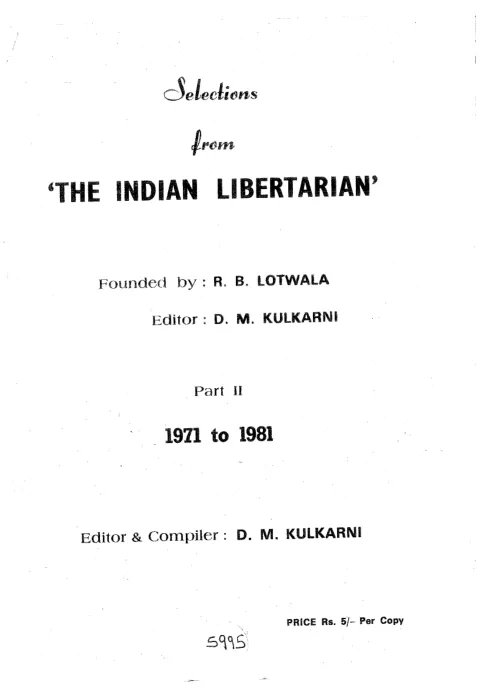
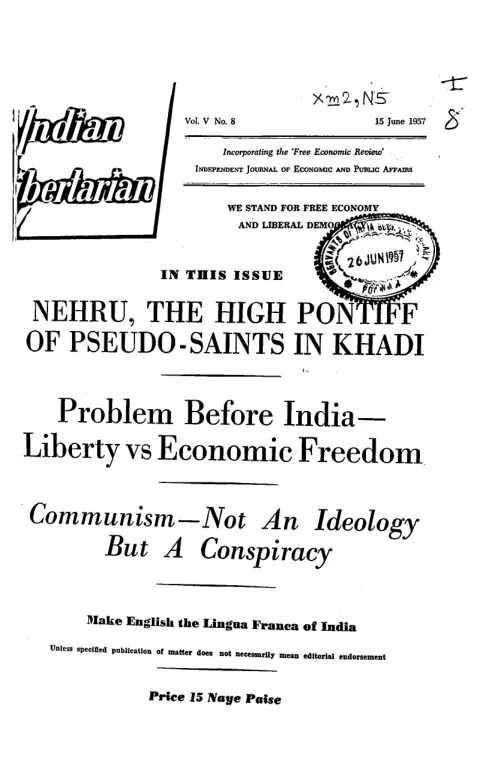
Selections from 'The Indian Libertarian'
Part III (Miscellaneous Articles)
Edited and Published by Mr. D. M. Kulkarni on behalf of Libertarian Publishers Pvt. Ltd., Arya Bhuvan, V. P. Road, Girgaon, Bombay-400 004 · Bombay
22 pages
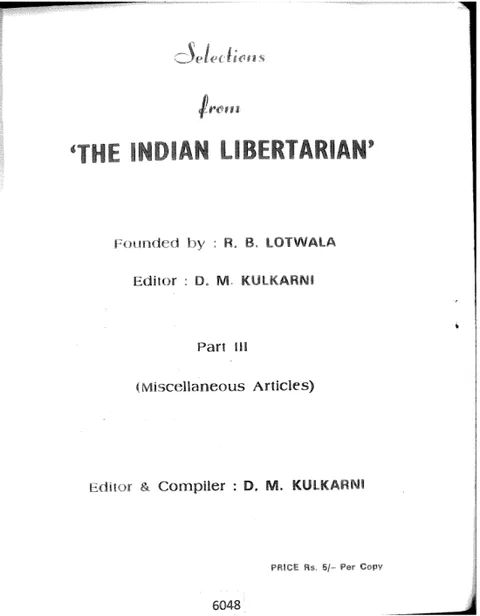
Selections from ‘The Indian Libertarian’
Summary
This is Part III of ‘Selections from The Indian Libertarian’, subtitled ‘Miscellaneous Articles’, a thematic anthology compiled by editor D. M. Kulkarni from the Bombay classical-liberal journal founded by R. B. Lotwala and published by Libertarian Publishers Pvt. Ltd. The collection gathers signed and unsigned articles reprinted from the journal on a wide range of subjects: tributes to C. Rajagopalachari, the impact of British liberalism and the English language on Indian thought, property and freedom, the Constitution and the common man, M. N. Roy and Indian secularism, language policy, and critiques of caste, varnashrama, untouchability and egalitarianism. Across the rendered pages the volume advances the journal’s libertarian creed — limited government, private property and individual freedom — against what it portrays as the totalitarian drift of Nehruvian socialism.
Key points
-
Part III of Selections from The Indian Libertarian, subtitled Miscellaneous Articles, is a thematic anthology compiled by editor D. M. Kulkarni from the Bombay journal founded by R. B. Lotwala.
-
Phiroze J. Shroff’s Rajaji: The Lone Fighter portrays C. Rajagopalachari as a solitary prophet warning against totalitarian planning and the cult of Nehruism, contrasting his fight against home-bred despotism with Gandhi’s struggle against foreign rule.
-
A. Ranganathan’s The Impact of British Liberalism on Indian Thought traces how figures such as Raja Ram Mohan Roy, Gokhale and Edmund Burke transmitted a liberal inheritance that shaped India’s freedom movement and Constitution.
-
An unsigned piece, M. N. Roy and Indian Secularism, presents Roy’s radical humanism as the foundation for a genuinely secular politics distinct from the religiously inflected nationalism of his contemporaries.
-
The anthology also gathers articles on property and freedom, the Constitution and the common man, language policy, and critiques of caste, varnashrama and untouchability.
-
Across its pieces the volume advances the journal’s libertarian creed of limited government, private property and individual freedom against what it calls the totalitarian drift of Nehruvian socialism.
Essays
Rajaji: The Lone Fighter
Phiroze J. Shroff’s ‘Rajaji: The Lone Fighter’ is a tribute to C. Rajagopalachari, cast as a solitary prophet warning India against totalitarian planning, class-war and the ‘cult of Nehruism’. Shroff contrasts Rajaji’s lonely fight against home-bred despotism with Gandhiji’s earlier, more unifying struggle against foreign domination, and laments that ‘vote-catching’ politicians exploiting the Nehru cult have made Rajaji’s task uniquely difficult.
- A tribute to C. Rajagopalachari as a lone fighter against totalitarianism.
- Attacks ‘Nehruism’ as totalitarian ideology rooted in materialism.
- Contrasts Rajaji’s fight against home-bred despotism with Gandhi’s against foreign rule.
The Impact of British Liberalism on Indian Thought
By A Ranganathan
A. Ranganathan’s ‘The Impact of British Liberalism on Indian Thought’ traces how nineteenth-century British liberal ideas — channelled through figures such as Raja Ram Mohan Roy, Gokhale and Edmund Burke — shaped Indian political thought, the freedom movement and the framing of the Constitution. It argues that the British connection, for all its faults, transmitted a liberal and constitutional inheritance to India.
- Traces British liberalism’s influence on Indian political thought.
- Invokes Raja Ram Mohan Roy, Gokhale and Edmund Burke as transmitters of liberal ideas.
- Links British liberalism to India’s freedom movement and Constitution.
M. N. Roy and Indian Secularism
‘M. N. Roy and Indian Secularism’ examines M. N. Roy’s contribution to secular and rationalist thought in India, presenting his radical humanism as a foundation for a genuinely secular politics distinct from the religiously inflected nationalism of his contemporaries.
- Discusses M. N. Roy’s role in shaping Indian secularism.
- Frames Roy’s radical humanism as a basis for secular politics.
Generated by the v1.5 extraction pipeline. Awaiting editorial review.
Metadata and summary are AI-extracted from the source PDF and reviewed for editorial accuracy. The original work is available via the Read PDF tab above (where present); paragraph-level citation inside the PDF is deferred to a future engagement.